Introduction
The rapid evolution of artificial intelligence is no longer just about smarter chatbots or advanced analytics; we are standing at the precipice of a true discontinuity in how software is built [1]. Where the industry once relied on static, pipeline-driven AI systems--such as recommendation engines or classifiers--we are now witnessing a fundamental transition toward AI Agents: dynamic, autonomous entities capable of perceiving, reasoning, and acting based on real-world context [2]. This shift mirrors a broader evolution in software architecture, moving from predictable, linear workflows to complex, autonomous orchestration loops.
As enterprise organizations strive to implement solutions capable of reasoning, planning, and executing complex, multi-step tasks independently, the architectural paradigms chosen today will definitively shape the operational viability, security, and scalability of tomorrow's systems [3]. We are no longer merely integrating AI into existing workflows; we are designing intelligent conductors and forging entirely new software engineering paradigms [4]. This article delves into the architectural foundations of these autonomous agents, examines the unique security threats they introduce, and explores the future workflows that will redefine the software engineering profession.
The Architectural Shift: From Static Pipelines to Autonomous Orchestration
To understand the impact of autonomous agents, one must first distinguish them from traditional AI systems. AI Agents are not simply "better" AI systems--they represent an entirely different architectural species. While traditional systems operate within rigid, predefined boundaries, agents bring autonomy, adaptability, and memory to intelligent systems [2]. This transition is often referred to as the dawn of Software Engineering 3.0, marked by a move from static software paradigms to autonomous agentic architectures [5].
Multi-Agent Systems and A2A Protocols
At the enterprise level, the focus is shifting to Multi-Agent Systems (MAS), where specialized entities collaborate on complex tasks. Engineering these systems requires the establishment of strict Agent-to-Agent (A2A) communication protocols and stable behavioral contracts between autonomous entities [5]. Just as microservices communicate via REST or gRPC, autonomous agents require standardized execution loops and functional subject attributes--such as goal planning and causal reasoning--to operate reliably in distributed environments [5].
Graph-Based Orchestration and State Management
For engineering teams building highly resilient, state-driven enterprise workflows, the industry standard is rapidly coalescing around graph-based architectures, such as LangGraph [3]. Unlike traditional chain-based libraries that process information linearly, LangGraph treats the agentic workflow as a cyclical graph data structure comprised of discrete nodes and conditional edges. This provides low-level infrastructure for stateful, long-running workflows, persisting the agent's state explicitly across multiple turns and tool executions [3]. This architectural approach ensures durable execution; if a system crashes during a prolonged task, the graph can automatically resume from the exact node of failure because the state object is continuously maintained [3].
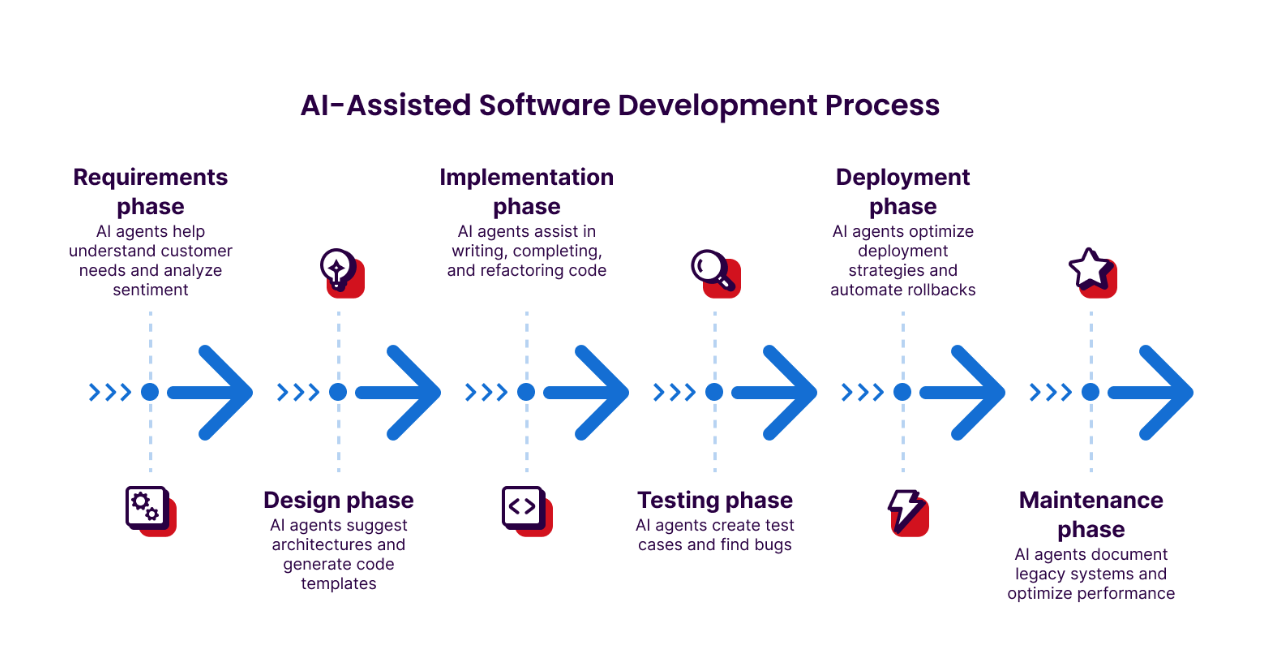 Integrating Agentic AI into the Software Development Lifecycle (SDLC) | by Rakesh Kumar Pal | Medium
"Vibe Coding" and the Evolution of Developer Workflows
As these architectural paradigms mature, they are fundamentally altering the daily workflows of software developers. A new concept emerging from this shift is "vibe coding"--a paradigm where developers interact with AI sidebars in modern IDEs to refine prompts, inspect generated code, and accept or reject suggestions in real-time [6]. This represents a critical evolution from AI serving merely as an assistive tool to acting as a true co-developer [7].
Autonomous Design Patterns
AI agents are increasingly capable of analyzing project requirements and performance data to generate and evolve architectural patterns dynamically. For instance, an agent might start with a monolithic design for a small application but automatically transition to microservices as the system scales, based on real-time metrics [8]. The shift from AI-assisted coding to fully autonomous code creation means agents can now generate complete codebases, including tests and documentation, while continuously optimizing for performance [8].
Navigating Constant Architectural Flux
However, deploying these agents requires a significant mindset shift. The pace of AI model progress necessitates constant architectural rewiring, creating an environment where best practices evolve dramatically every few quarters [1]. As Box CEO Aaron Levie notes, "Right as a best practice is solidified, models improve dramatically, and that old work is rendered obsolete." This constant state of flux demands agility from engineering teams, prioritizing adaptability over rigid, long-term architectural commitments [1]. To manage the cost and latency of these multi-step workflows, architects are turning to hybrid agents that use smaller models for sub-tasks, caching intermediate results, and deferring non-critical actions [2].
 The Architecture of Autonomy: Technical Innovations and Paradigm Shifts Shaping AI Agents in 2026 | by @pramodchandrayan | Predict | Medium
The Tri-Layered Security Threat Landscape
With great autonomy comes profound risk. As agents gain the ability to execute code, modify infrastructure, and interact with external systems, they introduce a novel attack surface that traditional security tools are ill-equipped to handle. Recent case studies, such as the analysis of the OpenClaw framework, have exposed systemic architectural flaws that require a reimagining of AI security [9].
Understanding the Risk Taxonomy
To systematically characterize these threats, researchers have proposed a Tri-layered Risk Taxonomy for autonomous agents, categorizing vulnerabilities across three orthogonal dimensions [9]:
- AI and Cognitive Security: Vulnerabilities originating from the reasoning processes, semantic understanding, and internal state management of the underlying language model, such as context amnesia or prompt injection.
- Software and Execution Security: Flaws in the toolchain and execution environments, where an agent might inadvertently execute malicious scripts or bypass sandboxing restrictions.
- Information and System Security: Risks related to data leakage, unauthorized access to sensitive databases, and the exposure of proprietary system prompts.
If not properly managed, agents could introduce severe vulnerabilities into systems, making rigorous validation and monitoring processes absolutely essential [10]. AI-generated code must be deeply scanned for vulnerabilities, requiring integration with Static Application Security Testing (SAST) tools specifically calibrated to understand AI outputs [6].
The FASA Paradigm and Zero-Trust Execution
To mitigate these risks, security frameworks like the Full-Lifecycle Agent Security Architecture (FASA) are emerging. FASA advocates for zero-trust agentic execution, dynamic intent verification, and cross-layer reasoning-action correlation [9]. In practice, this means autonomous agents need strict role-based access controls (RBAC) to prevent unauthorized changes in production environments [6]. Engineering teams must engage with internal security teams to define strict guardrails--stipulating exactly which parts of the codebase agents can modify and what human approvals are required before deployment [6].
Future Workflows and the Paradigm Shift in Engineering Culture
Looking ahead, the integration of autonomous agents will catalyze several transformative trends in software development. We are moving toward an era of Autonomous DevOps, where AI agents will completely manage infrastructure provisioning, scaling, and monitoring, paving the way for self-operating clouds [10]. Furthermore, AI-first architectures will become the norm, with applications designed from the ground up with agents as primary actors, orchestrating workflows, interactions, and decisions [10].
Bridging the Skills Gap
This paradigm shift brings significant human challenges, most notably the emerging skills gap. Developers will need new skill sets to work effectively with AI agents, including prompt engineering, machine learning fundamentals, and human-AI collaboration techniques [10]. The democratization of software development through AI could displace some traditional coding roles, but it will simultaneously create new opportunities in AI engineering, governance, and system management [10].
Trust, Transparency, and the New Developer Role
How do we ensure that AI agents make ethical and reliable decisions? Trust and transparency remain paramount [10]. Developers who fail to adapt risk being left behind in a world where natural language interfaces, autonomous debugging, and self-healing systems are the new standard [10]. The future role of the software engineer will pivot away from writing boilerplate code and toward strategic system design, agent direction, and governing the "intelligent conductors" that manage the software lifecycle [4][1].
Conclusion
The transition to autonomous AI agents in software engineering represents a profound and irreversible paradigm shift. By moving from static pipelines to graph-based, multi-agent orchestration, the industry is unlocking unprecedented levels of velocity, dynamic scaling, and architectural adaptability. However, this power comes with severe security responsibilities; the tri-layered threat landscape demands that zero-trust execution and rigorous intent verification become foundational to agent design. Ultimately, the era of creative, strategy-driven software engineering is upon us. Embracing these changes--by cultivating new skills, implementing robust security frameworks like FASA, and remaining agile in the face of constant architectural flux--is no longer optional, but essential for staying relevant in the AI-driven future of software development [6][10][1].
References
- 1.
- 2.
- 3.
- 4.
- 5.
- 6.
- 7.
- 8.
- 9.
- 10.