Introduction
For the modern enterprise, the most significant climate impact often lies far beyond its own walls. Scope 3 emissions--which encompass the entire value chain, from upstream suppliers to downstream product use and end-of-life treatment--can account for up to 90% of a company's total carbon footprint [1]. Yet, in an increasingly globalized economy where supply chains are highly decentralized and opaque, only about 9% of organizations currently possess the capability to comprehensively monitor these indirect greenhouse gas emissions [1]. This stark disparity between climate impact and operational visibility represents one of the most pressing challenges in corporate sustainability today.
Historically, carbon accounting has relied on static, retrospective methods that struggle to keep pace with the dynamic nature of global commerce. According to a Deloitte report highlighted by Rimm Sustainability, over 60% of global corporations face significant challenges in tracking emissions across their complex supply chains due to persistent data gaps and inconsistent reporting standards [2]. Traditional approaches frequently depend on recurring manual reporting, basic estimates, and generalized industry averages that are often out-of-date and inaccurate [3]. As a result, companies find it difficult to accurately grasp their emission reduction progress or identify high-intensity activities within their operations [4].
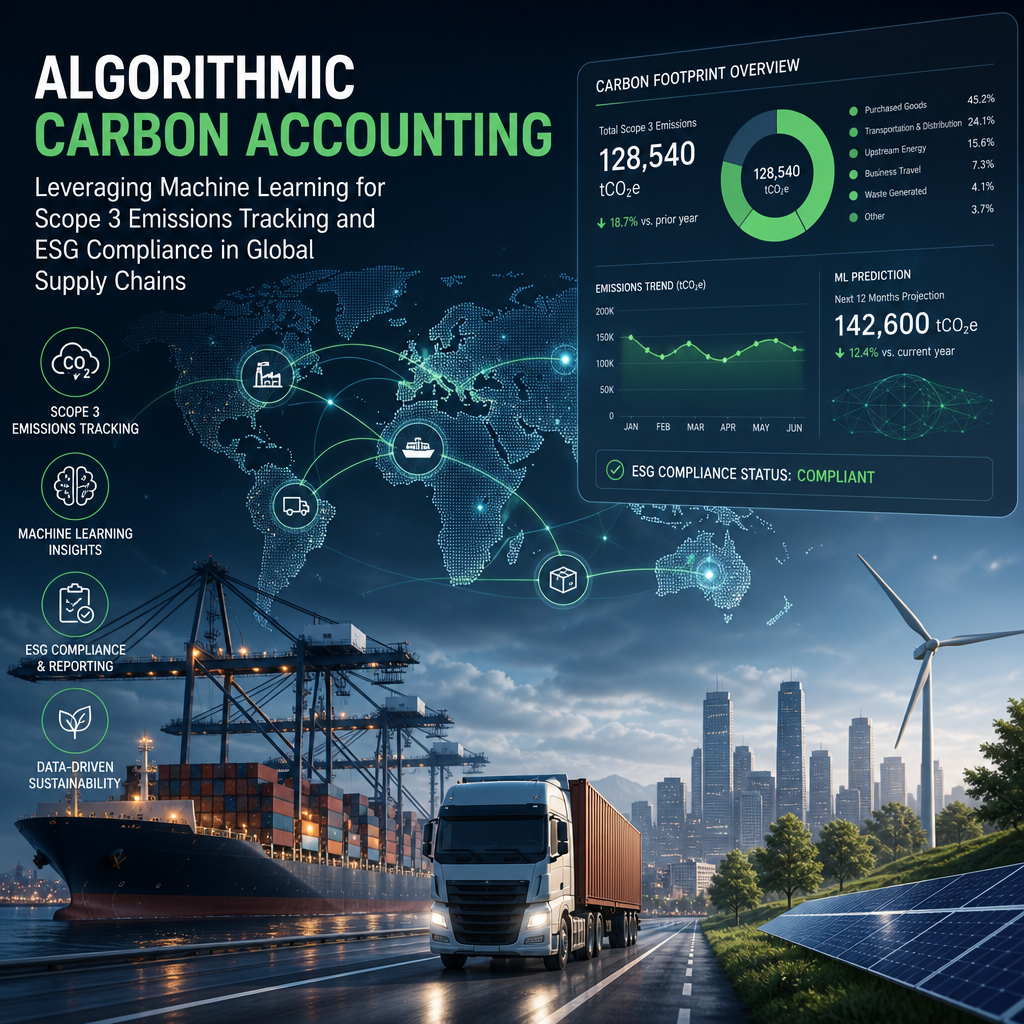
The emergence of algorithmic carbon accounting is rapidly rewriting this narrative. By leveraging machine learning (ML), artificial intelligence (AI), and advanced data fusion techniques, organizations are now able to pierce the veil of supply chain opacity. These technologies do not merely automate existing processes; they fundamentally reimagine how emissions data is sourced, calculated, validated, and operationalized, turning an insurmountable compliance hurdle into a manageable, data-driven strategic advantage.
 AI for ESG: Role, Benefits, Issues & Applications | GEP Blog
The Scope 3 Data Crisis: Why Traditional Accounting Falls Short
To understand the value of algorithmic carbon accounting, one must first understand the structural failures of the current paradigm. Accurate emission-factor data forms the backbone of nearly all carbon accounting and sustainability assessments, providing the essential coefficients that map economic activities to corresponding greenhouse gas emissions [5]. However, recent reports suggest that up to 70% of companies rely on third-party emission-factor datasets when calculating Scope 3 value-chain emissions, many of which are inaccessible, outdated, or lack sufficient sectoral coverage [5].
Traditional accounting methods often utilize linear models and heuristics based on these flawed datasets [6]. While frameworks like input-output matrices and the Leontief inverse have historically been used to trace embodied emissions through complex supply chains, they are inherently rigid. They struggle to account for the nuanced, non-linear realities of modern global trade, where a single supplier might serve multiple industries with vastly different emission profiles. Furthermore, the diversity of data sources, highly decentralized supply chain structures, and lack of transparent disclosures lead to profound uncertainties in collecting emissions information [4].
This data crisis forces sustainability teams into a reactive posture. Manual ESG data entry is highly prone to inconsistencies and inefficiencies, trapping skilled professionals in administrative tasks rather than allowing them to focus on strategic decarbonization [2]. Without transparent and consistent value chain emissions data, organizations are effectively flying blind, unable to effectively target activities with higher emission intensity or implement carbon reduction measures aligned with their broader ESG strategic goals [4].
How Machine Learning Transforms Emissions Tracking
Machine learning directly addresses the limitations of traditional carbon accounting by excelling at pattern recognition, handling high-dimensional data, and capturing complex, non-linear relationships that linear regression models completely miss [4][7].
Predictive Modeling and Non-Linear Accuracy
At the forefront of this transformation is the use of supervised machine learning algorithms to predict Scope 3 emissions using easily accessible proxy data. Pioneering research from Harvard Business School by George Serafeim and Gladys Velez Caicedo demonstrates that most reported Scope 3 emission types can be predicted with remarkably high accuracy using Adaptive Boosting (AdaBoost) algorithms [6]. By training models on widely available financial statement variables, easily measurable Scope 1 and 2 emissions, and standard industrial classifications, organizations can establish robust approximations of their supply chain footprint without requiring exhaustive direct supplier data [6].
Subsequent studies published in Frontiers in Sustainability have corroborated and expanded upon these findings, comparing algorithms like K-Nearest Neighbors, Random Forest, AdaBoost, and XGBoost against traditional linear baselines. The results are striking: while a baseline linear regression model might achieve an R-squared value of about 0.46, advanced algorithms like AdaBoost achieve an average R-squared of approximately 0.78 [4]. This dramatic leap in predictive power underscores the capability of ML to capture the hidden, non-linear interactions between financial inputs and environmental outputs [6][4].
Data Fusion and Automated Ingestion
Beyond predictive modeling, ML fundamentally changes how raw data is processed. AI automates data collection from a multitude of fragmented sources--including IoT sensors, supplier reports, regulatory filings, and unstructured text--ensuring real-time updates and high-fidelity accuracy [2]. For instance, platforms like carbmee are integrating Generative AI to automatically match internal customer data with massive, verified external emission databases like Ecoinvent, ensuring that emission factors are highly specific to individual purchased items rather than relying on broad industry averages [8].
Furthermore, companies like Muir AI are utilizing data fusion to fill the visibility gap. By leveraging machine learning to identify, track, and reduce emissions, these platforms can estimate a company's supply chain emissions without receiving any proprietary company-provided data, proving invaluable for both corporations lacking upstream visibility and investment firms evaluating climate transition risks [9].
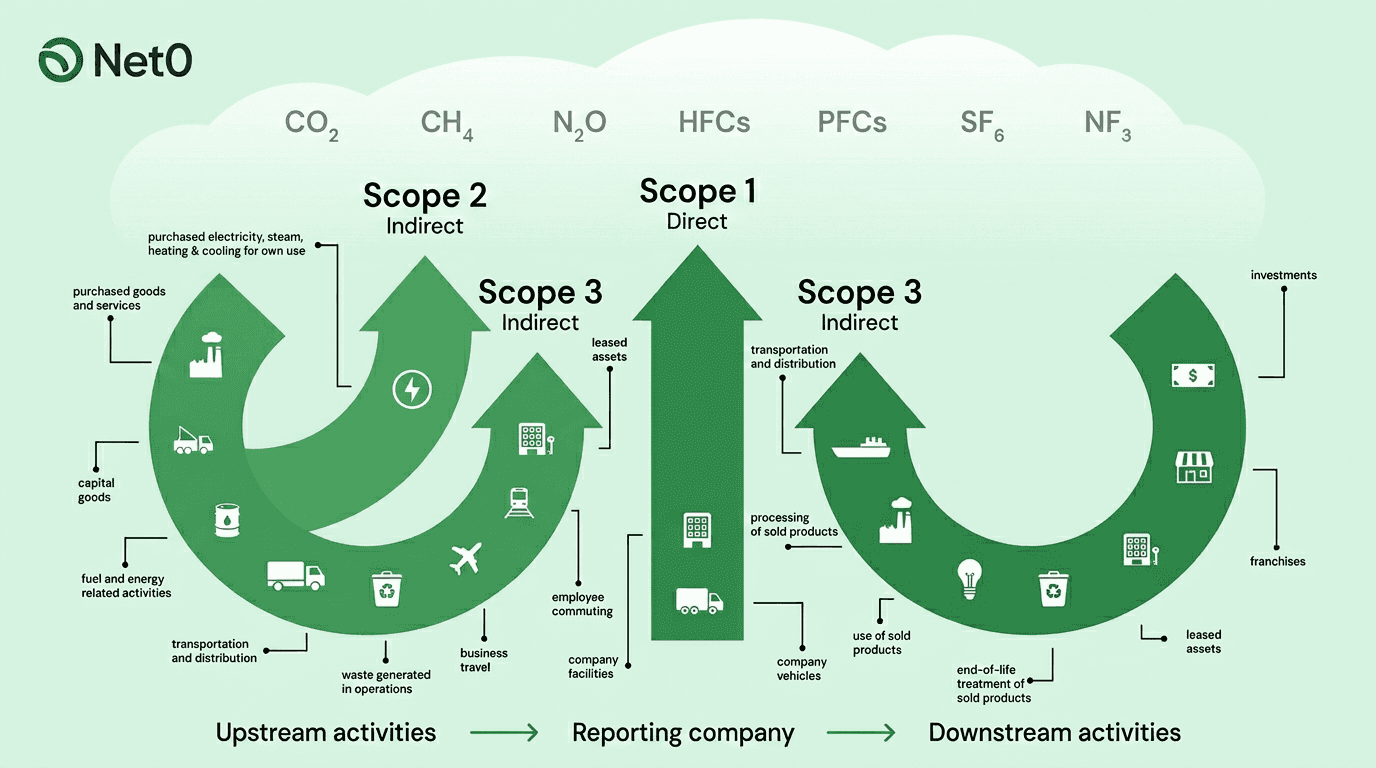 AI Blog for Governments and Enterprises | Net0
From Tracking to Action: Real-Time Monitoring and Anomaly Detection
The shift from static annual reporting to dynamic, real-time monitoring is perhaps the most operationally significant benefit of algorithmic carbon accounting. Traditional methods frequently rely on out-of-date estimates, but machine learning algorithms can identify pollution sources and patterns in emissions, providing near-real-time updates by continuously analyzing various data streams [3].
This is largely achieved by integrating AI analytics engines with IoT infrastructure. Sensors continuously collect granular operational data--such as fuel consumption, energy usage, and material throughput--which AI systems compare against industry benchmarks and historical patterns to identify inefficiencies [1]. Machine learning algorithms can match unstructured operational data against verified databases of over 200,000+ emission factors in real time, ensuring accurate, continuous measurements [1].
Crucially, this continuous monitoring enables sophisticated anomaly detection. AI platforms can statistically flag data inconsistencies in monitoring systems before audit submissions, effectively reducing the risk of greenwashing and ensuring the integrity of reported ESG metrics [2][1]. If a supplier suddenly reports a drastic drop in emissions that defies historical patterns or industry norms, the ML system flags it for review. This capability transforms carbon accounting from a backward-looking compliance exercise into an adaptive management system, enabling timely interventions to mitigate environmental impacts and facilitating continuous monitoring of greenhouse gas emissions [3].
Accelerating ESG Compliance and Strategic Decarbonization
The implementation of algorithmic carbon accounting is no longer merely a competitive advantage; it is rapidly becoming a regulatory necessity. With the intensification of frameworks like the Corporate Sustainability Reporting Directive (CSRD) and the EU Deforestation Regulation (EUDR), digital monitoring systems are critical for survival in the modern regulatory environment [1][8].
The efficacy of AI in meeting these demands is well-documented. Recent studies indicate that 75% of organizations reported improved data accuracy after adopting AI tools, while 78% noted increased efficiency in their carbon reporting processes [10]. Furthermore, AI adoption is strongly correlated with improved compliance; 46% of organizations observed significant progress in meeting complex regulatory requirements [10]. By automating emissions tracking, AI-driven platforms simplify data collection from unstructured sources, drastically reducing the reporting burden on sustainability teams [2].
Beyond mere compliance, the interpretability features inherent in certain ML algorithms offer profound strategic value. Algorithms like Random Forest and XGBoost provide feature importance analyses, which reveal the specific drivers behind emissions calculations [4]. If an algorithm highlights that a specific category of purchased services or a particular logistics route is disproportionately driving the carbon footprint, sustainability professionals can prioritize those areas for targeted interventions--such as supplier switching, route optimization, or process modifications [4][1]. AI-powered predictive analytics can also forecast energy demand and optimize production schedules, allowing companies to quantify the impact of potential decarbonization strategies before implementing them, ultimately delivering measurable return on investment [1][7].
 Scope 3 Emissions: The real test of corporate sustainability - Sustainability Dialogue
Conclusion
Algorithmic carbon accounting represents a paradigm shift in how humanity's most complex organizations understand and manage their climate impact. By replacing outdated linear heuristics with advanced machine learning models like AdaBoost and XGBoost, companies can finally pierce the opacity of global supply chains and accurately quantify their Scope 3 emissions using readily available financial and operational data.
The integration of IoT sensors, generative AI for precise data matching, and real-time anomaly detection has elevated carbon accounting from a flawed, retrospective administrative chore to a dynamic, predictive intelligence platform. As regulatory frameworks tighten and stakeholders demand unprecedented transparency, the ability to leverage AI for accurate, efficient, and compliant ESG reporting is no longer optional. Looking ahead, as AI technologies continue to evolve into scenario modeling and supply chain optimization, algorithmic carbon accounting will stand as the foundational pillar upon which the transition to a net-zero global economy is built.
References
- 1.
- 2.
- 3.
- 4.
- 5.
- 6.
- 7.
- 8.
- 9.
- 10.