Introduction
For more than a decade, physicians have identified a familiar culprit at the center of the burnout epidemic: the electronic health record. Excessive documentation--often completed after hours in what clinicians grimly call "pajama time"--has transformed medicine into a profession of typing as much as healing. Ambient AI scribes have emerged as the most widely embraced technological response to this crisis, with health systems, small primary care practices, and specialty clinics rapidly deploying tools that listen to patient encounters and draft clinical notes automatically [1][2].
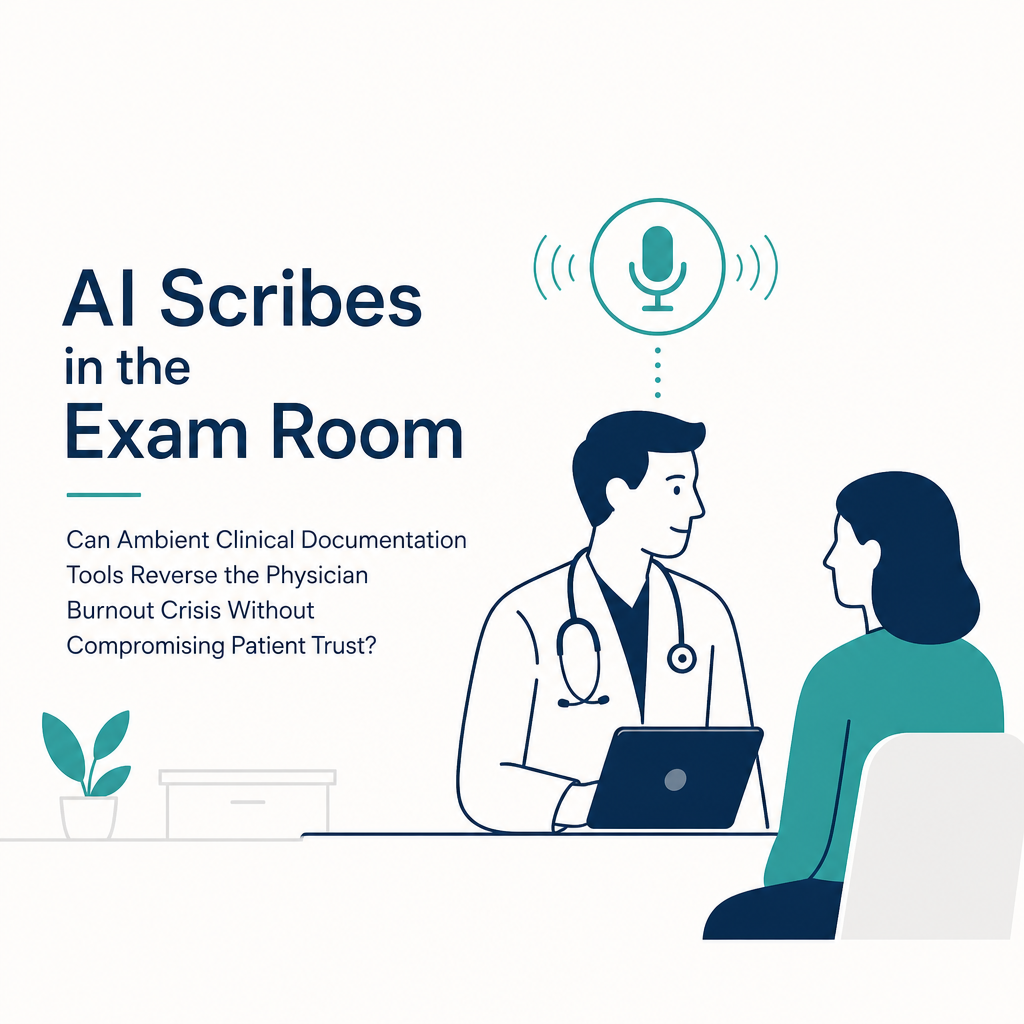
These systems, often described as ambient clinical intelligence (ACI), use microphones to capture the natural flow of conversation in the exam room, then apply conversational AI, machine learning, and natural language processing to generate structured clinical documentation [3][4]. Unlike traditional dictation or human scribes, they operate passively and unobtrusively, requiring no direct input during the clinical encounter [5]. The pitch is compelling: physicians regain their attention for patients, their evenings for families, and perhaps their joy in practice.
But as adoption accelerates, a more complicated picture is emerging. Early evidence suggests AI scribes can genuinely reduce documentation burden [6][4]--yet researchers and clinicians are raising pointed questions about patient discomfort with always-on microphones [7], the risk of AI "hallucinations" in medical records [8], and whether administrators will simply fill recovered hours with more patient volume, trading one form of exhaustion for another [9]. The central question facing healthcare is no longer whether ambient AI documentation works, but whether it can deliver on its promise without eroding the trust and cognitive capacity that medicine depends on.
How Ambient AI Scribes Actually Work
At their core, ambient AI scribes represent a fundamental rethinking of clinical documentation. Rather than requiring physicians to type notes, dictate after the visit, or rely on a human scribe, these systems passively "listen" to the natural dialogue between clinician and patient through discreet microphones or integrated devices [3]. The AI then interprets the conversation using natural language processing, distinguishing rhetorical cues and topic relationships between speakers, and produces a structured clinical note--typically a draft that the physician reviews, edits, and signs [1][4][5].
The workflow is deceptively simple. From the moment a patient enters the exam room, the technology operates as what one description calls "an invisible partner in care," listening, interpreting, and documenting the clinical conversation [1]. In most implementations, clinicians review and edit the AI-generated draft before signing it into the record--a safeguard that vendors acknowledge remains essential, even as they predict the need for edits will decrease as accuracy improves [5].
Deployment now spans primary care, specialty clinics, and even nursing workflows, with major vendors building integrations for dominant EHR platforms like Epic, Cerner, and Allscripts [5]. Leading products emphasize HIPAA compliance, encryption, and secure access protocols as foundational design elements rather than add-ons [1][5].
Yet the technical requirements are nontrivial. Successful implementation depends on microphone quality, secure physical environments, and seamless EHR integration--each of which can introduce friction [5]. And the systems are not merely transcription engines: they summarize, organize, and interpret, which is precisely where both their value and their risks reside.
The Burnout Evidence: Real Relief, Measurable Gains
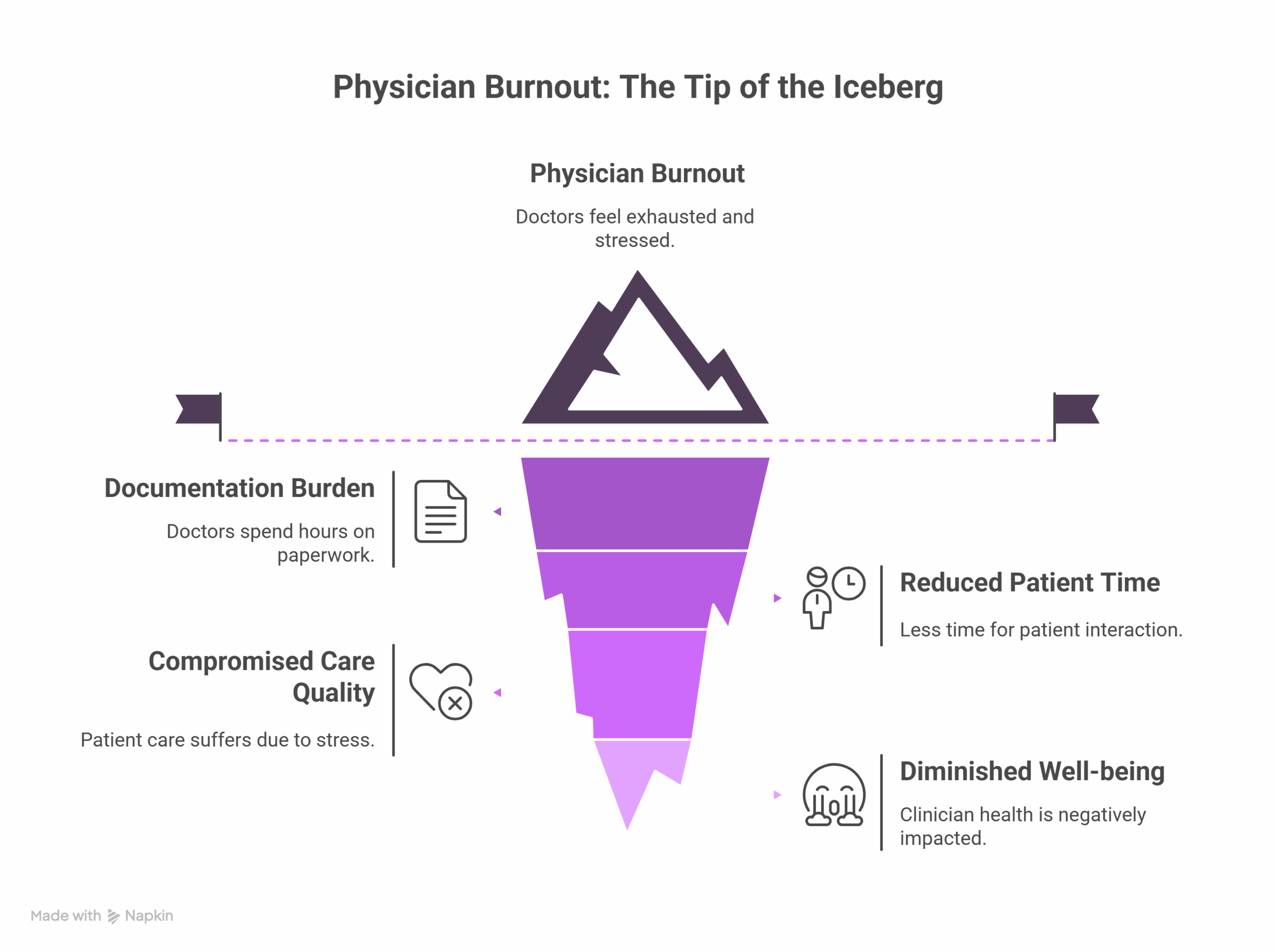
The case for ambient AI scribes rests on a growing body of evidence that documentation burden is a primary driver of burnout--and that these tools measurably reduce it.
A study of ambient clinical intelligence deployment found that ACI use "does indeed relieve the documentation burden and had both subjective and objective benefits," concluding that widespread adoption has "the potential to alleviate the crisis of physician burnout" [4]. The study noted that unlike earlier research--such as a University of Michigan study that found subjective but not objective improvements in patient satisfaction--the clinician-focused analysis identified benefits on both subjective and objective measures of workload and satisfaction [4].
The impact appears to extend across practice settings, including smaller practices that often lack resources for extensive IT support. A survey of small primary care providers conducted by Phyx found that ambient AI scribe use reduced burnout for 60% of primary care physicians [10]. Testimonials from that survey captured the range of experience: one physician reported that "my documentation is more thorough, especially for more complicated histories, physical exam findings, and complex plans," while a skeptic noted that the benefit "can be helpful to certain people depending upon how much time is required to document a visit" [10].
Peer-reviewed evaluation has reinforced the efficiency case. Research examining AI scribe impact found that these tools "can effectively enhance clinical efficiency and reduce administrative workload without compromising documentation quality" [6]. For practices under financial pressure, the productivity gains carry additional weight: by increasing clinician throughput, AI scribes are positioned as tools of financial sustainability as well as well-being [1].
Proponents argue the benefits ripple outward from the physician to the patient experience. By automating documentation, the tools allow physicians to focus attention on listening and engaging directly with patients rather than being distracted by screens, fostering stronger human connection and communication during appointments [3]. With comprehensive, current patient information more readily available, physicians may also make better-informed, more personalized treatment decisions [3].
 Ambient AI Scribes: Redefining Clinical Documentation & Burnout - John Snow Labs
The Patient Trust Problem: Consent, Comfort, and the Always-On Microphone
For all the enthusiasm on the clinician side, patients have been given far less say in the transformation of the exam room--and early signals suggest discomfort is real.
Surveys from health systems that have deployed AI scribes report that 28% of patients expressed discomfort when told the technology was listening to their visit [7]. That figure represents a substantial minority of patients whose experience of care is affected by the presence of ambient recording, raising questions about how consent is obtained, how transparently the tools are disclosed, and whether patients feel they can decline.
The consent question is not hypothetical. Public discussion among clinicians has surfaced the issue directly: "As a RN and from the standpoint of a patient, can a patient refuse the use of these systems listening in to the visit?" one commenter asked in response to coverage of ambient AI scribes [9]. The answer varies by institution and jurisdiction, and there is as yet no consistent standard for how opt-outs should work, how recordings are stored and deleted, or what patients are told about where their words travel after the appointment ends.
There is also a subtle tension in the trust calculus. Proponents argue that removing screens from the exam room rebuilds the human connection that EHR-era medicine eroded [3]. But replacing a screen with a microphone may simply relocate the surveillance concern rather than resolve it. Patients who feel genuinely heard by their physician may simultaneously feel uneasy knowing that a third-party AI system is transcribing--and interpreting--everything they say about symptoms, mental health, substance use, or family matters.
Health systems that ignore this dynamic do so at their peril. Patient trust, along with clinician trust, has been identified as essential to adoption, depending heavily on "the transparency, accuracy, and perceived value of the system" [5]. A technology that quietly improves physician metrics while quietly eroding patient comfort could prove counterproductive to the deeper goals of care.
The Unintended Consequences: From Keystroke Fatigue to Cognitive Collapse
Perhaps the most provocative critique of the AI scribe movement comes not from skeptics of the technology itself, but from burnout experts who worry about what happens after the documentation burden disappears.
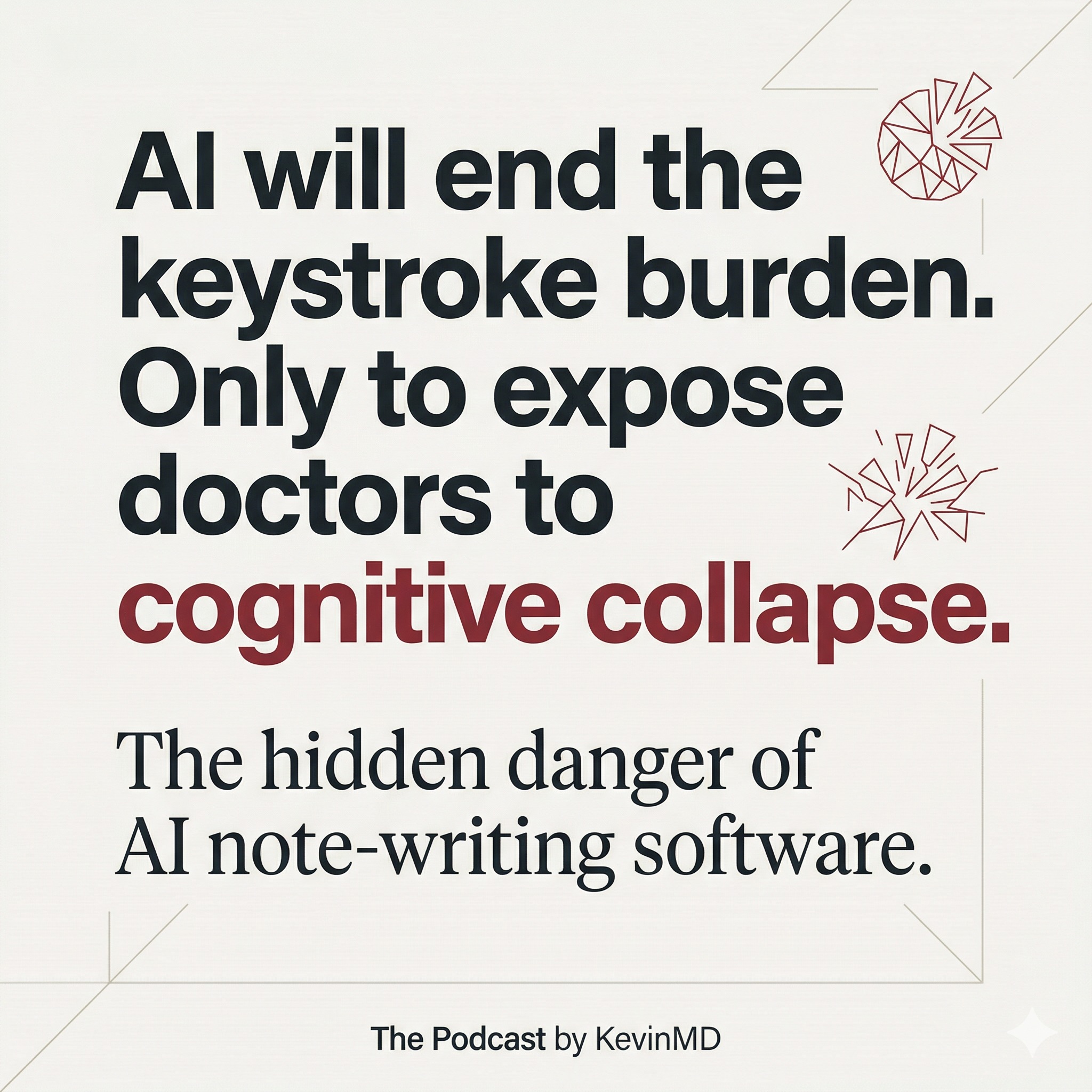
Dr. Dike Drummond, a physician burnout specialist, warns that while ambient AI will successfully eliminate pajama time and cut charting in half, it introduces "a massive new risk": if an AI scribe saves a physician two hours a day, hospital administrators are likely to fill that time with more patients--often immediately [9]. The result, he argues, is a trade of "keystroke fatigue for cognitive collapse." Without the natural pause that charting provided between encounters, physicians face compounded decision fatigue and compassion fatigue: "You can only handle so many complex medical histories back to back before hitting a wall" [9].
This workload redistribution concern is echoed in broader analyses of AI scribe governance. Despite measurable efficiency gains, current implementations raise substantive concerns about "accuracy, patient trust, data governance, and workload redistribution" [8]. Efficiency, in other words, is not the same as well-being--and if reclaimed time is converted into higher patient volume, the underlying drivers of burnout remain untouched or worsen.
Accuracy, Hallucinations, and Clinical Safety
A second cluster of risks concerns the reliability of AI-generated notes themselves. Because these systems summarize and interpret rather than simply transcribe, they can introduce errors that a human documenter would not. Research on foundation models in healthcare has documented the phenomenon of "medical hallucinations"--plausible but false clinical content generated by AI systems--and their potential impact on patient safety [8]. In a clinical note, a hallucinated symptom, medication, or finding can propagate through subsequent care decisions, consults, and billing.
Even absent outright hallucinations, AI-generated notes raise subtler problems. They "tend to follow patterns across repetitive phrasing and internal consistencies (e.g., conflicting symptoms)," creating risks that organizations risk repeating the same documentation pitfalls associated with chart cloning. Compliance experts emphasize that providers must review and sign off on AI-generated notes to remain compliant with documentation guidelines [2].
Workflow Gaps and Silent Decision Support
A third, less visible risk involves what clinicians stop seeing. When providers document on mobile devices or solely through ambient AI applications, they may never encounter the Best Practice Alerts and embedded EHR decision-support cues that normally prompt clinical condition reevaluation, medication monitoring, HCC recapture, or required documentation updates. Without these point-of-care prompts, organizations face increased risk of missed reconciliations, incomplete documentation, and overlooked clinical indicators [2].
There are also unresolved liability questions. Who is responsible when an AI-generated note contains an error that influences care--the physician who signed it, the vendor, or the health system? Clarifying responsibility for errors in AI-generated documentation remains an open legal and regulatory challenge [1], and healthcare organizations are being urged to engage in compliance reviews to ensure documentation and query practices meet regulatory standards [2].
Governance and the Path Forward
The trajectory of ambient AI documentation is not in question--adoption is accelerating, and the tools are improving. What remains contested is how health systems govern deployment so that the benefits accrue to patients and physicians alike rather than to throughput metrics alone.
Several priorities emerge from the current evidence and expert commentary:
Protect the recovered time. The single most important determinant of whether AI scribes reduce burnout may be organizational policy, not technology. If institutions commit reclaimed hours to cognitive rest, reduced panel sizes, or meaningful workflow relief, the burnout promise can be realized. If the hours are immediately backfilled with patient volume, physicians may face the unprecedented decision fatigue Drummond describes [9].
Standardize patient consent and transparency. With 28% of patients expressing discomfort with ambient recording [7], health systems need clear disclosure practices, genuine opt-out mechanisms, and plain-language explanations of how conversations are captured, processed, stored, and deleted. Treating patient consent as a checkbox rather than a conversation risks converting a trust-building technology into a trust-eroding one.
Maintain human review without exception. Every credible implementation model retains clinician review and sign-off of AI-generated notes [5][2]. As trust in the systems grows, the temptation to skim will grow with it--making institutional enforcement of meaningful review a patient-safety imperative, particularly given documented hallucination risks [8].
Audit for documentation drift. Because AI notes share stylistic patterns that can mirror chart-cloning pitfalls, organizations should conduct periodic compliance reviews of AI-generated documentation to catch repetitive phrasing, internal inconsistencies, and coding irregularities before they become systemic [2].
Preserve decision-support continuity. Workflows built around ambient tools should ensure clinicians do not lose access to embedded alerts and prompts that surface critical clinical indicators, whether through complementary interfaces or redesigned triggers [2].
Invest in clinician trust. Adoption ultimately depends on whether physicians perceive the systems as accurate, transparent, and valuable [5]. That trust must be earned through measurable performance, honest error reporting, and physician input into system design--rather than assumed.
Conclusion
Ambient AI scribes are the rare healthcare technology that clinicians have largely welcomed rather than resisted--and the early evidence justifies the enthusiasm. Studies across practice settings show meaningful reductions in documentation burden, with 60% of small-practice primary care physicians reporting decreased burnout and rigorous evaluations finding both subjective and objective benefits for clinician workload [4][10]. By removing the screen from between doctor and patient, these tools offer something medicine has struggled to reclaim in the digital era: presence [3].
But the technology is not a burnout cure in a box. It is a tool whose impact will be determined by the choices organizations make around it. A 28% patient discomfort rate [7] signals that trust cannot be treated as a given. Documented hallucination risks [8], compliance pitfalls [2], and unresolved liability questions [1] demand sustained human oversight. And the warning from burnout experts--that freed time will be converted into greater patient volume, trading keystroke fatigue for cognitive collapse [9]--should be posted on the wall of every executive considering an ambient AI deployment.
The question, ultimately, is not whether AI scribes can type notes better than physicians. They can, and they do. The question is whether the healthcare system will use the recovered hours to restore what burnout consumed--physician attention, compassion, and endurance--or simply to compress more encounters into the same exhausted day. Reversing the burnout crisis was never merely a documentation problem. Ambient AI has removed a major obstacle; whether the road ahead leads to renewal or to a new and quieter crisis depends on the human decisions that follow.
References
- 1.
- 2.
- 3.
- 4.
- 5.
- 6.
- 7.
- 8.
- 9.
- 10.