Introduction
Artificial intelligence has emerged as one of the defining technologies of the decade, promising to transform everything from drug discovery to disaster prediction. But when it comes to climate change, AI is increasingly described as a two-sided coin: a technology with tremendous potential to benefit the environment, even as the physical infrastructure powering it consumes vast amounts of energy and water [1]. The global AI market, valued at roughly $390.91 billion in 2025, is projected to balloon to nearly $3.5 trillion by 2033--a growth trajectory with profound physical consequences [1].
Those consequences are already measurable. According to the Brookings Institute, data center energy consumption could reach 1,050 TWh this year, driven largely by the rapid expansion of AI workloads [2]. Behind every chatbot query and image generation lies a sprawling industrial system: hyperscale facilities that can draw as much electricity as 100,000 households, evaporative cooling systems consuming millions of liters of water daily, and supply chains dependent on mineral extraction and rapid hardware turnover [3][4].
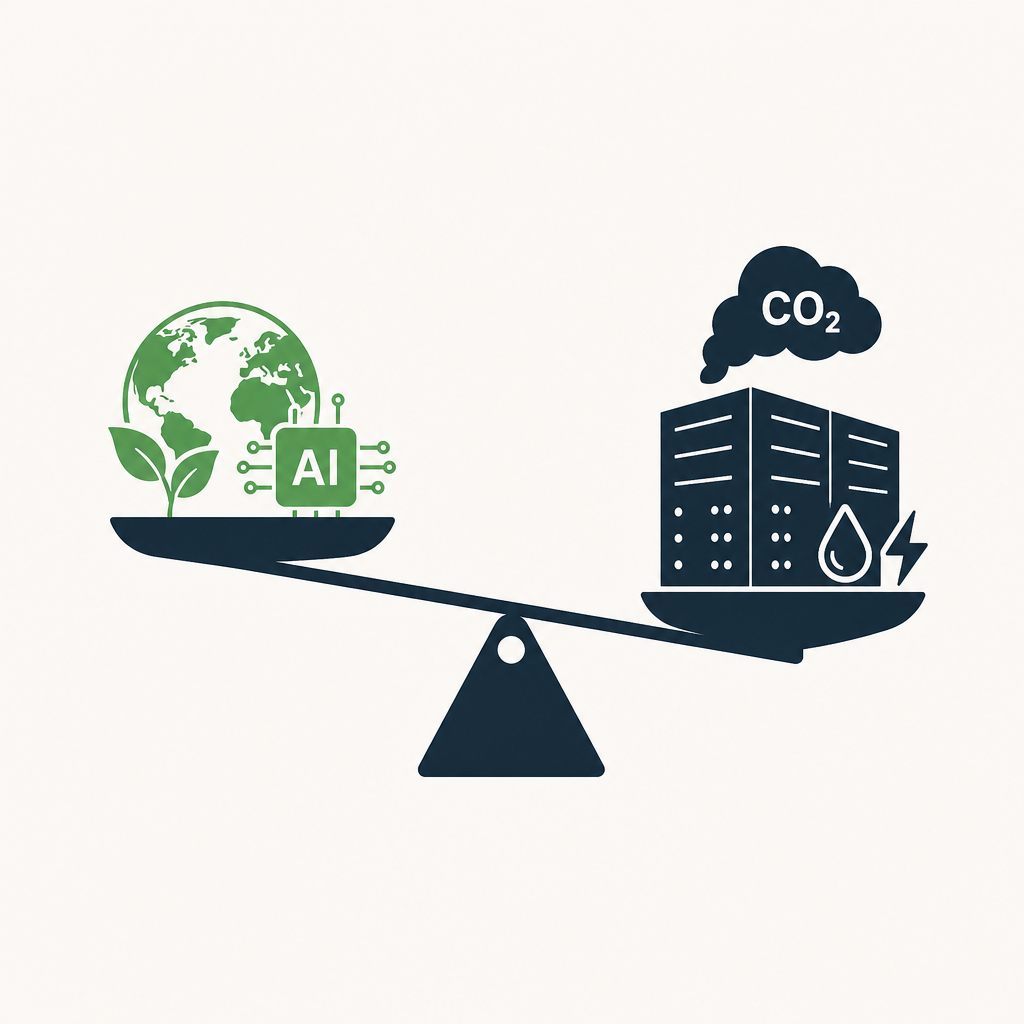
This tension--AI as both climate solution and climate burden--has been called the "carbon paradox." Can machine learning's emission-cutting potential outpace the surging energy and water demands of the very data centers that make it possible? The answer, according to researchers, depends not only on how much electricity AI uses, but on where that electricity comes from, who bears the environmental costs, and whether governance frameworks evolve as quickly as the technology itself [5].
The Promise: AI as a Climate Solution
Optimization at Scale
The case for AI as a climate ally rests on its capacity for optimization. Machine learning models can fine-tune energy grids, forecast renewable generation, improve industrial efficiency, and reduce waste across sectors from agriculture to logistics. AI-driven systems can predict equipment failures before they occur, route transportation more efficiently, and accelerate the discovery of new materials for batteries and solar cells. These applications, advocates argue, could deliver emissions reductions that dwarf the footprint of the technology itself.
The Carbon Debt Question
Yet timing matters. Analyses of AI's net climate impact suggest that benefits will come with delays as AI capabilities and climate solutions scale up. In the short term, AI is likely to amplify a carbon-intensive economy and generate what researchers describe as a "carbon debt" before any benefits materialize; in the long term, those benefits are expected to outweigh the debt--but that outcome is not guaranteed [3]. There is also a thornier question lurking beneath the optimism: fossil fuel producers may reap the benefits of AI just as readily as climate advocates, whether through efficiency gains that extend the life of oil and gas operations or faster discovery of new reserves [3].
The phenomenon echoes Jevons' Paradox, the observation that efficiency improvements often increase, rather than decrease, total resource consumption. If AI makes energy cheaper and industrial processes more efficient, the result could be expanded production and higher aggregate emissions--unless deliberate policy and market interventions steer the gains toward decarbonization [6].

The Price of Intelligence: Energy Demand and Emissions
An Unprecedented Growth Curve
The scale of AI's energy appetite is staggering. Data centers now serve far more than AI alone--they support cloud computing, internet services, financial transactions, and web hosting--but AI has become the dominant driver of new demand [3]. Over 80% of a data center's lifetime energy use comes from operations: the electricity needed to train and run AI models and, crucially, to keep servers cool [3].
A single hyperscale facility can have a capacity exceeding 100 megawatts, drawing as much electricity as 100,000 households [3]. Multiplied across hundreds of facilities under construction worldwide, this demand is straining national power grids and reshaping energy markets [7].
The Fossil Fuel Reality
Despite high-profile renewable energy commitments from major technology companies, fossil fuels--mostly coal and natural gas--still provide nearly 60% of the power delivered to data centers [3]. In the coming decade, natural gas in particular is expected to remain a primary source of AI power, a reality that undercuts claims of an inherently "clean" digital economy [8]. Beyond carbon dioxide, this reliance generates NOx and PM2.5 pollution that cause premature death, lung disease, and other serious health outcomes in communities near power plants [3].
The emissions trajectory is sobering. According to the International Energy Agency, carbon emissions from the electricity use of global data centers reached 180 million tonnes in 2024 and are projected to rise to 300 million tonnes by 2035 [4]. While AI data centers produce few direct emissions during normal operation--their footprint is almost entirely indirect, embedded in the electricity they consume--the climate consequences are no less real [4].
Geography Matters
Perhaps the most underappreciated dimension of AI's carbon footprint is geographic. In Virginia, one of the world's densest data center corridors, electricity remains primarily coal-based, making data center power there 48% more carbon-intensive than the U.S. national average [9]. As scholar Kate Crawford has written, "AI systems are not in the cloud - they are on Earth, in data centers, run on coal" [9]. A recent United Nations University report reinforces this point: AI's environmental costs depend not only on how much electricity is used, but on where and how that electricity is generated--and critically, low-carbon electricity is not automatically low-water or low-land, meaning these footprints do not always move in the same direction [5].
The Hidden Thirst: Water Consumption and Scarcity
How AI Consumes Water
While AI's carbon emissions have drawn increasing attention, its water footprint remains largely hidden. Researchers typically classify AI's water use into three categories: Scope 1 covers on-site cooling to prevent servers from overheating; Scope 2 covers off-site electricity generation, particularly from water-cooled power plants; and Scope 3 encompasses supply chain production, including chip and infrastructure manufacturing [9].
The volumes involved are enormous. Many large-scale data centers rely on evaporative cooling systems that consume tens of thousands to millions of liters of water daily. A 100 MW data center in the United States consumes on average around 2 million liters of water per day--equivalent to the daily use of about 6,500 households [4]. Global water consumption for data centers is currently estimated at around 560 billion liters per year and could rise to approximately 1,200 billion liters per year by 2030 [4]. Put differently, a large data center can consume as much water as a town of 10,000 to 50,000 people [3]. Google alone reported using 15.79 billion gallons of water in 2021, with a significant portion dedicated to data center cooling [8].
Building in the Wrong Places
What makes these figures acute rather than merely large is where data centers are being built. Since 2022, two-thirds of new data centers have been constructed in water-stressed areas, where their expansion competes directly with agricultural and municipal water needs [1][3]. One study found that U.S. communities will need up to $58 billion in new water infrastructure to meet data center demand--costs that ripple into agriculture, drinking water supplies, and household water bills [1].
 The Carbon Cost of Digital Climate Solutions: AI's Environmental Paradox | Sibool Blog
Toward Integrated Planning
Researchers increasingly argue that water stress could become a critical limiting factor for AI-driven expansion, and they call for integrated planning frameworks that jointly assess electricity and water footprints. Effective strategies include adopting low-water cooling technologies in water-scarce regions, siting facilities with attention to both water availability and grid capacity, and incorporating climate resilience metrics into future AI infrastructure planning [4].
Beyond Carbon and Water: Land, E-Waste, and Environmental Justice
AI as a Material System
A landmark report by the United Nations University Institute for Water, Environment and Health argues that AI must be understood not merely as a digital technology but as a material system with measurable environmental costs--one that depends on data centers, advanced chips, cooling systems, electricity grids, water resources, land, and critical mineral supply chains [5]. Every kilowatt-hour consumed by AI carries carbon, water, and land implications, yet public discourse remains fixated on carbon alone [5].
The E-Waste Problem
The breakneck pace of hardware innovation compounds the problem. As ever-faster GPUs are developed, older chips and servers are discarded on cycles of two to five years or less [1]. One study estimates AI could add between 1.2 million and five million metric tons of e-waste to the planet by 2030 [1]. This sits atop an already grim baseline: the world generated 53.6 million metric tonnes of e-waste in 2019, a figure expected to grow with demand for AI-capable devices [8]. Addressing this will require extending equipment lifespans, improving recycling processes, and embracing lifecycle responsibility in hardware design [8][5].
An Unequal Burden
Perhaps the most urgent critique is one of distribution. The benefits of AI flow across borders and sectors--accruing largely to wealthy institutions and corporations--while the environmental burdens of data center siting, electricity demand, water withdrawals, land use, mineral extraction, and e-waste are concentrated in specific communities, often in the Global South and marginalized communities within the Global North [5][9]. As AI deployment accelerates, there is also a risk that energy resources in developing countries could be diverted to power data centers at the expense of local communities' needs [8]. This framing transforms the carbon paradox from a technical problem into a governance and justice challenge [5].
 AI's Carbon Footprint: The Hidden Environmental Cost
Breaking the Paradox: Pathways to Sustainable AI
The paradox is not inevitable, and researchers have outlined a growing toolkit for reconciling AI's promise with planetary limits.
Efficiency by design. Improving hardware efficiency, developing more water-efficient cooling technologies, and optimizing models to reduce computation per output can bend the demand curve without halting innovation [8][5].
Strategic siting and clean power. Because AI's footprint is fundamentally shaped by its energy source, pairing data centers with genuinely additional carbon-free energy--and siting them with attention to water availability and grid capacity--matters more than efficiency alone [4][6]. However, analysts caution that claims of AI's negative climate impact being fully "negated" by carbon-free energy and offsets deserve scrutiny, as offset quality and additionality vary widely [6].
Transparency and accountability. Making AI's carbon, water, and land footprints visible and comparable would provide a practical basis for integrating AI into energy, climate, water, and land-use planning [5]. Standardized disclosure of data center consumption--already beginning with corporate sustainability reports--should become the norm rather than the exception.
Lifecycle responsibility and global cooperation. From extending hardware lifespans to managing e-waste and ensuring equitable distribution of both AI's benefits and burdens, a responsible AI ecosystem requires coordination among governments, industry, and affected communities [5][8].
Conclusion
The carbon paradox of AI resists easy resolution. On one side of the ledger sits genuine promise: machine learning tools that can optimize grids, accelerate clean-energy discovery, and reduce emissions across the economy. On the other sits an industrial footprint growing at a pace that grid operators, water managers, and affected communities are only beginning to comprehend--1,050 TWh of electricity demand [2], water consumption on track to double by 2030 [4], and an e-waste stream measured in millions of tonnes [1].
The emerging consensus among researchers is nuanced: AI's climate impact will not be determined by the technology itself, but by choices about where data centers are built, what powers them, how transparently their footprints are measured, and who bears the costs. In the short term, AI is likely to amplify carbon-intensive systems and accumulate environmental debt; whether long-term benefits eventually outweigh that debt depends on governance catching up with growth [3]. Making AI's full footprint--carbon, water, and land--visible, comparable, and accountable is the essential first step toward ensuring that the technology meant to help solve the climate crisis does not deepen it.
References
- 1.
- 2.
- 3.
- 4.
- 5.
- 6.
- 7.
- 8.
- 9.