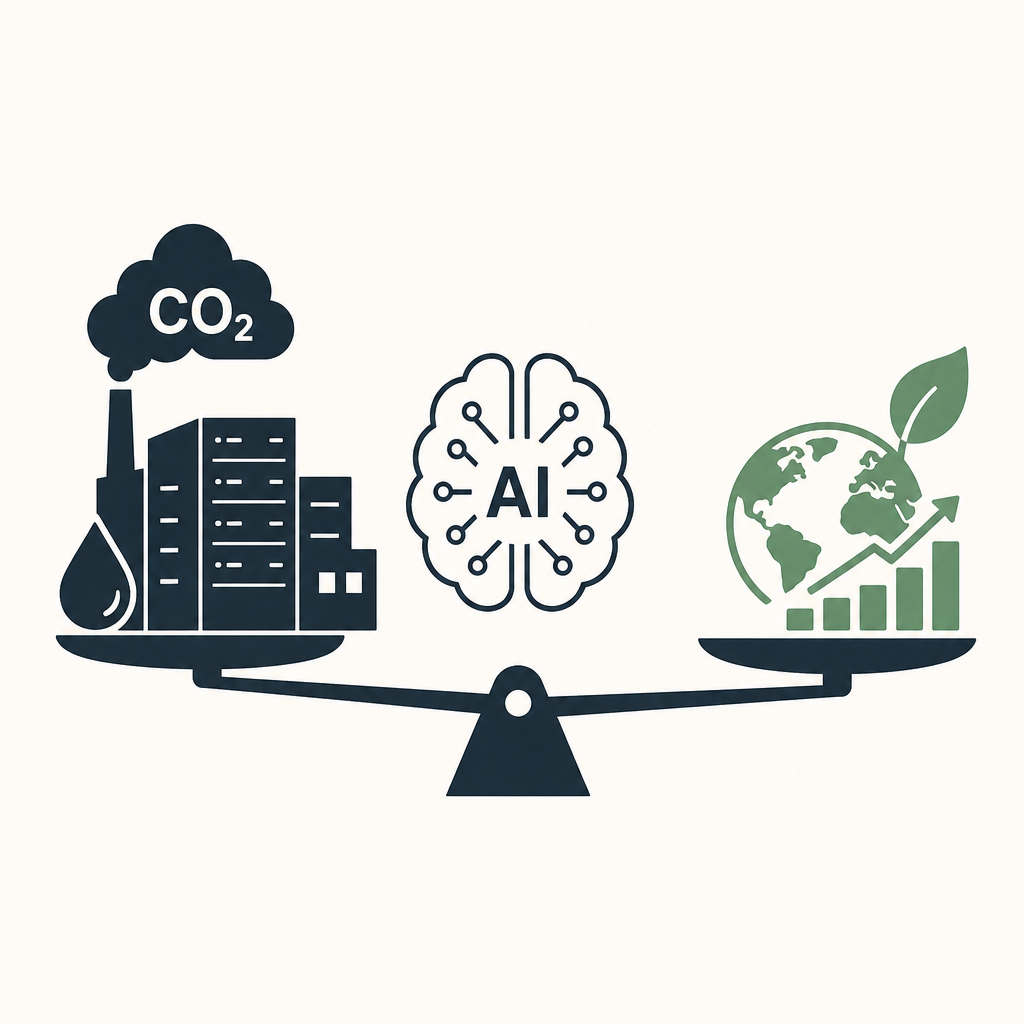
Introduction
Artificial intelligence has been cast in two competing roles in the climate story. On one side, machine learning is heralded as a transformative tool for decarbonization--optimizing power grids, accelerating materials discovery, improving weather forecasting, and squeezing waste out of energy-intensive industries. On the other side, the infrastructure powering this technology is expanding at a pace that threatens to undercut the very climate goals AI is supposed to advance. The International Energy Agency estimates that data centers, an increasing share of which are dedicated to AI, now account for roughly 4% of global electricity consumption, up from about 2% in 2020 [1].
This tension--what observers have dubbed the "AI energy paradox"--is no longer a niche academic debate. Google's own carbon emissions surged nearly 50% in just five years, driven largely by AI energy demand [2], and U.S. energy demand from AI servers and data centers is projected to increase up to threefold between 2023 and 2028, reaching roughly 300 terawatt-hours annually--enough electricity to power more than 28 million American homes [3]. Meanwhile, the water required to cool this infrastructure is drawing scrutiny in regions already facing shortages [3].
The central question for policymakers, businesses, and the public is deceptively simple: can the climate benefits AI delivers elsewhere in the economy outweigh the carbon and water costs of building and running it? The answer, according to researchers at MIT and elsewhere, is far more nuanced than either the hype or the alarmism suggests--and it depends heavily on choices still being made about where AI runs, what powers it, and how transparently the industry reports its impacts [4].

The Expanding Footprint: Carbon, Electricity, and Water
Electricity Demand and Carbon Emissions
The raw numbers behind AI's growth are striking. Data center energy consumption could reach 1,050 TWh globally in the current year, according to the Brookings Institute [5], and the IEA has estimated that global electricity demand from data centers could double between 2022 and 2026, fueled in part by AI adoption [6]. Of the electricity data centers currently consume, AI workloads are responsible for roughly 15% [2], and the IEA projects AI-related energy demand will double again by 2030 [2].
Yet context matters. MIT's John Sterman and Mutalemwa Turliuk reviewed the most current data and found that carbon emissions from AI and data centers today are responsible for roughly 0.5% of global CO₂ emissions from energy--a figure that is growing rapidly but remains small compared with transportation, buildings, industry, agriculture, and fossil fuel supply chain leakage [4]. Earlier research similarly found that data centers and information and communications technology accounted for only 1-2% of global greenhouse gas emissions in 2020 [7]. As Climate Impact Partners notes, AI's total carbon footprint today is relatively small compared with sectors like aviation or cement production--but AI is growing at a speed those sectors are not [2].
Water: The Overlooked Resource
If carbon has dominated headlines, water is fast becoming the more contested resource. The IEA estimated total data center water consumption at 560 billion liters in 2023, with the majority--about two-thirds, or 373 billion liters--coming from indirect consumption in electricity generation, roughly a quarter (140 billion liters) from direct on-site cooling, and around 8% (47 billion liters) from hardware manufacturing [8]. AI-specific projections are sobering: Food & Water Watch estimates AI in the U.S. could require as much as 720 billion gallons of water annually by 2028 just to cool servers--equivalent to more than a million Olympic swimming pools, or the indoor water needs of 18.5 million American households [3].
Crucially, many AI data centers are located in areas already experiencing water stress, and the added demand has derailed several Big Tech carbon-neutrality pledges while raising customer utility bills as infrastructure expands [3]. Investment is beginning to respond, shifting toward closed-loop cooling systems and siting in regions less exposed to water scarcity [1].

The Measurement Problem: What We Don't Know
Perhaps the most important caveat in this debate is how uncertain the headline figures actually are. A widely cited estimate placed AI's potential 2025 carbon footprint at 32.6-79.7 million tons of CO₂ and its water footprint at 312.5-764.6 billion liters--ranges comparable to New York City's annual emissions and global bottled water consumption, respectively [8]. But that study's central finding is often lost in translation: the numbers represent broad upper bounds, not precise measurements. Because data center operators do not distinguish AI from non-AI workloads in their environmental disclosures, the AI-specific share can only be approximated--and the study's authors emphasize that granular, mandated reporting is needed before any firm attribution is possible [8].
Independent commentators reviewing the work have stressed exactly this point: the comparisons to New York City and global bottled water consumption are hypothesis-driven upper bounds with significant uncertainty, and conflating data center impacts with AI impacts misrepresents the findings [9]. Honest analysis requires holding both facts at once--AI's footprint is real and growing, and the numbers being cited remain rough estimates shaped by methodology and disclosure gaps.
AI as a Climate Ally: The Case for Optimism
Where Machine Learning Delivers Emissions Cuts
The optimistic side of the paradox rests on machine learning's capacity to reduce emissions across the wider economy. AI is already used to optimize electricity grids for higher renewable penetration, improve industrial energy efficiency, sharpen climate modeling, and accelerate the development of low-carbon materials and fuels. Projections suggest efficiency gains in inference could reduce the energy footprint per AI interaction by 30-50% [1], and better algorithms, chips, and data center design are steadily improving performance per watt [4].
A Reality Check from Systems Modeling
Researchers at MIT Sloan have translated these competing dynamics into En-ROADS, a climate simulation tool that lets policymakers and the public explore the direct and indirect impacts of AI on energy use and emissions [4]. Their analysis identifies three factors that currently limit AI's direct climate harm: AI and data center emissions are still small relative to the total economy; renewable energy is growing rapidly and decarbonizing the electricity that powers data centers; and AI infrastructure itself is becoming more efficient [4].
But Sterman's conclusion is deliberately restrained: "AI is a remarkable technology, both promising and problematic. But, by itself, it does not solve the climate crisis and these other problems. We need sound policies to do that" [4]. The modeling also makes clear that AI and data centers generate impacts beyond climate--including surging electricity prices, water use, air pollution, and demand for critical metals [4]. In other words, the ledger is not a simple trade of AI's costs against AI's climate benefits; both sides of the scale are influenced by policy choices that AI alone cannot settle.
Weighing the Ledger: Pathways to Sustainable AI
If the paradox cannot be resolved by technology's momentum alone, what determines which side wins? Current evidence points to four levers.
Efficiency and engineering. Organizations can counter rising energy demand through foundational practices spanning model training design, more efficient hardware, and smarter data center operations. The MIT Lincoln Laboratory Supercomputing Center's efforts to reduce its own energy consumption demonstrate that sustainability measures can pair with, rather than trade off against, cost savings [6]. Given that training large models is energy-intensive but inference at scale accounts for the bulk of consumption [1], efficiency gains at the deployment stage offer outsized returns.
Location and clean energy. MIT research shows the carbon footprint of an identical computational workload can vary by a factor of ten depending on the local energy mix [1]. Where AI runs is therefore as consequential as how efficiently it runs--a reality pushing companies toward renewable-powered facilities, though overall usage growth partially offsets these gains [1]. Some tech giants are also turning to next-generation software optimization and direct-air carbon capture to net out their data center footprints [10].
Water-wise cooling. Investments in closed-loop cooling and siting away from water-stressed regions are expected to become standard practice [1], directly addressing the resource most likely to generate local conflict even where carbon accounting looks acceptable.
Policy and transparency. Because the environmental impact of data centers is growing rapidly, researchers argue the urgency for mandatory disclosure is also increasing [8]. Proposed interventions include tax incentives for renewable-powered AI training facilities and mandatory carbon reporting that would make emissions data visible to businesses and consumers [2]. Without granular reporting, even well-intentioned analysis remains guesswork [8][9].

Conclusion
The AI energy paradox is real, but it is not a fixed equation--it is an ongoing negotiation between demand growth and mitigation choices. Today, AI and data centers contribute a modest but fast-growing slice of global emissions, roughly 0.5% of energy-related CO₂ [4], alongside a water footprint whose true scale remains obscured by inadequate disclosure [8][9]. At the same time, machine learning is delivering genuine decarbonization value across other sectors, and the same forces propelling AI--efficiency gains, cheap renewables, engineering innovation--can also constrain its footprint [4][1].
The emerging consensus among researchers is that AI will not single-handedly rescue the climate, nor will it single-handedly sink it. Whether its climate solutions outweigh its carbon and water costs will hinge on deliberate decisions: mandating transparency so impacts can be measured rather than estimated [8], siting infrastructure where clean power and water are abundant [1], scaling efficiency and cooling innovation [6], and pairing AI deployment with the sound climate policies that no technology can substitute for [4]. The paradox, in the end, is less about AI than about the choices surrounding it--and those choices remain firmly within human hands.
References
- 1.
- 2.
- 3.
- 4.
- 5.
- 6.
- 7.
- 8.
-
9.
A new study suggests that AI systems may have a carbon footprint equivalent to that of New York City in 2025, while their water footprint could be in the range of the global annual consumption of bottled water. : r/science. (n.d.). Retrieved https://www.reddit.com/r/science/comments/1ppocj9/a_new_study_suggests_that_ai_systems_may_have_a
- 10.