Introduction
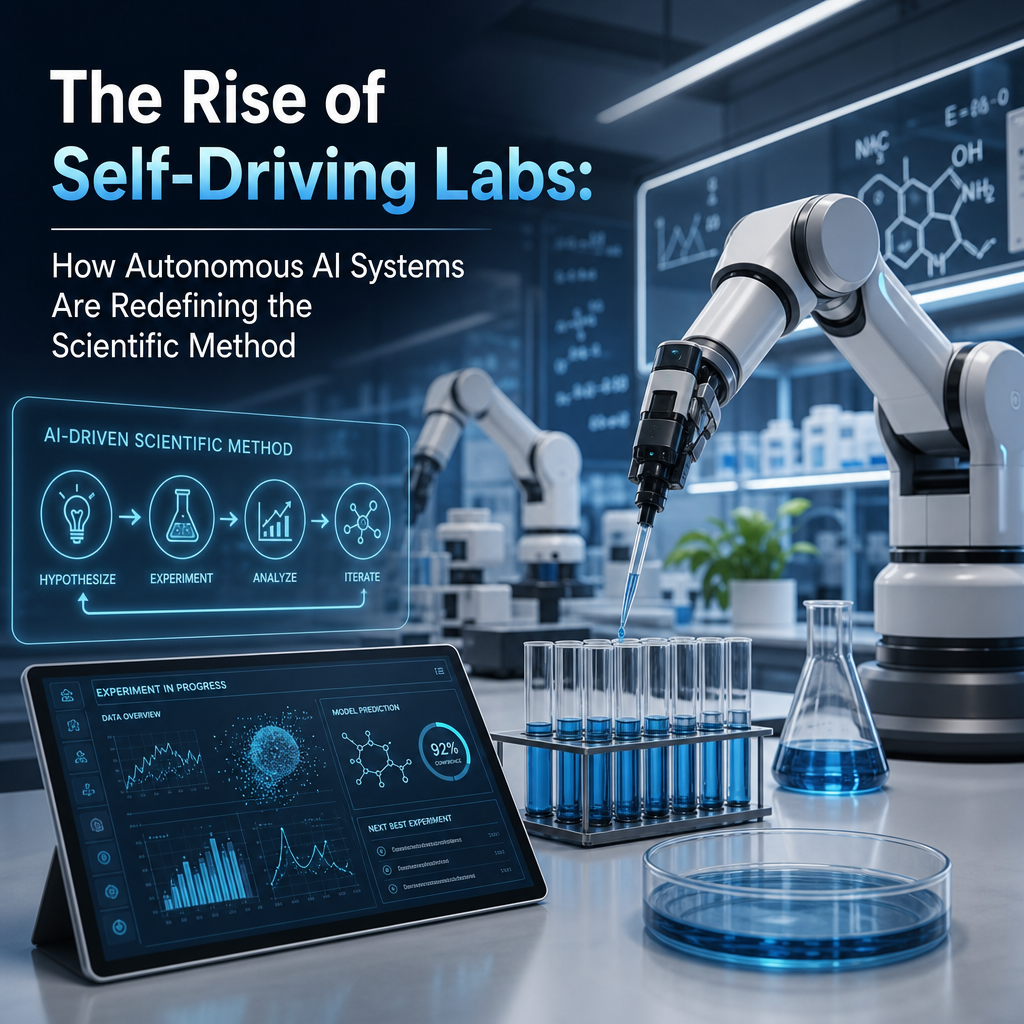
The traditional image of a scientist hunched over a microscope or carefully mixing chemicals in a flask is being rapidly superseded by a new reality: the "Self-Driving Lab" (SDL) [1][2]. Over the past several years, a revolutionary class of "Discovery AI" platforms has moved from theoretical pilots to active lab partners. These systems are no longer merely processing data; they are generating complex hypotheses, designing experimental protocols, and directly controlling robotic hardware to accelerate breakthroughs in fields ranging from physics and chemistry to biotechnology [1][3].
At its core, the scientific method--formulating and testing hypotheses through observation and experimentation--has endured for centuries [4]. However, self-driving laboratories promise an accelerated application of this method by augmenting automated experimentation platforms with artificial intelligence [5]. Unlike traditional automation, which simply executes repetitive, preset routines, SDLs actively search for promising experimental procedures by hypothesizing about outcomes based on previous results, creating a continuous, dynamic feedback loop [5].
This shift represents a fundamental rethinking of how scientific inquiry is conducted. As we move further into the late 2020s, the integration of human intent with machine execution is becoming the key metric for success in the tech and science sectors [1]. The coming years will likely bring a flurry of new advancements as more industries adopt these "self-driving" research methodologies, forever changing the pace of human progress [1].
Beyond Automation: The Closed-Loop Discovery Engine
To understand the impact of self-driving labs, one must distinguish them from standard laboratory automation. A self-driving lab is not just a robotic arm running a plate washer or a liquid handler repeating a static protocol; it is a closed-loop AI-powered discovery engine [6][7]. An autonomous or self-driving lab is a scientific space where machines--not humans--suggest, execute, and analyze experiments, depending on the degree of autonomy [2].
Today's most capable SDLs automate nearly the entire scientific method. This encompasses hypothesis generation, experimental design, physical experiment execution, data analysis, drawing conclusions, and updating hypotheses for subsequent rounds of optimization or discovery [8]. For example, in drug discovery and materials science, these autonomous systems use techniques like Bayesian optimization to rapidly iterate through chemical spaces, deciding in real-time which experiments to try next based on live results [9][10]. This feedback loop is crucial, as it drastically reduces the number of experiments needed to arrive at a meaningful discovery [5].
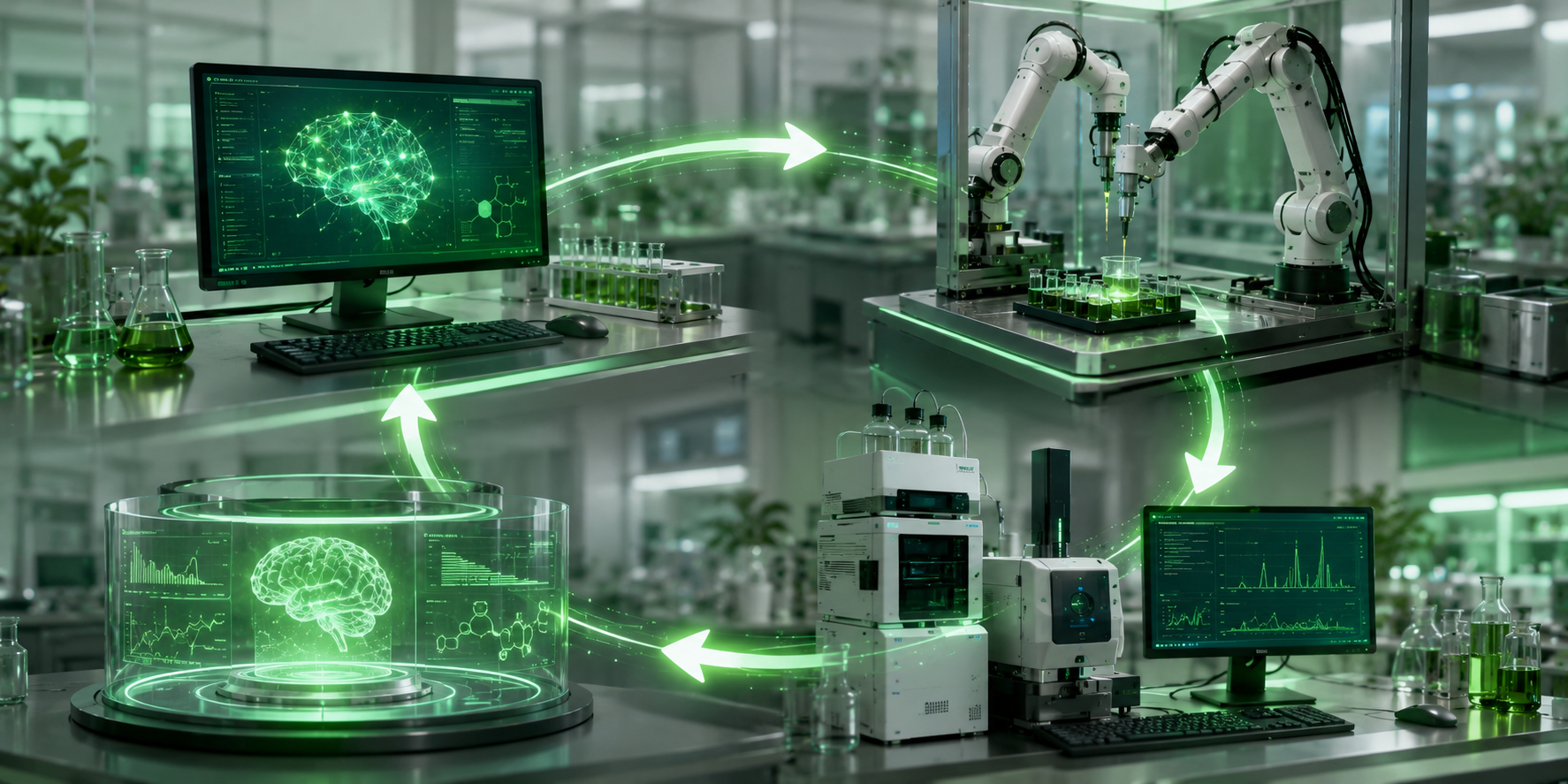 Self-Driving Labs: The Rise of Autonomous Chemical Discovery in 2026 -- ChemCopilot: PLM + AI for Chemical Industry
The Mechanics and Mechanics of Autonomous Discovery
The physical manifestation of an SDL usually involves a combination of robotic arms, automated liquid handlers, and advanced sensors working in tandem to conduct experiments with minimal human intervention [2][4]. However, the true intelligence lies in the software orchestrating these hardware components. AI agents process live data to instantly fit curves, suggest cutoffs, and trigger automated hypothesis reformation when an experiment yields poor results [7].
Looking forward, the next frontier is "Multi-Modal Discovery." Developers are working on AI systems that can watch videos of past experiments to learn manual techniques or interpret physical nuances that were previously un-codified [3]. Furthermore, the concept of "Self-Improving Chemists"--AI that can analyze its own failures to refine its underlying physics engines--represents a leap toward truly autonomous scientific reasoning [3].
This ecosystem is also spawning a new breed of "TechBio" and "TechChem" startups. Companies like Lila Sciences and Radical AI are building fully autonomous, closed-loop labs that focus on specific domains like inorganic compounds and clean energy materials [1]. Often more agile than established scientific equipment manufacturers, these startups are positioning themselves as "discovery-as-a-service" providers capable of out-innovating traditional, large-scale R&D departments [1]. Concurrently, "cloud labs" are emerging, offering subscription-based remote-control access to experimental capabilities and previewing a democratization of science where researchers can execute AI-directed experiments without ever stepping foot in a physical lab [8].
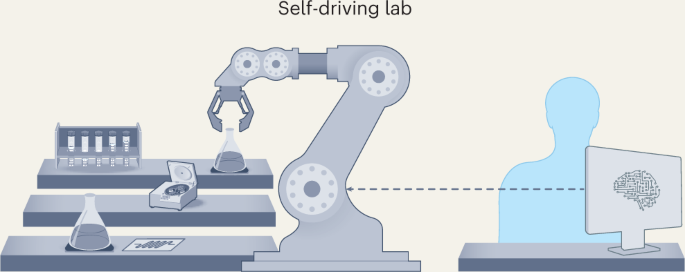 The rise of self-driving labs in chemical and materials sciences | Nature Synthesis
Navigating the Challenges: Integration, Ethics, and Interpretability
Despite the extraordinary promise, the transition to autonomous science is fraught with challenges. On the technical side, most laboratories today use a patchwork of instruments with incompatible protocols. Creating unified interfaces that allow AI to coordinate seamlessly across different devices remains a significant hurdle [9]. Furthermore, without common frameworks for storing and sharing experimental results--data standards and interoperability--valuable insights risk being siloed [9]. Building a fully autonomous lab also requires advanced robotics, sensors, and AI infrastructure, presenting a high barrier to entry for many institutions [9].
The risks extend far beyond hardware integration. Like any powerful innovation, self-driving labs come with profound AI-specific risks, including a loss of interpretability if AI agents cannot explain their reasoning, and the danger of overfitting algorithms to short-term metrics rather than long-term discovery [6][7]. There are also serious ethical implications surrounding data ownership, lab labor displacement, and decision-making authority [6][8]. Inventions emerging from AI-driven science pose grand challenges for society, particularly concerning biosecurity and the need for human oversight to safeguard accuracy and safety [8][10].
 The Rise of Autonomous Self-Driving Laboratories | AI, Robotics & the Scientific Discovery | Uplatz
The Evolving Role of the Human Scientist
Amidst this automation revolution, the consensus among experts is clear: self-driving labs are not poised to replace human scientists anytime soon [2]. Instead, a hybrid model is anticipated as the most effective workflow, where AI and robotic automation handle the experimental heavy lifting, while human scientists remain essential [2].
What is fundamentally changing is the role of the scientist and the scientific paradigm [2]. The goal of SDLs is to relieve researchers of repetitive, time-consuming tasks, allowing them to focus on hypothesis generation, high-level interpretation, and creativity [2][7]. As these systems become more autonomous, the primary challenge for humans will shift toward defining the goals and ethical boundaries of the research, rather than performing the physical experiments themselves [3].
The intellectual complementarity of AI and human scientists provides the greatest inspiration for the future of this technology [8]. AI systems process information and solve problems differently than humans. While AI vastly exceeds human aptitude in certain areas--such as the design of novel proteins, exemplified by breakthroughs like AlphaFold, or predicting three-dimensional molecular structures--humans provide the intuition, ethical grounding, and creative leaps that algorithms lack [8][10]. The solution lies in "human-in-the-loop" design, where scientists and AI agents collaborate as co-pilots rather than competitors [6][7].
Conclusion
The rise of self-driving laboratories marks a pivotal chapter in human inquiry. By merging AI intelligence with robotic precision, these systems enable experiments that are faster, more reproducible, and more cost-efficient than ever before [9]. They are already compressing research timelines that once spanned years into weeks or even days, accelerating breakthroughs in drug discovery, sustainable chemistry, and advanced materials [10][7].
If judiciously shepherded, we can envision a near future where autonomous systems and human scientists work together in a synergistic, symbiotic fashion, capitalizing on the unique strengths of the other to advance knowledge [8]. Self-driving labs are no longer science fiction; they are already here in prototypes and early-stage deployments. If the scientific community builds them ethically, accessibly, and with purpose, the lab of the future will not just be smart--it will be curious, collaborative, and capable of discovering the future before we do [6][7].
References
- 1.
- 2.
- 3.
- 4.
- 5.
- 6.
- 7.
- 8.
- 9.
- 10.