Introduction
For their first several years in science, large language models were cast in the role of librarian: summarizing papers, drafting reviews, and accelerating the grueling work of literature synthesis. A new generation of "agentic" systems is now staking a far more ambitious claim--that AI can function as a genuine co-scientist, generating novel, mechanistic hypotheses and experimentally testable research proposals rather than merely cataloguing what humanity already knows. Google DeepMind's Co-Scientist, built on the Gemini model family, frames this explicitly, positioning itself as "one of the first examples of a reliable multi-agent system for structured scientific thinking" capable of delivering "tangible results in novel hypothesis generation for complex scientific problems" [1]. Open-source efforts such as OpenScientist make similar claims for semi-autonomous biomedical discovery [2].
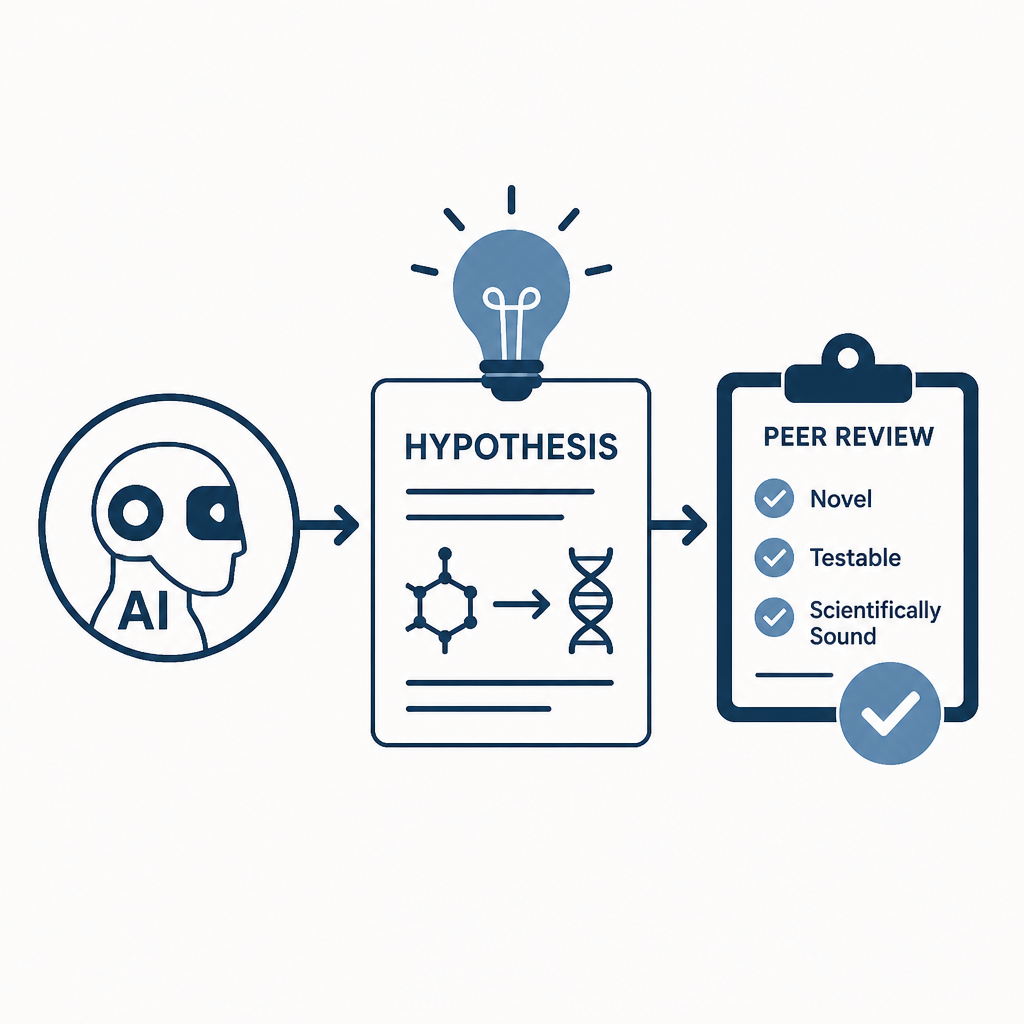
The central question is no longer whether these systems can produce plausible-sounding text, but whether their outputs can withstand the most demanding quality filter science has: peer review. Can an AI-proposed hypothesis be genuinely novel rather than an elaborate recombination of published ideas? Is it testable with a concrete experimental plan? And does it hold up when confronted with real data--including data engineered to contain no signal at all? Early evidence spans drug repurposing in acute myeloid leukemia (AML), epigenetic target discovery in liver fibrosis, mechanisms of antimicrobial resistance [3], and multiple myeloma progression from routine RNA-seq data [2]--with parallel advances in closed-loop materials discovery [4].
The answers, drawn from a rapidly growing body of validation studies, are encouraging but nuanced. These systems demonstrably generate hypotheses that humans judge as novel, plausible, and executable, and several have been vindicated in the laboratory [3], [5]. At the same time, controlled evaluations show that autonomous validation remains incomplete: when the underlying biology is scrambled, some AI-generated hypotheses stubbornly refuse to die [2]. Understanding both sides of that ledger is essential for anyone deciding how much scientific authority to delegate to machines.
From Synthesis to Discovery: How Co-Scientist Architectures Work
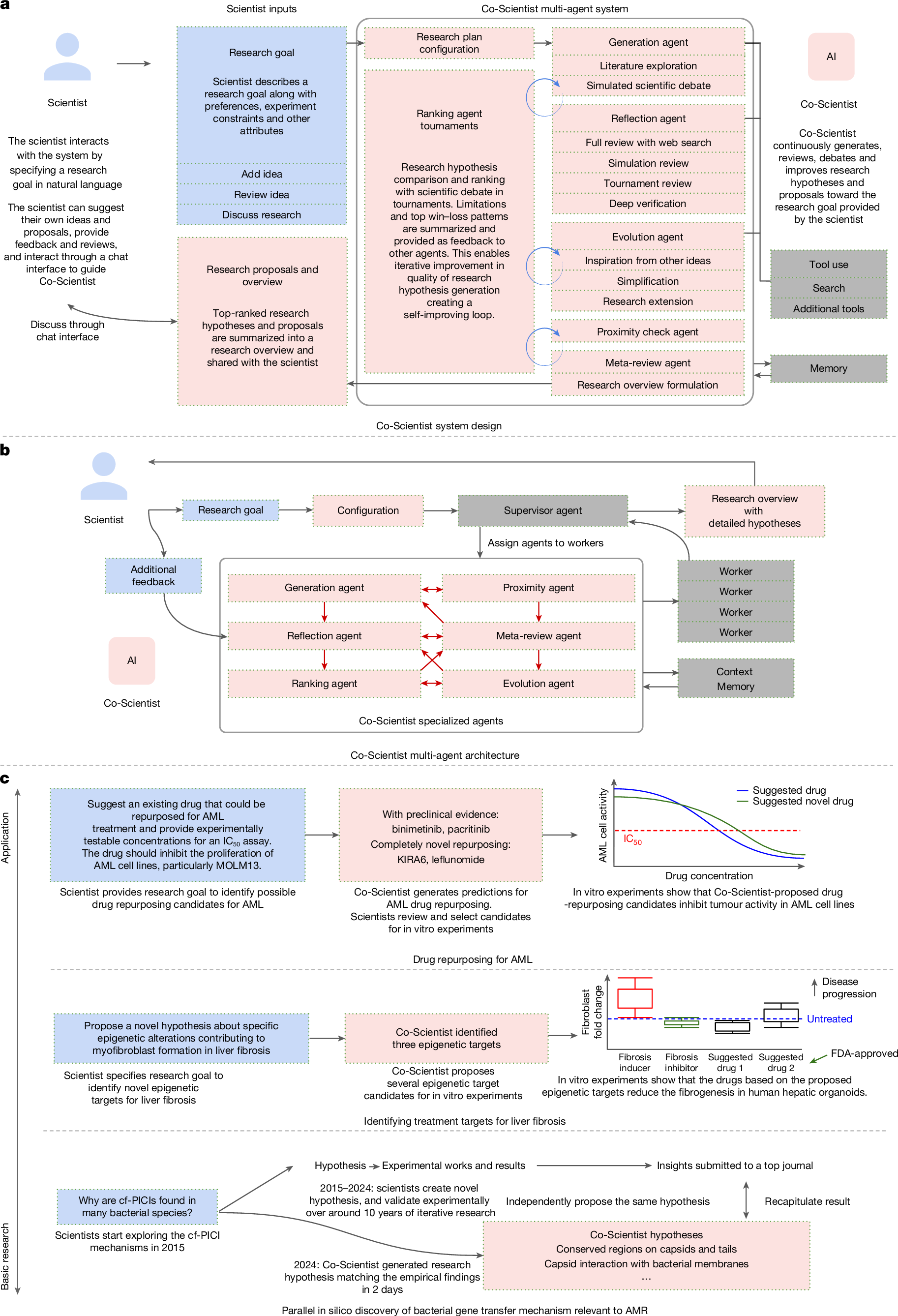
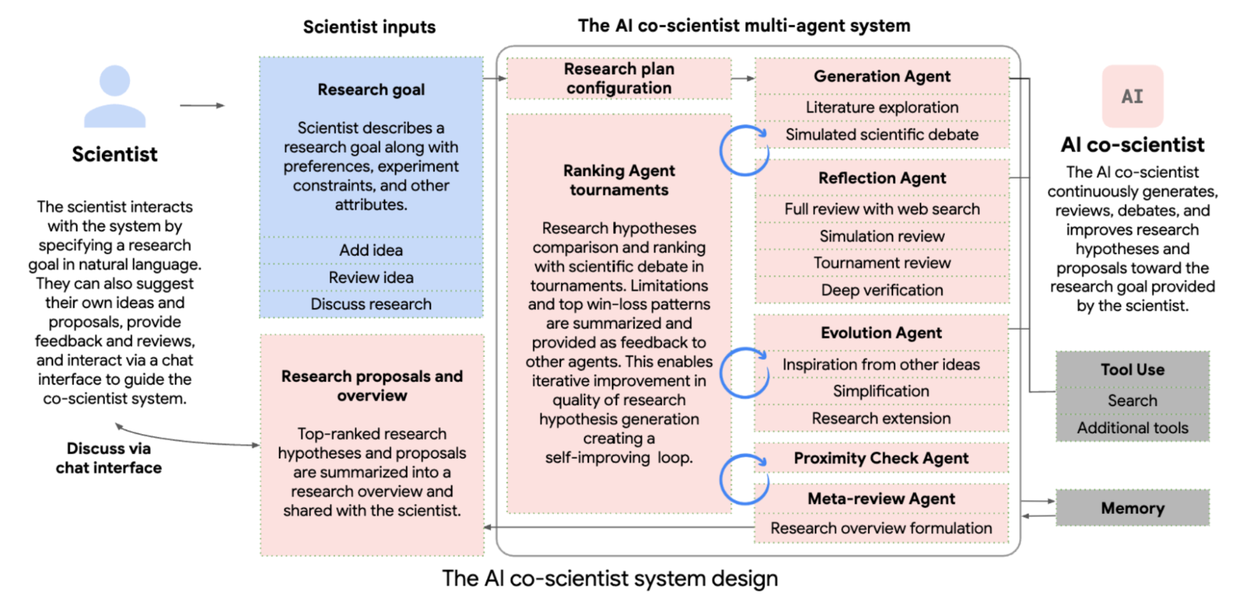
The defining feature of the new co-scientist systems is that hypothesis generation is not a single prompt but a structured, multi-agent workflow. Google's Co-Scientist organizes a "collaborative coalition of specialized agents" into three phases [1]:
- Generate ideas. A generation agent proposes initial research directions and novel hypotheses grounded in scientific literature and data, while a proximity agent maps and clusters those hypotheses to ensure diverse coverage of the research space rather than redundant variations on one theme [1].
- Debate ideas. A reflection agent acts as a "virtual peer reviewer," critically evaluating hypotheses for correctness, quality, and novelty. A ranking agent then orchestrates an "idea tournament," using pairwise comparisons, simulated scientific debates, and an Elo-based rating system to iteratively prioritize the most promising candidates while injecting fresh knowledge to expand exploration [1].
- Evolve ideas. Top-ranked hypotheses are refined, cross-checked against literature and specialized databases such as ChEMBL and UniProt, and paired with experimental plans; advanced tools like AlphaFold are being integrated as callable models in select collaborations [1].
Critically, the majority of the system's computation is dedicated not to generation but to verification--deeply cross-checking claims so they remain "grounded, factually accurate, and logically coherent" [1]. This is a deliberate architectural answer to the central criticism of earlier LLM research tools: that they synthesize rather than discover. The distinction is sharpened by comparisons with literature-review platforms such as BioSkepsis, which is explicitly designed for auditable citation chains and structured synthesis rather than novel hypothesis generation, and whose makers describe a complementary ecosystem: "Co-Scientist generates a novel hypothesis about an epigenomic target for liver fibrosis. BioSkepsis verifies the underlying evidence... AMGEL executes the proposed assays... VITALE records every experimental step. Each system handles a distinct phase; none duplicates another's core job" [6].
The boundary matters because recapitulation is easy and discovery is hard. The "data-to-paper" platform by Ifargan and colleagues, for example, successfully guides multiple LLM and rule-based agents to produce complete research papers with automated verification--but its evaluations are "limited to recapitulating existing peer-reviewed publications," leaving unclear whether the system can generate "truly novel, yet grounded" hypotheses [3]. That gap--between reproducing known results and producing new, defensible claims--is exactly where the co-scientist paradigm is being tested.
 Accelerating scientific discovery with Co-Scientist | Nature
The Biomedical Evidence Base: Wet-Lab Validation and Case Studies
The strongest claims for AI-generated hypotheses rest on empirical validation, and 2025 brought a wave of it. The Co-Scientist team reported "end-to-end validation of novel AI-generated hypotheses" across three increasingly complex biomedical domains: the system predicted novel repurposing drugs for AML, identified novel epigenetic treatment targets for liver fibrosis grounded in preclinical evidence, and proposed novel mechanisms for gene transfer in bacterial evolution and antimicrobial resistance--with each of these discoveries "validated in wet-lab settings" in separate technical reports [3]. Perhaps the most striking anecdote circulated widely in coverage of the work: the system "rediscovered bacterial evolution mechanisms before human scientists published them" [5], a concrete instance of machine-generated hypotheses converging on results an independent human team was simultaneously pursuing.
Notably, the value proposition emphasized in the arXiv report goes beyond simply naming a drug or target. The co-scientist integrates "molecular pathways, existing preclinical evidence, and potential therapeutic applications into structured, testable specific-aims," providing researchers with literature-supported rationales and concrete experimental approaches for validation--the structural elements a human reviewer would demand of a grant proposal [3].
The open-source counterpoint comes from OpenScientist, which evaluated its agents on multiple myeloma using gene expression data spanning disease progression from normal plasma cells through monoclonal gammopathy of uncertain significance (MGUS) and smoldering multiple myeloma to active disease. The system was tasked with generating mechanistic hypotheses from RNA-seq data (n=99 samples, 33,297 genes), independently validating them against an external Mayo Clinic cohort (n=162 samples, GSE6477), and--crucially--correctly identifying when validation fails using randomized negative controls [2]. Across clinical use cases, OpenScientist integrated user-provided data with published literature, performed bespoke computational analyses, and synthesized "mechanistic insights into coherent, verifiable results and testable hypotheses" [2].
The broader ecosystem is filling in quickly. Stanford's Biomni is designed to "read the literature, form hypotheses, choose datasets and tools, write code, interpret results and suggest next-stage experiments in a complete research workflow" [7], while AI-Researcher represents a fully autonomous research pipeline from idea to evaluated output [8]. Surveys of autonomous "scientist AI" systems catalog the recurring module stack--hypothesis generation scored against literature APIs, experiment managers with agentic tree search, code synthesis and execution, automated analysis, and manuscript generation with integrated review agents--now being applied across genomics, drug discovery, and biomedical engineering [4].
 AI Co-Scientists: How Systems Like Co-Scientist and Robin Are Quietly Rewriting the Scientific Method | by Mehmet Özel | Artificial Intelligence in Plain English
The Peer-Review Standard: Judging Machine-Generated Science
If AI systems are to produce hypotheses "that meet peer-review standards," someone--or something--must apply those standards. The first judge is built in: Co-Scientist's reflection agent explicitly plays the role of "virtual peer reviewer," and the Elo tournament formalizes quality pressure through pairwise comparison, mimicking the adversarial dynamics of review panels [1]. This matters at scale: the system is designed to let research teams "explore thousands of research directions in parallel, surface non-obvious connections across disciplines, and propose experimental plans," with human labs retaining physical validation [6].
Independent benchmarks suggest machine review is closing in on human performance, at least on coarse judgments. Automated peer-review agents critiquing papers achieve "balanced accuracy near human-level (e.g., 0.65 vs. 0.66 for acceptance decisions)" [4]. Comparative studies probing whether AI can match domain experts in evaluating scientific literature and evidence are now an active research area in their own right [9]. Meanwhile, end-to-end autonomous pipelines have adopted explicit acceptance thresholds--for example, requiring LLM-assigned review scores of at least 6/10 before a manuscript exits the loop [4].
Yet a methodological caution hangs over all of this: much of the evaluation is circular. When an LLM-based reflection agent scores hypotheses generated by other LLM agents, agreement may reflect shared biases, stylistic fluency, or embedded training knowledge rather than genuine scientific merit. The most convincing validations are therefore the ones that escape the loop entirely--wet-lab experiments whose outcomes the model could not have simply recalled [3], and adversarial controls where success means rejecting hypotheses, not endorsing them. That is precisely where the current generation of systems shows cracks.
The Novelty Problem: When Validation Fails
The most scientifically important finding in the recent literature is a failure mode, candidly reported. OpenScientist's multiple myeloma study included randomized negative controls in which the true biological signal was eliminated--and the system "does not yet consistently achieve complete hypothesis rejection when underlying biological structure is removed." In these analyses, "a subset of hypotheses remained statistically supported despite elimination of true signal, indicating incomplete discrimination between genuine biological effects and residual structure." The authors are careful to contextualize this: these are "similar to modes of failure and mistakes made by human scientists," and continued refinement is expected to improve performance [2]. But the implication is clear--an AI co-scientist can generate biologically coherent, plausible hypotheses even from noise, which is simultaneously a testament to its generative power and a warning about its calibration.
This failure mode connects to a broader reliability picture. Surveys of autonomous research systems report experimental execution failure rates as high as 42% in early versions of agentic experiment pipelines [4], and the field's own reviewers note that many end-to-end systems still struggle to distinguish recollection from reasoning. The distinction between "novel" and "newly phrased" remains difficult to certify: a hypothesis can be genuinely new to the literature yet trivially derivable from existing knowledge, or genuinely surprising yet unsupported by the cited evidence. Verification tools exist to police this--Co-Scientist's deep cross-checking against literature and curated databases [1], and evidence-verification platforms that check whether cited papers actually support the mechanistic claims being made [6]--but the OpenScientist negative-control result shows that even statistically rigorous pipelines can be fooled by residual structure in data.
 Accelerating scientific breakthroughs with an AI co-scientist
Materials Science and the Closed-Loop Frontier
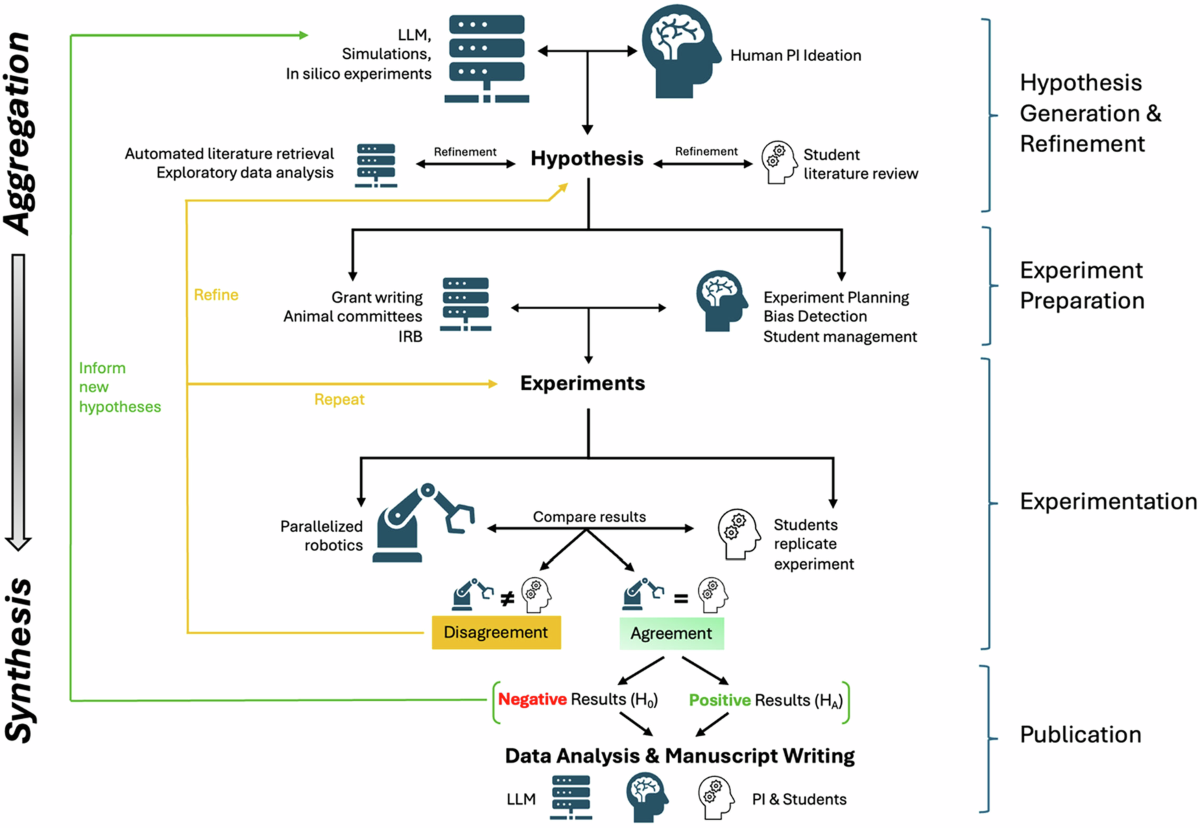
Biomedicine supplies the most human-consequential case studies, but materials science is emerging as the domain where autonomy advances fastest--largely because experiments there can be roboticized. Recent work demonstrates "closed-loop materials design and optimization via integrated RAG, multi-agent collaboration, and robotic execution" [4], collapsing the traditional distance between hypothesis and test. In parallel, a specialized configuration of Google's Co-Scientist extends the platform "beyond in silico hypothesis generation" into "an execution-grounded research partner advancing closed-loop scientific workflows across materials science, biology, and computer science," spanning hypothesis generation, experimentation, and manuscript generation [7].
This closed-loop turn changes the evaluation calculus. When an AI proposes a hypothesis, designs the experiment, executes it robotically, analyzes the result, and updates its next hypothesis, the peer-review standard is no longer applied only to prose--it is applied to reproducible physical outcomes. Fully autonomous systems such as AI-Researcher are being designed around exactly this evaluation challenge, transforming "how AI-driven scientific discovery is conducted and evaluated" [8]. Conceptually, researchers are converging on framing AI-assisted discovery around exploration: how systems search for evidence, identify promising questions, generate explanations, and iterate [10]. In a closed loop, a bad hypothesis is quickly punished by reality; in an open loop ending at a manuscript, it may only be punished--much later--by human reviewers, if at all.
 Will AI become our Co-PI? | npj Digital Medicine
Toward an Auditable Discovery Ecosystem
What should labs and institutions take from the current evidence? Three lessons stand out.
First, verification is the bottleneck, and it should be engineered, not assumed. Co-Scientist dedicates the majority of its compute to verification against literature, ChEMBL, UniProt, and structural models [1]; OpenScientist is built with "auditability, modularity, and interpretability as core design principles" [2]; and evidence-checking platforms exist specifically to confirm whether citations support the mechanistic claims a hypothesis rests on [6]. Systems that skimp on this layer should be treated with skepticism, because the failure data show what happens without it: hypotheses that survive even when the signal is gone [2].
Second, the roles are complementary, not competitive. The clearest operating model emerging from practice assigns each phase to a specialized system--hypothesis generation at scale, evidence verification with auditable citation networks, automated assay execution, and comprehensive experimental logging [6]--with human scientists retained for physical validation and final judgment [6]. This "coalition" model mirrors the internal architecture of the co-scientist systems themselves: generation balanced by adversarial critique [1].
Third, the peer-review bar is partially met but not fully cleared. Machine review now performs near human level on acceptance decisions [4], and AI-generated hypotheses have been vindicated in wet labs across drug repurposing, target discovery, and antimicrobial resistance [3]. But negative-control failures [2], high execution error rates in early autonomous pipelines [4], and unresolved questions about reviewer circularity mean that "meets peer-review standards" should currently be read as "survives review-like scrutiny, pending independent empirical confirmation"--not as a substitute for expert evaluation. The comparison between AI and domain experts in scientific evidence review remains an open empirical question [9].
Conclusion
The evidence assembled across biomedicine and materials science supports a qualified yes: agentic AI co-scientist systems can generate hypotheses that are novel in the meaningful sense--converging with unpublished human discoveries, proposing repurposing candidates and epigenetic targets subsequently confirmed in the wet lab, and expressing them as structured, testable specific-aims with literature-grounded rationales [3], [5]. Architecturally, this is achieved by institutionalizing peer review inside the machine--virtual reviewers, debate tournaments, and verification against curated knowledge bases [1]--and by embedding discovery in closed loops where robotic execution provides an unforgiving external judge [7], [4].
But the strongest argument for cautious optimism comes from the field's own negative results. OpenScientist's demonstration that some hypotheses survive even randomized controls [2] is exactly the kind of honest evaluation that separates a scientific instrument from a hype cycle--and, notably, it mirrors the failure modes of human scientists themselves [2]. The near-term trajectory, then, is not autonomous replacement of the scientific method but a division of labor: machines proposing and stress-testing hypotheses at a scale and speed no human team can match [6], humans supplying taste, context, and final accountability. The open question for the next wave of evaluation studies is whether AI-generated hypotheses can clear the highest bar of all--not merely convincing an automated reviewer or surviving a tournament, but persuading a skeptical human expert that a genuinely new idea about the natural world is worth years of laboratory effort. On present evidence, that conversation has genuinely begun.
References
- 1.
- 2.
- 3.
- 4.
- 5.
- 6.
- 7.
- 8.
- 9.
- 10.