Introduction
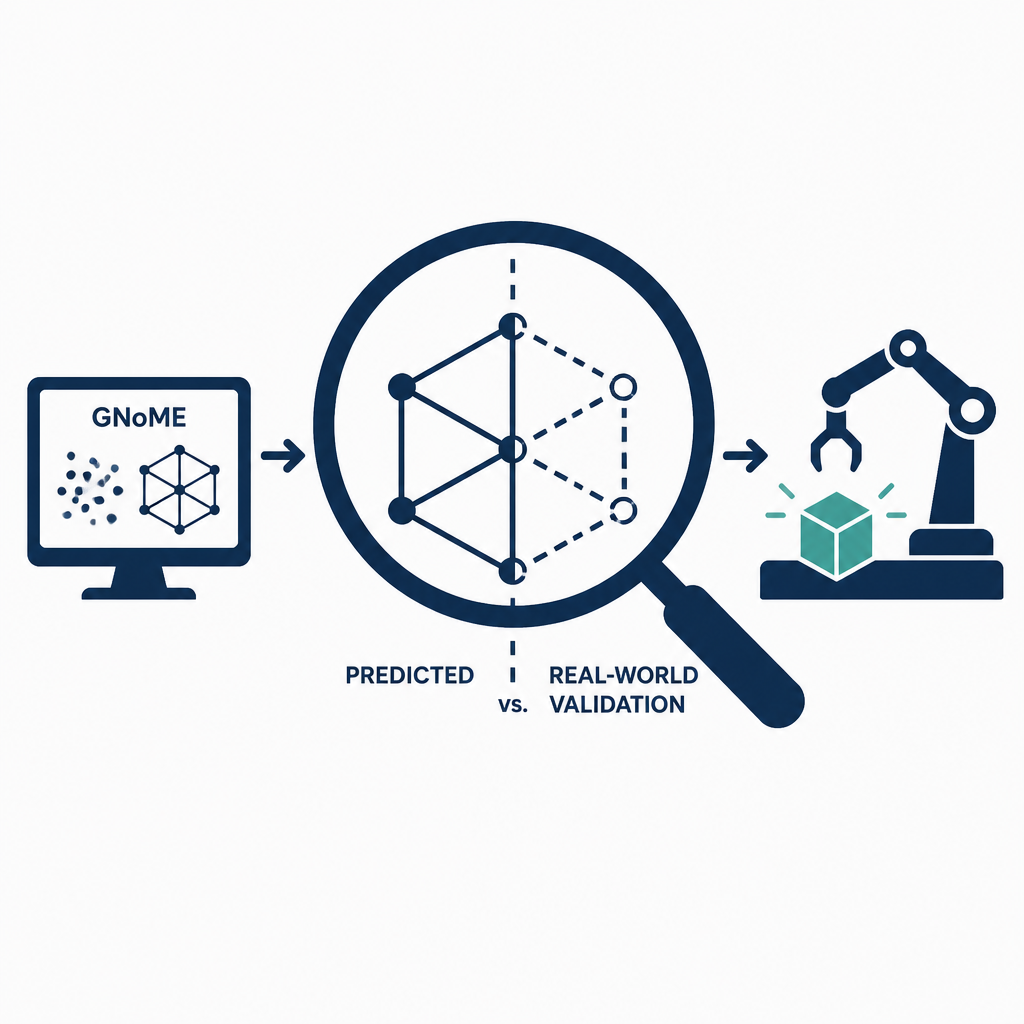
In 2023, Google DeepMind's GNoME (Graph Networks for Materials Exploration) announced one of the largest claims in the history of chemistry: roughly 2.2 million predicted crystal structures, of which some 381,000 were assessed as thermodynamically stable--more new inorganic compounds, in a single publication, than humanity had previously catalogued in centuries of experimentation [1][2]. Almost simultaneously, a companion effort at UC Berkeley introduced the A-Lab, a robotic platform that spent seventeen days of continuous operation attempting to synthesize 58 of these AI-flagged targets, delivering 41 novel compounds with no human hands at the bench [2].
The headlines wrote themselves. But headlines are not validation. Beneath the spectacular numbers sits a quieter and more consequential question: how many of these AI-discovered materials actually survive when they meet real furnaces, real impurities, real structural disorder, and real independent replication attempts? The answer, as a growing body of audit-oriented research makes clear, is more complicated than either the hype or the skepticism suggests.
This article examines the reproducibility gap across four dimensions: the evidentiary status of GNoME's massive prediction set, the instructive successes and failures of autonomous synthesis, the hidden assumptions embedded in the computational and machine-learning pipeline itself, and the emerging institutional responses--from lab autonomy readiness scales to formal hierarchies of scientific validation. The picture that emerges is neither triumph nor collapse, but something more interesting: a field learning, in public, how to audit itself.
381,000 Predictions: What Counts as "Verified"?
The first question any auditor must ask is what verification actually means for a claim of this scale. GNoME's defenders point to a genuinely strong signal: of the experimentally known structures aggregated in the Inorganic Crystal Structure Database (ICSD), 736 match structures that GNoME independently recovered--materials already synthesized by labs around the world, including "exciting" superconductor candidates [2][3]. DeepMind also partnered with Lawrence Livermore National Laboratory to attempt real synthesis and property verification of selected candidates, rather than relying purely on simulation-based checks [2].
Yet the arithmetic deserves scrutiny. Seven hundred and thirty-six confirmations is a rounding error against a database of hundreds of thousands of predictions--and crucially, those 736 are already-known materials. Their recovery demonstrates that GNoME's models are consistent with established chemistry, which builds confidence in the methodology. It does not validate the vast majority of predictions, which describe compounds nobody has ever made. As Jakoah Brgoch, an associate professor of chemistry at the University of Houston, put it: "Of course, experimentally validating these predictions is easier said than done" [3].
The structural problem was anticipated in field reviews: computational predictions now far outpace experimental synthesis and characterization capabilities, creating a persistent experimental validation bottleneck. Worse, synthetic feasibility constraints are often not incorporated into generative models at all, producing a gap between computationally predicted stability and actual synthesizability (Ceder et al., 2025, as summarized in [4]). A compound can sit comfortably on the thermodynamic convex hull and still be unreachable by any known laboratory route.
Brgoch offered a more generous framing of the same problem: perhaps some AI-suggested compounds simply are not viable at current lab temperatures and pressures--but what happens if researchers alter those variables? "Science is often a slog," he observed. "The hope and the hype is we don't have to go through this slog" [3]. The audit question is whether the slog has actually been eliminated, or merely relocated.

The A-Lab: An Experimental Oracle With a Built-In Post-Mortem
If GNoME represents the supply side of AI materials discovery, the A-Lab is the closest thing the field has to an experimental oracle. Its architecture is instructive: synthesis recipes were proposed by natural-language models trained on the scientific literature, then optimized through active learning grounded in thermodynamics--analysis of failed syntheses providing "direct and actionable suggestions to improve current techniques for materials screening and synthesis design" [2].
The A-Lab's successes demonstrate genuine machine intelligence, not just automation. In one case, the system's initial recipe for a calcium-iron phosphate target hit a kinetic trap: the chosen reaction intermediates offered a thermodynamic driving force of only about 8 meV per atom toward the final product. The AI diagnosed the problem, proposed alternative intermediates with a driving force of roughly 77 meV per atom, and the revised autonomous synthesis achieved approximately a 70% yield of the target compound [1]. The system was not merely executing instructions--it was analyzing failure, applying chemical principles, and redesigning the experiment.
The failures are arguably more valuable for this audit. Of the 17 targets the A-Lab could not synthesize, at least three were ultimately attributed not to robotic shortcomings but to inaccuracies in the underlying DFT calculations on which GNoME's stability predictions rested [1]. The case of one lanthanum-manganese oxide target is exemplary: every A-Lab attempt produced the well-known compound LaMnO₃ instead of the predicted novel phase. When researchers went back and inspected the original DFT calculations, they found those calculations had predicted the known, stable LaMnO₃ phase to be highly unstable [1]. If a calculation gets a famously stable material wrong, its prediction for a novel related material cannot be trusted.
This is the reproducibility audit functioning exactly as it should: the autonomous laboratory did not just produce successes; it generated systematic evidence about where the computational supply chain breaks. The uncomfortable implication, however, is that many GNoME predictions may never face such scrutiny--the A-Lab validated 58 targets, not 381,000.
The Disorder Problem: Idealized Crystals Versus Messy Reality
A deeper structural weakness lies in what the predictive models assume rather than what they compute. A 2025 study from the Fritz Haber Institute of the Max Planck Society found that AI-powered prediction models frequently rely on idealized representations of crystal structures that do not reflect how materials actually form under real-world conditions. When the research team applied a new tool for detecting structural disorder to existing materials databases, the results were stark: in some datasets, more than 80% of AI-recommended materials were likely to exhibit disorder in real experiments--meaning their true properties could deviate dramatically from theoretical expectations [5].
This finding strikes at the heart of the discovery pipeline. Disorder--atoms occupying the "wrong" sites, vacancies, partial mixing--can transform electronic, magnetic, and optical behavior. A material screened as a promising semiconductor or solar absorber under an idealized structure may simply never deliver those properties as synthesized. The FHI team framed their work as identifying this critical gap and providing tools to address it, calling the result "an important step toward more trustworthy and efficient computational materials discovery" [5].
Researchers close to the translational problem have long flagged the same chasm from the other direction. "There is a wealth of AI knowledge, but currently there's a gap between translating those insights to material synthesis in the lab," said Akira Miura of Hokkaido University, who led an early study attempting to bridge computational predictions with bench chemistry [3]. Between idealized DFT structures, missing synthetic feasibility constraints [4], and the disorder revealed by FHI's screening, the audit trail from prediction to physical material accumulates assumptions at every stage--each one a place where reproducibility can silently fail.

Auditing the Machine: Reproducibility Inside the ML Pipeline
The materials themselves are only half the story. A separate audit effort has targeted the machine-learning pipeline that produces the predictions--and found reproducibility fragile even there. A case study from Brookhaven National Laboratory set out to replicate ML analyses in materials informatics and discovered that "even when data and methods are known, reproducibility is still a challenge, due to hidden theoretical assumptions and lack of transparency" [6]. The researchers catalogued a litany of issues: theory-driven and numerical errors embedded in training data (much of it derived from the same DFT methods the A-Lab later implicated), lack of reproducibility across software platforms and versions--demonstrated through comparisons of TensorFlow, PyTorch, and lightGBM--and the effects of stochastic training randomness on results [6].
A comprehensive review of trustworthy AI for materials discovery reinforced the pattern with sobering metrics. Among published studies, work received transparency credit simply for releasing open-source software, yet software quality and associated metrics were not reported in any study, and standard software engineering practices such as unit testing for correctness were rarely implemented. The review's authors argued that expecting materials data-scientists to test and document their code is as reasonable as expecting experimentalists to report calibration standards for their equipment--and its absence "speaks directly to the reproducibility crisis in scientific results" [7].
This matters because "reproducibility" itself is a spectrum, not a binary. A recent validation framework distinguishes repeatability (consistent results under identical conditions) as merely the minimal baseline; reproducibility (external researchers validating the original experiment's correctness) as substantially stronger; and direct and conceptual replicability--do findings hold when implementation details or entire methodological approaches change?--as the highest standards. Illustratively, medical imaging models that satisfied reproducibility criteria within their original context failed at direct replicability the moment implementation context changed, and other reproduction efforts exposed fatal methodological flaws invisible to simple re-execution [8]. Most GNoME-adjacent claims, audited against this hierarchy, sit near the bottom of it.
The problem extends to how scientists now work. Most AI-assisted R&D today is prompt-based, which means most of it cannot be reproduced--an acute liability in materials R&D, where analyses "have to survive scrutiny from stage-gate committees, IP counsel, regulators, and partners," and "an analysis that cannot be reproduced cannot be defended" [4].
Autonomous Labs: Both Remedy and New Risk
Autonomous laboratories are frequently proposed as the cure for the validation bottleneck, and the evidence for their strengths is real. Robotic platforms can produce single-source experimental data with high reproducibility while simultaneously achieving high throughput, enabling rapid and repeatable exploration of large numbers of synthesis hypotheses--a genuinely new platform for data-driven synthesis science [9]. Where a single research group once validated a handful of candidates per year, a robotic lab can run systematic repetition as a matter of course: in one study, ten individual repetitions of the synthesis of a complex organic-inorganic halide, (NH₂C₅H₈F₂)₄AgBiI₈, were performed specifically to assess experimental reproducibility [9]. Machine-guided approaches have also been shown to achieve higher success rates than expert chemical intuition, which one study benchmarked at just 16.4% [9].
Yet the same reviews that celebrate autonomy also warn that it introduces its own trust and reproducibility challenges. A proposed "lab autonomy readiness scale" outlines what credible autonomous experimentation requires: verified interlocks, exploration guided by uncertainty quantification, automatic pausing when calibration drifts, and demonstrated reproducibility across different instruments--complemented by task-level scorecards designed to satisfy the need for auditability [7]. Separately, systems-integration problems remain unsolved: seamlessly coupling in situ characterization with autonomous platforms, coordinating multiple lab modules, and standardizing interfaces and data formats across platforms so that results from one robotic lab can be independently reproduced in another [4].
And there are physical limits automation cannot repeal. As DeepMind's own policy analysis put it: automated labs "only suit some fields, are expensive to build and are still early in development. And even automation cannot rush nature's clock. Cell lines need time to grow, chemical reactions take time to complete" [10].
 Crystal-hunting DeepMind AI could help discover new wonder materials | New Scientist
The Widening Bottleneck--and the Emerging Audit Infrastructure
The most sobering assessment comes from inside the AI frontier itself. DeepMind's 2026 policy paper "Conjecture Machines" concludes that "the validation gap in most disciplines is widening, not closing": AI agents can propose a novel hypothesis, but cannot say definitively whether it actually works. This explains why Google DeepMind, Ginkgo Bioworks, and Lila Sciences are investing in automated labs--and why the paper urges policymakers and funders to tackle the validation bottleneck directly, through investment in existing experimental validation infrastructure and accelerated development of automated laboratories [10].
The materials-discovery community is meanwhile building the beginnings of an audit discipline. The FHI team has released tools that flag structural disorder before predictions are trusted [5]. The trustworthiness review proposes interpretable descriptors and cross-checkable rules so that model outputs can be vetted against established scientific principles before experimental validation, along with autonomy-readiness criteria linking uncertainty to explanation in an auditable form [7]. And the hierarchical validation framework offers a vocabulary the field has largely lacked: distinguishing repeatable from reproduced from replicated results would force claims like "41 novel compounds synthesized" or "381,000 stable crystals predicted" to state explicitly which level of scrutiny they have survived [8].
Conclusion: From Prediction Abundance to Validation Infrastructure
The audit yields a nuanced verdict. On the credit side: GNoME independently recovered 736 known experimental structures, its models passed genuine consistency checks, and the A-Lab demonstrated that autonomous systems can not only synthesize novel compounds but diagnose their own failures--including catching errors in the DFT machinery that fed them [1][2]. On the debit side: fewer than a thousand of hundreds of thousands of predictions have any experimental grounding; over 80% of recommended materials in some screened databases may harbor disorder that invalidates their predicted properties [5]; the ML pipeline itself struggles with cross-platform reproducibility and skips basic software testing [7][6]; and the validation bottleneck is widening as AI hypothesis generation accelerates [10].
The deeper lesson is that the reproducibility gap is not an argument against AI-driven materials discovery--it is an argument about where the field's next investments must go. Prediction is no longer the scarce resource; trustworthy, independent, instrument-agnostic validation is. The labs, frameworks, and audit standards now emerging suggest a maturing discipline that understands this. Whether AI's promised materials revolution arrives will depend less on how many crystals the algorithms can imagine, and more on how many can survive the long, unforgiving slog of being made, measured, and made again by someone else.
References
- 1.
- 2.
- 3.
- 4.
- 5.
- 6.
- 7.
- 8.
- 9.
- 10.