Introduction
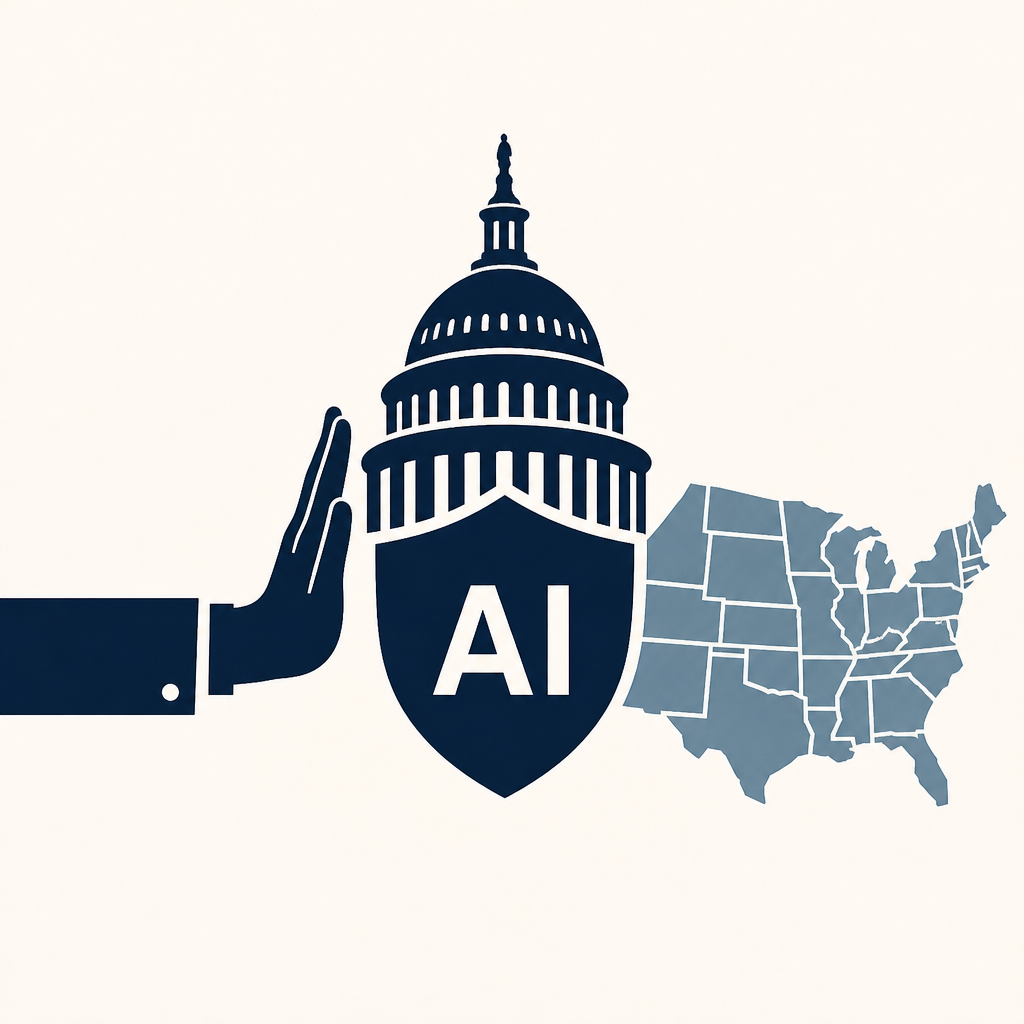
Few questions in American technology policy have generated as much legislative drama in recent years as a seemingly procedural one: who gets to regulate artificial intelligence? The answer, traditionally, has been "everyone"--a hallmark of American federalism in which states serve as laboratories of democracy while Congress sets national baselines. But as state legislatures have sprinted ahead with AI regulation while Congress has stalled, an aggressive counter-movement has emerged. Backed by the White House and major technology developers, congressional Republicans have repeatedly attempted to sweep state AI laws off the books through federal preemption--and have repeatedly failed in spectacular fashion.
The scorecard tells the story. Earlier this year, House Republicans attached a ten-year moratorium on state AI regulation to a major reconciliation package, only to watch the Senate strip it out by a vote of 99 to 1 after immense backlash from governors, state attorneys general, child safety groups, consumer advocates, and AI safety researchers [1]. Months later, the White House made a second attempt, with AI czar David Sacks leading an eleventh-hour push to insert preemption language into the must-pass National Defense Authorization Act (NDAA)--which also failed [2][3]. Congress has now rejected broad AI preemption in both the One Big Beautiful Bill Act and the NDAA, leaving the state regulatory patchwork intact for the foreseeable future [4].
Yet the battle is far from over. Lawmakers have signaled that narrower preemption proposals will return in 2026, the administration is deploying executive orders and litigation strategies to pressure states, and the underlying tension--between national consistency and state-level innovation policy--remains unresolved. This article examines how the preemption fight unfolded, why executive action has proven legally fragile, what history teaches about when Congress should override the states, and what the emerging landscape means for businesses, policymakers, and the future of American AI governance.
A Patchwork Takes Shape: The State Regulatory Surge
The preemption debate exists because states have moved decisively into a vacuum. The United States has no comprehensive federal AI law, and in the absence of congressional action, state legislatures have acted aggressively: more than 1,200 state AI bills were introduced in 2025 alone, with California, Colorado, Texas, Illinois, and New York each enacting or advancing substantive AI legislation carrying conflicting requirements, enforcement timelines, and penalty structures [4].
The pace has only accelerated. The first two weeks of March 2026 alone produced five AI-related bills in Washington State, Oregon's SB 1546 chatbot safety measure, nine AI bills in Utah, three in Virginia, and Vermont's AI election media bill [4]. States with laws already on the books include Colorado, Utah, Tennessee, New York, and California [1]--a list that spans the political spectrum and includes states led by both parties.
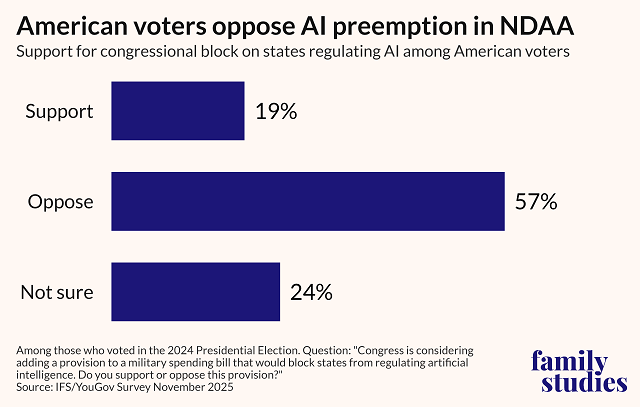 New Poll Shows Americans Overwhelmingly Oppose Federal Preemption of State AI Regulations | Institute for Family Studies
Crucially, not all state AI laws are alike, and critics of the preemption campaign argue that treating them as a single category is a fundamental analytical error. The National Taxpayers Union has identified two fundamentally different groups that emerged for distinct reasons [5]. The first consists of broad, cross-cutting governance requirements--impact assessments, transparency obligations, and documentation standards--such as Colorado's SB 24-205 (2024), Connecticut's SB 1103 (2023), and Vermont's H.121 (2024). States enacted these largely because Congress has not established a federal baseline; they are stopgap measures rather than attempts to set national AI policy. The second group consists of sector-specific rules governing how AI is used in domains that states have regulated for more than a century, irrespective of the underlying technology--most prominently employment, housing, health care, insurance, and consumer protection [5].
This distinction matters enormously for the policy debate. Cross-cutting state frameworks might plausibly yield to a federal successor; sector-specific rules are far harder to displace, both legally and politically. The result of ignoring that distinction, critics warn, is precisely what the administration itself has called "a patchwork of 50 different regulatory regimes"--but one that cannot be dissolved by fiat [4][5].
The Preemption Campaign: Moratorium, Defeat, and the NDAA Gambit
The push to override state AI law reached its first peak in the summer of 2025. The U.S. House of Representatives passed an early version of a moratorium on state AI regulation in May as part of the reconciliation package [3]. The initial proposal would have imposed a ten-year ban on state AI enforcement--though, as observers wryly noted, ChatGPT wasn't even around ten years ago, making a decade-long freeze on regulating a fast-moving technology a difficult sell even for sympathetic lawmakers [1]. The provision was watered down to five years before reaching the Senate [2].
It didn't matter. After a diverse coalition of governors, state attorneys general, child safety groups, consumer advocacy organizations, AI safety researchers, and everyday Americans pushed back, the Senate voted 99 to 1 to strip the provision from the bill [1]. Notably, more than 50 Republican lawmakers across 22 states have expressed concern about overriding state AI regulation, reflecting the reality that Republican-led states including Florida and Texas have advanced their own AI governance frameworks and are not uniformly eager to cede that authority to federal regulators [4].
The defeat did not end the campaign--it changed its venue. In November, President Trump publicly urged Congress to revive the effort and either attach a federal standard to the NDAA or pass a standalone bill, warning that a "patchwork" of state rules would undermine U.S. competitiveness [2]. On November 20th, congressional Republicans launched a last-minute attempt to insert an AI preemption provision into the must-pass NDAA, though the text was never made public. The eleventh-hour, must-pass-bill strategy closely resembled the reconciliation approach that had already failed once [3]. Once again, the effort collapsed. White House AI czar David Sacks had led the push, with major AI developers lining up behind a federal standard, arguing that state-by-state rules would slow innovation [2]. House Majority Leader Steve Scalise has since acknowledged that AI preemption language could appear "in other places" [2].
 The Challenge of Regulatory Preemption in AI Governance | The Regulatory Review
The Executive Branch End-Run: Why It Keeps Hitting Legal Walls
Frustrated by congressional inaction, the Trump administration has attempted to advance preemption through executive channels. In December, the president signed an executive order entitled "Ensuring a National Policy Framework for Artificial Intelligence," calling for a uniform federal policy framework that preempts state AI laws [6]. The administration followed in March with a four-page national policy framework stating that Congress should preempt state AI laws [6]. The AI Action Plan similarly endorsed a more limited version of the concept [7].
But these documents face a structural problem: an executive order cannot preempt state law on its own. Preemption must rest on congressional statutory authority, and without a federal framework for AI governance--risk classifications, documentation obligations, transparency standards--there is no baseline against which state provisions could even conflict [5]. Long-standing state authority over employment, housing, health care, insurance, and consumer protection cannot be displaced by executive action; preemption in these domains requires clear congressional authorization [5].
The administration's draft executive order has instead leaned on administrative and litigation pressure points. According to analyses of the order, the FTC is directed to issue a policy statement on how consumer protection law applies to AI models, including when it could override state laws that "alter their truthful outputs"; the Commerce Department is tasked with reviewing and publishing an evaluation of state AI laws, flagging so-called onerous ones and referring them to the Justice Department's AI litigation task force; Congress is expected to consider rules tying broadband funding to state AI lawmaking; and the FCC is directed to consider a national AI reporting and transparency standard that would preempt conflicting state laws [8]. The draft EO also proposed potential litigation against state AI laws [9].
Legal observers are skeptical that most of these channels will bear fruit. The FCC's jurisdiction is communications, and it has no substantive statutory authority over AI; any attempt to stretch its authority to preempt state AI laws would face serious legal challenges [1]. As Public Knowledge and others have concluded, while the White House can advance a legislative framework or prioritize preemption arguments in litigation, it is ultimately up to Congress to pass laws with preemptive effect [1]. The federal preemption debate, most analysts now agree, will be resolved primarily in Congress--not in the executive branch or in courts adjudicating specific state laws [4].
Lessons from History: When Should Congress Preempt?
The current fight is not the first time Congress has confronted the question of overriding state regulation of an emerging technology. The Carnegie Endowment for International Peace has examined this history and identified three main goals that have historically driven congressional preemption of emerging technologies: preventing conflicting state laws from fragmenting a national industry; restraining outlier states from effectively imposing their preferred rules on the rest of the country; and drawing on federal expertise, especially in areas related to national security [7].
History also offers sobering caveats. The mere fact of diverging state laws is not typically enough to justify preemption--the regulated industry must form a truly national market, one in which economies of scale outweigh the benefits of local choice over governance [7]. Moreover, Congress rarely preempts an entire policy area. Instead, combinations of political and policy motivations have usually led it to carve out areas of respective or overlapping state and federal responsibility. The governance of past technologies evolved as regulators experimented and industry adapted, and when states pushed too far too fast, Congress proved capable of responding rapidly to shore up federal interests [7].
Applied to AI, these lessons cut against the broad-moratorium approach. The moratorium was historically unprecedented, and while defenders argue that unprecedented circumstances warranted unprecedented measures, critics note that most of the thousands of proposed state AI bills will never become law, and the vast majority of those that do will impose modest obligations [3]. Perhaps the most important historical lesson, though, is the one senators themselves articulated when they killed the reconciliation moratorium: many objected not only to its duration but to preemption without replacement [9]. Organizations and policymakers across both parties share the concern that pausing state action without simultaneously establishing a federal standard would leave a policy vacuum beset by uncertainty and risk [9]. Future federal proposals that limit state authority will likely need to include clear national standards in the same bill to gain traction [9].
The Road Ahead: Narrower Bills, Smarter Federalism, and Corporate Reality
What comes next? The most likely near-term development is a shift in strategy rather than an abandonment of goals. Analysts expect a narrower preemption bill in 2026 focused on "national competitiveness" and critical-infrastructure AI, with carve-outs for discrimination and safety [2]. Congressional activity is already moving on multiple fronts: the House Energy and Commerce Committee passed the Kids Act with preemption of certain state child safety bills; the House introduced the Secure Data Act and the Guard Financial Data Act with preemption provisions; and Rep. Jay Obernolte (R-CA) is reportedly preparing an AI bill that includes state preemption [10][6].
At the same time, a more sophisticated theory of preemption is gaining currency among policy experts: that the scope of preemption should correspond to the scope of federal policies actually implemented--potentially close to a one-to-one correspondence. For instance, a federal bill that included AI whistleblower protections and mandatory transparency requirements for frontier model developers could be packaged with a provision preempting only state AI whistleblower laws (such as § 4 of California's SB 53) and state frontier model transparency laws (such as § 2 of SB 53) [3]. This "preempt-and-replace" model--federalizing the truly interstate elements of AI governance while pairing targeted preemption with federal standards--would give developers the clarity needed for innovation while preserving state responsibilities that have long structured the U.S. regulatory system [5][3].
For enterprises deploying AI across multiple states, the immediate reality is less elegant: they must simultaneously satisfy conflicting definitions, audit timelines, and disclosure obligations with no guarantee of harmonization--creating compounding compliance and security governance gaps [4]. This has driven interest in multi-framework control sets, such as the Cloud Security Alliance's AI Controls Matrix, which maps to ISO/IEC 42001, the NIST AI Risk Management Framework, and the EU AI Act, and can bridge state-by-state compliance requirements without being discarded if federal preemption eventually occurs [4]. Organizations with policy engagement capacity also have a window to weigh in on the specific scope of any proposed preemption--in particular, whether a federal floor would preserve existing algorithmic accountability standards in states with more mature regimes [4].
 AI Preemption Debate In Congress's Hands
Conclusion
The preemption problem is, at its core, a governance problem masquerading as a jurisdictional one. The administration is right that fragmentation poses real challenges, and the desire for national consistency is legitimate [5]. But the repeated collapses of the moratorium and the NDAA gambit demonstrate a durable political consensus: preempting state authority without a substantive federal replacement is a hard sell [9]. States will continue to legislate--indeed, the patchwork will probably accelerate [2]--and businesses and the public will keep calling for national standards and consistency.
The path forward most likely runs through Congress, and it almost certainly runs through compromise. Whether via narrowly tailored bills pairing federal standards with corresponding preemption [3], targeted federalization of interstate AI governance [5], or bipartisan frameworks that provide national assurances on privacy, accountability, and transparency while preserving space for states to test and refine solutions [9], the emerging model looks less like a wipeout of state authority and more like a recalibration of American federalism for the AI age. The core challenge for policymakers will be designing approaches that deliver the certainty innovators need without extinguishing the state-level experimentation that has historically informed--and occasionally disciplined--federal technology policy [7][9]. Until Congress gets that balance right, the patchwork persists, and the preemption problem will remain the defining battleground of American technology governance.
---CONTENT-END---
References
- 1.
- 2.
- 3.
- 4.
- 5.
- 6.
- 7.
- 8.
- 9.
- 10.