Introduction
The global race for artificial intelligence supremacy is no longer fought solely on the battlefield of compute power and algorithmic architecture; it has moved into the halls of governance. As AI systems become deeply integrated into economies, militaries, and civic life, the world's three major technological powers--the European Union, the United States, and China--are drafting distinct regulatory blueprints. These frameworks reflect fundamentally different political values, economic priorities, and strategic goals, turning AI governance into a primary theater of geopolitical competition [1].
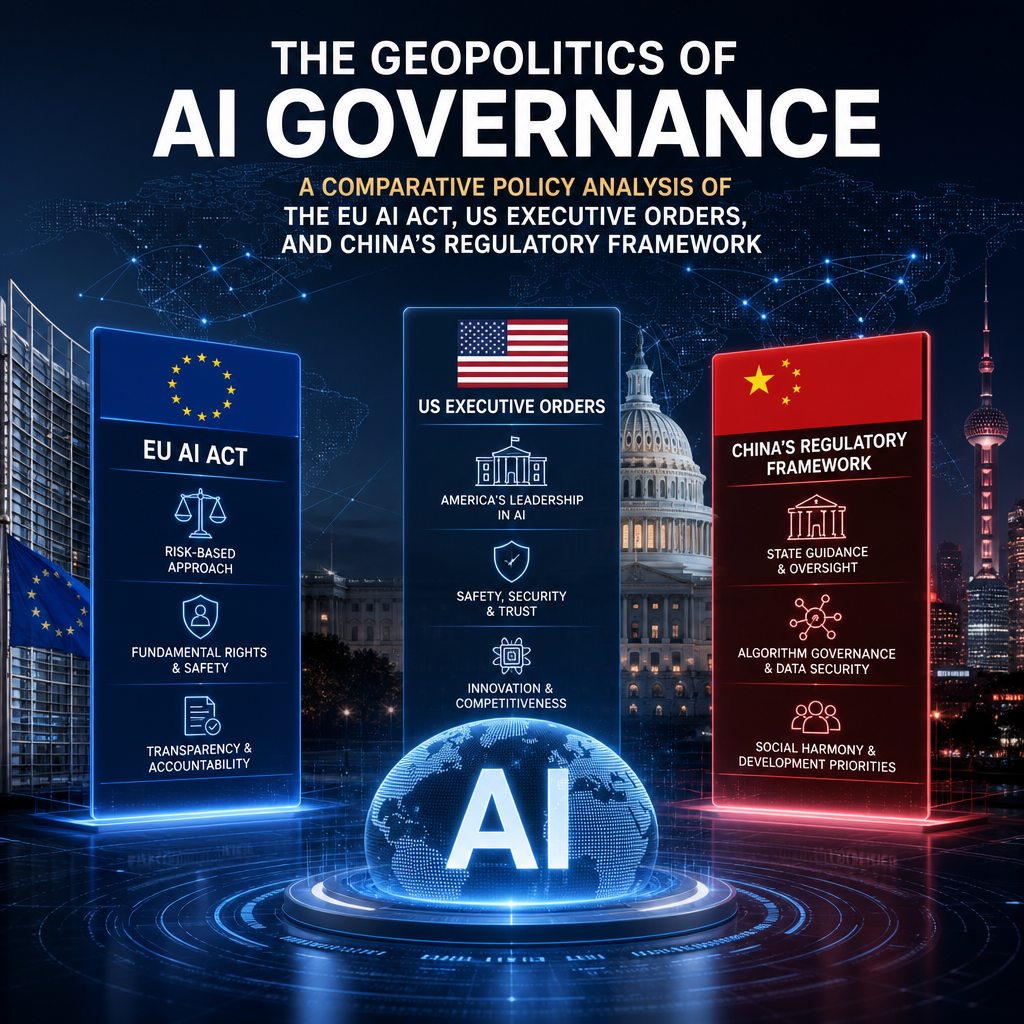
The approaches taken by these three actors are as varied as their political systems. The EU has positioned itself as the global standard-setter, prioritizing fundamental rights through a sweeping, horizontal risk framework. The US has maintained its traditionally market-driven stance, favoring decentralized, sector-specific guidelines that protect innovation. Meanwhile, China has engineered a hybrid model that marries centralized political control with aggressive, decentralized economic innovation. Understanding the nuances, strengths, and vulnerabilities of these competing frameworks is essential for navigating the future of global technology.
The European Union: The Architect of the Risk-Based Standard
The European Union has taken the most direct and comprehensive approach to AI governance with the passage of the EU AI Act. Driven by a policy emphasis on "social impact" and human rights, the Act represents a horizontal, risk-based regulatory framework that applies uniformly across all sectors [2][3]. It categorizes AI systems into four distinct risk levels--unacceptable, high, limited, and minimal--with corresponding regulatory requirements that demand proactive risk identification and mitigation from companies [2][4][5].
The EU's strategy is intentionally broad, much like the GDPR, with the explicit ambition of establishing a global benchmark. By leveraging the "Brussels Effect," the EU hopes its rules will influence practices worldwide, compelling foreign companies to adopt European standards to access the lucrative EU internal market [2][6]. To ensure compliance, the Act features strict penalties that can reach up to 35 million euros or seven percent of a company's global annual turnover, phased in gradually through August 2026 [7].
However, this thoroughness comes with significant trade-offs. Critics argue that the abstract, ambiguous language of the Act belies the difficulty of applying universal rules to disparate, real-world use cases, potentially stifling innovation [8][5]. Recognizing these pressures, the EU has already shown signs of softening; a simplification package adopted in 2025 pushed some high-risk deadlines outward, signaling a concession to competitiveness concerns [7].
 Global AI Policy Comparison on EU vs US vs Asia | Exeed College
The United States: Decentralized Agility and Market Primacy
In stark contrast to the EU's top-down legislation, the United States has opted for a flexible, sector-specific approach that relies heavily on voluntary guidelines and existing legal frameworks [6][9]. Structurally, US AI policy emphasizes the "government role"--coordinating existing federal, state, and local regulatory and enforcement entities rather than creating a single, overarching AI authority [8][3]. This fragmented system allows individual states and cities to experiment with their own rules, creating a patchwork of compliance landscapes.
The US model is fundamentally market-driven, designed to promote rapid innovation and maintain technological supremacy [8][2]. Rather than binding statutory rules, the federal government has utilized Executive Orders to encourage safe development while relying on procurement leverage and "trusted-partner" statuses to shape corporate behavior [7]. This approach avoids the heavy compliance burdens feared in the EU, but it is not without vulnerabilities. The lack of a centralized framework risks creating protection gaps across different sectors and may hinder the US in managing cross-border AI challenges [6][1].
Interestingly, the US could eventually back into EU-style visibility requirements without ever passing a comprehensive federal statute. If proposed legislation like the Algorithmic Accountability Act--which, like the EU AI Act, mandates impact assessments before and after deployment--were to pass, the regulatory postures of Washington and Brussels would align much more closely [1].
 Literature Review] Comparative Global AI Regulation: Policy Perspectives from the EU, China, and the US
China: The Hybrid Paradigm of State Control and Local Innovation
China's AI regulatory framework is perhaps the most misunderstood globally. While it exhibits the appearance of centralized, top-down control, in practice, it operates as a sophisticated hybrid that synthesizes elements of both the EU and US models [8]. Like the EU, China emphasizes safety, top-down guidance, and the mitigation of technological risks, but these are subordinated to the imperatives of national security, civil-military fusion, and the Chinese Communist Party's (CCP) interests [2][4][10].
Rather than a horizontal risk framework, China employs a vertical, technology-specific approach. It has enacted targeted regulations for specific capabilities, such as the Generative AI Measures and Deep Synthesis Provisions, which mandate detailed oversight, algorithmic transparency, and content alignment with the "correct political direction" dictated by Xi Jinping [2][4][9]. This ensures strict censorship and social stability, distinguishing China's model from the rights-based democracies of the West [2].
Yet, beneath this authoritarian veneer lies a fiercely decentralized engine of economic development. Like the US, China prioritizes "research and application," relying on bottom-up innovation, regional competition, and local markets to drive AI advancement [8][3]. The state fosters this through massive investments in thousands of 'Little Dragons' (tech startups) and maintains relatively lax enforcement for economic growth initiatives, sending what analysts describe as a "strong pro-growth signal" to the industry [8][9].

The Geopolitical Endgame: Convergence, Fragmentation, and Digital Sovereignty
As these three distinct frameworks mature, the global landscape is experiencing a paradoxical mix of quiet convergence and stark fragmentation. On one hand, all three regimes are settling on a similar operational truce between control and speed: a voluntary framework with a credible enforcement floor underneath it. Crucially, all three increasingly rely on existing laws for final enforcement--China utilizes existing criminal statutes, the US leans on the existing criminal code, and the EU layers its AI Act atop the GDPR and product-safety frameworks [7].
On the other hand, the geopolitical trajectory points toward digital fragmentation. The current political climate virtually guarantees continued decoupling between the EU/US and China regarding data governance and digital ecosystems [1]. Western policymakers frequently point to China's rapid regulatory capacity as a geopolitical threat; US Senate Majority Leader Chuck Schumer, for instance, has cited China's efforts as a "wake-up call," warning that the US cannot allow Beijing to write the global rules for AI [5].
This dynamic leaves the US striving for an equilibrium--fast enough to out-innovate China, but structured enough to align with European democratic values. As AI capabilities continue to advance, securing international AI alignment remains one of the most significant challenges of the 21st century [1].
Conclusion
The geopolitics of AI governance reveals a world diverging into distinct digital spheres of influence. The EU has bet on regulatory power, attempting to export its values through the AI Act. The US is betting on market agility, hoping decentralized innovation will outpace the need for heavy regulation. China is attempting to have it both waysharnessing local market chaos for economic growth while maintaining absolute political control over algorithmic outputs. While there are subtle mechanical convergences in how these states enforce their rules, their foundational philosophies remain incompatible. How nations navigate this fragmented regulatory landscape will determine not just the future of technology, but the balance of global power for decades to come.
References
- 1.
- 2.
- 3.
- 4.
- 5.
- 6.
- 7.
- 8.
- 9.
- 10.