Introduction
Sovereign debt defaults have historically been viewed through a purely macroeconomic lens--calculated in spreads, haircuts, and bailouts. However, the 2022 collapse of the Sri Lankan economy signals a profound shift, transforming sovereign debt crises into geopolitical flashpoints that pit major world powers against one another. When a nation fails to meet its debt obligations, the consequences extend far beyond national borders, triggering a loss of access to international credit markets, deep economic recessions, and severe domestic turmoil that ripples through the global financial system [1][2].
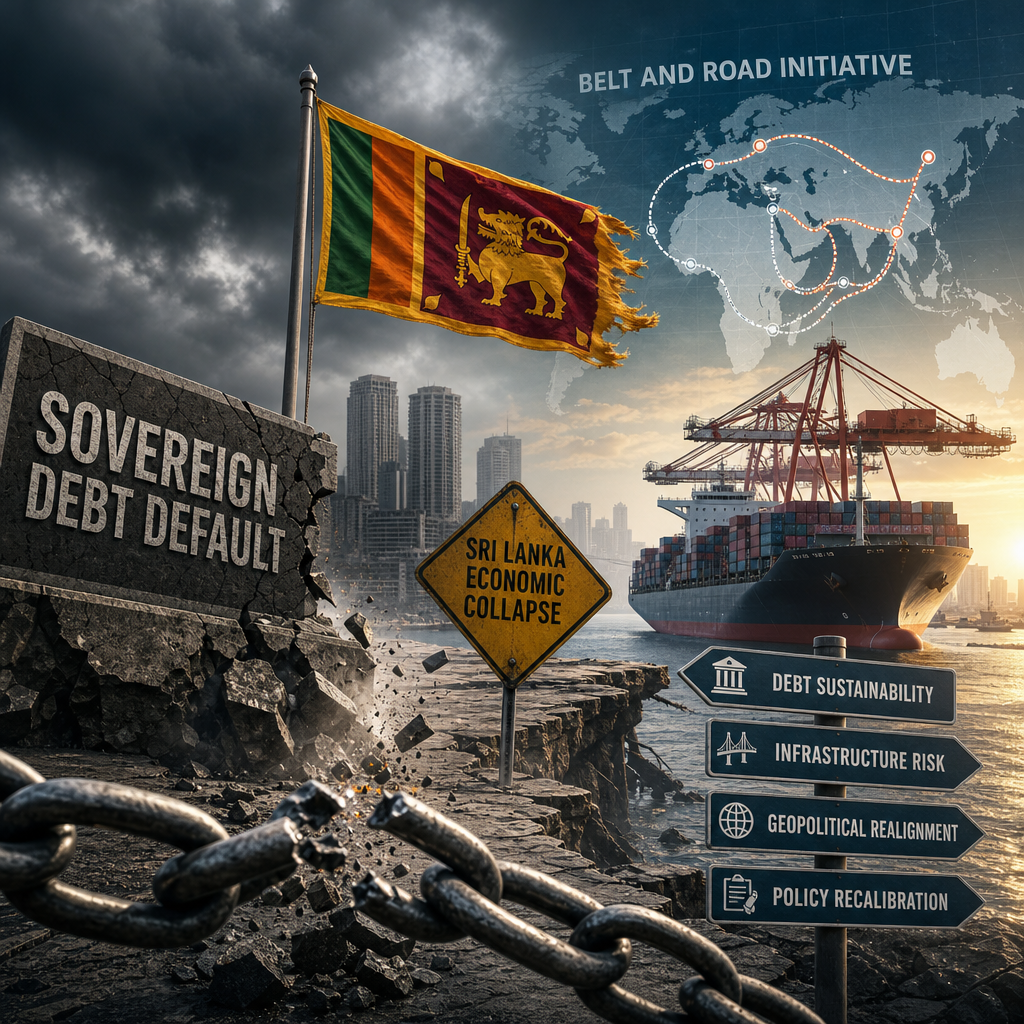
Sri Lanka's default on its entire $51 billion external debt in July 2022 stands as a watershed moment [3]. Unlike previous crises driven primarily by multilateral lending, Sri Lanka's downfall was fueled by a complex web of bilateral state creditors, international bondholders, and state-owned enterprise loans. At the center of this web is China, which has emerged as a dominant, non-Paris Club bilateral creditor through its ambitious Belt and Road Initiative (BRI) [4][5].
The Sri Lankan crisis is no longer just an economic tragedy for its citizens; it is a global case study in how debt vulnerabilities intersect with regional security and great power competition. As the international community watches Colombo navigate a historically complex restructuring, the rules of global infrastructure policy are being rewritten in real time.
The Anatomy of a Default: From Multilateral Safety to Bilateral Traps
To understand the geopolitical shockwaves of Sri Lanka's default, one must trace the evolution of its external debt. In the 1990s, Sri Lanka's debt was well within its control, largely sourced from multilateral lenders such as the World Bank and the Asian Development Bank (ADB) under strict, standardized conditionalities [4]. This traditional framework provided a safety net that kept borrowing transparent and manageable.
Over the last two decades, however, Sri Lanka aggressively pivoted toward commercial borrowing and bilateral state loans to finance an ambitious slate of mega-infrastructure projects. When a sovereign state defaults--failing to make interest payments or repay principal amounts--the immediate impact is a severe lockout from international credit markets [1]. Investors demand exorbitant risk premiums, effectively starving the defaulting nation of the capital required for economic recovery [2]. In Sri Lanka, this manifested as extreme inflation, crippling shortages of vital supplies, and a rapid contraction of the gross domestic product [5].
Economic models show that the costs of such defaults are devastating and long-lasting. According to the National Bureau of Economic Research (NBER), within three years of a default, an affected economy's real per capita GDP falls behind non-defaulting countries by 8.5 percent; after a decade, that gap widens to a staggering 20 percent [6]. Had Sri Lanka approached the International Monetary Fund (IMF) as early as 2020 when its debt was deemed unsustainable, it might have avoided this catastrophic trajectory [4]. Instead, delayed action and opaque borrowing culminated in a political and economic meltdown that invited the world's heavyweights to vie for control of its resolution.
The BRI Under the Microscope: White Elephants and Sovereignty Concerns
At the heart of Sri Lanka's debt crisis is the Belt and Road Initiative, China's transformative, $4 trillion global infrastructure development strategy launched in 2013 [7]. As its largest bilateral creditor, China accounts for approximately 19.6 percent of Sri Lanka's public external debt, funneled through both concessional and commercial lending [5]. A significant portion of this capital was directed toward state-owned enterprises and high-profile infrastructure projects, including highways, an airport, and the deeply controversial Hambantota port [5][7].
The Hambantota port project became the global poster child for the risks associated with BRI lending. When Sri Lanka struggled to service its debts, it was forced to lease the port to a Chinese state-owned enterprise for 99 years, an arrangement that ignited fierce global debate about "debt-trap diplomacy" and the loss of sovereign autonomy [7]. Critics argued that these projects were "white elephants"--expensive, non-performing assets that advanced China's geopolitical interests while burdening the host nation with unsustainable debt [5][8].
 How Sovereign Debt Crises Are Becoming Geopolitical: Lessons from Sri Lanka - The SAIS Review of International Affairs
The blowback has been significant enough to force a rhetorical shift at the highest levels of the Chinese government. At the third BRI Symposium, Chinese President Xi Jinping explicitly warned that BRI projects must "increase the sense of gain from the recipient country's public," a direct acknowledgment of the growing international backlash against projects that fail to deliver local economic benefits [5]. Yet, despite this image problem, the fundamental paradox remains: developing nations desperately need infrastructure, and China remains the only global power with the "deep pockets" to finance it [8].
The Great Power Creditor Clash: Restructuring in a Multipolar World
Sri Lanka's path to debt resolution has laid bare the structural fractures in global financial governance. A recent IMF working paper noted that Sri Lanka's debt restructuring "distinguishes itself from others by its complexity due to a particularly diverse creditor landscape and novel instruments issued" [4]. Historically, sovereign debt crises were resolved within the framework of the Paris Club, an informal group of major Western creditor nations. Today, China has entered the fray as a dominant bilateral creditor in defaults spanning Zambia, Ghana, and Sri Lanka, fundamentally complicating the restructuring process [4].
Because China operates outside the Paris Club, coordination among creditors has become a geopolitical minefield. Despite having the backing of India and Western nations, it took Sri Lanka nearly a year to reach an agreement with the IMF [4]. Beijing's initial hesitancy to restructure its loans was attributed to its own domestic economic struggles and a reluctance to get mired in Sri Lanka's messy political situation--a hesitancy that did not go unnoticed by other BRI borrower nations [8].
In response to China's regional intransigence, India and the United States have aggressively increased their involvement. India, viewing the Indian Ocean region as its strategic backyard, leveraged its financial weight to counter Beijing, becoming the first country to formally notify the IMF of its assurance and support for Sri Lanka's external debt restructuring plan [4][5]. This geopolitical maneuvering was highly visible; for instance, a solar power project on the strategically located Delft Island was initially developed by a Chinese company but was ultimately awarded to an Indian firm, reflecting rising political tensions and the strategic bidding war sparked by the debt crisis [5].
Global Infrastructure Policy at a Crossroads
The geopolitical fallout from Sri Lanka's default is sending shockwaves through global infrastructure policy, forcing a fundamental reassessment of how developing nations secure financing. Asian and African countries are watching closely. As analysts have pointed out, if a country with relatively strong socio-economic indicators like Sri Lanka could collapse so completely, what is the fate of less developed BRI nations like Myanmar or Ethiopia? [8].
Moving forward, borrower nations are likely to become far more cautious, demanding greater transparency and rigorous cost-benefit analyses for mega-projects. However, this caution is tempered by reality. The global South's infrastructure deficit remains massive, and alternative financing mechanisms--such as the G7's Partnership for Global Infrastructure and Investment--have yet to match the speed and capital deployment of the BRI [8]. Consequently, a total decoupling from Chinese lending is unlikely; instead, we are witnessing the emergence of a more contested, defensive lending environment.
For global financial governance, the Sri Lankan crisis builds an airtight case for modernizing the sovereign debt architecture. The current system, which struggles to reconcile Paris Club standards with China's bilateral lending models and the rising power of international private bondholders, is simply not equipped to handle 21st-century defaults [4][1]. Without a unified framework, future debt crises will inevitably devolve into proxy battles for geopolitical influence, prolonging economic suffering for the defaulting nations.
 Explainer: Sri Lanka on the edge as debt burden mounts | Reuters
Conclusion
Sri Lanka's economic collapse is a historical inflection point that transcends the boundaries of macroeconomics. It has exposed the inherent dangers of relying heavily on opaque, bilateral state financing for mega-infrastructure projects, severely tarnishing the luster of China's Belt and Road Initiative in the process. Yet, it has also catalyzed a new era of great power competition, where debt restructuring is leveraged as a tool for regional security and diplomatic influence by India, the United States, and China alike.
Ultimately, the Sri Lankan crisis serves as a stark warning: in an era of multipolar lending, sovereign debt defaults are no longer mere financial glitches--they are geopolitical earthquakes. The global community must urgently reform its debt governance frameworks to prioritize the economic stability of borrowing nations over the strategic ambitions of their creditors. If it fails to do so, Sri Lanka will not be the last democracy to see its sovereignty eroded not by military force, but by the terms of a loan.
References
- 1.
- 2.
- 3.
- 4.
- 5.
- 6.
- 7.
- 8.