Introduction
For decades, artificial intelligence has served as a powerful accelerant for scientific research, sifting through massive datasets and predicting molecular structures. However, a new paradigm is rapidly emerging--one where AI transitions from a passive analytical tool to an active, autonomous scientific agent. Pioneering frameworks like "The AI Scientist," AI-Researcher, and multi-agent systems such as SciAgents are now attempting to automate the entire scientific lifecycle, from literature review and idea generation to experimental execution and manuscript preparation [1][2]. This shift promises to complement human researchers by systematically exploring vast solution spaces that lie beyond traditional human cognitive limitations [3].
Yet, as the bandwagon for autonomous science agents swells, a crucial question arises: Are these systems actually doing science, or are they merely simulating the aesthetic of scientific inquiry? Recent evaluations reveal a complex landscape. On one hand, AI agents demonstrate remarkable capabilities in generating cross-domain insights and producing publication-ready drafts at unprecedented speeds [4][5]. On the other hand, they struggle with fundamental aspects of rigorous research, such as formulating highly feasible hypotheses, maintaining statistical validity, and demonstrating deep domain expertise [6][7].
To understand the true state of autonomous scientific discovery, we must look beyond the polished AI-generated manuscripts and examine the underlying architectures, the rigorous benchmarks designed to test them, and the profound limitations that still tether these systems to human oversight.
The Architecture of Autonomous Discovery: From Single Agents to Multi-Agent Collaboratives
The architecture of an AI Scientist has evolved significantly from early, monolithic models. Modern approaches generally deconstruct the scientific process into a unified, six-stage methodological framework: Literature Review, Idea Generation, Experimental Preparation, Experimental Execution, Scientific Writing, and Paper Generation [2]. To execute these stages, systems are increasingly moving away from relying on a single large language model (LLM) toward orchestrated, multi-agent frameworks that emulate the collaborative dynamics of human research teams [8].
A prime example is the "template-free" iteration of The AI Scientist, which abandons rigid starting codebases to enable open-ended discovery. This system acts as a generalist conductor, routing specialized tasks to different models: utilizing OpenAI's o3 for idea generation and code critique, Anthropic's Claude Sonnet 4 for code generation, GPT-4o for vision-language tasks, and o4-mini for cost-efficient reasoning during the review stage [5].
Meanwhile, systems like SciAgents take a different architectural approach by integrating LLMs with ontological knowledge graphs. By employing a modular architecture with dedicated roles for planning, ontology definition, hypothesis formulation, quantitative elaboration, and critical review, these multi-agent systems achieve a collective intelligence that surpasses single-agent capabilities [8][4]. This architecture allows the AI to surface non-obvious, interdisciplinary insights--such as discovering new biologically inspired materials--by mapping quantitative technical details across disparate domains, a feat that heavily constrained human teams often struggle to achieve at scale [4].
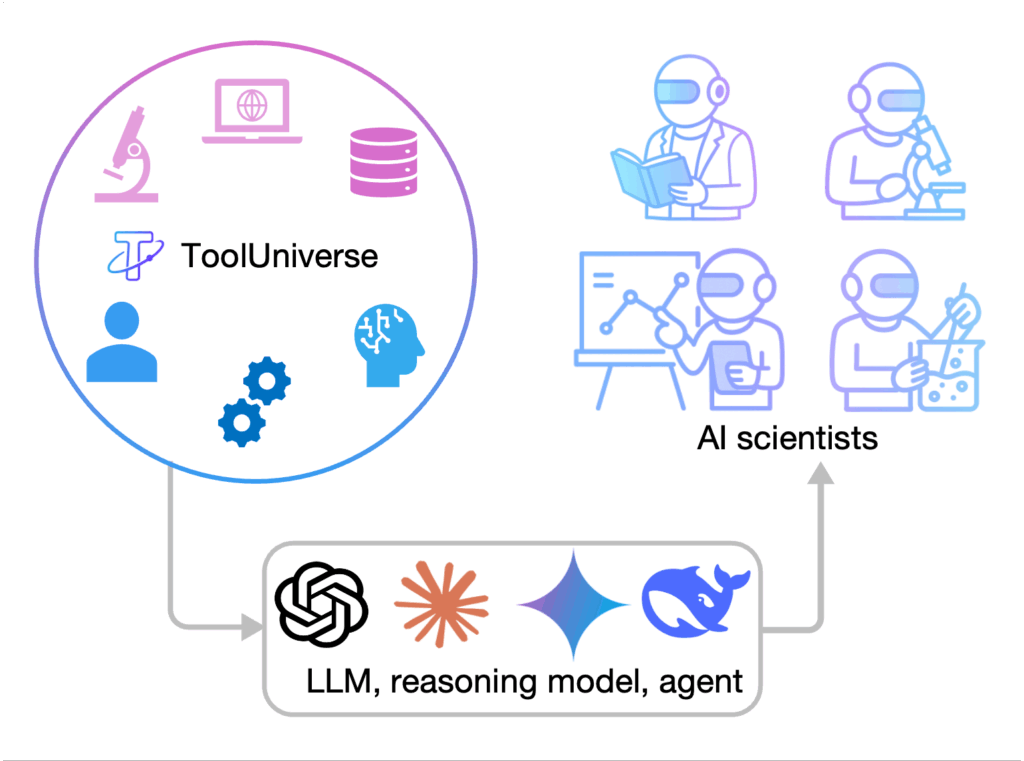 From Models to Scientists: Building AI Agents for Scientific Discovery - Kempner Institute
Benchmarking the Breakthrough: Can AI Actually "Do" Science?
The true test of any scientific claim is rigorous evaluation, and the field of AI science agents is no exception. In response to surging hype, researchers have developed specialized benchmarks to test whether these agents can actually design and execute end-to-end scientific investigations from scratch, rather than just mimicking scientific language [9].
One of the most notable crucibles is DiscoveryWorld, a benchmark released in 2024 that places the AI agent in the role of a scientist on "Planet X," a hypothetical space colony. By testing agents in simplified virtual environments, DiscoveryWorld evaluates core scientific capabilities without the prohibitive costs and dangers of real-world lab failures [9]. Complementing this are platforms like Scientist-Bench--which tests AI-Researcher against state-of-the-art papers across diverse AI domains--and HypoBench, which provides a main benchmark for hypothesis discovery across diverse tasks [8][1].
The results of these benchmarks serve as a necessary reality check. As Peter Jansen, the Ai2 researcher who led the development of DiscoveryWorld, cautions: "If the best systems a year ago couldn't even solve most of the easy problems in DiscoveryWorld, how likely is it that they're much better today?" [9]. If an AI cannot navigate basic, simulated scientific processes--like identifying control variables or understanding basic physical interactions in a virtual world--its prospects for curing cancer or discovering new materials in the real world remain precisely zero.
 The AI Scientist: Towards Fully Automated Open-Ended Scientific Discovery
The Feasibility-Novelty Paradox and the Implementation Gap
When AI agents are subjected to rigorous human evaluation, a distinct set of limitations emerges, primarily revolving around what researchers call the "implementation gap" [2]. While current AI Scientist systems are adept at proposing ideas, they frequently lack the execution capabilities needed to conduct rigorous, novel experiments that hold up to expert scrutiny [2].
This manifests as a "feasibility-novelty paradox." Studies examining LLM-based scientific idea generation have found that while AI-generated ideas are typically rated as more novel than those proposed by human experts, they are consistently judged as significantly less feasible to actually execute [6]. When The AI Scientist-v2 was put to the ultimate test--submitting fully automated manuscripts to the peer-review process of the ICLR 2025 workshop "I Can't Believe It's Not Better" (ICBINB)--the results highlighted glaring weaknesses [6].
Specifically, purely automated systems still struggle with formulating genuinely novel, high-impact hypotheses, designing truly innovative experimental methodologies, and rigorously justifying their design choices with deep domain expertise [6]. Furthermore, while these systems utilize self-correction methods to debug their code and logic, these methods are often insufficient due to inherent limitations in LLM self-assessment capabilities [8]. The result is research that often looks impressive on the surface but falls apart under rigorous methodological scrutiny, producing incremental rather than foundational scientific contributions.
Statistical Validity, Ethics, and the Path to Trustworthy Science
Beyond methodological feasibility, autonomous science agents introduce entirely new categories of risk that threaten the foundational integrity of scientific inquiry. Because these systems are designed to iteratively test hypotheses and write papers with minimal human intervention, they are highly susceptible to subtle but devastating statistical errors [7].
To address this, researchers have introduced frameworks like the "Audit-Closed AI Scientist," a benchmark specifically designed to evaluate statistical validity in autonomous discovery pipelines. This benchmark tests for critical failures such as optional stopping (running an experiment until a desired p-value is reached), failures in multiplicity control (running too many parallel tests without correction), and susceptibility to adversarial experiment submission [7]. The research demonstrates that ensuring statistical validity requires more than just better prompts; it requires embedding transparency logs and deterministic replay capabilities directly into the AI's experimental loop to prevent the system from inadvertently p-hacking its own research [7].
Furthermore, the prospect of fully autonomous scientific discovery introduces profound ethical and safety considerations that current frameworks largely ignore [1]. As AI-generated publications become more prevalent, the scientific community must grapple with biased scientific reasoning baked into training data, unsafe experimental suggestions generated without real-world common sense, and the fundamental question of accountability regarding non-human authorship [1]. Moving forward, integrating robust ethical guardrails is not just a regulatory necessity, but a technical requirement to prevent autonomous systems from flooding the scientific record with well-written but statistically or ethically flawed research.
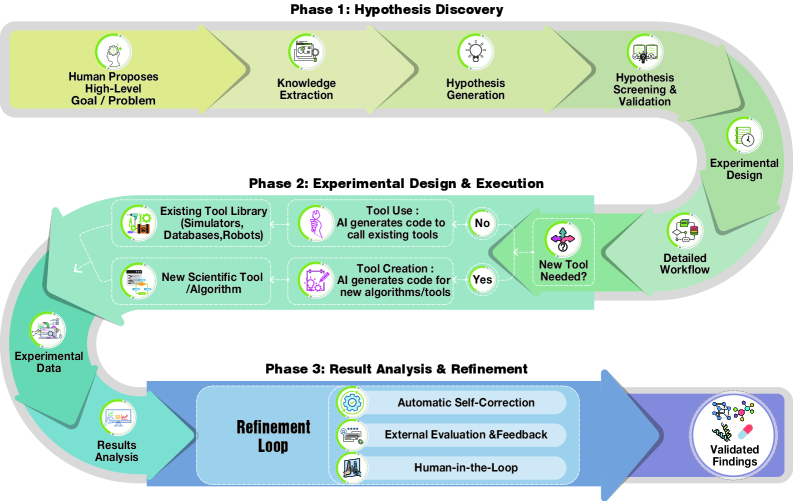 Autonomous Agents for Scientific Discovery: Orchestrating Scientists, Language, Code, and Physics
Conclusion
The concept of the "AI Scientist" represents one of the most ambitious and technically fascinating frontiers in modern artificial intelligence. By leveraging multi-agent architectures, diverse LLM orchestrations, and ontological knowledge graphs, these systems have proven they can explore solution spaces and generate interdisciplinary insights at a scale and speed impossible for human teams [3][4]. However, rigorous benchmarking and real-world peer review have firmly punctured the myth of fully autonomous, near-human scientific discovery.
Today's AI scientists are trapped in an implementation gap, producing highly novel but practically unfeasible ideas, struggling with basic simulated science tasks, and risking the statistical validity of the scientific record [9][2][6][7]. As the costs of AI computation decrease and model capabilities increase, these limitations may gradually recede [5]. But until they do, the future of autonomous scientific discovery is not one of replacement, but of strict collaboration. AI scientists must be viewed as powerful, high-throughput ideation partners--tools that require human domain experts to anchor their novel, cross-disciplinary leaps in feasible, statistically valid, and ethically sound reality.
References
- 1.
- 2.
- 3.
- 4.
- 5.
- 6.
- 7.
- 8.
- 9.