Introduction
The rapid deployment of artificial intelligence across healthcare, finance, human resources, and criminal justice has forced American policymakers into a reactive sprint. In the absence of a comprehensive federal statutory framework governing AI, individual states have stepped into the void. Driven by constituent concerns over algorithmic bias, data privacy, and job displacement, state legislatures are rapidly drafting and passing laws that create a fractured regulatory landscape.
This phenomenon is not entirely new; American history is replete with instances of states acting as "laboratories of democracy" when federal action lags. However, the inherently borderless nature of software and AI systems poses a unique challenge to this traditional model. An AI model trained and deployed in the cloud does not respect state lines, meaning a product built in Texas can instantly run afoul of a law passed in Colorado.
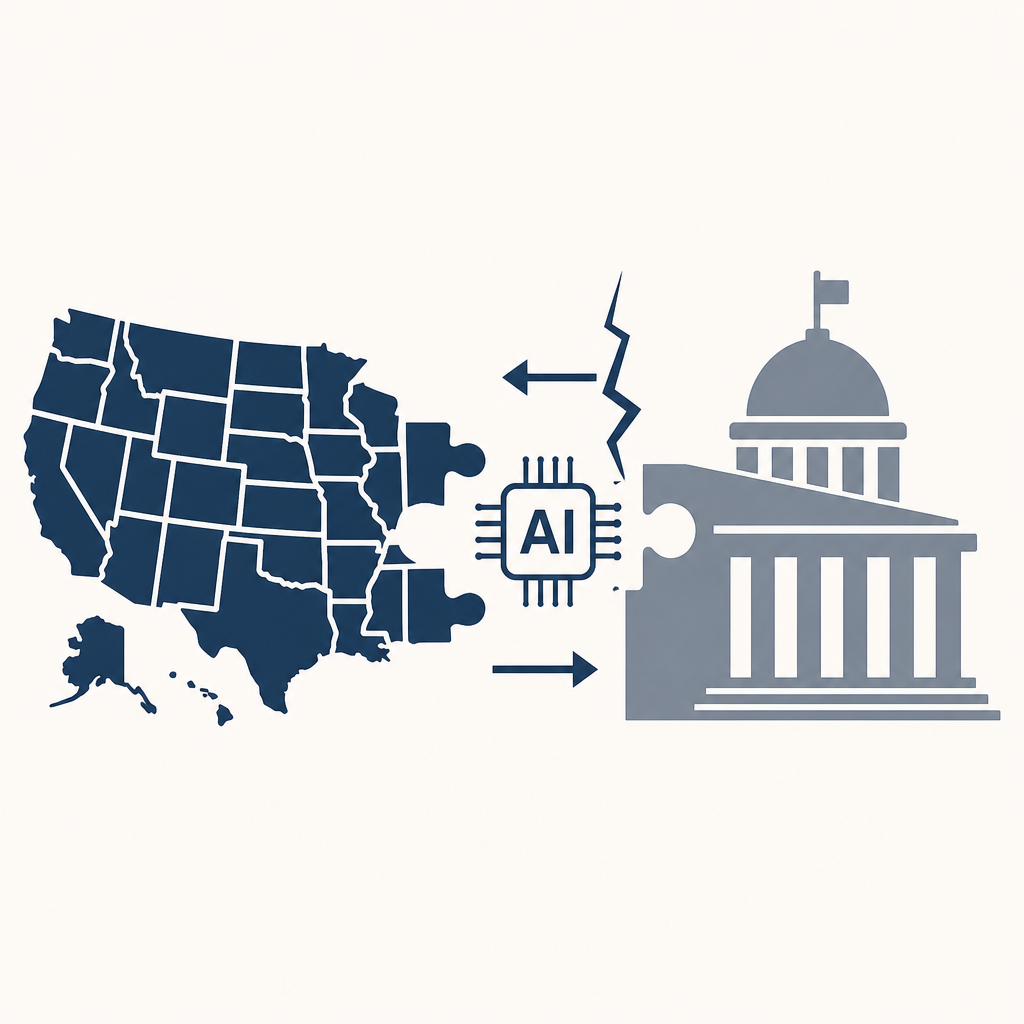
The resulting friction between aggressive state-level legislation and emerging federal preemption efforts represents one of the most significant regulatory challenges of the digital age. As technology companies and civil rights groups brace for a prolonged legal and legislative battle, the fundamental question remains: Can the United States foster AI innovation while simultaneously protecting its citizens through a chaotic, state-by-state approach?
The Rise of State-Level AI Legislation
Frustrated by congressional gridlock, states have taken it upon themselves to regulate artificial intelligence, resulting in a legislative surge that shows no signs of abating. In 2023 and 2024, nearly every U.S. state introduced some form of AI-related bill, with a particular focus on "high-risk" AI systems--algorithms that make consequential decisions regarding employment, housing, credit, and insurance [1].
Colorado made national headlines by passing the Colorado AI Act, the first comprehensive state legislation in the U.S. to broadly regulate AI deployments. The law requires developers and deployers of high-risk AI systems to use reasonable care to protect consumers from algorithmic discrimination, mandating impact assessments, risk management programs, and transparency disclosures [2]. Similarly, states like Illinois have built upon their existing biometric privacy laws to encompass AI-driven facial recognition, while local jurisdictions like New York City have implemented strict requirements for automated employment decision tools (AEDTs) [3].
Proponents of this state-level action argue that local legislatures are better positioned to respond to the specific needs and anxieties of their constituents. By acting independently, states can impose tailored safeguards that a sluggish federal bureaucracy might take years to conceptualize, let alone implement.
The Federal Response and the Push for Preemption
While states have been busy legislating, the federal government's approach to AI has been largely administrative rather than statutory. The Biden Administration's Executive Order 14110 on "Safe, Secure, and Trustworthy Artificial Intelligence" represented a significant federal salvo, utilizing the Defense Production Act to mandate safety testing and reporting for the most powerful foundation models [4]. However, executive orders lack the enduring force of law and are subject to the whims of successive administrations.
In Congress, numerous bipartisan bills have been introduced--from the Algorithmic Accountability Act to the National AI Commission Act--but none have crossed the finish line to establish a overarching federal AI law. Into this vacuum, the concept of federal preemption has become the most contentious battleground. Preemption, a doctrine rooted in the Supremacy Clause of the U.S. Constitution, allows federal law to override conflicting state laws.
Major technology industry groups, including the Software Alliance and the Information Technology and Innovation Council, have mounted aggressive lobbying campaigns for strong federal preemption. They argue that a fragmented regulatory environment forces developers to build 50 different versions of the same software to comply with 50 different regulatory regimes [5]. Without federal preemption, industry leaders warn, the U.S. risks ceding its competitive edge in the global AI race to international rivals who benefit from unified regulatory structures.
Core Areas of Regulatory Friction
The clash between state autonomy and federal uniformity is not merely theoretical; it is playing out across several highly contentious domains of AI application.
Consumer Protection and Algorithmic Bias
The most prominent area of friction lies in how to handle algorithmic discrimination. State laws like Colorado's focus heavily on requiring developers to mitigate foreseeable risks of algorithmic bias before deployment. However, tech companies argue that "bias" is an incredibly difficult concept to define legally, and forcing developers to guarantee a lack of bias opens the floodgates to frivolous litigation. Federal lawmakers are hesitant to codify strict liability for algorithmic bias, preferring voluntary frameworks and industry standards, which directly conflicts with the hardline mandates emerging from state capitals [6].
Employment and Automated Decision-Making
AI in the workplace has proven to be a lightning rod for state regulation. Beyond New York City's localized AEDT law, states are considering bills that would require human oversight for AI-driven hiring, firing, and scheduling decisions. The friction here is palpable: federal labor laws, such as the Civil Rights Act of 1964, already prohibit employment discrimination, regardless of whether a human or a machine makes the decision. Federalists argue that existing federal agencies, like the Equal Employment Opportunity Commission (EEOC), are equipped to handle AI discrimination claims, rendering state-level AI employment laws redundant and legally conflicting [3].
The Economic and Innovation Impact
The regulatory patchwork has profound economic implications that extend far beyond the legal departments of Silicon Valley. The primary casualty of this friction is the American startup ecosystem. While tech giants possess the financial capital and legal bandwidth to employ teams of compliance officers to navigate 50 distinct state AI laws, early-stage startups do not. The cost of multi-state compliance acts as an asymmetric moat, entrenching incumbent monopolies and stifling disruptive innovation from smaller players [5].
Furthermore, the venture capital community is beginning to factor regulatory risk into funding decisions. Investors are increasingly hesitant to back AI startups whose business models rely on high-risk deployments in heavily regulated states. This capital flight could geographically concentrate AI development, leaving businesses and consumers in stricter states with less access to cutting-edge AI tools, thereby exacerbating the digital divide.
The Path Forward: Finding Equilibrium
Resolving the friction between state and federal AI regulation will require nuanced compromise rather than absolute victory for either side. A binary choice between a chaotic state-by-state system and a blunt federal preemption that strips states of all regulatory power is a false dichotomy.
The most viable path forward likely involves a "federal floor" approach. Under this model, Congress would establish baseline, nationwide requirements for AI safety, transparency, and anti-discrimination--providing the uniformity that the tech industry desperately craves. Crucially, this federal floor would serve as a preemption mechanism, invalidating state laws that are identical or less protective. However, it would explicitly preserve the right of states to enact stricter regulations tailored to their local demographics or specific industries [6].
This hybrid approach mirrors the historical regulation of emerging technologies, such as automotive safety and environmental protection, where federal standards coexist with state-level innovation. Achieving this equilibrium will require Congress to overcome its current partisan gridlock and engage deeply with state attorneys general, civil rights organizations, and technologists to draft legislation that is both agile and durable.
Conclusion
The United States stands at a critical inflection point in its approach to artificial intelligence. The current regulatory patchwork--born of necessary state urgency but hindered by jurisdictional limitations--threatens to undermine both the ethical deployment of AI and the nation's technological supremacy. While state legislatures have rightfully highlighted the immediate dangers of unchecked algorithms, the long-term solution cannot be a disjointed mosaic of conflicting laws. Federal preemption efforts must evolve from a corporate shield against accountability into a thoughtful, unified framework that protects consumers. Only by harmonizing state innovation with federal cohesion can the U.S. ensure that its AI future is safe, fair, and globally competitive.