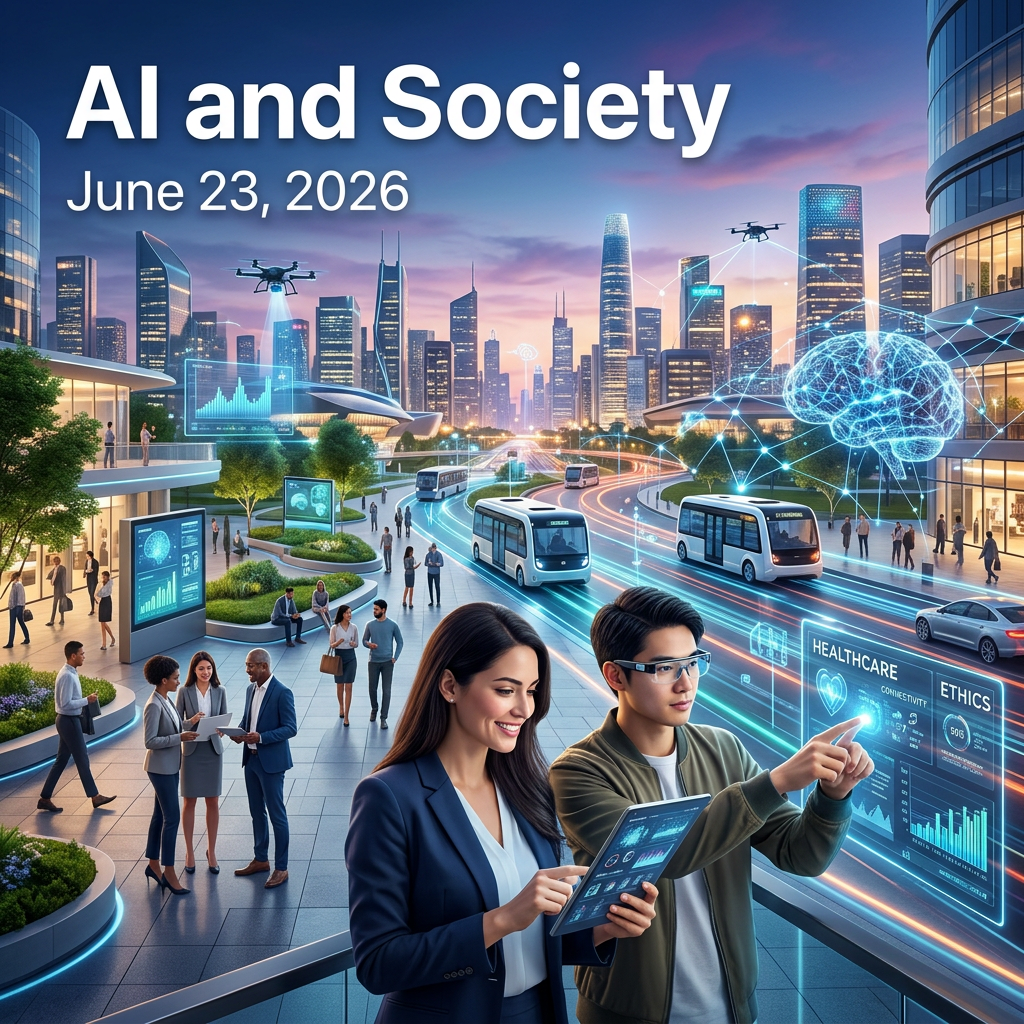
The AI Pulse: 7 Key Developments Reshaping Our Daily Lives -- June 23, 2026
Published: June 23, 2026 | Source: Reducates AI Research
A comprehensive daily digest covering the latest developments in artificial intelligence and their real-world impact on our daily lives. This article examines 7 key topics drawn from today's most credible AI news sources, providing actionable insights for researchers, professionals, and anyone interested in how AI is transforming our world.
Table of Contents
- Agentic AI: The Rise of Autonomous Workers
- The Great American AI Act: Federal Regulation Takes Shape
- Robotaxis Go Mainstream: Self-Driving Cars Hit More Cities
- AI in Healthcare: From Diagnostics to Drug Discovery
- Education Transformed: AI-Powered Personalized Learning
- NVIDIA's Edge Play: RTX Spark Brings AI to Laptops
- Anthropic's IPO and the AI Industry's Trillion-Dollar Race
Introduction
Artificial intelligence continues to evolve at an unprecedented pace, affecting nearly every aspect of modern life. As of June 23, 2026, the AI landscape is marked by significant breakthroughs in research, new product launches, evolving regulatory frameworks, and growing public discourse about the societal implications of these technologies.
According to the Stanford HAI 2026 AI Index Report, generative AI has reached 53% population adoption within just three years -- faster than the PC or the internet achieved at similar milestones. Enterprises are shifting from experimental pilots to strategic deployments, with 68% of organizations expected to have AI deeply integrated into their core operations this year.
This daily digest brings together the most informative and impactful AI news, curated from trusted sources across technology, science, business, and policy domains.
1. Agentic AI: The Rise of Autonomous Workers
2026 is being called "The Year of Agentic AI." Unlike traditional chatbots that simply respond to prompts, agentic AI systems can independently plan, execute multi-step tasks, and make decisions on their own. The market for these systems is projected to grow from $5.2 billion in 2024 to an estimated $200 billion by 2034 -- a staggering 38× expansion.
Real-world results are already impressive. Industrial manufacturer Danfoss reduced customer response times from 42 hours to near-instant by automating 80% of transactional decisions using AI agents. In the coding world, Anthropic's Claude Code has surged ahead as the leading AI development assistant, while Microsoft introduced its first in-house coding model, MAI-Code-1-Flash, at Build 2026 -- signaling that even the biggest tech platforms are racing to own the agentic AI stack.
The implications for business productivity are immense. AI agents are now handling everything from supply chain optimization to customer service, data analysis, and even software development. For enterprise leaders, the message is clear: organizations that fail to adopt agentic AI risk falling significantly behind.
Source: Kersai -- AI Breakthroughs in 2026 | BuildFastWithAI -- AI News Today June 6, 2026
2. The Great American AI Act: Federal Regulation Takes Shape
On June 4, 2026, a landmark bipartisan bill was introduced in the U.S. Congress. The Great American AI Act, a 269-page draft sponsored by Reps. Obernolte (R-CA) and Trahan (D-MA), represents the most ambitious attempt yet to create a cohesive federal AI regulatory framework.
Key provisions include a three-year preemption of state AI development laws -- effectively freezing state-level legislation like Colorado's AI Act (which takes effect June 30, 2026) and various California bills. Companies with revenue exceeding $500 million would be required to publish Frontier AI Frameworks, report critical safety incidents, allow auditor verification of cybersecurity plans, and contribute to a $100 million annual fund for the Center for AI Standards and Innovation. The bill also introduces criminal penalties for AI-assisted government impersonation.
The reaction has been predictably divided. Labor unions including AFL-CIO and AFT have rejected the bill, arguing it preempts state anti-discrimination protections without providing equivalent federal safeguards. Tech industry groups like ITI and NetChoice have praised the move toward regulatory clarity. Legal experts predict a decade of litigation regardless of the outcome.
With Colorado's AI Act just days from taking effect and this federal bill in play, June 2026 marks a pivotal moment for AI governance in the United States.
Source: BuildFastWithAI -- AI News Today June 6, 2026 | Cimplifi -- 2026 AI Regulation Guide
3. Robotaxis Go Mainstream: Self-Driving Cars Hit More Cities
If you haven't yet ridden in a self-driving car, that may soon change. Robotaxis -- fully autonomous vehicles with no driver and sometimes no steering wheel -- are rapidly expanding to more cities around the world.
Waymo (Alphabet) leads the charge, already operating in the Bay Area, Los Angeles, Atlanta, Austin, and Phoenix, with 2026 expansion plans for Dallas, Las Vegas, Denver, Miami, Nashville, London, and Tokyo. Tesla launched its ride-hailing service in Austin and San Francisco in 2025 and is developing a dedicated "Cybercab" vehicle. Amazon's Zoox operates in Las Vegas and San Francisco and is expanding to Austin and Miami. Uber is launching multiple partnership initiatives this year.
The safety conversation, however, remains nuanced. These vehicles have been involved in incidents -- hitting people and animals, catching fire, and shutting down mid-trip. Yet proponents argue that autonomous vehicles, once widely deployed, could dramatically reduce the 40,000+ annual traffic fatalities in the U.S. alone, the vast majority caused by human error.
The technology is here, the regulatory barriers are lowering, and the expansion plans are ambitious. The robotaxi era is no longer science fiction -- it is a rapidly approaching reality.
Source: Built In -- 5 Ways AI Will Change Your Life in 2026
4. AI in Healthcare: From Diagnostics to Drug Discovery
Healthcare AI in 2026 is moving beyond pilot programs into real clinical impact. The U.S. Department of Health and Human Services issued a sweeping Request for Information on accelerating AI adoption in clinical care -- the broadest federal action on healthcare AI to date. Meanwhile, the Advanced Research Projects Agency for Health (ARPA-H) is soliciting proposals for two agentic AI clinical assistants, aiming to set a novel regulatory precedent with the FDA.
Scientific breakthroughs are equally impressive. The University of Michigan has developed AI that can diagnose coronary microvascular dysfunction from a standard 10-second EKG -- turning a routine test into a potentially life-saving diagnostic tool. Örebro University's AI detects dementia with 97% accuracy by analyzing EEG data. Philips has introduced AI-powered cardiac MR imaging that is 3× faster and 80% sharper, completing a full scan in under 30 seconds.
In drug discovery, Insilico Medicine's ISM001-055 became the first AI-designed drug targeting an AI-discovered disease target to show positive results in Phase IIa clinical trials. AlphaFold's protein structure prediction capabilities, which earned a Nobel Prize in Chemistry, continue to accelerate research into new treatments.
Perhaps most impactful for everyday patients: AI-powered ambient scribes are saving physicians an estimated 15-20 hours per week on administrative tasks, allowing more time for actual patient care.
Source: Crescendo AI -- AI in Healthcare News | Deepgram -- Top Medical AI Models 2026 | Kersai -- AI Breakthroughs in 2026
5. Education Transformed: AI-Powered Personalized Learning
In 2026, AI in education has moved from experimental tool to fundamental operating system for learning. Studies show that 84% of U.S. high school students and 92% of UK university students already use generative AI for schoolwork. More importantly, educational outcomes are improving: an AIPRM study of U.S. students found a 62% increase in test scores among those using AI-powered instruction systems, attributed to AI's ability to identify and address knowledge gaps before they develop into larger challenges.
The shift is toward specialized educational intelligence rather than general-purpose AI. Advanced AI tutoring platforms now handle specific STEM subjects -- grading LaTeX equations, creating personalized learning paths for biomedical engineering students, and providing real-time feedback on complex problem-solving.
The World Economic Forum's 2026 report, "Shaping the Future of Learning," identifies eight foundational conditions for successful AI integration in education, including data governance, personalized learning frameworks, educator capacity building, and equitable access. The conversation has shifted from "whether AI should be adopted" to "how education must be redesigned in response to its presence."
For parents and educators, the takeaway is clear: AI literacy is no longer optional -- it is a fundamental skill for the 21st century, and forward-thinking programs are already integrating these technologies into real academic experiences.
Source: TutorFlow -- How AI Is Transforming Education in 2026 | Faculty Focus -- Designing the 2026 Classroom | WEF -- Shaping the Future of Learning 2026
6. NVIDIA's Edge Play: RTX Spark Brings AI to Laptops
At Computex 2026, NVIDIA announced the RTX Spark -- an Arm-based superchip for Windows laptops that integrates AI agents, content creation, and gaming capabilities. Adobe is rebuilding Photoshop and Premiere Pro natively for the platform. The strategic signal is unmistakable: NVIDIA is moving from data center dominance to edge computing, making AI inference accessible on personal devices.
This is part of a broader trend toward specialized, efficient AI hardware. Models like the Falcon-H1R -- a 7-billion-parameter system that outperforms models 7× its size -- demonstrate that the era of "bigger is better" is giving way to compact, specialized intelligence. Falcon-H1R achieves 88.1% on AIME-24 math benchmarks and 68.6% on coding benchmarks (LCB v6), all while running at 1,500 tokens per second per GPU.
Combined with Apple's Siri partnership with Google DeepMind's Gemini (1.2 trillion parameters running on Apple's Private Cloud Compute), it's clear that 2026 is the year AI becomes truly portable and personal.
Source: BuildFastWithAI -- AI News Today June 6, 2026 | Kersai -- AI Breakthroughs in 2026
7. Anthropic's IPO and the AI Industry's Trillion-Dollar Race
On June 1, 2026, Anthropic filed a confidential S-1 with the SEC, setting the stage for what could be one of the largest tech IPOs in history. The company's revenue run-rate has reached approximately $47 billion (up from ~$10 billion the prior year), and its $65 billion Series H round valued the company at $965 billion post-money. Wall Street analysts project a trillion-dollar debut.
Anthropic's biggest cost challenge -- $1.25 billion per month paid to SpaceX for compute -- will define the margins discussion in the S-1. With OpenAI also expected to file its own IPO, Fortune has called them "the two largest AI listings of 2026."
Meanwhile, Anthropic's Project Glasswing has expanded to cover critical infrastructure including power grids, water systems, healthcare, and communications, with systems supporting over 100 million people. In its first month, Claude's vulnerability-finding tool (Mythos) discovered 23,019 vulnerabilities across 1,000+ open-source projects, with 90.6% confirmed as real threats. The Claude Compliance API now integrates with CrowdStrike, Palo Alto Networks, Okta, and Zscaler across 28 platforms.
The message is clear: AI is no longer just about chatbots -- it's about trillion-dollar companies, critical infrastructure protection, and the fundamental reshaping of the global economy.
Source: BuildFastWithAI -- AI News Today June 6, 2026
Key Takeaways
Today's AI landscape, as examined on June 23, 2026, reveals several important trends:
- Agentic AI Goes Mainstream -- AI systems are evolving from reactive tools to proactive, autonomous agents that plan, decide, and execute complex tasks independently.
- Regulation Catches Up -- The Great American AI Act and Colorado's AI Act signal a new era of governance, balancing innovation with consumer protection.
- Healthcare Transformation -- AI is moving from research labs to clinical practice, saving time, improving diagnoses, and accelerating drug discovery.
- Education Revolution -- AI-powered personalized learning is delivering measurable improvements in student outcomes, with 62% higher test scores in some studies.
- AI Goes Personal -- From laptop superchips to privacy-preserving cloud AI, powerful intelligence is becoming accessible on personal devices.
- Trillion-Dollar Industry -- With Anthropic's IPO and fierce competition among OpenAI, Google, Microsoft, and others, AI has firmly entered the big leagues of global industry.
- Critical Infrastructure Protection -- AI is being deployed to protect power grids, healthcare systems, and communications networks at unprecedented scale.
This article was researched and compiled by Reducates AI Research. Visit reducates.com for more AI insights and research tools. Tags: AI, Artificial Intelligence, AI News, Technology, Research, June 23, 2026