Introduction
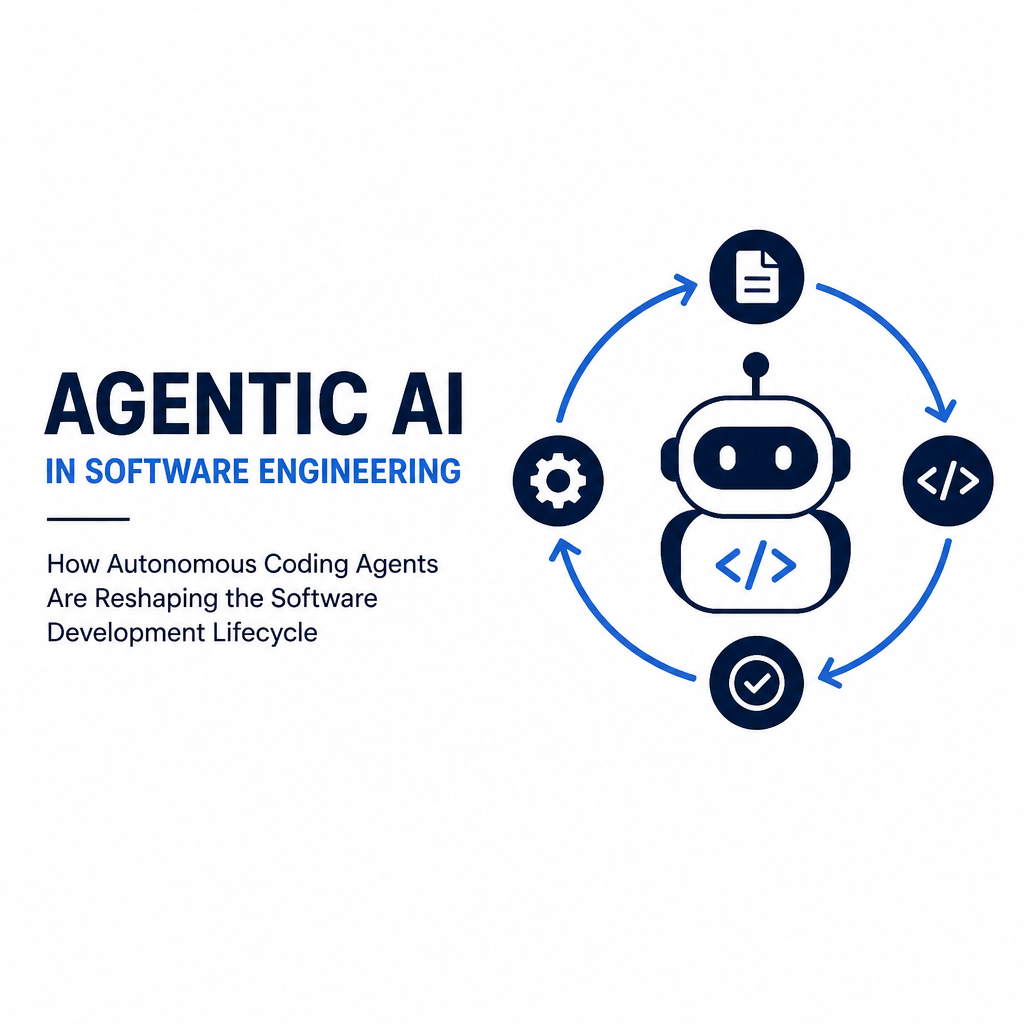
For most of the past decade, AI's role in software engineering was defined by a single interaction pattern: a developer types, and an assistant suggests the next few lines. That era is ending. A new generation of autonomous coding agents--including tools like Claude Code, Cursor, Devin, Factory, and Blitzy--can now plan, write, test, and revise entire features without a human writing a single line of code [1]. The industry is not merely accelerating old workflows; it is reorganizing the entire software development lifecycle (SDLC) around agents that pursue goals across multiple steps while humans set intent and review outcomes [2].
The scale of this shift is difficult to overstate. A National Bureau of Economic Research study drawing on data from 100,000 GitHub developers found that autonomous coding agents increase coding activity--measured by commits--by 180% [3]. Engineering teams report shrinking development timelines that once stretched for months down to days [3], and Anthropic's 2026 Agentic Coding Trends Report found that engineers using agentic tools experience a significant net decrease in time spent per task alongside a much larger net increase in output volume [4].
Yet the transition is neither automatic nor uniformly beneficial. More code, produced faster, does not automatically mean better software [5]. The agentic SDLC introduces new failure modes--verification debt, security exposure, architectural drift--and exposes organizational weaknesses that were always there. As one industry analysis put it, AI does not mend weak engineering; it makes weak engineering visible [6]. This article examines how autonomous agents are reshaping each phase of development, where the productivity gains are real, what new risks emerge, and how engineering leaders can redesign their organizations to capture the value of agentic AI without losing control of quality.
 Agentic AI in Software Development: How It's Changing 2026
From Assistant to Agent: What Makes Development "Agentic"
Defining the Agentic SDLC
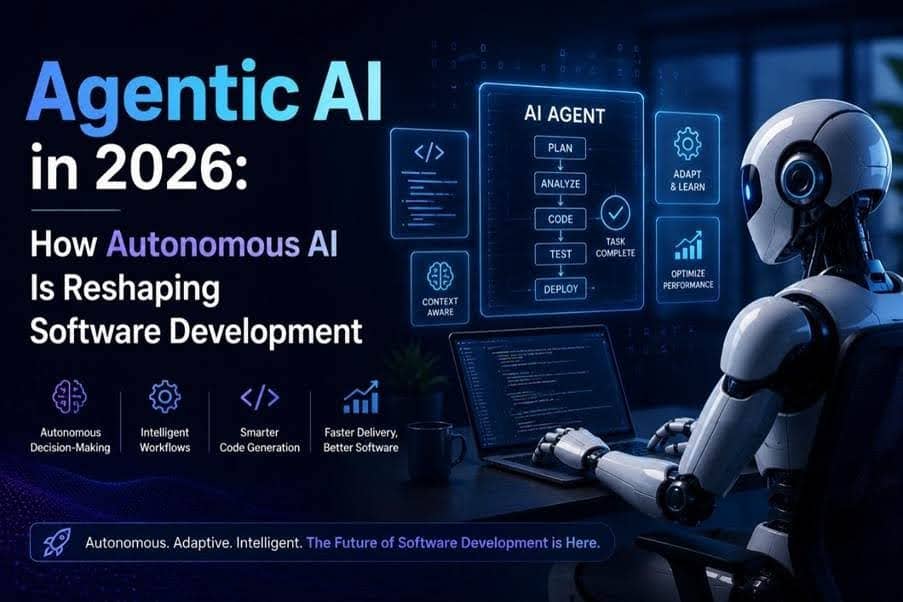
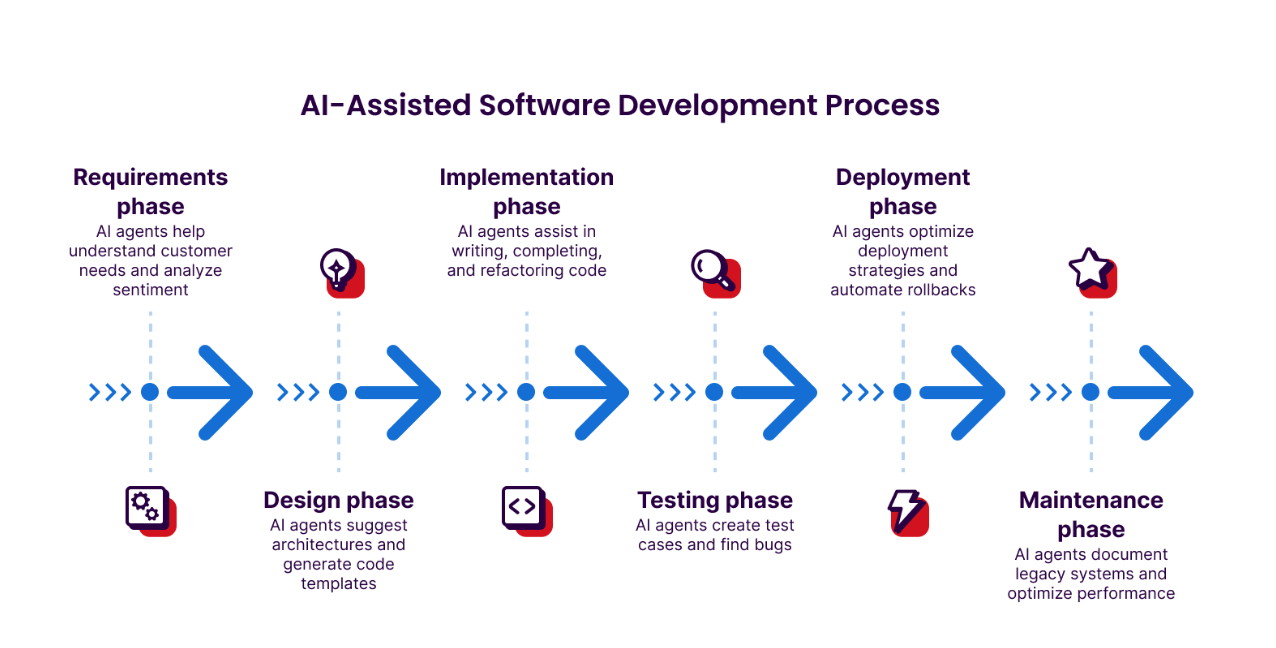
The agentic software development lifecycle is a delivery practice in which AI agents participate meaningfully across the full lifecycle--planning, coding, reviewing, deploying, and operating. Unlike AI-assisted development, where a human directs each action, agents in the agentic SDLC pursue goals across multiple steps without a human directing every one. The developer sets the intent and reviews the result; the agent handles the workflow in between [2]. In practice, this means agents that can groom backlogs, generate implementations, run test suites, open pull requests, and even assist with deployment--operating from objectives rather than line-by-line instruction [7][2].
The distinction matters because autonomy changes the unit of work. Assistants accelerate individual tasks; agents take on complete tasks. As one analysis of the shift observed, the most consequential change AI drives to software engineering is not that it writes code, but that it now performs engineering work [6]. Organizations that treat AI agents as strategic collaborators rather than mere automation tools are already reporting gains in velocity, quality, and innovation [7].
Vibe Coding vs. Agentic Coding
Not all natural-language-driven development is created equal. "Vibe coding" describes an informal style in which a person describes what they want and accepts the AI's output with little review--a mode suited to prototypes and personal projects where mistakes are cheap. Agentic coding, by contrast, deploys autonomous agents that plan, write, test, and revise code under defined oversight, wrapped in context, automated checks, and human accountability. The level of verification is what separates the two [5]. This distinction is increasingly important as the label "AI-built" gets applied indiscriminately to code of very different reliability.
Reinventing Each Phase of the Lifecycle
Planning: The Pendulum Swings Back to Up-Front Thinking
One of the more counterintuitive consequences of agentic coding is the return of practices associated with classic waterfall development. As AI agents make code easier to generate, the pendulum is swinging back toward up-front planning, architectural design, and explicit specification [3]. When an agent can produce thousands of lines in a session, the scarce resource becomes clarity of intent: teams must be far more explicit from the start about requirements, constraints, and expected behavior, and must feed agents the right context to build exactly what was intended [1][3].
A new ecosystem of planning tools is emerging to serve this need. Companies like Linear, Modem, and Intent Lab are building products that help teams manage context, triage customer feedback, scope roadmaps, and translate priorities into specifications that coding agents can consume directly [1]. The bottleneck is shifting upstream: deciding what to build, not how to type it [4].
Development: The Rise of Software Factories
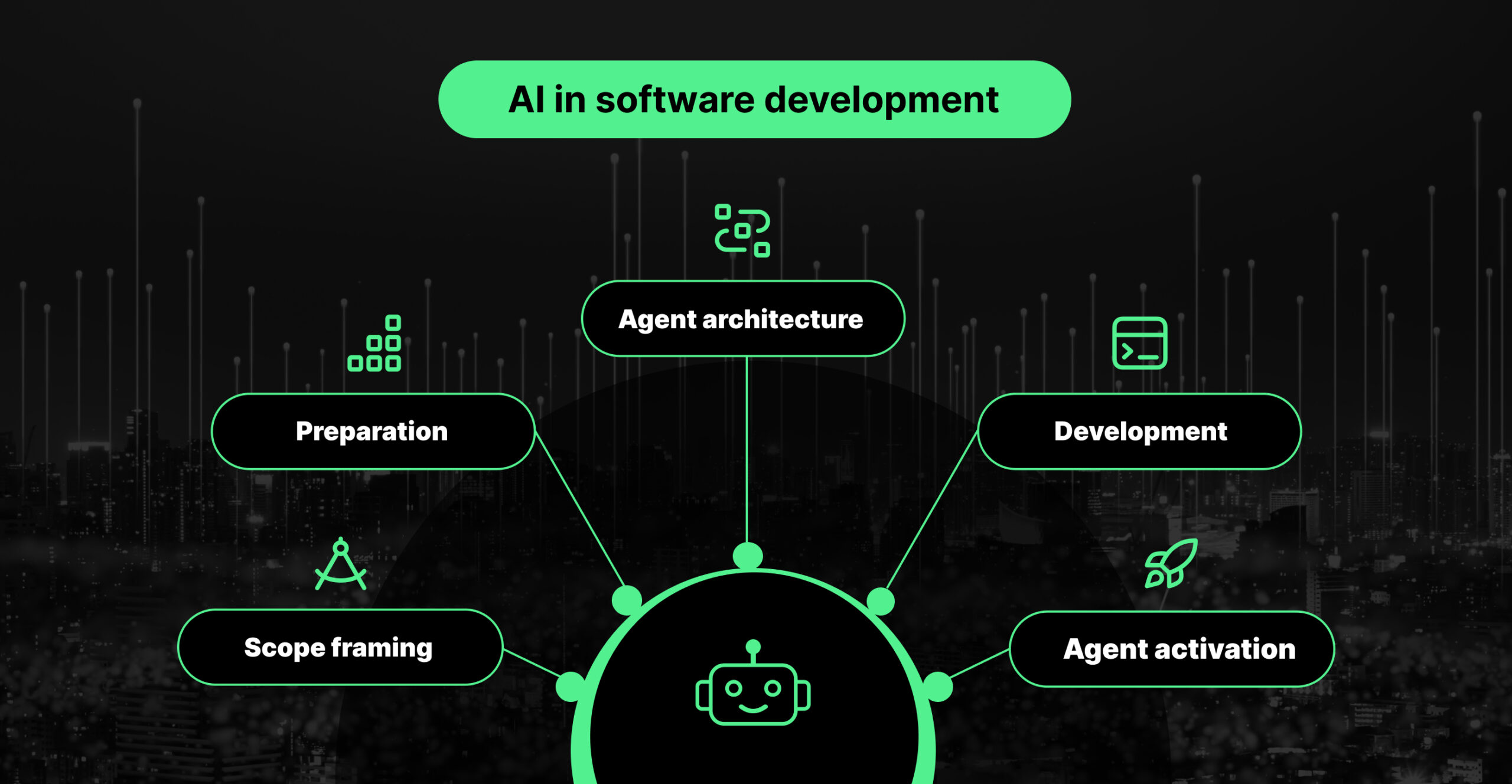
At the core of the agentic SDLC are autonomous agents writing production code. Today, much of this activity targets "brownfield" work--refactoring existing codebases and migrating legacy systems to modern languages--where agents excel at well-defined, pattern-rich transformations. As foundation models and agent harnesses improve, however, these agents are expected to take on increasing amounts of "greenfield" new-code development, becoming part of vendor-neutral software factories that marry upstream context with the best coding agent for a given job [1].
Forward-thinking enterprises are not waiting. Organizations such as Ramp, Stripe, and Coinbase have each developed internal, fully autonomous software factories--internal platforms where specifications flow in and working, tested features flow out [1]. Underpinning this multi-agent stack are interoperability standards such as the Model Context Protocol, which allows agents to access the repositories, documentation, and tools they need to operate effectively [4].
 Integrating Agentic AI into the Software Development Lifecycle (SDLC) | by Rakesh Kumar Pal | Medium
Verification: The New Center of Gravity
Perhaps no phase is changing more dramatically than review and testing. The volume and complexity of pull requests that agents produce have outstripped the capacity of manual human review, forcing a move toward automated, deterministic verification of high-volume agent output [5]. Structured frameworks have emerged to impose discipline on this process--among them Sonar's Agent Centric Development (AC/DC) approach, which organizes the workflow into Guide, Generate, Verify, and Solve stages to catch coding issues, architectural violations, and security risks before they reach production [5].
Review tooling itself is becoming a distinct layer in the agentic stack, addressing what practitioners describe as a "confidence gap": developers can now generate more code than they can trust, and the review layer must close that distance [2]. On the delivery side, agentic AI is also lowering barriers that once required specialized effort--robust CI/CD pipelines, for example, are becoming far more accessible, with repeatable nonfunctional requirements and quality checks embedded into delivery pipelines from the start [3].
The Productivity Paradox: Committing More, Shipping Barely More
The raw numbers on agentic productivity are striking. Beyond the 180% increase in coding activity documented in the NBER study, industry surveys report productivity increases of 30-50% in routine coding tasks [3][8]. Yet the same research reveals a sobering bottleneck: while commits rose 180%, actual releases rose only 30%, with human bottlenecks in the production chain identified as the limiting factor [3].
In other words, the constraint on software delivery has moved. It is no longer writing code--it is deciding what to build and verifying that what was built is correct [4]. Teams that simply bolt agents onto an unchanged organization end up with a flooded review queue, an overburdened release process, and a widening gap between code generated and code shipped. Capturing the value of agentic AI therefore requires reengineering the downstream phases of the lifecycle--review, verification, and release--at least as aggressively as the upstream ones.
 How Agentic AI is reshaping the Software development lifecycle
New Risks and the Governance Imperative
Verification Debt and Quality Erosion
Speed without verification accumulates a new form of liability. Engineering leaders report that agentic development can trigger "verification debt"--a growing backlog of unreviewed, unvalidated agent-generated code--alongside increases in code analysis warnings [5]. Agents generating thousands of lines in a single session can also introduce architectural violations and subtle defects that only surface in production, making systematic, automated quality gates a non-negotiable component of the agentic SDLC [5][9].
Security in an Agent-Driven Pipeline
Security concerns sharpen considerably when autonomous agents hold write access to production codebases. The agentic SDLC demands a deliberate security posture: securing the codebase itself, controlling what agents can access and modify, and embedding security checks into automated pipelines rather than relying on human reviewers to catch every issue [1][3]. Balancing autonomous action with human oversight is essential--not only to reduce rework but to limit the security risks that come with handing all the keys to AI [3].
Governance as a Leadership Responsibility
For technology leaders, the agentic transition raises questions that go beyond tooling: How do we architect systems that are agent-ready? What governance models ensure safety and accountability in autonomous workflows? How do we reskill teams to collaborate effectively with AI agents? [7]. Industry analyses frame the challenge as three interlocking shifts--engineering becoming intent-driven, the rise of governed software delivery, and the economics that determine whether autonomy actually pays [6]. The consistent lesson across early adopters is that autonomy without governance converts speed into risk; governance without autonomy forfeits the gains entirely.
The Changing Role of the Engineer
The agentic era is giving rise to what some call "agentic engineering"--a discipline in which engineers increasingly define goals, constraints, and success criteria while AI agents figure out the execution [9]. This does not eliminate developers; it repositions them. Rather than writing explicit instructions for computers, engineers become architects of intent, curators of context, and auditors of machine output [3][9]. Human judgment moves up the stack--toward requirements, architecture, trade-off analysis, and verification--while agents absorb the repetitive execution layer beneath it [3][8].
This evolution has implications that reach back into education and hiring. The traditional pipeline from computer science programs to software careers is being reshaped as the skills that matter shift from syntax fluency toward systems thinking, specification writing, and engineering reliability--capabilities that determine whether agentic output becomes trustworthy software or accumulating technical debt [9]. Organizations that invest in reskilling their teams to collaborate with agents are positioned to compound the productivity gains; those that do not risk a widening capability gap [7].
Looking Ahead
The trajectory of the agentic SDLC points toward increasingly autonomous development pipelines in which agents handle entire features from specification to deployment, with human developers concentrating on architecture, strategy, and innovation [8]. Agents are expected to become more specialized--incorporating domain knowledge and regulatory requirements into their decision-making--and more adaptive, learning team preferences, project constraints, and organizational goals over time [8]. Benchmark evolution is part of this maturation: earlier evaluation suites such as SWE-bench Verified proved inadequate as frontier measures, prompting harder, enterprise-scale successors that better reflect real-world engineering complexity [6].
For engineering organizations, the near-term agenda is clear. Treat agents as strategic collaborators rather than point tools [7]. Rebuild planning and specification practices for an intent-driven world [3]. Invest in automated verification to close the confidence gap [5][2]. Secure the pipeline against new classes of agent-mediated risk [1]. And redesign the human bottlenecks in review and release so that a 180% increase in commits can translate into something close to a 180% increase in shipped value.
Conclusion
Agentic AI is not an incremental upgrade to the developer's toolkit--it is a structural change in how software gets built [4]. Autonomous coding agents are collapsing development timelines, resurrecting up-front planning, industrializing code production into software factories, and forcing verification to become the center of gravity in the lifecycle. But the technology alone guarantees nothing. The organizations that benefit will be those that redesign the SDLC around agents deliberately: explicit intent, governed autonomy, deterministic verification, and engineers reskilled to direct, critique, and collaborate with their machine counterparts. The question for technology leaders is no longer whether AI can code. It is whether their engineering organizations are built to let it--and to trust what it builds [6].
References
- 1.
- 2.
- 3.
- 4.
- 5.
- 6.
- 7.
- 8.
- 9.