Introduction
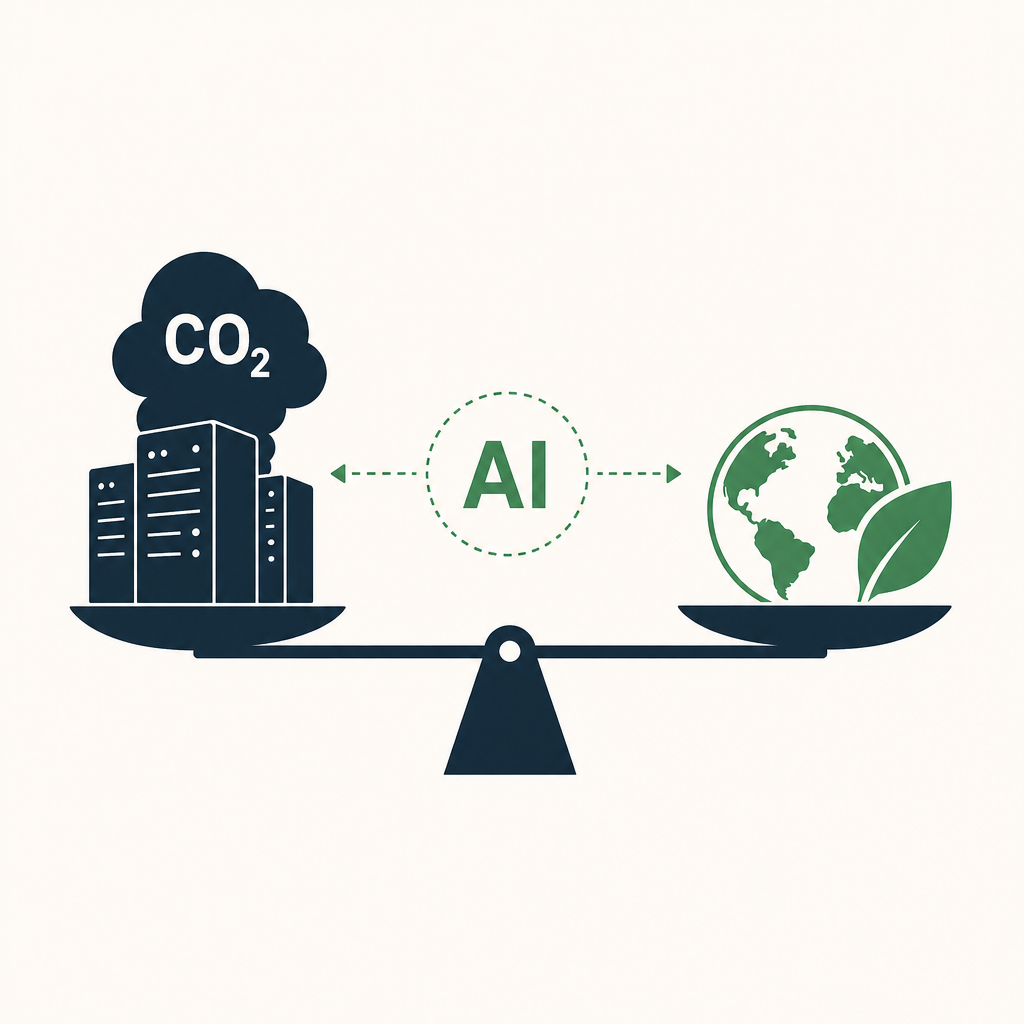
Artificial intelligence has thrust itself into the center of one of the most consequential debates of the decade: can a technology that consumes enormous quantities of electricity and water credibly position itself as a weapon against climate change? The question is no longer academic. By 2030, AI data centers could emit between 24 and 44 million metric tons of CO2 annually -- the equivalent of adding 5 to 10 million cars to American roads -- while consuming water on par with the annual usage of 6 to 10 million people [1]. Detailed modeling of AI server deployment in the United States confirms this range, projecting an annual water footprint of 731 to 1,125 million cubic meters alongside those carbon emissions between 2024 and 2030 [2].
Yet the same technology is also being deployed to optimize power grids, accelerate the discovery of low-carbon materials, improve agricultural yields, and predict extreme weather events. Researchers estimate that AI-enabled mitigation could avoid somewhere between roughly 0.03 and 5.4 gigatonnes of CO2-equivalent per year, depending heavily on adoption rates and the mix of applications -- a potential upside that, even at the cautious end, exceeds the technology's own direct footprint today [3]. A 2024 study in npj Climate Action focused on just three sectors -- transport, meat and dairy, and light road vehicles -- and found AI advancements could cut global greenhouse gas emissions by 3.2 to 5.4 billion metric tons annually by 2035, enough to outweigh all projected global data-center emissions in the same timeframe [4].
So which side of the ledger wins? The honest answer, increasingly shared by researchers across academia, industry, and civil society, is that the outcome depends on choices rather than inevitability [3]. This article examines both sides of the equation: the surging footprint of AI infrastructure, the genuine promise of AI-driven climate solutions, the economic traps that could erase efficiency gains, and the policy and industry responses that will determine whether AI is ultimately remembered as a climate solution or a complicating burden.
The Surging Footprint: AI's Growing Environmental Toll
From Marginal to Material
It is tempting to dismiss AI's emissions as trivial. After all, data centers currently account for just over 1% of global electricity demand and roughly 0.5% of global CO2 emissions, according to International Energy Agency (IEA) data [5][6]. MIT Sloan researchers likewise peg AI and data centers at roughly 0.5% of global CO2 emissions today -- a small share compared with transportation, buildings, industry, and agriculture [5].
But the trajectory, not the baseline, is what alarms researchers. The IEA notes that while headlines often trumpet demand "doubling" or "tripling," these dramatic relative increases are starting from a low baseline -- yet they compound rapidly as generative AI adoption accelerates [6]. A single query illustrates the shift: a standard Google search consumes roughly 0.0003 kWh, while an AI-augmented search uses approximately ten times more energy [1]. Multiply that delta across billions of daily interactions, and the arithmetic changes quickly.
Beyond Carbon: Water, Land, and Materials
Carbon is only part of the story. A recent United Nations University Institute for Water, Environment and Health (UNU-INWEH) report moves beyond a carbon-only lens, quantifying the carbon, water, and land footprints associated with the electricity used to train, deploy, and operate AI systems at scale. Its central finding is sobering: AI's environmental costs depend not only on how much electricity is used, but on where that electricity is generated and from which sources. Critically, these footprints do not always move in the same direction -- low-carbon electricity is not automatically low-water or low-land [7].
The location question matters enormously. Currently, coal is the biggest single electricity source for data centers globally, largely due to the numerous facilities in China, meaning much of today's AI workload runs on the dirtiest power available [6]. This geographic unevenness also raises justice concerns: the UNU report frames AI's environmental footprint as a governance and equity challenge, noting that while AI's benefits flow across borders and sectors, the burdens of data center siting, water withdrawals, land use, and mineral extraction concentrate in specific communities and regions [7].
Beyond AI's surging energy use: UN details escalating water, land, and CO2 emission consequences | EurekAlert!
The Promise: AI's Emission-Cutting Potential
Where AI Delivers Real Savings
Against this rising toll stands a genuine counterbalance. AI's most quantifiable climate contributions come from optimization. Applied to power grid management, machine learning can deliver 10-15% efficiency improvements that translate into millions of dollars in energy cost savings; data center cooling itself can see a 40% reduction in energy use through AI control systems [1]. The U.S. Department of Energy estimates AI can reduce a building site's energy consumption by 30% or more [8].
Agriculture -- responsible for 10-25% of global emissions -- is another promising frontier, with AI-driven optimization of fertilizer use, irrigation, and livestock management offering potential emission reductions of 10-20% [1]. In materials science, AI-designed sorbents for carbon capture are proving more efficient than conventionally engineered alternatives [1]. Beyond these direct applications, AI is accelerating climate research itself, from weather prediction to grid-scale renewable integration [1][9].
A Large But Uneven Upside
The aggregate numbers are striking. The npj Climate Action analysis suggests 3.2 to 5.4 billion metric tons of annual emission reductions by 2035 from just three sectors -- dwarfing the projected data-center footprint of the same period [4]. Even the IEA's exploratory analysis acknowledges that AI-enabled efficiency gains across the energy system could cancel out any extra data-center emissions from AI growth [6].
Google's own researchers argue that machine learning's carbon footprint will plateau and then shrink as techniques mature. Their analysis identifies four best practices -- efficient model selection, optimized processors, cloud-based training, and map-based allocation of compute to clean grids -- that together can cut ML energy use 100-fold and its carbon footprint 1,000-fold. Still, even Google concedes that ML already constitutes 10-15% of its total energy use, a reminder that efficiency improvements must outrun demand growth to bend the curve [10].
The Rebound Trap: Why Efficiency Alone Won't Save Us
Here the optimism meets its most serious intellectual challenge -- one that has little to do with technology and everything to do with economics.
The Direct Rebound Effect
Greater efficiency cuts both ways: the cheaper it becomes to train and run AI, the more AI gets used, offsetting some or all of the environmental benefits of those gains. This feedback loop, known as the direct rebound effect, means that every efficiency breakthrough risks being consumed by expanded demand rather than banked as emissions savings [5]. Researchers assessing whether AI can be climate-positive estimate that 3-5x efficiency gains are needed for the technology to break even -- gains that rebound dynamics could quietly erode [1].
The Indirect Rebound Effect
More troubling still is the indirect rebound effect. AI is widely expected to boost productivity and accelerate economic growth -- but faster growth means more energy demand and more greenhouse gas emissions across the entire economy [5]. Using the En-ROADS climate simulator, MIT's John Sterman demonstrated that even dramatic reductions in the energy intensity of AI would lead to a negligible reduction in global warming by 2100, assuming no new climate policies are implemented [5]. In other words, making AI efficient without also decarbonizing the broader energy system may amount to rearranging deck chairs.
Skepticism From the IEA
The IEA shares elements of this skepticism. While its exploratory scenarios show AI's efficiency gains could offset data-center growth, the agency cautions that "there is currently no existing momentum of AI adoption that would unlock these emissions reductions" at the scale required [6]. Meanwhile, there are real concerns that data-center expansion is being used to justify prolonged fossil fuel use -- "locking in" a high-emissions future. Some oil majors have framed AI in exactly these terms, and some data-center operators have explicitly sought gas connections to meet their electricity needs [6].

Industry and Policy Responses: Engineering a Better Ledger
The Shift to Additionality
The single most decisive lever is what powers the data centers -- and here, hyperscalers are making moves that go beyond accounting tricks. The most telling shift is toward additionality: rather than purchasing renewable energy certificates, companies are financing new clean generation outright. Microsoft has signed a 20-year deal to restart a reactor at Three Mile Island; Google has contracted small modular nuclear reactors from Kairos Power; and Amazon is investing in small-reactor developers. Firms are also pairing campuses with geothermal generation and storage, and pursuing hourly "24/7 carbon-free energy" matching rather than annual averages -- a far more rigorous standard [3][10]. Google has pledged that by 2030 all its data centers will run on 100% locally generated carbon-free energy, around the clock [10].
Cooling, Siting, and Efficiency Engineering
On the operational side, engineers are deploying closed-loop and liquid cooling systems that dramatically cut evaporative water losses -- with siting decisions in cooler, water-rich climates amplifying the benefit [3][9]. Companies like Nvidia and Schneider Electric are pioneering liquid-cooled AI clusters that reduce data center cooling energy by up to 20% [9]. The Nature Sustainability modeling quantifies the stakes of these choices: improving power usage effectiveness (PUE) yields over 7% reductions in total energy consumption and carbon emissions, while water usage effectiveness (WUE) improvements cut the total water footprint by more than 29%; advanced liquid cooling contributes further incremental savings [2]. Google and Microsoft have both pledged to become "water positive" by 2030 [3].
A Regulatory Landscape Taking Shape
Policy is beginning to catch up. The EU's AI Act now includes clauses requiring companies to assess and disclose the environmental impact of AI systems, from training emissions to resource usage. In the United States, proposed legislation such as the Digital Carbon Transparency Act would push cloud providers to include carbon scores with their APIs, enabling greener consumer choices. Canada prioritizes carbon-neutral AI ventures in its federal innovation fund, while Japan and South Korea have adopted green cloud computing incentives [9]. The UNU report goes further, calling for a responsible AI ecosystem grounded in transparency, efficiency by design, equity, environmental justice, lifecycle responsibility, and global cooperation -- arguing that making AI's footprints visible and comparable is the prerequisite for integrating AI into energy, climate, water, and land-use planning [7].
 The Carbon Countdown: AI and Its 10 Billion Rise in Power Use
The Narrow Window: Best Case, Worst Case, and the Race Between Them
The Nature Sustainability analysis offers perhaps the clearest picture of how wide the outcome range really is. Under best-practice scenarios -- aggressive efficiency, renewable deployment, and optimal siting -- U.S. AI servers could limit residual carbon emissions to about 11 Mt annually by 2030, requiring roughly 28 GW of wind or 43 GW of solar to fully offset, a target made more plausible by the 13+ GW of renewables AI companies have already claimed [2]. Under worst-practice scenarios, however, the industry risks unachievable net-zero pathways: 71 Mt of annual residual carbon emissions and more than 5,224 million cubic meters of residual annual water usage by 2030, even under low-demand assumptions [2]. The researchers conclude the AI server industry is unlikely to meet its net-zero aspirations without dramatic intervention [2].
This spread -- an order of magnitude between best and worst cases -- is precisely why analysts insist the question cannot be answered in the abstract. As the framing emerging from this research makes clear, the outcome depends on whether efficiency gains are banked rather than consumed by rebound; whether data centers catalyze new clean generation or merely crowd out other users on dirty grids; whether AI's climate applications are prioritized over fossil-fuel extraction use cases; and whether regulators force the transparency needed to audit the whole equation [3].
Conclusion
Can machine learning's climate solutions outweigh the surging carbon footprint of data center expansion? The arithmetic says it is possible: the emission-cutting potential of AI -- measured in billions of tons of avoided CO2 across grids, agriculture, and transport -- is large enough to outpace its own growing demands [3][4]. The physics and engineering say it is possible too: liquid cooling, efficient chips, and 24/7 clean energy matching can shrink the footprint of every computation [10][9][2].
But possibility is not destiny. The rebound effects documented by MIT researchers warn that efficiency gains can evaporate into expanded consumption, and that AI's biggest climate impact may arrive indirectly -- through economic growth that raises emissions economy-wide -- unless accompanied by broader decarbonization policy [5]. The IEA cautions that the AI-driven efficiency revolution remains more hypothetical than real [6], while the UNU warns that the burdens of AI's expansion are already falling unevenly on the world's most vulnerable communities [7]. Coal still tops the list of global data-center power sources [6], and even optimists within Google acknowledge that machine learning already draws 10-15% of the company's total energy [10].
The window in which AI could be remembered as a climate solution rather than a complicating burden is open now -- but it will not stay open indefinitely [3]. Whether AI lands on the right side of the climate ledger depends less on algorithms than on arithmetic made visible, energy made additional, and choices made deliberately, on a deadline, with honest accounting. The race is real. The race has barely begun.
References
- 1.
- 2.
- 3.
- 4.
- 5.
- 6.
- 7.
- 8.
- 9.
- 10.