Introduction
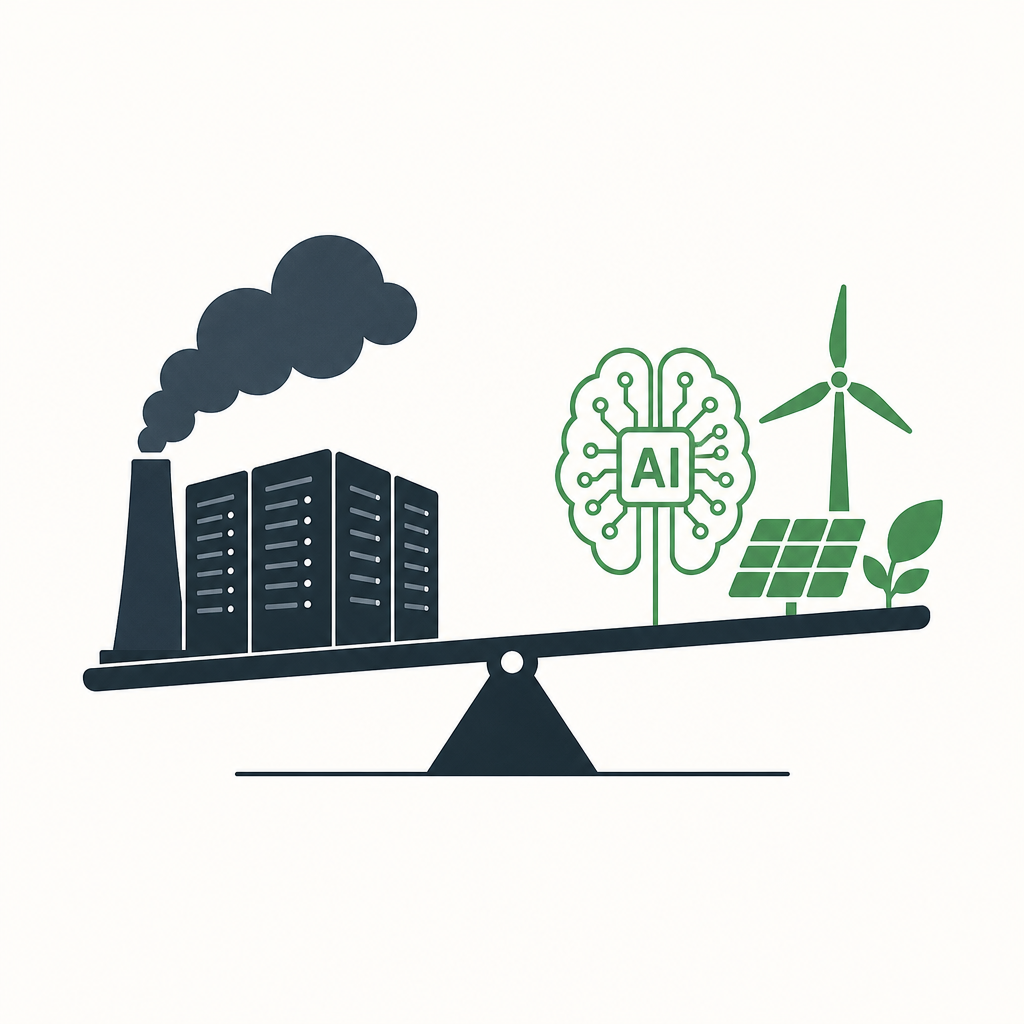
Artificial intelligence has emerged as the defining technology of the decade -- and one of its most consequential climate dilemmas. On one side of the ledger sits a booming infrastructure buildout: hyperscale data centers packed with power-hungry GPUs, straining electrical grids and driving utilities to commission new fossil fuel plants. On the other side sits AI's transformative promise: smarter grids, optimized renewable energy generation, and accelerated innovation in materials, logistics, and industrial processes that could shave gigatons off global emissions. The World Economic Forum has called this a stark "energy paradox" -- and the verdict on which side wins is far from settled [1].
The numbers behind the paradox are striking. AI and data center emissions are currently responsible for roughly 0.5% of global CO₂ emissions from energy -- modest today, but growing rapidly [2]. The International Energy Agency (IEA) projects that global data center electricity consumption will roughly double to 945 TWh by 2030, with AI's share of that power use potentially surging from under 15% to as much as 35-50% [3]. At the same time, researchers at MIT Sloan and modeling platforms like En-ROADS are quantifying whether AI's enablement benefits -- the emissions it helps avoid elsewhere in the economy -- can plausibly outweigh its direct footprint [2][4].
The answer, increasingly, is that technology alone will not decide the outcome. As MIT's John Sterman puts it, "AI is a remarkable technology, both promising and problematic. But, by itself, it does not solve the climate crisis... We need sound policies to do that" [2]. This article examines the scale of the problem, the countervailing benefits, the systemic dynamics at play, and the policy frameworks that governments are beginning to deploy -- or should deploy -- to tip the balance.
The Scale of the Problem: AI's Surging Energy Appetite
An Insatiable Demand Curve
The growth trajectory of data center electricity demand is unlike anything else in the modern economy. The IEA pegs the sector's growth rate at roughly 15% per year -- more than four times faster than all other sectors [1]. Goldman Sachs Research projects 160% growth in data center power demand globally by 2030, while EPRI forecasts 5-15% annual growth in the United States, and the Open Data Center Committee projects roughly 10% annual growth in China [5].
The scale is best understood through rankings. In 2022, data centers were the 11th largest electricity consumer in the world -- nestled between Saudi Arabia and France. By 2026, they are expected to rank fifth, between Japan and Russia [6]. In one extreme scenario, data centers could consume as much as 12% of U.S. electricity, with the pace of construction so rapid that the majority of new demand is met by burning fossil fuels, increasing global carbon emissions by 220 million tons [6].
Per-interaction, the inefficiency is also striking: a single ChatGPT request consumes an estimated 2.9 watt-hours -- roughly ten times the 0.3 Wh of a standard Google search [6][1]. Multiply that differential across billions of daily queries, AI-assisted search, and the explosion of generative applications, and the aggregate demand becomes enormous.
 The AI - Energy Paradox: Will AI Spark a Green Energy Revolution Or Deepen the Global Energy Crisis?
The Emissions Ledger
Translating electricity into emissions, the IEA's Energy and AI report projects emissions from data center electricity use rising from approximately 180 million metric tons (Mt) of CO₂ today to 300 Mt CO₂ by 2035 in its Base Case -- potentially reaching 500 Mt CO₂ in a high-growth scenario [1]. While a fraction of total global energy emissions, the trajectory matters enormously at a time when the world is rapidly spending down its remaining carbon budget [4][1].
Critically, the emissions intensity of this growth depends heavily on geography and grid mix. U.S. data centers already account for more than 4% of total U.S. electricity consumption, with 56% of that power derived from fossil fuels [3]. The demand surge is prompting a significant expansion of fossil fuel generation -- scores of new gas-fired power plants in the U.S. are a direct response to AI-driven demand, and cities like Phoenix are planning gas plants specifically to serve new data centers [1][5]. AI, in short, is not merely adding load to the grid; it is reshaping investment decisions in the power sector itself.
It is worth noting that AI is not the only driver -- streaming services, 5G networks, social media, and online gaming all fuel data center demand [5]. But AI is arguably the most important factor, and it carries distinct characteristics: AI-ready facilities rely on energy-dense accelerators like GPUs and TPUs, require advanced liquid cooling to handle high-density heat, and demand high-speed, low-latency interconnects that multiply infrastructure requirements [7].
The Other Side of the Ledger: AI as a Climate Solution
Enablement Potential
The case for AI's climate benefits rests on its ability to optimize systems that are today profoundly inefficient. AI can forecast renewable generation, manage grid balancing in real time, improve industrial process efficiency, and accelerate the discovery of low-carbon materials and energy technologies. Research commissioned by Google and conducted by BCG argues that AI can significantly accelerate climate action across energy production, supply, and consumption [5]. In the long term, according to a recent analysis in the AI research literature, "AI has the potential to be a game-changer in CO₂ reduction. Its ability to further automate and optimize processes across industries, from energy production to logistics, could significantly decrease our carbon footprint" [7].
Efficiency Gains Within the Data Center Itself
The direct footprint is also not static. Google engineers led by David Patterson have argued that the carbon footprint of machine learning training will plateau, then shrink, thanks to hardware improvements, algorithmic efficiency, and cleaner computing [8]. Within facilities, engineering advances are substantive: liquid cooling offers greater efficiency in handling high-density heat, improving power usage effectiveness (PUE), while experience and economies of scale drive down the energy intensity of compute over time [4][7]. Certification and benchmarking schemes -- from the U.S. ENERGY STAR data center standard to Japan's DPPE (Data Center Performance Energy Efficiency) framework, which tracks infrastructure, IT equipment, and operational KPIs including renewable energy use -- give operators concrete targets [8].
The Modeling Picture: Uncertain but Decisive
The pivotal question is whether these benefits compound faster than the direct footprint grows. Systems-modeling tools like En-ROADS, recently updated to simulate AI's direct and indirect impacts on energy use and emissions, allow policymakers and corporate leaders to explore exactly this question [2][4]. The early modeling results suggest the outcome is highly contingent: AI's net climate impact depends on how fast data center energy intensity improves, how quickly the grid decarbonizes, and how much AI-driven productivity growth amplifies -- rather than moderates -- a still carbon-intensive economy.
 AI carbon footprint: The non-negligible hidden emission source - PMC
The Paradox Dynamics: Feedback Loops and the Carbon Budget
When Efficiency Backfires
One of the most important insights from systems modeling is that efficiency gains alone may not reduce emissions. In the En-ROADS framework, speeding up data center energy intensity reductions lowers electricity consumption -- but it creates a balancing dynamic: as marginal energy costs fall, overall use rises [4]. This classic rebound effect means that making AI cheaper to run may accelerate its deployment faster than per-unit efficiency improves.
Compounding this, an "AI economic boost" feedback loop means AI-driven productivity gains amplify economic activity across a still carbon-intensive economy, raising energy demand well beyond the data center sector itself [4]. In other words, even if AI itself becomes remarkably efficient, the prosperity it generates could increase emissions elsewhere unless the underlying energy system is decarbonized in parallel.
Why Every Gigaton Counts
Climate Interactive's analysis frames the stakes bluntly: "Data centers are a rapidly growing, energy-intensive industry, and as long as the carbon intensity of energy stays high, that growth accelerates how fast we spend our [carbon] budget" [4]. This reframes the debate. The relevant question is not whether AI's footprint is small relative to global emissions today -- it is whether its growth rate is compatible with mid-century net-zero pathways.
There are also significant non-climate externalities that complicate any simple cost-benefit calculus: surging electricity prices that ripple through consumer bills, water consumption for cooling, air pollution from nearby fossil generation, and demand for critical metals -- alongside security, privacy, and ethical concerns [2][7]. The measurement challenge itself is formidable; as MIT's Elsa Olivetti notes, the speed of AI improvement has outpaced our ability to measure and understand the tradeoffs [6].
Yet the levers of control are identified. According to MIT Climate Project analysis, grid decarbonization, efficiency improvements, and strategic siting could together reduce data center carbon emissions by 73% and water usage by 86% [6]. That figure is the strongest argument that the paradox is resolvable -- but only with deliberate intervention.
Policy Frameworks to Tip the Balance
Governments are not standing still. A growing toolkit of disclosure obligations, regulatory standards, and fiscal incentives is emerging worldwide, and the design choices made now will determine whether AI's climate benefits outpace its costs [8].
Transparency and Disclosure Mandates
The foundation of effective governance is measurement. Leading policy roadmaps call on AI developers and data center owners to report energy use and GHG emissions associated with AI workloads -- and for governments to mandate such reporting rather than rely on voluntary action [5]. Developers are urged to evaluate their models using the ISO's Software Carbon Intensity (SCI) methodology, giving customers and investors comparable carbon metrics [5]. Corporate disclosure is also an immediate lever: many large corporations are no longer on track for their net-zero targets, and some cite AI as the reason, making standardized AI emissions reporting essential for accountability [2].
Standards, Benchmarks, and Renewable Mandates
Regulatory standard-setting can lock in efficiency and cleanliness requirements. Governments can mandate minimum renewable energy use, requiring operators to source a defined percentage of electricity from solar, wind, or other low-carbon generation -- accelerating the transition away from fossil fuels and stimulating clean energy investment [9]. Carbon intensity benchmarks, comparing carbon emitted per unit of energy used (and rewarding effective reuse of waste heat), ensure facilities minimize operational emissions while supporting national decarbonization goals [9]. Technical frameworks are converging to support this: the AI Data Center Energy Performance Framework developed by PNNL, ASHRAE, and NEMA provides guiding principles across planning, design, construction, operation, and retrofit; Schneider Electric offers strategic guidance on when to retrofit facilities for AI workloads versus building new [9]. Existing instruments like ENERGY STAR certification and Japan's DPPE KPI framework provide templates that can be strengthened and harmonized internationally [8].
Fiscal Tools: Pricing Carbon, Rewarding Clean Power
Economists increasingly argue that broad climate policy is also the best AI policy. Carbon pricing, paired with incentives to speed energy efficiency and decarbonization across the economy, would cut emissions today while steering more AI research toward climate solutions [2]. The IMF has specifically proposed that tax policy address surging AI and crypto emissions [5]. In modeling terms, the highest-impact levers are clear: subsidizing renewable and nuclear energy, implementing carbon prices or clean electricity standards, taxing fossil fuels or removing fossil fuel subsidies, and limiting new fossil infrastructure [4]. Governments should also promote and support policies enabling data center operators to purchase low-carbon energy at scale -- including new clean generation and grid expansion -- while operators prioritize energy-efficient hardware and carbon-aware computing strategies that shift flexible workloads to times and places where the grid is cleanest [5].
International Coordination and Observatory-Building
Because data center growth varies dramatically by country and is shaped by geopolitics, trade policy, and national security investments, no single jurisdiction can manage the transition alone [7]. Policy roadmaps recommend that IEA member governments expand the IEA's Energy and AI Observatory, devoting additional resources to monitoring data centers' energy use, environmental impacts, and global policy trends -- and that the Clean Energy Ministerial expand its data center work under its power sector and AI initiatives [8]. Such coordination matters not only for tracking, but for preventing a race to the bottom in which data centers migrate to jurisdictions with cheap, dirty power.
 Reviewing the socio-technical dynamics of AI, data centers and digitalization on energy and the environment - ScienceDirect
Conclusion
The AI energy paradox has no automatic resolution. The same technology that could optimize grids and accelerate decarbonization is driving the fastest-growing source of new electricity demand in the world economy -- demand that, absent intervention, is being met disproportionately by fossil fuels. Modeling suggests the net climate effect will be determined not by AI's intrinsic properties but by the systems around it: how fast data center energy intensity improves, how quickly the grid decarbonizes, and whether efficiency gains are captured as emissions reductions or consumed by rebound effects and AI-amplified economic growth [2][4].
The encouraging news is that the levers are well understood. Mandatory emissions disclosure, carbon intensity benchmarks, renewable energy mandates, carbon pricing, clean electricity standards, carbon-aware computing, and international observatory-building together form a coherent policy architecture [8][2][9][5]. Analysis suggesting that grid decarbonization, efficiency, and siting could cut data center carbon emissions by 73% demonstrates that the gap between the good and bad outcomes is bridgeable [6]. But the window matters: with data center electricity set to double by 2030 and AI's share of that power potentially reaching half, policies designed today will shape emissions trajectories for decades [3]. AI alone will not solve the climate crisis -- and left ungoverned, it may worsen it. The task for policymakers is to ensure that every watt powering the intelligence revolution is increasingly clean, every model's carbon cost is measured and disclosed, and the technology's formidable problem-solving capacity is deliberately aimed at the decarbonization challenge itself. The balance is not foreordained. It will be tipped -- one policy at a time.
References
- 1.
- 2.
- 3.
- 4.
- 5.
- 6.
- 7.
- 8.
- 9.