Introduction
The era of purely private-sector AI is drawing to a close. Once the exclusive domain of Silicon Valley startups and tech giants, artificial intelligence has rapidly mutated into a matter of statecraft. Nations are waking up to the reality that AI is not just another software product, but a general-purpose capability that will dictate how societies govern, economies grow, and wars are fought [1]. Consequently, the development of frontier models is no longer viewed merely through a commercial lens, but as a critical component of national power.
This realization has sparked a global paradigm shift toward "Sovereign AI"--a strategic imperative for states to produce and operate AI on their own terms. From the United States' massive $500 billion Stargate infrastructure commitment to India's launch of a sovereign large language model, countries are aggressively building domestic compute capacity, data pipelines, and talent pools to break free from foreign technological dependency [2]. Artificial intelligence has officially become the central arena for twenty-first-century international competition, cooperation, and conflict [2].
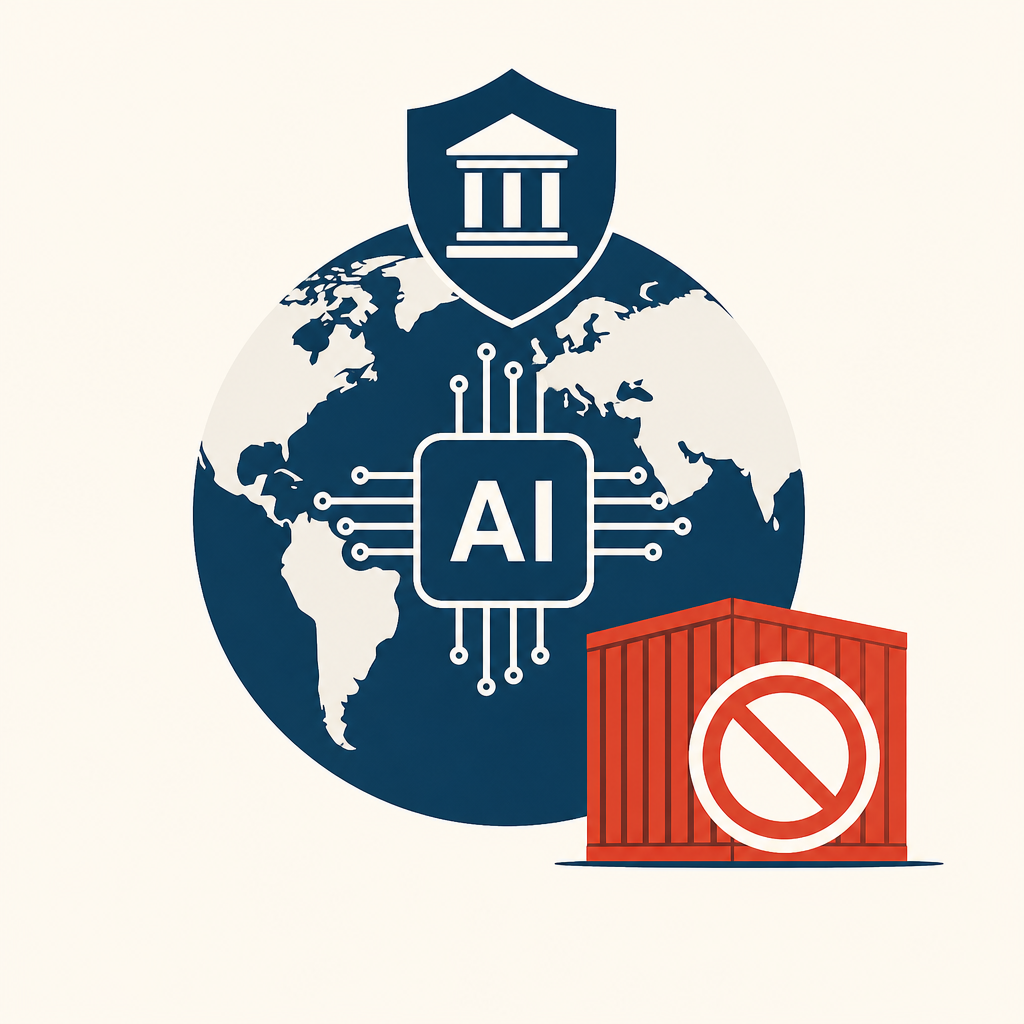
However, this race is not just about building; it is also about restricting. The intersection of AI development and national security has given rise to an unprecedented web of export controls, investment screens, and "soft nationalization" strategies. The result is a rapidly fragmenting global order where the foundational infrastructure of intelligence is being drawn along geopolitical fault lines, forcing a fundamental reevaluation of how technology is governed, deployed, and controlled.
The Anatomy of Sovereign AI
At its core, a Sovereign AI strategy is a national plan to produce and run artificial intelligence on terms the nation controls. This requires dominance across five distinct pillars: data, compute, models, governance, and talent [1]. The objective is to ensure that a nation's critical capabilities are not gated by foreign platforms, subject to export controls, or vulnerable to shifting geopolitical winds [1].
The physical manifestation of this strategy is the rise of the "AI Factory"--massive exascale data centers optimized for training and running large models. Just as steel mills powered the nineteenth century and oil refineries defined the twentieth, these AI factories are the new industrial plants of the digital era [1]. Nations must decide where these centers are located, how they are powered, and, most importantly, who controls access to their immense computational power.
We are already seeing distinct flavors of sovereign AI emerge globally. South Korea is pursuing an aggressive full-stack approach to reduce its reliance on U.S. and Chinese ecosystems, committing over $735 billion in state-private funds, securing 10,000 GPUs for a national compute center, and building a sovereign Korean-language foundation model [1][3]. Conversely, smaller states like Singapore are carving out "cultural sovereignty" through projects like SEA-LION, which trains models in local languages and contexts [1]. Similarly, India has launched its own sovereign large language model, joining a growing roster of nations determined to capture the economic benefits of AI without importing foreign dependency [2].

The Soft Nationalization of Artificial Intelligence
The debate around AI nationalization is often falsely framed as a question of whether governments will seize private entities like OpenAI, Anthropic, or Google DeepMind. While direct expropriation is unlikely in most democracies, nationalization rarely begins with a flag being planted on private property [4]. Instead, it begins subtly through equity stakes, subsidies, procurement dependence, compute allocation, public wealth funds, and national-security vetoes. By this practical definition, the nationalization of AI has already begun [4].
Sovereign wealth funds and public capital are emerging as the primary vehicles for this soft nationalization. Reports indicate that sovereign wealth funds have committed upwards of $120 billion to the global AI infrastructure buildout [3]. For AI companies, embracing partial public ownership is becoming a pragmatic necessity. A 1, 2, or 5 percent state stake--particularly through a sovereign AI fund--serves as political insurance. It signals to citizens that the AI windfall is not reserved solely for founders and venture capitalists, while simultaneously demonstrating to governments that these companies recognize the public character of the infrastructure they are building [4].
However, the dangers of this trend are obvious and profound. Poorly executed nationalization could politicize AI models, protect favored incumbent firms, create opaque state-company bargains, and ultimately turn AI into an instrument of surveillance or ideological control [4]. The state must not be allowed to decide what artificial intelligence is allowed to say, nor should public stakes be used to shield incumbents from competition. This risk can only be mitigated if public ownership is structurally passive--an incredibly difficult balance to maintain in an era of intense geopolitical rivalry [4].
Export Controls and the Silicon Curtain
If sovereign AI represents the "promote" side of a national strategy, export controls represent the "protect" side [5]. The most visible theater for this protectionism is the escalating semiconductor cold war between the United States and China, a conflict that has officially entered a precarious new era of "managed restriction" [6].
As of early 2026, the global semiconductor landscape has been radically altered. The U.S. government has transitioned to a rigorous annual licensing framework for major chipmakers operating in China, aiming to choke off Beijing's access to the advanced compute necessary for frontier AI models [6][7]. In retaliation, China has implemented a strict state-authorized whitelist for the export of critical minerals--such as gallium, germanium, and rare earths--that are essential for high-end electronics and AI hardware [6].
The effectiveness of these export controls, however, remains a subject of intense debate among strategists. Analysts at the RAND Corporation and Foreign Affairs suggest that the utility of chip controls depends entirely on the future trajectory of AI [8][3]. If China develops a viable alternative compute stack, U.S. chip controls will become essentially useless, shifting the competition to global software deployment. If China catches up through model distillation, intellectual property theft, or the rapid spread of algorithms, chip controls will merely serve as a delaying tactic rather than a permanent roadblock [8].
 Sovereign AI and the Geopolitics of Compute: Export Controls, National Chip Programs, and the Fracturing Global AI Stack - Vamsi Talks Tech
The Global Fracturing of the Technology Stack
The ultimate outcome of these competing forces--sovereign buildouts and aggressive export controls--is the bifurcation of the global technology stack. Historical parallels are increasingly relevant; just as Middle Eastern nations nationalized Western oil interests in the 1950s, and Egypt seized the Suez Canal in 1956, nations are beginning to treat AI infrastructure as vital national territory [9].
Yet, total technological decoupling remains highly unlikely. The predicted outcome is a state of "managed interdependence," where both superpowers realize that severing ties completely is too economically costly, yet neither is willing to trust the other with the "keys" to the AI kingdom [6]. This delicate balance requires a new breed of "tech diplomat"--executives who are as comfortable navigating the regulatory halls of China's Ministry of Commerce (MOFCOM) and the U.S. Department of Commerce as they are in the research lab [6].
Meanwhile, U.S. export controls are having a paradoxical effect on the rest of the world: they are actively driving global interest in sovereign AI. As AI expert Andrew Ng noted, export controls are teaching the world a lesson in self-reliance, but at machine speed [10]. Regions like the Gulf states, Southeast Asia, and Europe are rushing to develop their own variations of sovereign AI to ensure they do not become mere vassal states in a bipolar U.S.-China AI order [2]. In mid-2026, the European Commission formally proposed a Tech Sovereignty Package aimed at strengthening Europe's digital autonomy and resilience, signaling that the push for independent AI ecosystems is no longer confined to superpowers [3].
Conclusion
The age of borderless, purely private artificial intelligence is over. The transition to an era of Sovereign AI represents a fundamental rewiring of the global economy, where the foundational infrastructure of intelligence is treated with the same strategic gravity as oil reserves, nuclear arsenals, and territorial borders. Nations are simultaneously executing a dual strategy of "promote and protect"--funneling billions of public dollars into domestic AI factories while aggressively weaponizing export controls to deny adversaries access to critical chips and minerals.
The central challenge of this new geopolitical era will be managing the paradox of soft nationalization. Governments must harness public capital and state leverage to secure their strategic interests without suffocating the innovation, openness, and competition that make artificial intelligence so valuable in the first place. As the global technology stack fractures into competing regional ecosystems, the decisions made today regarding compute allocation, model governance, and semiconductor supply chains will not just shape the next quarter's earnings--they will define the geopolitical hierarchy of the twenty-first century.
References
- 1.
- 2.
- 3.
- 4.
- 5.
- 6.
- 7.
- 8.
- 9.
- 10.