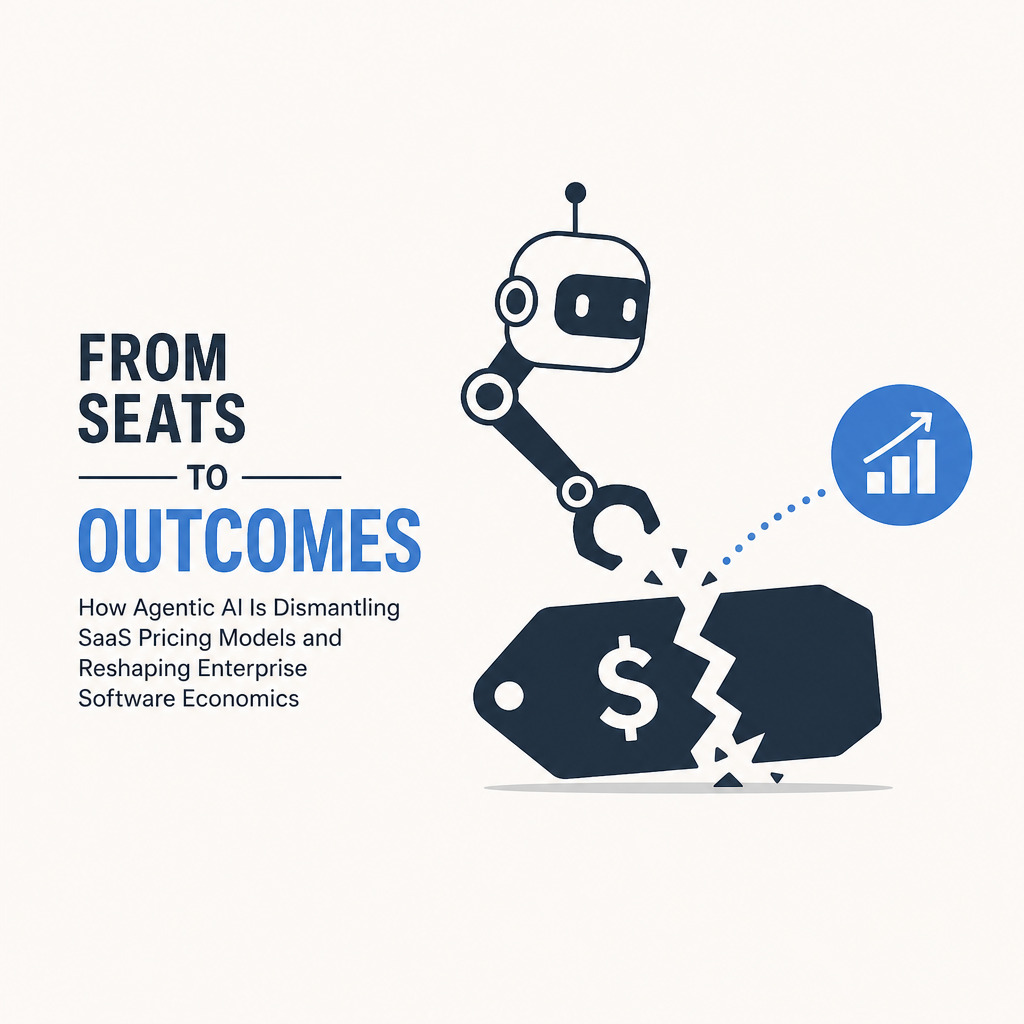
Introduction
For most of the software industry's modern history, the economics rested on a deceptively simple equation: revenue equals seats multiplied by price. Cloud delivery turned software into a subscription, and customer headcount became the universal proxy for value delivered. That equation is now breaking down. Agentic AI--systems that do not merely assist with tasks but autonomously execute them--is severing the connection between human users and software value. When a single AI agent performs the work of five people, charging per human login "becomes a broken metric for value" [1].
The market consequences are no longer hypothetical. Gartner projects that agentic AI will disrupt up to $234 billion in enterprise application software spending through 2030, with market price adjustments accounting for roughly 20% of enterprise SaaS spending by that date [2]. Real-world pricing behavior is already shifting: the share of companies relying on seat-based pricing fell from 21% to 15% in just twelve months, while hybrid models surged from 27% to 41% [3]. Salesforce, Intercom, and Zendesk have all introduced per-conversation or per-resolution pricing for their AI agents [4].
Yet this is a story of restructuring, not obituary. The much-hyped "SaaSocalypse" narrative overstates the threat--agentic AI is not eliminating enterprise software but rewriting how it is priced, delivered, and integrated [3]. What is emerging is neither pure subscription nor pure outcomes, but a hybrid consensus that combines fixed platform fees with consumption and outcome-linked charges. This article examines why the seat is collapsing as a pricing unit, the critical distinction between usage-based and outcome-based models, the margin economics of inference, and the strategic playbooks separating winners from losers in the transition.
Why the Seat Is Losing Its Meaning
From Buying Access to Buying Completed Work
For decades, SaaS pricing models assumed that more users created more value [5]. Agentic AI inverts that assumption. As agents take over repetitive execution, "the employee increasingly supervises rather than performs every task," which changes how customers perceive value: "They are no longer buying software access. They are buying completed work" [5].
The implications are easiest to see in a simple comparison. Imagine two customer support platforms: the first charges per support agent; the second charges based on customer issues successfully resolved. The second aligns far more directly with the customer's actual business goals [5]. That alignment question is what is driving the industry's feverish experimentation with outcome-based pricing and what many now describe as "outcome as a service" [5].
The Arithmetic of Displacement
The compression of seat counts is not a marginal efficiency story--it is structural. According to expert interviews conducted by Dialectica, deploying a central agentic interface in basic administrative processes can reduce end-user license requirements by approximately 90% or more, "confining seat counts strictly to administrative and oversight roles." That, the analysis notes, "is a structural compression of the revenue unit the entire pricing model depends on" [3].
From the buyer's perspective, the economics increasingly fail the sniff test. Nucleus Research observes that per-seat licensing is "not universally dead, but its viability now depends on whether enough users actively engage with the software they are paying for"--seat-based pricing remains defensible only where consumer surplus exceeds the vendor's incremental AI serving costs, and idle seats become a direct cost liability [6]. Meanwhile, vendors who flip the model unlock what RSM describes as uncapped revenue: under subscriptions, "revenue is artificially capped by the customer's head count," whereas outcome-based pricing scales with the volume of work--invoices processed, code generated--rather than the number of employees [7].
The migration is measurable. Beyond the twelve-month shift from seats to hybrid models, IDC forecasts that approximately 70% of vendors will have moved away from pure per-seat models by 2028 [3], and Teneo's research tracking hundreds of U.S. software vendors found that 78% had already transitioned to a hybrid model by 2026 [1].
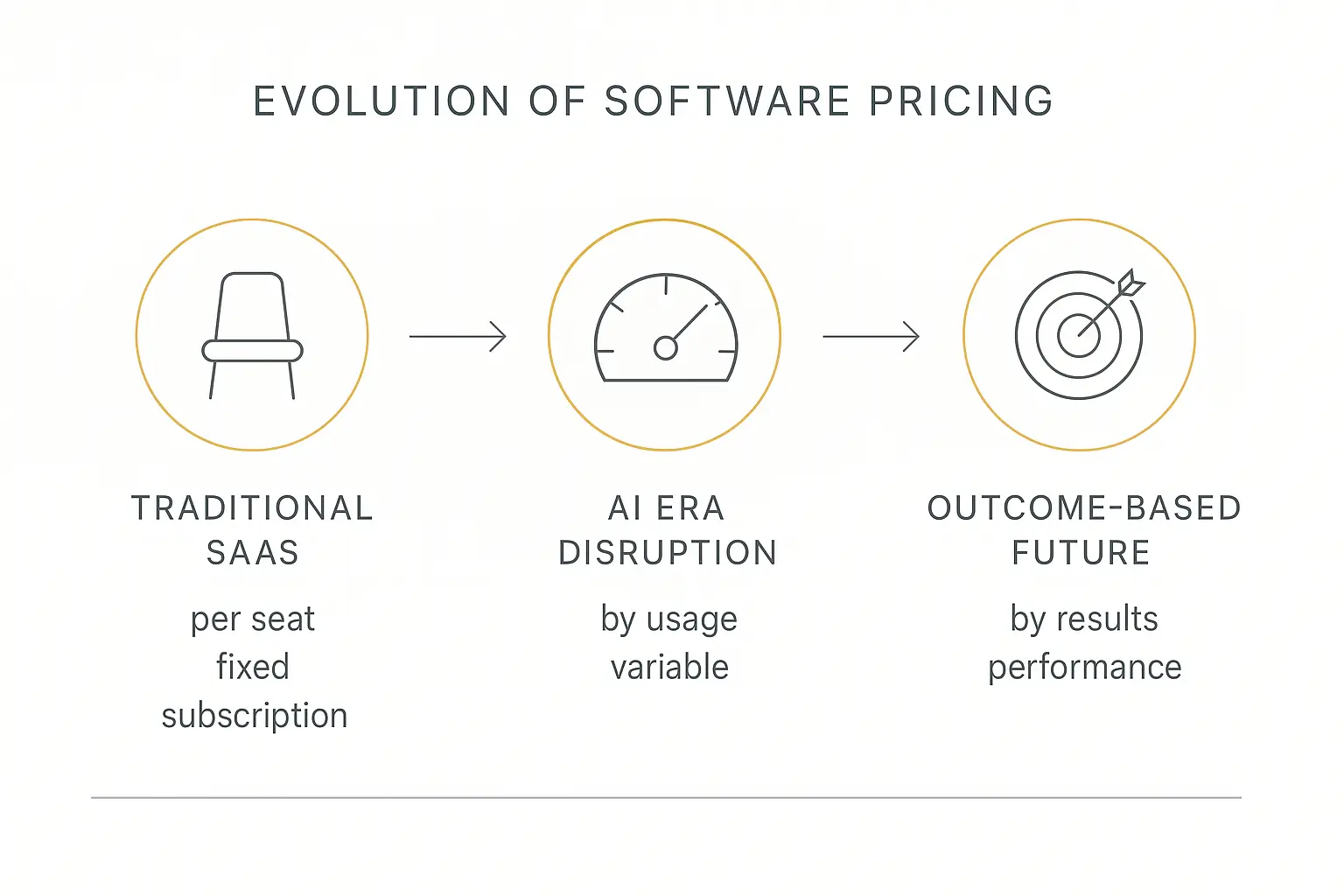 The End of the SaaS Seat: How AI Agents Are Rewriting Enterprise Software Economics | Reducates
Consumption Is Not Outcomes: The Critical Distinction
Not every alternative to seat pricing is created equal, and the industry's vocabulary is still catching up to the economics. Usage-based pricing measures software consumption; outcome-based pricing measures business success. "One rewards activity. The other rewards results. That distinction may define the next generation of AI SaaS pricing models" [5].
Outcome-based pricing ties payment to measurable business impact: revenue generated, claims processed, support tickets resolved, qualified leads delivered, documents processed, hours saved, productivity improvements, and operational costs reduced [5]. In practice, most current "AI pricing" still sits at the consumption end of the spectrum. Salesforce charges $2 per Agentforce conversation or $0.10 per action via Flex Credits; Intercom charges $0.99 per resolution for its Fin agent; Zendesk bills between $1.20 and $2 per resolution [4]. These are per-work-unit models--a meaningful departure from seats, but not yet full outcome pricing.
True outcome-based pricing is attractive only under specific conditions: when the result is "measurable, repeatable, and attributable to the software" [8]. As one analysis puts it, "the economics of agentic software will depend on the cost of reliably completing work, not merely generating responses" [8].
The model also transfers substantial risk from buyer to vendor. Under per-resolution pricing, the vendor absorbs the compute cost of every failed reasoning attempt, wrong answer, or hallucination prior to reaching a successful resolution [4]. Vendors must additionally account for human review, integrations, and service-level commitments [8]. The compensating upside is structural: outcome pricing aligns revenue with the rising variable costs of inference, protecting vendor margins while removing the headcount ceiling on growth [7].
The Margin Squeeze: Inference Economics Upend Software Finance
Traditional SaaS enjoyed a defining financial luxury: near-zero marginal cost per additional user. Agentic AI destroys that luxury. Every task an agent performs requires computational power, API calls, and token processing--"running these agents is more expensive than hosting and maintaining software code" [7].
The enterprise software sector is splitting into two halves. The first half--vendors clinging to flat, seat-based pricing--is being forced to absorb rising compute bills internally, watching gross margins narrow and revenue growth decelerate. The second half--vendors monetizing agent workloads separately through consumption credits, usage metering, or per-resolution billing--are passing inference costs to customers and accelerating top-line growth [4].
The strain is visible in real financials. Bessemer's fastest-growing "Supernovas" average around 25% gross margins, frequently dipping negative on usage spikes; Replit's gross margins contracted from 36% to 23% in 2025 due to surging AI usage; and Cursor ran negative gross margins on select plans before overhauling its pricing [4].
There is also a demand-side paradox: many vendors are dramatically underpricing the value they create. One founder's AI agent reduced invoice processing time by 99%, saving more than £400,000 in annual operational costs--while charging £299 per month, pegged to competitor rates. As the analysis concludes: "When your AI agent saves a company £500,000 annually, £299/month isn't pricing--it's charity" [9]. The lesson cuts two ways: buyers want outcomes rather than features, and pricing complexity itself can signal the depth of value delivered [9].

The Hybrid Consensus: Where Pricing Is Actually Landing
If the death-of-seats narrative is overdone, so is the idea that pure outcome-based billing is ready to replace it. The dominant transition state is hybrid, not pure outcome-based pricing [3]. Pure consumption pricing--charging raw tokens or compute--creates volatile, unpredictable bills "that corporate CFOs reject" [1].
The market is instead settling on a layered structure. Teneo's research describes a hybrid consensus combining a fixed platform or seat fee (around 30%) with variable usage metrics such as credits or completed outcomes (around 70%) [1]. This can take many forms: subscription bundles with usage-based overages, or outcome-based pricing applied selectively to high-value workflows layered atop a foundational platform [5][7]. The pace of experimentation is remarkable--top software vendors are changing their pricing structures between five and 52 times a year to optimize value capture [1].
For vendors navigating the transition, RSM recommends concrete preparation: running shadow pricing models now to analyze how revenue would change if current users were billed on outcomes rather than seats, and establishing new KPIs in which "outcome success rates" become the primary metric of business health rather than user retention alone [7]. The shift will be gradual and uneven across sectors, but the direction is fixed [7].
 The 5 stages of SaaS death - Arnon Shimoni
Winners, Losers, and the New Strategic Playbooks
Incumbent Advantages and Battlegrounds
Bain's analysis maps the disruption by workflow type. Where AI "outshines SaaS"--workflows with high user automation but low AI penetration--incumbents hold exclusive data and rules that give them a head start on full automation; Cursor's AI code editor and Guidewire's claims adjudication are cited examples. Leaders should build end-to-end agents, shift pricing from seats to outcomes, and train sales teams to sell business results rather than features. Where AI "cannibalizes SaaS," incumbents retain the advantage only if they proactively replace their own SaaS activity with AI--turning their product into the battleground [10].
Bain's summary of the pricing imperative is blunt: "stop charging for access and start charging for work done," citing Intercom and Salesforce as leaders already shifting in this direction [10]. Intercom and Salesforce likewise anchor the list of vendors successfully passing inference costs through consumption and per-resolution models [4].
The Platform Play and the New Sales Motion
The highest-stakes positioning is platform-level. Vendors that control critical endpoints, rally ecosystems around standards, and monetize agentic access can become marketplaces "earning revenue even when someone else's agent takes the action." Those that miss this risk "exposing IP and becoming a silent back end while the semantic gatekeepers harvest the margin" [10].
The sales conversation is changing in parallel. "The era of selling modules and features is largely dead. It's been replaced by the era of selling workflows, actual work done and work completed," according to Teneo's Sam Little [1]. And delivery matters as much as pricing: "Those that are winning are figuring out how to integrate seamlessly into a customer's workflow without dirtying their desktop or creating another screen for their folks to use," notes AWS's Micah McCollough [1].
The Losers
The losers are equally clear. Gartner warns that vendors "defending legacy dashboards and seat-based models" face an existential threat, and that those who fail to adopt agentic systems "might not survive" [2]. Vendors that embed an agentic layer into their platforms, by contrast, can capture both existing spend and incremental budget as clients achieve ROI [2]. For any provider still charging per seat while its product successfully automates the tasks of human users, the uncomfortable truth is that it is "effectively engineering its own revenue decline" [7].
Why the Full Transition Remains Hard
For all the momentum, the obstacles to outcome-based pricing are substantial, and most are organizational rather than technical. The biggest barrier to enterprise agentic AI deployment is data quality and change management, not technology: fragmented legacy infrastructure and inconsistent metadata stall a substantial majority of deployments, and only around 26% of companies have the capabilities to move beyond pilot projects [3].
Outcome-based models also impose demanding prerequisites on vendors. They must be able to measure the value their AI creates in hard currency, guarantee reliability sufficient to stand behind specific outcomes, run finance functions capable of handling variable revenue streams, and validate the model with pilot customers before scaling [9]. Attribution remains genuinely difficult--outcome pricing works only when results are measurable, repeatable, and attributable to the software [8]. And buyers should not confuse adoption with proven return on investment; a 2026 Gartner analysis emphasizes that organizations must increasingly demonstrate control over agent behavior, reliability, and operating costs [8]. In the meantime, prudent buyers should evaluate every technology agreement on engagement and value delivered per seat, not just price [6].
Conclusion: Convergence, Not Collapse
The evidence points to a clear verdict: the "SaaSocalypse" is a compelling thesis that is largely wrong [3]. Agentic AI is not eliminating enterprise software--it is restructuring how software is priced, delivered, and integrated. Per-seat licensing is compressing, consumption and outcome-based models are replacing it, and the organizations best positioned to absorb the shift are those that have already invested in clean data infrastructure and clear governance frameworks [3]. The likely future is "not a complete replacement of SaaS" but "a convergence of SaaS infrastructure with agentic execution" [8].
Every major technology shift changes what customers are willing to pay for. Cloud computing changed where software runs. SaaS changed how software is purchased. Agentic AI may change what software is actually expected to accomplish [5]. The winners of the next decade will not necessarily be the companies with the largest feature sets, but those that consistently deliver the best business outcomes with AI [5]. The seat had a good run. The outcome is the new unit of value--and the vendors that learn to price, sell, and reliably deliver it first will define the next era of enterprise software economics.
References
- 1.
- 2.
- 3.
- 4.
- 5.
- 6.
- 7.
- 8.
- 9.
- 10.