Introduction
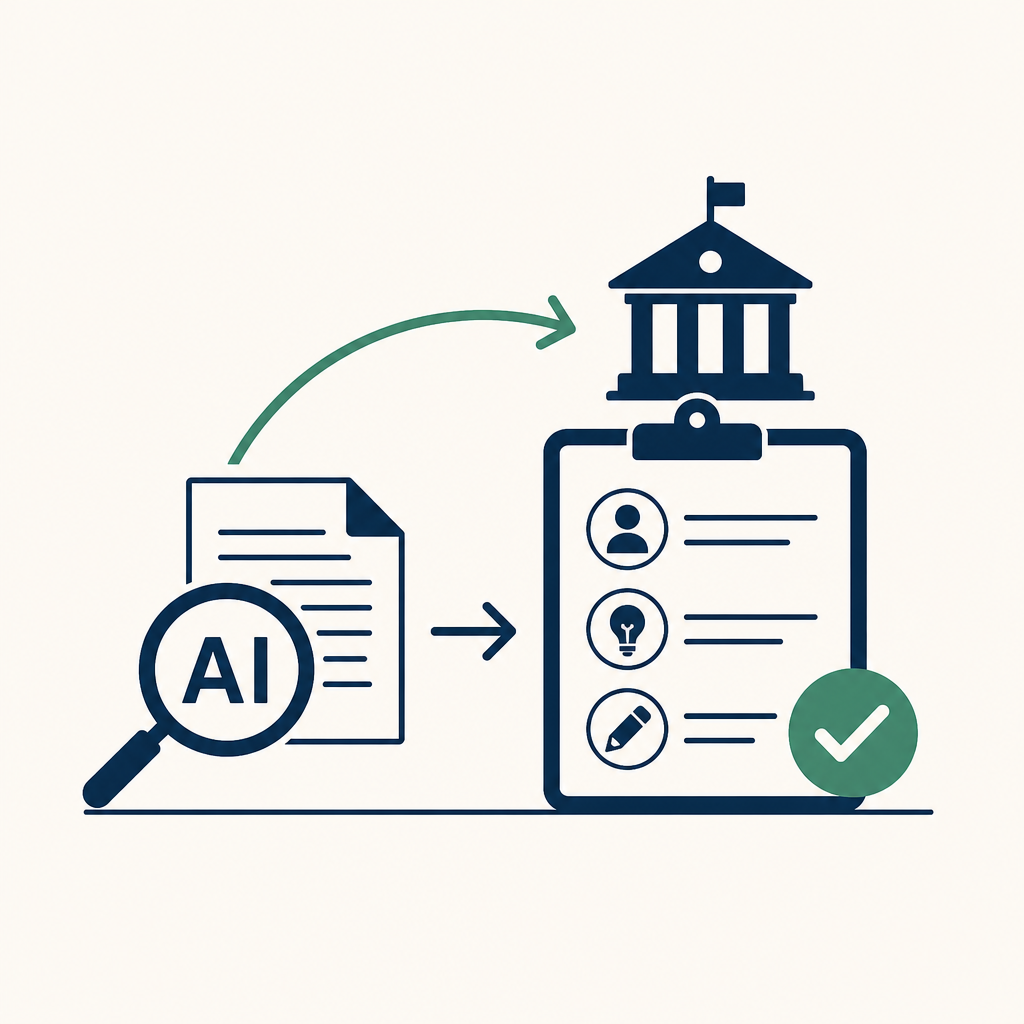
When ChatGPT and its successors entered mainstream use, they did not merely add a new tool to the student toolkit--they destabilized the foundational assumption underlying most higher education assessment: that a polished written product is reliable evidence of independent learning. Tasks once considered trustworthy no longer guarantee authentic student work, and the field is responding by shifting its focus away from what students submit and toward how they think, argue, verify information, and reason [1].
The first institutional reflex--deploying AI-detection software and drafting prohibition policies--has largely collapsed under scrutiny. Detection tools are unreliable, contested, and disproportionately flag work by non-native English speakers, while bans have proven both unenforceable and educationally counterproductive [2][3]. What has replaced this reflex is a more ambitious agenda: a wholesale rethinking of assessment purpose, design, and governance that treats generative AI not as a cheating problem to be policed, but as a catalyst for long-overdue reform [4].
This article examines how universities are executing that pivot. It traces the failure of the detection paradigm, surveys the redesign strategies now emerging across institutions, explores the policy frameworks guiding institutional change, and considers the unintended consequences--including heavier assessment burdens and new equity risks--that accompany even well-intentioned reform.
The Detection Dead End
The case against AI detection as a strategy has hardened rapidly, and it now comes from nearly every corner of the sector. At Carleton University, new guidance from the Teaching and Learning Services team delivers a blunt core message: stop chasing AI detection because it doesn't work, and start redesigning assessments for visibility and authenticity instead [5]. University College London has likewise concluded that detecting unauthorized generative AI use is "generally deemed unfeasible," a judgment echoed across institutional guidance documents [2].
The empirical record supports this skepticism. Turnitin, whose AI writing detector became a flashpoint in the debate, has faced sustained contestation over its accuracy and false-positive rates [3]. A recent scoping meta-synthesis of policy texts from 40 open and distance learning providers found that biased AI-text detectors and error-prone facial-analytics proctoring tools disproportionately burden multilingual and low-bandwidth learners--raising the prospect that surveillance-heavy responses punish the very students already facing structural disadvantages [3].
Notably, that same study found that institutions scoring higher on an "AI-aware Assessment Policy Index"--which positions institutions along redesign-versus-surveillance and transparency-versus-opacity axes--showed lower AI-detector flag rates and reduced reliance on proctoring, without any evidence of increased misconduct [3]. In other words, trusting students and redesigning assessment appears to work at least as well as watching them.
The reputational calculus is also shifting. With rising media coverage and regulator warnings, institutions face growing pressure to demonstrate meaningful reform rather than doubling down on detection regimes that experts widely regard as theater [4].

The Scale of the Shift: Student AI Use Goes Mainstream
Understanding why institutions are pivoting requires confronting the usage data. The Higher Education Policy Institute's (HEPI) 2025 Student Generative AI Survey found that 92% of UK undergraduates now use AI tools in some form--up sharply from 66% in 2024--and 88% report using generative AI for assessments [6]. Most students say AI improves their learning, yet fewer than half feel supported by their institutions to use it effectively, and many remain unclear about what acceptable use actually looks like [6].
The survey also documents a persistent digital divide: wealthier, male, and STEM students are more likely to use AI confidently, reinforcing the report's call to move from punitive responses toward supportive, skill-building approaches [6]. The challenge is amplified in online and distance education, where institutions like the UK Open University--with over 150,000 primarily remote students--have fewer opportunities for in-person modeling of academic practice, making both the detection and prevention of unauthorized use even harder [6].
The sector's own analysis increasingly frames this as a "wicked problem"--one not amenable to simple fixes like prohibition, but requiring institutional permission to innovate, iterate, and even compromise in assessment design [4]. Australia's Assessment Reform for the Age of Artificial Intelligence report makes a pointed observation in this vein: the challenges now attributed to AI largely predate it. AI has simply sharpened the urgency of rethinking practices that were already fragile [4].
The Redesign Playbook: From Product to Process
If detection is dead, what replaces it? Across institutions, a coherent playbook is emerging, organized around a single principle: capture the process of thinking, not just the polished product.
Making Thinking Visible
Carleton University's guidance exemplifies the approach with concrete substitutions: essays become process memos; reports become drafts paired with revision reflections. The underlying directive is to "grade the thinking, not just the output" [5]. This aligns with research arguing that because generative AI can so easily produce polished artifacts, redesigning assessments to capture how students create and develop work--rather than what they produce at the end--makes learning visible and strengthens assessment validity [7][1].
The shift is philosophical as much as technical. Where assessment once functioned as knowledge control, the emphasis now falls on how students engage with material, construct arguments, verify information, and demonstrate reasoning--with particular scrutiny of how digital tools are used, especially when they replace rather than support thinking [1].
Speaking, Defending, Demonstrating
One approach gaining traction asks students to speak their assignments rather than simply submit written work. When learners explain concepts aloud, they reinforce understanding, build communication skills, and make their thinking visible in a way that is much harder to outsource to AI [5]. Spoken responses can even generate learning analytics and reflection reports, giving educators visibility into comprehension, confidence, and knowledge gaps. The diagnostic question changes accordingly: not "Did AI write this?" but "Can the student explain, apply, and defend their understanding?" [5].
Yet researchers caution against treating format-swapping as a cure-all. Simply substituting written essays with oral presentations can constitute "surface level changes that ultimately reproduce the same underlying problems in a different format" [4]. Meaningful redesign requires revisiting the purpose, design, and resourcing of assessment--not treating redesign as a technical fix for reputational anxiety [4].
Designing With Intentionality
Practitioner guidance increasingly emphasizes that redesign must begin with purpose, not rules. A practical guide for lecturers developed in South Africa frames the field through "do's, don'ts and don't knows," with the first imperative being purpose and alignment: clarify what a task is intended to achieve before deciding whether AI should be allowed or banned [7]. From that foundation, instructors can determine which skills and knowledge must be demonstrated independently and which can be meaningfully supported by AI [7].
The guide also acknowledges an uncomfortable truth: regardless of whether AI use is permitted, students will likely use these tools. Designing with that reality in mind--while recognizing that appraising artifacts of process carries real resource costs, especially in large classes--means accepting explicit tradeoffs between competing goods [7].

Institutional Frameworks and Policy Responses
Individual course redesign is only part of the story; the deeper changes are structural. A document analysis of 135 English-speaking university and educational organization websites identified seven principal themes in institutional responses, including the terminology used to describe AI's role in assessment, provisional usage principles, and instructor guidance [2]. Notably, the analysis found a broad consensus against outright banning generative AI, on the grounds that prohibitions risk restricting legitimate assistive use and may simply be unenforceable [2].
Some institutions are thinking even bigger. Australia's Tertiary Education Quality and Standards Agency (TEQSA) has called for structural change at the program level, arguing that "rather than investing primarily in detection mechanisms, institutions need to emphasise the redesign of assessment to capture authentic demonstrations of student capability and comprehension" [8]. King's College London has similarly distinguished short-term adjustments from a long-term approach that would "redesign assessment entirely" [2].
Policy clarity has become its own frontier. The Russell Group principles on generative AI aim to empower students "to use these tools appropriately and acknowledge their use where necessary," and many universities now communicate permissible AI use through RAG (red-amber-green) rating systems attached to individual assessments [8].
More unconventional proposals are also circulating. One idea would make all submitted work visible to peers within a cohort--students could read, comment on, and upvote one another's essays. The theory: visibility intensifies comparison, which could counteract AI-driven "bland sameness" by rewarding originality, while formulaic AI-flavored work would visibly fail to gain peer endorsement [8].
Meanwhile, a growing research literature argues that the integration of AI into assessment itself--automating task creation, peer-matching, and evaluation--could make assessment more executable and objective, provided faculty are supported through structured development programs [9]. Studies of faculty who participated in generative AI workshops suggest that collective, collaborative exploration is key to building the motivation and frameworks needed for genuine redesign [9].
Unintended Consequences and Open Questions
The Over-Assessment Problem
Redesign has a shadow side. As universities split assessments into smaller stages and add process checkpoints, some observers worry the net effect is simply more assessment. The 2025 Student Academic Experience Survey, conducted by HEPI and Advance HE, found students reported completing an average of 5.8 summative and 4.1 formative assessments in 2025--up from 5 and 2.5, respectively, five years earlier [10]. Assessment expert Michael Draper warns that continuous assessment leaves students little time to reflect on feedback and demonstrate improvement, a concern sharpened by the fact that more than two-thirds of students now work part-time during term [10].
Others see a silver lining: splitting assessments into stages with continuous feedback echoes long-recommended anti-contract cheating practice of "seeing the process, not just the final product," and may benefit students if designed intentionally rather than reactively [10]. Still, the frustration expressed by some commentators--that detection is contested, accusation processes are unworkable, and a coordinated national approach including invigilated exams might be needed--underscores how unsettled the field remains [10].
Equity and the Global Dimension
The redesign movement's benefits are not evenly distributed. Research on open and distance learning in the Global South highlights how surveillance-oriented responses--including biased detectors and facial-analytics proctoring--overburden multilingual learners and students with low-bandwidth connections [3]. HEPI's survey findings on the digital divide among UK students point in the same direction: without deliberate design for equity, assessment reform risks advantage those already best positioned to exploit AI confidently [6].
There are also warnings against reform as mere reputation management. Commentators note that institutional pressures and regulator attention are prompting calls for redesign, but that authentic reform must embed purpose, capacity, and alignment into assessment practice--what advocates call trust-based reform, which does not ignore ethical concerns but refuses to build assessment around suspicion [4].
 Assessment Redesign 101: How to Make Exams AI Can't Just Answer
Conclusion
The story of higher education's response to generative AI is, increasingly, a story of strategic retreat and creative advance: retreat from detection tools that never delivered on their promise, and advance toward a more fundamental reimagining of what assessment is for. The emerging consensus--from Carleton's process memos to TEQSA's program-level reform agenda--is that assessment must capture how students think, not merely what they submit, and that the question "Did AI write this?" matters far less than "Can the student explain, apply, and defend their understanding?" [5][8].
Significant challenges remain. The wicked-problem framing is apt: there is no single fix, only iterative experimentation that requires institutional permission to innovate and even compromise [4]. Over-assessment threatens to trade one student burden for another, detection tools persist in classrooms despite their flaws, and equity gaps risk widening if reform is designed for the digitally confident [10][3][6]. Yet the direction of travel is clear. Generative AI has not simply created a cheating crisis--it has exposed how much of higher education assessment was already measuring the wrong things, and it has given universities both the urgency and the permission to rebuild assessment around what actually matters: visible, authentic, defensible student learning.
References
- 1.
- 2.
- 3.
- 4.
- 5.
- 6.
- 7.
- 8.
- 9.
- 10.