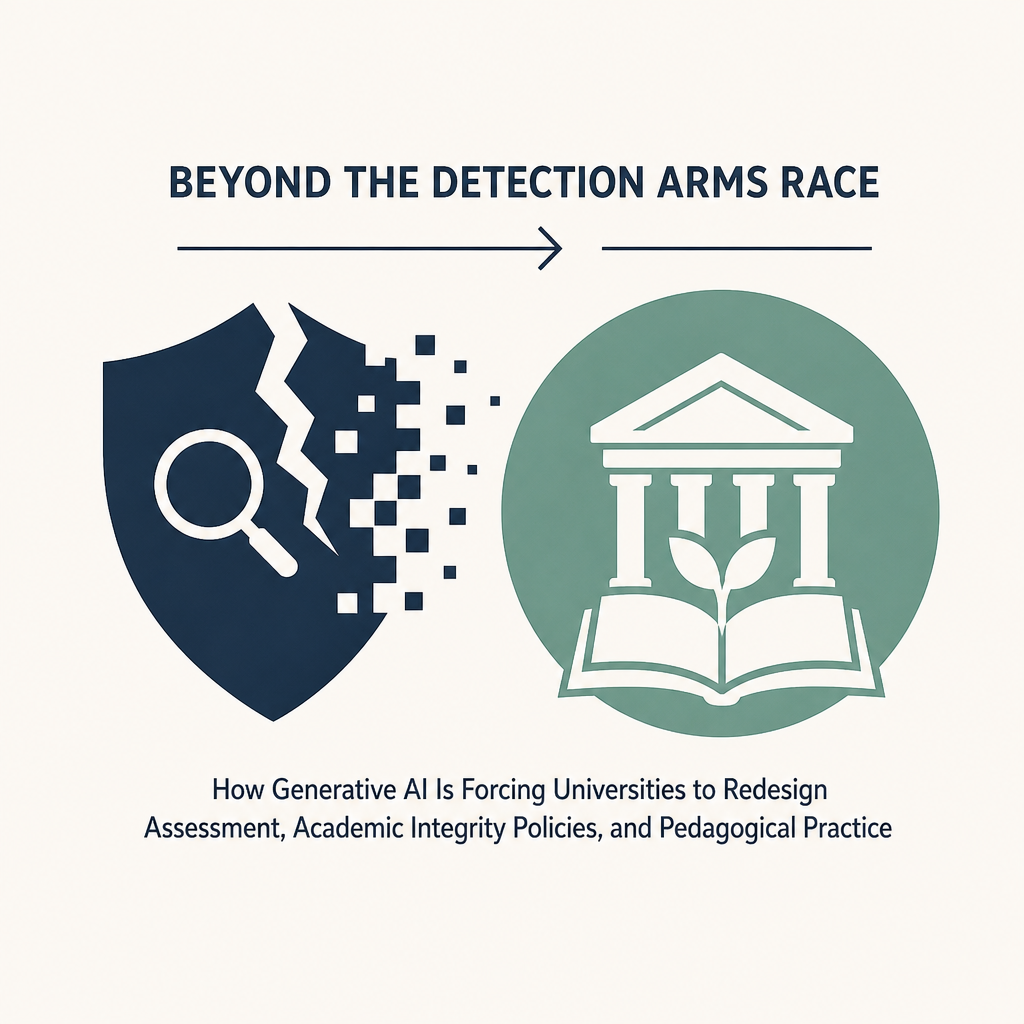
Introduction
When ChatGPT and its successors placed powerful text generation in the hands of every student with an internet connection, universities faced an existential question about their most fundamental unit of currency: the written assignment. The initial institutional response followed a familiar logic--if new technology enables cheating, build a tool that catches it. That logic produced a wave of AI detection software, embedded in plagiarism workflows and deployed at scale across campuses worldwide.
That experiment is now visibly unravelling. Research from Vietnam to Australia, sector guidance from TEQSA, and analyses from teaching-and-learning centers converge on a striking consensus: heavy reliance on AI detection tools is neither sufficient nor sustainable [1]. Detectors are inaccurate, easily circumvented, and prone to bias; false accusations carry real human costs; and the adversarial dynamic they create undermines the very integrity they claim to protect [1][2][3]. Meanwhile, student adoption of generative AI has reached near-universal levels, with 92% of UK undergraduates now using AI tools in some form [4].
The consequence is a profound institutional pivot--from policing to pedagogy. Universities are dismantling the detector-centric enforcement model and rebuilding assessment around process, verification, and authentic demonstration of learning [2][5]. This article examines why the detection paradigm failed, what the redesign movement looks like in practice, how academic integrity itself is being redefined, and what institutions must do to make the transition genuine rather than cosmetic.
 How AI is reshaping integrity, assessment in universities
The Cracking Foundations of the Detection Paradigm
Why Detectors Fall Short
The empirical case against AI detection tools has hardened considerably since their rapid adoption. Studies and sector reviews have repeatedly critiqued detectors for inaccuracy, susceptibility to circumvention, and linguistic discrimination--a concern that falls hardest on non-native English speakers, whose writing is disproportionately flagged as machine-generated [1]. Crucially, even the strongest technical argument for detection is undermined by a simpler problem: blind studies show that experienced human markers cannot reliably identify AI-generated work either, which reveals that the task facing higher education is harder than buying better tools [2].
The evidentiary implications are significant. Sector bodies such as the Mississippi Artificial Intelligence Network (MAIN) have concluded that a detector score should be treated as a "non-conclusive prompt for trained human review" and should "never independently trigger a zero, accusation, or disciplinary finding" [3]. Even Turnitin's AI Writing Report, embedded within a familiar similarity-review workflow, does not escape this limit--institutional integration does not turn a signal into proof [3]. When detector outputs cannot be treated as independent evidence of misconduct but only as "one signal among several in broader academic integrity processes," the entire enforcement architecture built on automated scores becomes ethically precarious [2]. Accusing a student of misconduct on the basis of a probability score the evidence cannot support is, as recent analysis puts it, "not a defensible pedagogical position"--and institutions are increasingly acknowledging as much [2].
Detection as an Arms Race
Beyond the evidentiary problem lies a structural one: detection invites evasion. As students learn what "triggers" detectors, they adapt--rewriting outputs, paraphrasing, blending human and machine text--so that detection becomes an arms race rather than a learning strategy [6]. This dynamic is exhausting for staff, inequitable for students, and, in the words of one assessment-design analysis, "pedagogically empty" [7]. A detection-first institutional stance implicitly communicates a belief that students will cheat and that the university's job is to catch them; the arms race that follows corrodes trust on both sides of the lectern [7].
The Scale of the Challenge: Student Adoption and the Legitimacy Gap
The urgency of redesign is driven by data on how thoroughly generative AI has penetrated student workflows. The Higher Education Policy Institute (HEPI) Student Generative AI Survey 2025 found that AI use among UK undergraduates surged to 92%--up from 66% in 2024--and that 88% now use generative AI tools for assessments [4]. Most students report that AI improves their learning, yet fewer than half feel supported by their institutions to use it effectively, and many remain unclear about what constitutes acceptable use [4].
This clarity gap exposes a structural weakness in the traditional integrity model. Many universities still operate a punitive framework in which students are held to high standards of referencing and originality without being given the educational tools to meet them--integrity training is often delivered passively through optional online resources or dense library guides that the students who need them most are least likely to access [4]. The predictable result is that honest mistakes escalate into misconduct referrals, and generative AI becomes the tempting shortcut for tasks students have never been taught how to approach legitimately [4]. There is also a persistent digital divide: wealthier, male, and STEM students are more likely to use AI confidently, compounding existing inequities in who benefits from the technology [4].
From Policing to Design: The Assessment Redesign Movement
What Redesigned Assessment Looks Like
If detection cannot secure integrity, assessment design must. Empirical work suggests this shift already reflects practitioner confidence: lecturers report low trust in unsupervised writing tasks but strong confidence in process-based, oral, and staged assessments--meaning many educators no longer see AI detection as a viable means of protecting the academic process at all [1]. The design principle is to make intended learning visible and verifiable: preserving AI-free performance where learning objectives demand it, while using process evidence and direct verification of critical outcomes elsewhere [3].
Flagship institutions have moved early and concretely. Stanford University shifted from traditional essays toward interactive, project-based evaluations that require students to apply theoretical knowledge to real-world problems--tasks that AI tools struggle to complete meaningfully [8]. Duke University established an "AI Ethics Committee" to keep institutional policies current and ensure students and faculty understand ethical boundaries [8]. The University of Australia's University of Sydney implemented oral examinations and group projects, formats that foster critical thinking and collaboration while lowering the risk of AI misuse and promoting deeper learning [8].
Shared Frameworks and Sector Coordination
The redesign movement is increasingly organized around shared frameworks rather than ad hoc experimentation. Australia's Tertiary Education Quality and Standards Agency (TEQSA) curates a national knowledge hub of case studies and resources, including Southern Cross University's assessment adaptation model, the University of Adelaide's "Don't be sorry, just declare it" declaration-based approach, the University of Queensland's partnership model for ethical AI use and its principles for criteria and standards in assessment, and RMIT University's "AI Assessment Venn" outcome-context-method framework [5]. At the theoretical level, scholars argue that universities can neither ban nor ignore generative AI--they must govern and design for it, treating the core challenge as one of institutional architecture rather than tool acquisition [9].
Underlying all of these efforts is a conceptual shift best described as moving "from detection to evaluative judgment": designing assessments that reward the learning institutions say they value, so that academic integrity is supported by the design of the task rather than by detection alone [2]. Institutions that approach this proactively--building shared rubric principles, reusable feedback workflows, and consistent expectations across courses--are the ones managing the transition without losing quality [7].
 PDF) Generative Artificial Intelligence in Tertiary Education: Assessment Redesign Principles and Considerations
Redefining Academic Integrity: From Suspicion to Competency
The redesign movement is accompanied by a redefinition of what integrity means. The focus is moving beyond a narrow definition of plagiarism toward a broader concept of ethical and transparent tool use: rather than banning AI, institutions are developing policies that require students to acknowledge and document their AI use--shifting the conversation from "did you cheat?" to "how did you use this tool responsibly?" [10]. This reframing depends on a culture of honesty built on proactive pedagogy rather than reactive detection [10].
Policy logic is evolving in parallel. MAIN's guidance articulates the emerging consensus: AI use is not inherently cheating--it becomes misconduct only when it violates a clear rule, replaces learning a student is required to demonstrate independently, or is misrepresented under institutional integrity standards, while some learning objectives legitimately require AI-free performance that schools should preserve [3].
The deeper philosophical shift is captured in a provocative reframing from the integrity community: perhaps integrity is not just about catching rule-breakers, but about designing educational environments where students want to do the right thing because they understand what it means--and because they were given the chance to learn how [4]. In a post-AI landscape, universities face a choice between tighter rules, tougher penalties, and ever-more surveillance on one hand, or leaning into their role as educators who treat ethical learning as something taught, modelled, practised, and expected [4].
The Institutional Dimension: Support, Capacity, and Policy
Assessment redesign does not happen through individual heroics; it requires institutional scaffolding. Evidence from Vietnamese universities shows that institutional support is decisive--clearer policies, training, and guidance significantly influence lecturers' willingness to adopt new assessment practices, indicating that responses to generative AI demand a multifaceted approach integrating pedagogical innovation with institutional and policy development [1]. The warning signs are equally clear on the demand side: staff confronting "unsustainable pressure" to redesign without resourcing, and students caught between assessments that no longer make sense and integrity regimes that no longer command legitimacy [2].
Faculty development infrastructure is emerging to fill this gap. The AI-Resistant Pedagogy Studio, a framework for redesigning assignments for an AI-augmented classroom, has been adopted as a faculty development resource at institutions across the United States--including Clemson University, South Dakota University, Washington University, Hood College, and the University of Houston-Downtown--shifting professional development programs away from detection and toward intentional pedagogical design [10]. Sector-level resource sharing, such as TEQSA's knowledge hub and the Australasian Academic Integrity Network's summary of institutional responses, accelerates diffusion of workable models [5].
 PDF) Generative Artificial Intelligence in Tertiary Education: Assessment Redesign Principles and Considerations
Equity and Access: The Hidden Divide in Redesign
An often-overlooked dimension of assessment redesign is equitable access to AI tools themselves. If redesigned assessments assume AI fluency, they can quietly privilege students who can afford premium subscriptions. The AI-Resistant Pedagogy Studio addresses this directly: an equitable approach requires designing assessments that do not depend on premium AI tools and explicitly teaching students to identify and critique algorithmic bias--designing for the baseline, so that if a tool is not institutionally provided, it is not required for the grade, complemented by campus-wide licenses and dedicated in-class lab time [10]. For institutions serving under-resourced populations, such as Hispanic-Serving Institutions, this equity lens is not optional but foundational [10]. It aligns with the broader finding that the digital divide in AI confidence tracks wealth, gender, and discipline, making equitable access a precondition for fair assessment in the AI era [4].
The Danger of Performative Reform
The pivot to redesign carries its own risks. Commentators describe generative AI in assessment as a "wicked problem" requiring "institutional permission" to solve--genuine change rather than incremental patching [2]. The most insidious failure mode is compliance-based reform: institutions under public pressure may perform redesign--rebranding assessments, adding viva requirements, issuing new AI policies--without changing the underlying pedagogy, then declare the problem solved. Such reform may reassure quality assurance systems while leaving the actual learning enterprise untouched [2]. Redesign also carries downstream consequences for policy, workload, and even the definition of academic quality, which institutions must resource honestly rather than absorb as unfunded mandates [7]. The lesson from the detector era applies here too: technical or procedural fixes adopted for reputational reasons, without pedagogical substance, tend to fail expensively.
Conclusion: The Assessment Is the Message
The story of generative AI in higher education is, at bottom, a story about what institutions believe education is for. A detection-first response says students cannot be trusted and must be surveilled--an approach now widely judged inaccurate, inequitable, and unsustainable [1][2][3]. An assessment-design response says students want to learn and that the institution's job is to make genuine engagement the path of least resistance [7]. That work is harder, but it produces better learning outcomes and a more honest, trusting institutional culture [7].
The emerging consensus across research, sector guidance, and institutional practice is remarkably coherent: secure integrity through design rather than surveillance; treat students as learners to be developed rather than suspects to be caught; teach ethical AI use as a competency rather than merely policing its misuse; and back pedagogical innovation with the policies, training, and resources that make it real [1][7][4][3]. How universities respond to AI in assessment sends a signal about what they believe education is for--and the institutions that get this right will be those that treat the AI disruption not as a security crisis to be managed, but as a long-overdue invitation to redesign learning itself.
References
- 1.
-
2.
From Detection to Redesign: How Universities Are Dismantling the AI Detector Experiment and Rebuilding Assessment for the Generative AI Era | Reducates. (n.d.). Retrieved https://reducates.com/ai-digests/from-detection-to-redesign-how-higher-education-institutions-are-abandoning-ai-detection-tools-and-rebuilding-assessment-models-for-the-generative-ai-era
- 3.
- 4.
- 5.
- 6.
- 7.
- 8.
- 9.
-
10.
The AI-Resistant Pedagogy Studio: Redesigning Assignments for an AI-Augmented Classroom - Faculty Focus | Higher Ed Teaching & Learning. (n.d.). Retrieved https://www.facultyfocus.com/articles/educational-assessment/the-ai-resistant-pedagogy-studio-redesigning-assignments-for-an-ai-augmented-classroom