Introduction
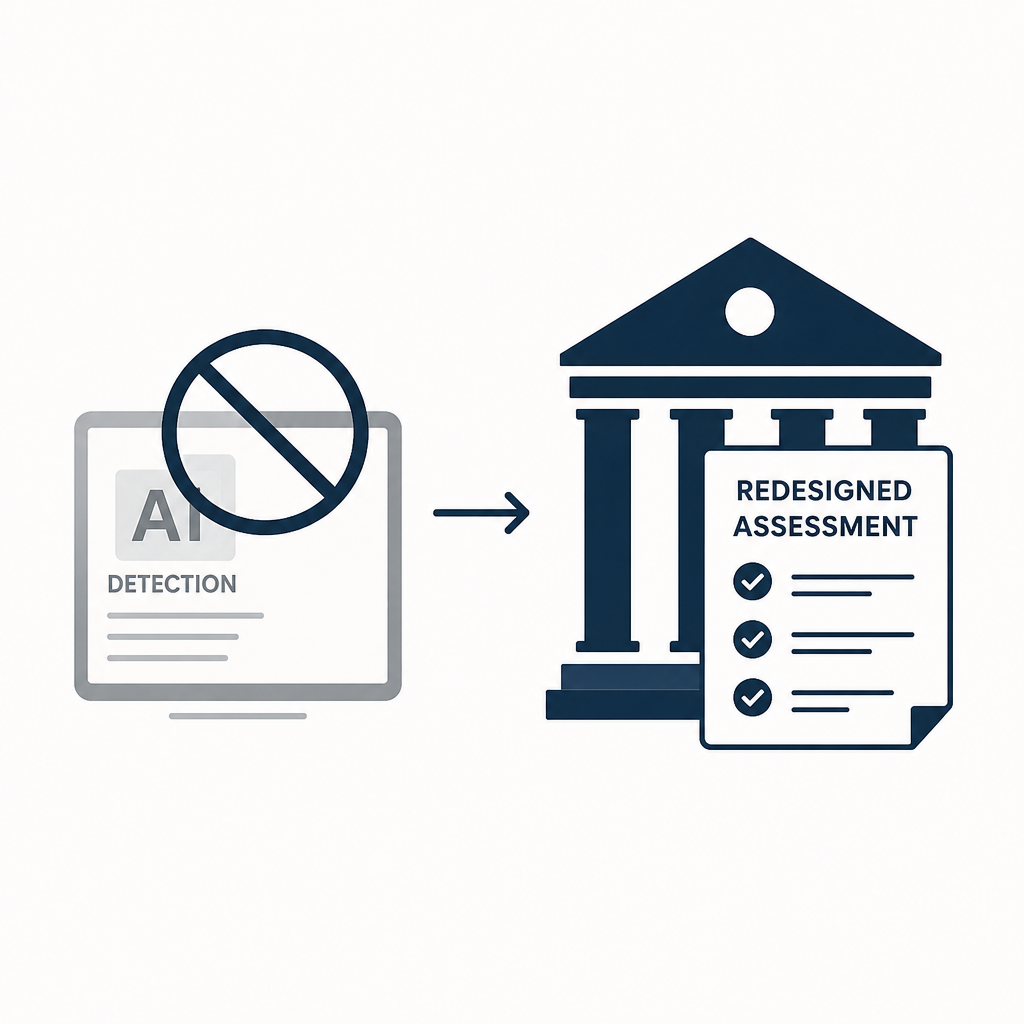
When ChatGPT exploded into public consciousness in late 2022, higher education's first instinct was defensive: find a tool that could catch the machines. Three years later, that experiment is quietly winding down. Across the United States, the United Kingdom, and Australia, universities are retiring AI-writing detectors as arbiters of academic truth, citing poor accuracy, demonstrated bias against non-native English writers, and the ease with which detection can be defeated by simple paraphrasing tools [1]. The pivot is no longer fringe commentary--it is institutional policy at some of the world's most prominent universities, from MIT to the University of California system [2].
What replaces detection is more interesting than what it replaces. Institutions are demoting detector scores to "triage data"--one weak signal among many inside a broader integrity process--while rebuilding the evidentiary base of assessment around process-based artifacts: drafts, version histories, staged submissions, and oral verification [1]. Structured permission frameworks such as the AI Assessment Scale are giving students clarity about what AI use is acceptable, and assessment itself is being redesigned to make genuine learning visible in ways a polished final document never could [1][3].
This article examines the retreat from detection across four interconnected fronts: the collapse of confidence in detection technology, the resulting policy pivot at major institutions, the redesign of assessment around process and authenticity, and the deeper cultural shift toward teaching students to use AI ethically. Together, these developments suggest that the universities thriving in the generative AI era are not those building higher surveillance walls, but those redesigning the educational experience to make real learning worth doing--and visible [3].

The Collapse of the Detection Consensus
Accuracy Failures and the False Positive Problem
The core problem with AI detection tools is blunt: they do not work reliably enough to justify their consequences. Writing in early 2024, educator and researcher Dr. Leon Furze argued bluntly that "AI detection in education is a dead end"--that these tools are not only largely ineffective but also "a short-term, ill-advised, and possibly unethical approach to academic integrity" given their limitations [4]. By 2025 and 2026, that assessment had moved from expert opinion to institutional action, with US universities openly moving away from detection tools amid concerns that the systems wrongly flag genuine student work as machine-generated [5].
The empirical evidence is damning. A major real-world study published in PLOS ONE tested AI-generated exam submissions inside an actual university assessment system and found that most AI-written submissions went undetected--and that the AI submissions frequently received higher grades than authentic student work [6]. Meanwhile, the human cost of detection ran in the opposite direction: false positives fell disproportionately on students who wrote their own work but used simple sentence structures, formal academic language, or English as a second language [6]. Massachusetts Institute of Technology has stated the conclusion plainly: "AI Detectors Don't Work" [2].
The Evasion Arms Race
Even where detectors functioned as designed, they were trivially defeated. Paraphrasing tools specifically built to launder AI-generated text through detector-evolving rewrites made the technology an arms race that detection was always going to lose [1]. At the same time, the boundary between "student work" and "AI work" dissolved in practice. During a University of British Columbia teaching-and-learning session on rethinking assessment, presenters noted that trained evaluators were unable to distinguish AI-created content from student-created content in hybrid assignments--and that paid AI assistants with long memory of a user's style can now produce highly convincing personal reflections on demand, even mimicking established reflection models like Gibbs [7].
Pervasive Use Makes Prohibition Incoherent
The final blow to the detection paradigm is demographic. The 2026 HEPI survey found that 94% of UK undergraduates now use generative AI in assessed work [8]. When nearly every student uses the technology, detection ceases to be a tool for catching outliers and becomes a mechanism for arbitrary enforcement. As Professor Nada Kakabadse has argued, the traditional unsupervised take-home essay as a test of unaided student writing has fundamentally changed, and the answer is neither a ban nor ever-more-problematic detection systems, but a redesign of assessment around how students think with AI [8].
From Verdict to Signal: The Institutional Policy Pivot
Who Is Walking Away--and Why
A 2026 snapshot of institutional practice reveals a consistent pattern across continents [1]. In the United States, MIT has explicitly recommended focusing on human-centered learning and transparent AI-use policies rather than unreliable detection [2]. The University of California system--notably UC San Diego, UC Berkeley, and UCLA--has deactivated or opted out of AI detection features, emphasizing clear guidelines and assignment design instead [2]. The University of Pittsburgh disabled its detection tool entirely, stating it was not reliable enough to deploy "without a substantial risk of false positives" [2]. In Australia, Curtin University will disable AI detection beginning January 1, 2026, framing the move as a step toward fostering trust and continuously improving assessment [2].
Crucially, these decisions were not made in a vacuum. Several institutions paused or disabled detection only after internal disputes and demonstrable student harm from overreliance on a single tool's output [1]. The reputational and legal exposure of false accusations--leveled disproportionately at vulnerable student populations--proved as decisive as the technical shortcomings [1][5].
Detectors as Triage Data, Not Verdicts
Where detectors remain in use, their role has been fundamentally redefined. Detection scores are now treated as "triage data": one input among many inside a wider academic integrity process, rather than grounds for accusation on their own [1]. The logic that has emerged across institutions is straightforward: if a student cannot explain their own argument, the detector score is irrelevant--the gap between the student and the submitted work is the real evidence [1]. Many universities now rely less on automated detection and more on faculty judgment, draft reviews, and oral assessment methods to establish what a student actually knows and can do [1].

Redesigning Assessment: Process, Authenticity, and Transparency
Making the Writing Process Visible
The most constructive response to undetectable AI is to stop grading artifacts in isolation and start assessing processes. Universities are rebuilding assessment around version histories, staged submissions, and in-class verification of learning--making the journey of a piece of work visible in ways a final document never can [1]. Colleges increasingly permit AI use provided students disclose their prompts and can explain their edits, turning AI engagement itself into an assessable skill [1]. The goal, as one synthesis of assessment guidance puts it, is for students not merely to produce an answer but to show how they reached it [6].
Concretely, this means replacing generic essay prompts with richer designs. A simple "discuss the causes of climate change" question may no longer suffice; a stronger assessment asks students to apply the topic to a local case, compare two sources, explain their reasoning in class, submit drafts and reflections, defend the argument orally, or connect theory to personal fieldwork or lab experience [6]. The Centre for Teaching, Learning and Technology at the University of British Columbia has been among the institutions training faculty in exactly these strategies--assessments that support critical thinking, transparency, and process-based learning rather than detection or prohibition [7].
Authenticity Reconsidered
Scholarship is converging on the same conclusion. A 2025 peer-reviewed paper in Education Sciences argues that higher education must move decisively away from detection-focused responses and toward assessments that authentically reflect contemporary professional practice--environments where generative AI and other emerging tools are integral to knowledge work, not intrusions upon it [9]. Authenticity, the authors contend, must be reconceptualized: no longer merely replicating workplace tasks, but preparing students to work ethically, reflectively, and adaptively with the full range of tools and challenges of modern professional practice [9].
Structured Permission: The AI Assessment Scale
Redesign also requires clarity about what is allowed. Transparent AI-use frameworks such as the AI Assessment Scale give instructors and students a shared vocabulary for specifying permitted AI engagement at each level of an assignment--from none, to planning assistance, to full AI collaboration with disclosure [1]. This replaces the corrosive ambiguity of the early ChatGPT years, when students operated in a gray zone of unspoken rules and instructors enforced policies they could not actually verify [1][3].

The Deeper Challenge: Assessment as a 'Wicked Problem'
Why Surface-Level Fixes Won't Hold
If there is a cautionary note in the emerging consensus, it is against mistaking redesign for a technical fix. The UK Higher Education Policy Institute warns that generative AI is increasingly understood as a "wicked problem"--one not amenable to simple solutions like prohibition, requiring institutional permission to innovate, iterate, and even compromise in assessment design [10]. HEPI cautions that reputational protection demands meaningful redesign, not "simply substituting written assessments with oral presentations or similar surface-level changes that ultimately reproduce the same underlying problems in a different format" [10]. Universities need to revisit the purpose, design, and resourcing of assessment itself, rather than treating redesign as a salve for reputational anxiety [10]. The Quality Assurance Agency's advice points in the same direction: institutions need sustainable assessment strategies that move beyond detection alone, grounded in principled redesign rather than reactive policy [10].
The cost of getting this wrong is real. Compliance-driven reform--keeping old assessments while adding surveillance, then swapping surveillance for oral exams when detection fails--consumes institutional resources without addressing the underlying question: if AI can produce the artifact, what exactly is the assessment measuring [8][10]?
The Cultural Shift: Teaching Ethical AI Use
Alongside policy and assessment changes, institutions are pursuing a cultural transformation: educating students for ethical AI use rather than policing them for any AI use [3]. This means clear institutional policies, faculty support and training, and transparency about expectations--so students know what is allowed and teachers are equipped to design for it [6]. It also means honesty about the new realities of the tools themselves, including capabilities like AI memory that can generate convincing reflective writing on request, which educators must design assessments to account for [7]. As one assessment guide concludes: AI can produce answers; higher education must assess thinking [6].
Conclusion
The abandonment of AI detection tools marks not a retreat from academic integrity but a maturation of it. Three years of evidence demonstrated that detectors were inaccurate, biased against non-native English writers, easily evaded, and incapable of keeping pace with tools embedded in students' everyday workflows [1][6][4]. Institutions from MIT to Curtin have drawn the obvious conclusion and are redirecting their energy toward approaches that actually work [2].
What is emerging in detection's place is a coherent new paradigm: detectors demoted to weak signals within broader integrity processes, assessment rebuilt around process evidence--drafts, version histories, oral defense, and disclosure of AI use--and frameworks like the AI Assessment Scale that replace ambiguity with structured permission [1][3]. The scholarship reinforces the direction of travel, reframing authenticity as preparation for professional worlds where AI is a standard tool, not a forbidden one [9].
The hard work, as HEPI and the QAA remind the sector, lies ahead: genuine assessment reform means revisiting purpose and design, not swapping one superficial fix for another [10]. But the strategic insight is already clear. The institutions that will thrive in the generative AI era are not those building higher surveillance walls, but those redesigning the educational experience so that genuine learning is visible--and worth doing [3]. Assessment is not ending; it is beginning its most significant redesign in a generation [6].
References
-
1.
Beyond Detection: How Universities Are Abandoning AI-Writing Detectors and Redesigning Assessment for the Generative AI Era | Reducates. (n.d.). Retrieved https://reducates.com/ai-digests/beyond-detection-how-universities-are-abandoning-ai-writing-detectors-and-redesigning-assessment-for-the-generative-ai-era
-
2.
The shift in higher education: Universities are stopping AI detection tools and recommending alternatives to improve assessment. | Prof. Ali Abouelnour. (n.d.). Retrieved https://www.linkedin.com/posts/prof-ali-abouelnour-389b673b_highereducation-aiineducation-academicintegrity-activity-7373238802154332160-6CKR
-
3.
Beyond Detection: How Universities Are Redesigning Assessment and Academic Integrity Policies in the Post-Generative AI Era | Reducates. (n.d.). Retrieved https://reducates.com/index.php/ai-digests/beyond-detection-how-universities-are-redesigning-assessment-and-academic-integrity-policies-in-the-post-generative-ai-era
- 4.
- 5.
- 6.
- 7.
- 8.
- 9.
- 10.