Introduction
When generative artificial intelligence first burst into the mainstream academic consciousness, the immediate institutional reflex was often prohibition. Fearing academic integrity breaches and uncertain about the technology's implications, many universities rushed to implement campus-wide bans. However, as the dust settles, a consensus is rapidly emerging among higher education leaders: banning AI is not a sustainable strategy, but rather a dereliction of educational duty.
Today, the narrative is shifting dramatically from restriction to integration. Institutions are recognizing that AI literacy--the ability to understand, critically evaluate, and responsibly apply AI--is no longer a niche technical skill but a core educational competency [1]. From national policy frameworks to individual faculty workshops, a comprehensive blueprint is being drafted to weave AI literacy seamlessly into the fabric of undergraduate education. This transition requires higher education to move beyond surface-level adaptations and fundamentally restructure how core curricula are designed, taught, and assessed.
The Pitfalls of Prohibition: Why Bans Fall Short
The initial impulse to ban AI tools in higher education was rooted in a desire to maintain academic standards, but it overlooked a glaring reality: these tools are rapidly becoming ubiquitous in the professional world. As institutional leaders have begun to note, failing to develop proactive policies and guidelines around AI almost certainly leads to a default campus-wide ban, which ultimately deprives students of the opportunity to develop an extremely marketable skill [2].
By banning AI, institutions effectively push student usage underground, preventing educators from guiding students on how to use these tools ethically and effectively. Without structured instruction, students risk disseminating misinformation, over-relying on AI-generated insights, and overlooking critical ethical implications [1]. A prohibitionist stance leaves graduates unprepared for a workforce where AI proficiency is increasingly assumed, ultimately doing a disservice to both the students and the industries they will enter.
.png) Blueprint for Action:AI Literacy for All | EDSAFE AI
Blueprint for Action:AI Literacy for All | EDSAFE AI
Defining the Blueprint: What Does AI Literacy Actually Mean?
To embed AI literacy into a curriculum, institutions must first clearly define what it entails. AI literacy extends far beyond simply knowing how to prompt a chatbot; it encompasses a holistic understanding of the technology's mechanics, limitations, and societal impacts. Recent frameworks propose organizing AI literacy into distinct, progressive dimensions. For instance, the AI in Teaching and Learning framework categorizes literacy into four essential dimensions: "know and understand," "use and apply," "create and evaluate," and "AI ethics" [3].
In specialized fields, these dimensions are expanding into highly structured pillars. In public health education, for example, experts have proposed a five-pillar framework encompassing technical foundations, ethical and regulatory literacy, experiential learning, governance and policy, and equity and access [1]. This ground-up approach ensures that students grasp basic principles like machine learning and natural language processing, while simultaneously developing critical evaluation skills through case studies highlighting algorithmic bias, data misuse, and privacy concerns [4]. By defining these competencies clearly, institutions can avoid vague mandates and instead create targeted, assessable learning outcomes.
The Pedagogy of Embedding: Lessons from Academic Literacies
The challenge of integrating AI into existing degree programs is not entirely unprecedented. Higher education has previously navigated the embedding of other cross-cutting literacies, such as academic writing and, more recently, climate literacy. Research on embedding academic literacies into degree curricula provides a highly relevant blueprint for AI integration.
Scholars note that academic literacy has a "core role" in the construction of knowledge but is often ignored in favor of a narrower focus on content [5]. The solution lies in recognizing the "symbiotic relationship" between a literacy and the discipline content. The first stage of embedding involves determining the specific literacy practices students are expected to develop by the time they complete a program, and then distributing these practices naturally across different assessment items in core courses [5]. Rather than relegating AI to a standalone introductory module, institutions must map where AI tools and critical evaluations arise most naturally as prerequisites to engaging with core disciplinary content. This approach mirrors successful strategies used in embedding climate literacy across core subjects, utilizing horizontal integration rather than isolated add-on courses [6].
 Strategies for Addressing AI Literacy in Higher Education | Download Scientific Diagram
Cross-Disciplinary Integration: AI Across the Curriculum
A critical mistake institutions make is treating AI literacy as the exclusive domain of computer science departments. The emerging consensus is that AI literacy must be universal. As Erin Mote, executive director of the EDSAFE AI Alliance, notes: "We believe that AI literacy is critical throughout all domains and is as important in an English class as it is in a Computer Science class" [7].
This cross-disciplinary approach is already being formalized in national blueprints. Policy recommendations emphasize embedding AI concepts across all subjects--from analyzing bias in AI-generated texts in English classes to exploring the ethical implications of algorithmic policing in social studies [7]. Globally, countries like China, Singapore, and South Korea have already launched national strategies that embed AI literacy across school curricula and teacher training, serving as a warning to other nations that failing to make similar investments risks falling behind in workforce readiness and ethical AI governance [8]. To keep pace, undergraduate programs must dismantle disciplinary silos and encourage faculty across the humanities, sciences, and social sciences to collaborate on AI integration strategies.
Institutional Strategies for Actionable Implementation
Moving from theory to practice requires coordinated institutional action. Research initiatives, such as the collaborative project led by Ithaka S+R involving 45 colleges and universities, highlight that institutions are ready to shift from reactive to proactive engagement [9]. However, effectively integrating AI literacy into the curricula requires actionable pathways tailored to specific institutional contexts [9].
To achieve this, institutional leaders must deploy several key strategies:
- Investing in Faculty Development: Expanding AI-focused professional development is non-negotiable. Faculty cannot be expected to teach AI literacy if they do not possess it themselves. Workshops that help educators map their existing learning outcomes to AI literacy dimensions are proving highly effective [3].
- Creating Infrastructure and Hubs: Establishing regional or campus "AI learning hubs" that connect academic departments with industry partners can provide the necessary technical support and real-world context for curriculum design [7].
- Focusing on Equity: Institutions must recognize that AI adoption can exacerbate social inequities if not carefully managed. Curricula must include training in bias detection and mitigation, ensuring all students have equitable access to AI tools and training [1][8].
- Program-Level Mapping: Rather than leaving integration to individual faculty, institutions should mandate program-level audits. By identifying where AI competencies fit naturally into core assessments, universities can ensure cohesive, progressive skill development rather than a fragmented student experience [5][3].
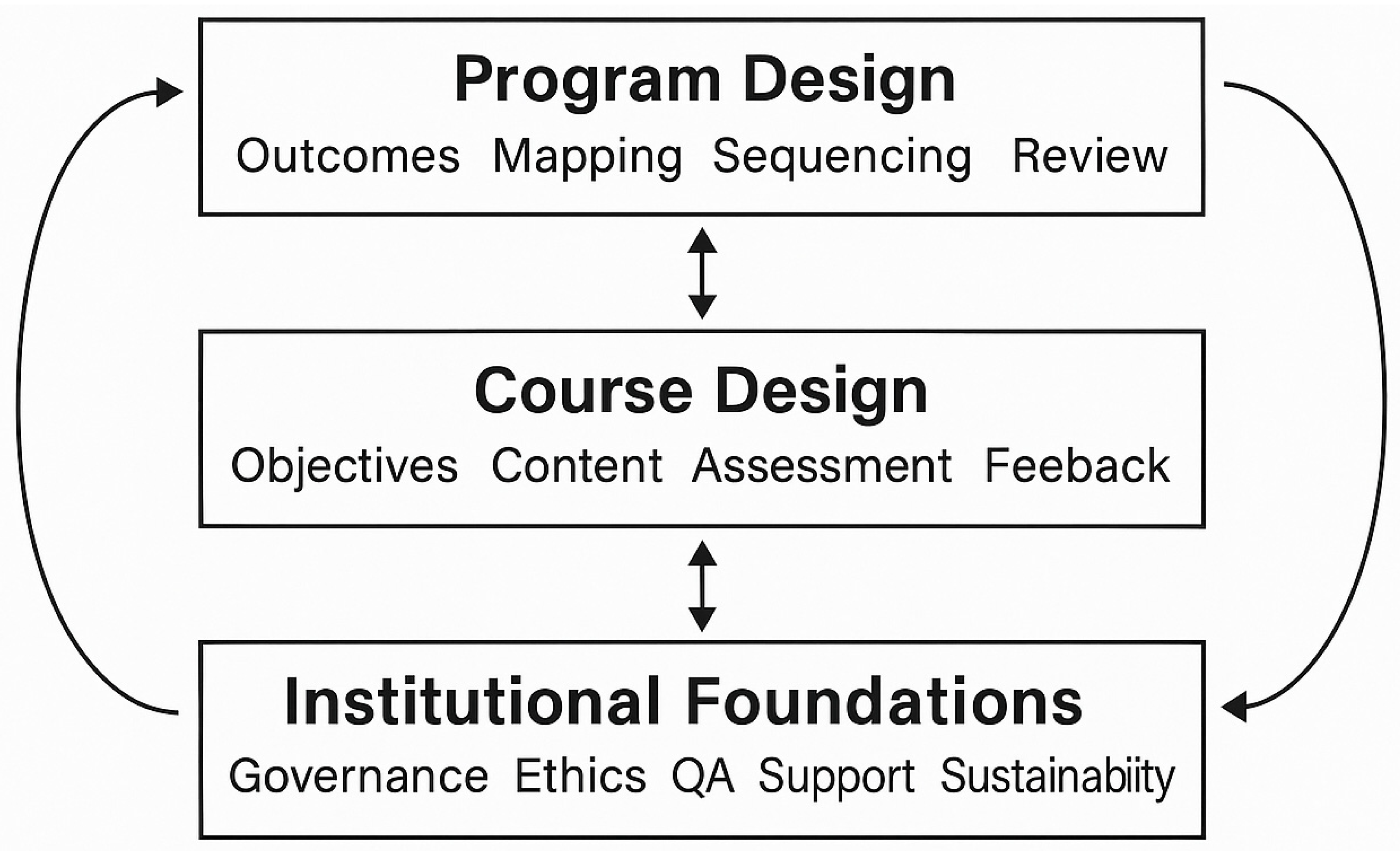 AI-Enabled Framework for Program and Course Design in Higher Education[v1] | Preprints.org
Conclusion
The journey from banning artificial intelligence to blueprinting its integration represents a necessary maturation in higher education's response to disruptive technology. By recognizing AI literacy as a core competency--on par with academic writing or quantitative reasoning--universities can ensure their graduates are not merely passive consumers of technology, but critical, ethical, and capable users.
Achieving this vision requires abandoning the siloed, add-on approach in favor of deeply embedding AI literacy into the DNA of core undergraduate curricula. Through strategic investments in faculty training, cross-disciplinary collaboration, and structured program-level mapping, institutions can bridge the growing gap between AI advancements and academic preparedness. In doing so, they will fulfill their ultimate mandate: equipping the next generation of leaders with the skills and agency required to navigate and shape an AI-driven future.
References
- 1.
- 2.
- 3.
- 4.
- 5.
- 6.
-
7.
New national blueprint calls for AI literacy in every U.S. classroom to prepare students for an AI-driven future — EdTech Innovation Hub. (n.d.). Retrieved https://www.edtechinnovationhub.com/news/new-national-blueprint-calls-for-ai-literacy-in-every-us-classroom-to-prepare-students-for-an-ai-driven-future
-
8.
New national blueprint calls for AI literacy in every U.S. classroom to prepare students for an AI-driven future — EdTech Innovation Hub. (n.d.). Retrieved https://sealion-lavender-ar2n.squarespace.com/news/new-national-blueprint-calls-for-ai-literacy-in-every-us-classroom-to-prepare-students-for-an-ai-driven-future
- 9.