Introduction
Few drug classes in modern medicine have traveled as far, as fast, as the glucagon-like peptide-1 (GLP-1) receptor agonists. Developed originally as incretin-based therapies for type 2 diabetes, agents such as semaglutide, liraglutide, dulaglutide, and tirzepatide have since become the defining pharmacological treatments of the obesity era--and household names in the process. Yet the scientific and commercial story is now evolving well beyond weight loss. Researchers and pharmaceutical companies are exploring GLP-1-based therapies across a remarkably broad range of conditions, including cardiovascular disease, addiction, inflammatory disorders, liver disease, and neurodegenerative conditions such as Alzheimer's disease [1].
This expansion is not simply commercial ambition; it is rooted in biology. GLP-1 receptors are distributed far beyond the pancreas, populating the heart, vasculature, liver, kidneys, and multiple regions of the brain. As a result, clinical trials designed to answer one question--can these drugs lower blood sugar, or help patients lose weight?--keep revealing another: they appear to protect organ systems that obesity and metabolic dysfunction damage over decades. Regulatory agencies including the U.S. Food and Drug Administration (FDA), the European Medicines Agency (EMA), and the UK's Medicines and Healthcare products Regulatory Agency (MHRA) are now navigating a rapidly shifting evidence landscape in which therapies originally approved for diabetes may eventually span multiple therapeutic categories [1].
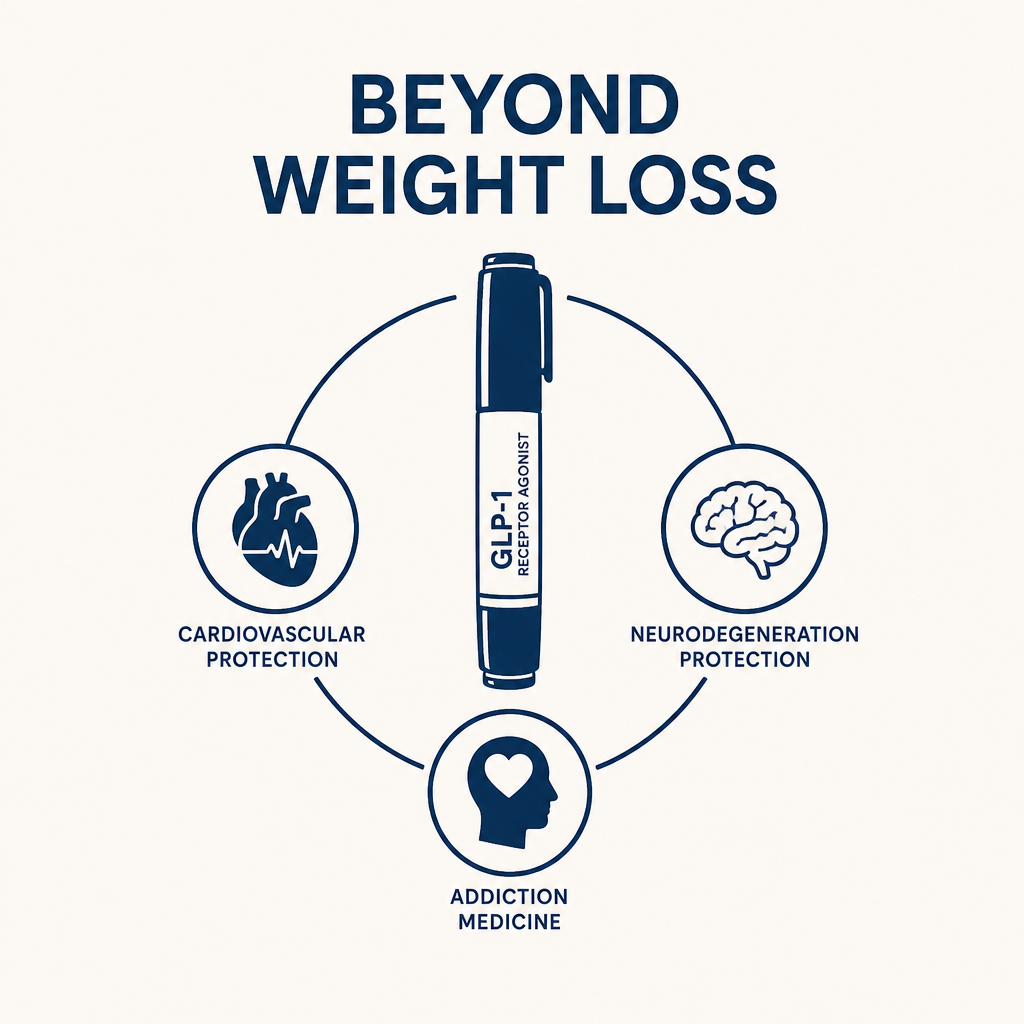
This article examines the evidence behind three of the most consequential frontiers--cardiovascular protection, neurodegeneration, and addiction medicine--and considers what they collectively suggest about the future of chronic disease management.
 The Expanding Universe of GLP-1 Medications: A Revolution Beyond Diabetes and Weight Loss
Cardiovascular Protection: The Evidence That Changed the Conversation
From Safety Requirement to Surprising Benefit
The cardiovascular story of GLP-1 receptor agonists began, ironically, with regulatory caution. In 2008, the FDA required the drug development industry to demonstrate that new antidiabetic therapies were not associated with unacceptable increases in cardiovascular risk, effectively mandating large cardiovascular outcome trials (CVOTs) for every new agent in the class [2]. What those trials ultimately revealed exceeded anyone's expectations: rather than merely proving cardiovascular safety, several GLP-1 receptor agonists demonstrated meaningful cardiovascular benefit.
The landmark trials tell a consistent story. LEADER showed that liraglutide reduced major adverse cardiovascular events (MACE) by 13% in patients with type 2 diabetes, a benefit driven largely by fewer cardiovascular deaths. SUSTAIN-6 found that once-weekly semaglutide lowered heart attack, stroke, and cardiovascular death by 26%, with stroke risk dropping an extraordinary 39%. REWIND demonstrated that dulaglutide reduced risk by 12% even in patients who had not yet experienced a cardiovascular event--evidence of benefit in primary prevention [3]. Taken together, systematic reviews of these trials concluded a 12-14% reduction in composite cardiovascular outcomes among patients with type 2 diabetes [2].
Benefits Beyond Blood Sugar--and Beyond the Scale
Perhaps the most consequential finding came from SELECT, a trial that enrolled more than 17,000 overweight or obese patients with established atherosclerotic cardiovascular disease but without diabetes. Semaglutide 2.4 mg weekly produced a 20% relative risk reduction in MACE--cardiovascular death, nonfatal myocardial infarction, and nonfatal stroke--compared with placebo [3][4]. These benefits emerged independent of glycemic effects, and the Kaplan-Meier survival curves began to diverge before significant weight loss would have been expected to occur [4].
That timing matters, because it undermines the assumption that cardiovascular protection is merely a downstream consequence of shedding pounds. In LEADER and SUSTAIN-6, patients lost a modest 2-4 kilograms on average--yet showed robust reductions in major adverse events. The evidence points instead to a multi-layered mechanism: anti-inflammatory action, anti-atherogenic effects, endothelial protection, and plaque stabilization that operate independently of glucose or kilograms lost [3][5]. Notably, individual agents differ in their receptor pharmacokinetics, which may explain why semaglutide, liraglutide, and dulaglutide have demonstrated cardiovascular superiority while exenatide ER showed safety but not benefit--an important reminder that "GLP-1" is not a monolithic category [3]. Currently, only these three agents are approved for cardiovascular disease prevention [2].

An Expanding Cardiovascular Portfolio
Beyond atherosclerotic disease, the evidence base now touches heart failure, chronic kidney disease, and metabolic liver disease. Clinical data support improvements in heart failure with preserved ejection fraction (HFpEF)--in symptoms, functional capacity, and cardiac remodeling--though findings in heart failure with reduced ejection fraction have been neutral or, in some analyses, concerning, and mechanisms of benefit versus harm across heart failure phenotypes remain uncertain [4]. Kidney protection has been demonstrated, and trials of metabolic dysfunction-associated steatohepatitis (MASH) have shown histologic resolution of the disease with fibrosis improvement [4]. Tirzepatide, a dual GLP-1/glucose-dependent insulinotropic polypeptide (GIP) agonist, has also demonstrated significant MACE reduction in its own outcome trial, and has received FDA approval for obstructive sleep apnea [4][5]. The emerging picture is of a drug class that functions less as a metabolic treatment with incidental benefits and more as a genuine cardiovascular medicine.
The Brain Frontier: Neurodegeneration and Neuroprotection
Why Neurologists Became Interested
If the cardiovascular evidence is mature, the neurological evidence is younger and more provisional--but biologically compelling. Postmortem studies have confirmed GLP-1 receptor expression in human brain tissue, with neuronal expression in the hippocampus and cortex and additional expression on astrocytes and microglia, the brain's immune cells [6]. Through activation of these receptors, GLP-1 receptor agonists may influence a wide range of neurobiological processes: modulating neurotransmitter release, supporting neurogenesis, enhancing synaptic function, reducing neuroinflammation, and improving brain energy metabolism. Their effects on vascular function may offer additional protection against cerebrovascular damage, a common contributor to cognitive decline [7].
Preclinical work has been strikingly consistent. In rodent models of Alzheimer's disease, GLP-1 receptor agonists have been linked to reduced amyloid-beta deposition, diminished tau hyperphosphorylation, less neuroinflammation, and improved performance on memory and learning tests [7]. A recent systematic review of preclinical stroke models found that GLP-1 receptor agonists significantly reduced infarct volumes and improved functional recovery after ischemic injury [7].
Encouraging Signals, Sobering Caveats
Human evidence, however, remains a work in progress. On the encouraging side, biomarker studies show robust target engagement: semaglutide has been shown to significantly reduce Alzheimer's-relevant biomarkers including p-tau181 and p-tau217. In Parkinson's disease, lixisenatide demonstrated disease-modifying potential, with motor benefits persisting even after drug washout--a pattern that, if confirmed, would suggest true modification of disease course rather than symptomatic relief. Liraglutide, meanwhile, reduced brain volume loss by approximately 50% in an Alzheimer's trial [6]. Early human observational data have also hinted at reduced dementia risk among diabetes patients using GLP-1 receptor agonists [7].
Yet the field's honest assessment is more tempered. While biomarker effects are clear, translation to clinical endpoints has been inconsistent, highlighting the well-known difficulties of neurodegenerative drug development. GLP-1 receptor agonists nonetheless represent one of the most advanced drug-repositioning efforts ever mounted from metabolic disease to neurodegeneration, with multiple large-scale clinical trials completed and a well-established safety profile in large populations supporting continued investment [6].
 The expanding role of GLP-1 receptor agonists: a narrative review of current evidence and future directions - eClinicalMedicine
An Unexpected Frontier: Addiction Medicine
From Observation to Evidence
One of the more surprising areas of investigation is addiction. Early clinical observations and preclinical studies suggest that GLP-1 receptor agonists may influence reward signaling pathways in the brain, potentially reducing cravings associated with alcohol, nicotine, and other addictive substances [1]. In rodent models, the hypothesis has received substantial support: mice and rats showed decreases in addiction-related behaviors for alcohol, nicotine, amphetamines, and cocaine while on GLP-1 receptor agonists. The notable exception was opioids, where efficacy appeared more limited compared with other substances [8].
Human results have been less consistent overall--with one striking exception: alcohol use disorder (AUD). A recent randomized clinical trial followed patients with AUD who were not actively seeking addiction treatment but were taking semaglutide for weight loss. Over nine weeks, participants reported reductions in heavy drinking days, drinks per drinking day, and weekly alcohol cravings--along with reduced cigarette use. Critically, these significant findings were independent of body mass index, suggesting the effect was not simply a byproduct of weight loss [8]. Neuroimaging from related work showed a statistically significant reduction in alcohol cue reactivity in the treatment group compared with placebo, as well as reduced dopamine transporter availability [8]. Subsequent analyses, including one examining social media posts from people taking semaglutide or tirzepatide, found many users spontaneously reporting reduced alcohol cravings or consumption, fewer binge-drinking days, and lower scores on the Alcohol Use Disorders Identification Test (AUDIT) [8].
The Reward Circuitry Puzzle
Mechanistically, the addiction findings present a genuine scientific puzzle. Surveys of GLP-1 receptor levels in the brain have revealed only modest expression on the midbrain dopamine neurons and their target neurons in the nucleus accumbens--the circuits primarily affected by addictive drugs. This has led researchers to suspect that other brain regions with far higher receptor densities drive the anti-craving effects. Chief among these is the interpeduncular nucleus (IPN), which contains some of the highest concentrations of GLP-1 receptors in the brain, alongside high levels of mu-opioid receptors, nicotinic acetylcholine receptors, and CB1 cannabinoid receptors--all of which regulate the actions of addictive drugs [9]. Untangling this circuitry may yield important new insights not only into addiction treatment but into how the use of addictive drugs, metabolic disturbance, and diseases like diabetes intersect [9].
Important caveats remain. GLP-1 receptor agonists are not approved treatments for substance use disorders, and further trials will be required before any such indication could be pursued. Experts suggest the most promising patient population is those with alcohol use disorder, rather than other substance use disorders [8].
A Unifying Framework: Chronic Disease as Connected Biology
One Drug Class, Many Diseases--One Explanation
What links atherosclerosis, Alzheimer's disease, alcohol addiction, liver fibrosis, and obesity? Increasingly, researchers argue that conditions once treated in isolation are biologically interconnected through shared metabolic and inflammatory pathways [1]. GLP-1 receptor biology sits squarely at this intersection. At the cellular level, GLP-1 receptor activation triggers cascades with broad protective effects: cAMP/PKA signaling promotes cell survival, PI3K/Akt pathways inhibit programmed cell death, and emerging evidence suggests receptor activation upregulates APE1, an enzyme critical for DNA base excision repair and genomic stability [10]. This convergence explains why a single drug class could plausibly influence organ systems as disparate as the myocardium, the cortex, and the mesolimbic reward pathway.
This reframing has profound implications. Rather than developing therapies for a single condition, the field may be moving toward medicines designed for complex, multi-system health outcomes--and toward a vision of medicine in which healthspan, not merely lifespan, is the primary endpoint [10]. Even the chemistry is advancing to support this ambition: in 2025, University of Utah chemists reported the discovery of PapB, a radical SAM enzyme capable of macrocyclizing GLP-1-like peptides into tighter, more stable ring structures, potentially enabling next-generation drugs with improved receptor binding, longer half-lives, and greater resistance to enzymatic degradation [10].
Barriers and Open Questions
A balanced assessment must also acknowledge the obstacles. High drug cost and insurance restrictions remain significant barriers to access [4]. Real-world adherence is challenging: gastrointestinal intolerance is common, with discontinuation rates exceeding 40% in some real-world studies, and the durability of benefit after discontinuation is unknown [4]. Long-term safety uncertainties persist, particularly in vulnerable populations such as patients with advanced heart failure [5]. And head-to-head comparisons with other cardiometabolic agents, such as SGLT2 inhibitors, remain limited [4]. Finally, clinicians emphasize that these medications are not substitutes for lifestyle intervention--diet and exercise remain essential to achieving the best outcomes [2].
Conclusion
The trajectory of GLP-1 receptor agonists offers a case study in how a drug class can outgrow its original indication. The cardiovascular evidence is now firm enough that semaglutide, liraglutide, and dulaglutide are legitimately considered preventive heart medicines, with benefits demonstrable even in patients without diabetes [3][4][2]. The neurodegeneration evidence is promising but unsettled--robust biomarker engagement and intriguing disease-modification signals coexist with inconsistent clinical outcomes [6][7]. The addiction evidence is the youngest of the three, but early human data in alcohol use disorder, bolstered by convergent preclinical findings, suggest a genuine therapeutic frontier [9][8].
What unites these frontiers is a conceptual shift: chronic diseases are increasingly understood as biologically linked through shared metabolic and inflammatory pathways, and GLP-1 biology sits at that nexus [1]. Whether these drugs ultimately fulfill their promise across all these domains remains to be proven. But one thing is becoming increasingly clear--the future of GLP-1 therapies extends far beyond weight loss [1].
References
- 1.
- 2.
- 3.
- 4.
- 5.
- 6.
- 7.
- 8.
- 9.
- 10.