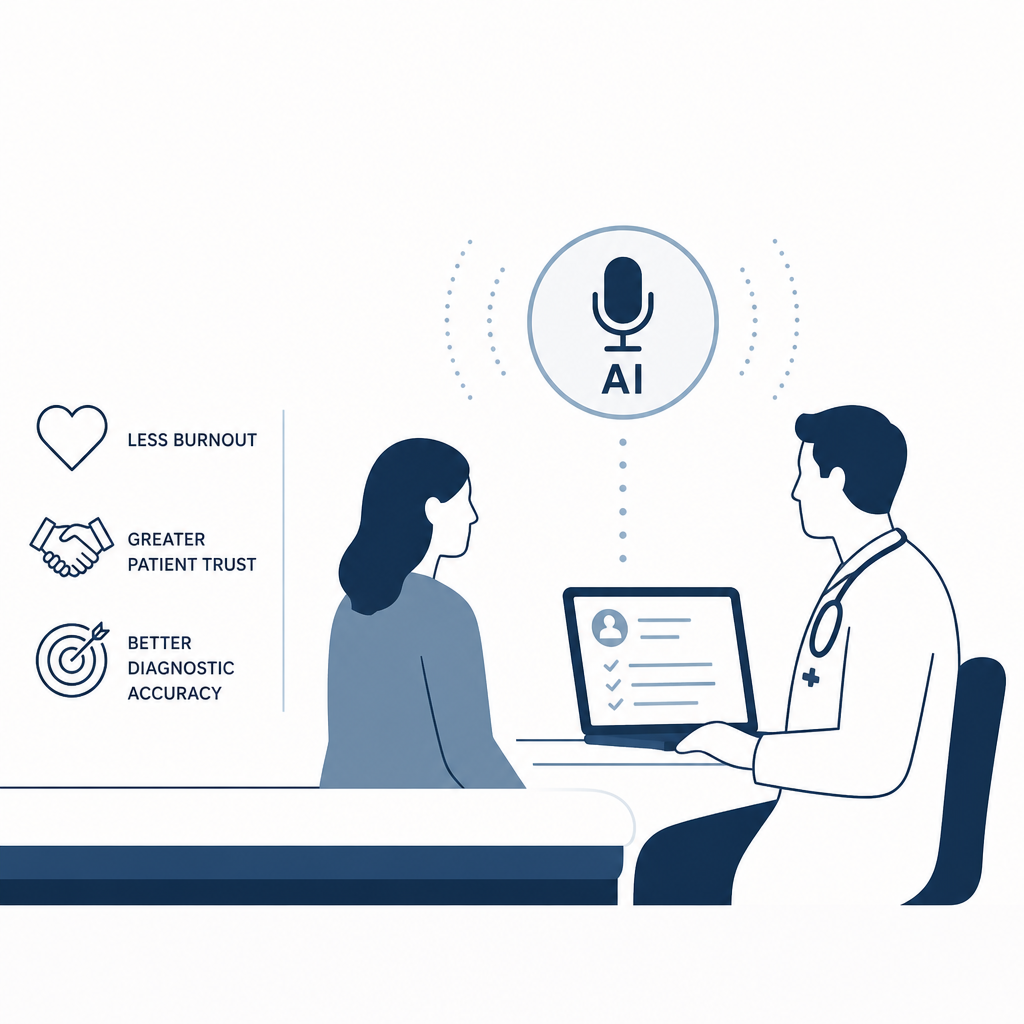
Introduction
Clinical documentation has long been healthcare's most stubborn paradox: it is indispensable for quality care, legal compliance, and care coordination, yet it has become one of the primary drivers of clinician dissatisfaction and burnout [1]. Time-and-motion studies paint a grim picture--for every hour of direct patient care, physicians spend roughly two hours on electronic health record (EHR) and administrative tasks, pushing a substantial share of their "documentation day" into evenings and weekends. Clinicians have a name for this after-hours grind: "pajama time" [1]. The consequences extend beyond individual suffering; burnout--characterized by emotional exhaustion, depersonalization, and a diminished sense of accomplishment--is associated with more medical errors, lower patient satisfaction, and higher physician turnover [1].
Into this crisis has stepped a new class of technology: ambient artificial intelligence. These systems, built on advanced speech recognition, natural language processing, and large language models (LLMs), passively listen to the clinician-patient conversation and transform it into structured, compliant clinical documentation with minimal disruption to workflow [2][3]. Adoption has been remarkably swift--arguably faster than any previous healthcare technology--driven by the twin pressures of burnout and workforce shortages [4].
But rapid adoption demands rigorous scrutiny. Can ambient AI genuinely restore the human connection in the exam room? Does it measurably reduce burnout, or merely shuffle administrative work? And critically, what happens to documentation quality and diagnostic accuracy when algorithms draft the clinical record? A growing body of research-- including recent studies published in JAMA Network Open and survey-based evaluations across multiple health systems--now offers the first meaningful answers.
 Transforming clinical documentation with ambient artificial intelligence (AI) scribes: a narrative review of technology, impact, and implementation - PMC
From Keyboard to Conversation: How Ambient Documentation Works
Ambient AI scribes represent a fundamental shift from transcription tools of the past. Earlier generations of dictation software required clinicians to speak deliberately, format their own notes, and correct errors manually. Ambient systems, by contrast, operate in the background of a live clinical encounter. They capture the natural dialogue between clinician and patient, apply speech recognition and LLM-based reasoning to identify clinically relevant content, and generate a structured draft note--typically within minutes of the visit ending [3][5].
The workflow is designed around a crucial safeguard: autonomy has limits. In most current deployments, clinicians review and edit the AI-generated draft before signing it into the record, retaining final authority over what enters the patient's chart [3]. The University of Chicago Medicine, which rolled out ambient clinical documentation powered by Abridge AI to its clinicians after a three-month pilot with roughly 200 physicians, emphasizes this point explicitly--clinicians review all AI-generated documentation, and they have the final say [6].
Major vendors have built their platforms to integrate with dominant EHR systems such as Epic, Cerner, and Allscripts, with encryption and secure access protocols designed around HIPAA and data privacy frameworks [3]. As trust in output quality grows, the intensity of required editing may decline--but the clinician-in-the-loop model remains the industry standard, at least for now.
The Burnout Evidence: What the Data Actually Shows
Time Savings--Modest on Paper, Meaningful in Practice
The most tangible benefit of ambient AI is recovered time, though the magnitude depends heavily on how it is measured. In two studies published in JAMA Network Open and analyzed by researchers at the University of Chicago Medicine, clinicians using ambient documentation tools spent 8.5% less total time in the EHR than matched controls, with a more than 15% drop in time spent composing notes specifically [7].
At first glance, those figures appear underwhelming--especially compared to industry-reported reductions in documentation time of 41% [3] or even nearly 60% in one JAMA Network Open study cited by informatics analysts [8]. The discrepancy reflects different metrics: total EHR time captures everything from order entry to inbox management, while documentation-specific measures isolate note writing, where ambient AI has its most direct effect.
Clinicians argue the aggregate numbers understate the lived experience. "At first glance, an 8.5% reduction in documentation time might seem small, but when you do the math, a clinician who sees 20 patients per day and saves two or three minutes per patient by using an ambient AI scribe could recoup multiple hours per week," said Kevin Pearlman, MD, a clinical informatics fellow who helped lead the UChicago Medicine study [7]. "That's time clinicians could spend diving deeper into a patient's medical history, using support tools to inform better clinical decisions, or completing other patient care-related tasks" [7].
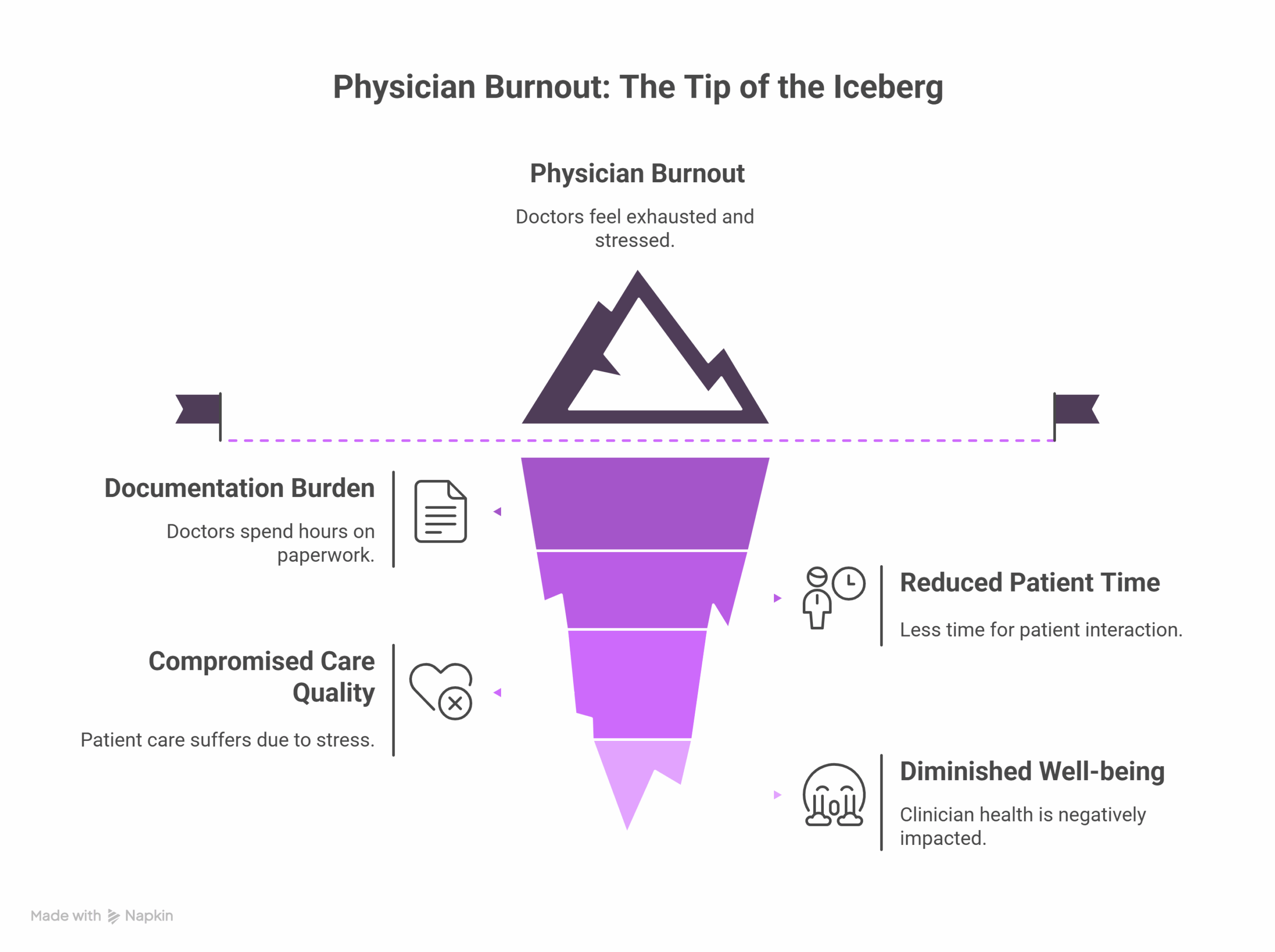 Ambient AI Scribes: Redefining Clinical Documentation & Burnout - John Snow Labs
Burnout and Cognitive Load: Consistent Downward Signals
The wellbeing data is strikingly consistent across independent studies. In a survey of more than 250 physicians and advanced practice providers across six health systems running ambient AI pilots, self-reported clinician burnout dropped from roughly 52% to 39%, accompanied by lower cognitive burden, less after-hours documentation, and a better ability to stay present with patients [7].
A separate study using the Professional Fulfillment Index--a validated burnout instrument--found that ambient AI significantly reduced provider burnout and modestly enhanced professional fulfillment, attributing the improvement to reduced documentation time and more meaningful patient engagement, both of which are strongly correlated with job satisfaction [2]. Research on Nuance's DAX ambient clinical intelligence platform reached similar conclusions through regression analysis: ACI software usage was significantly and negatively predictive of burnout (OR = 0.96; 95% CI: 0.94-0.98), while "pajama time" remained significantly and positively associated with burnout (OR = 1.01) [9]. Notably, in that study, 97% of providers identified documentation time as their greatest frustration--and that frustration was cut in half after ambient AI implementation [9].
Aggregated industry analyses report even bolder figures: up to 60% fewer primary care physicians reporting burnout after adopting AI scribes, some health systems observing a 40% decrease in burnout symptoms, and daily time savings approaching a full hour per clinician [3]. Researchers caution, however, that much of the evidence remains survey-based and early-stage, and systematic reviews note that while limited evidence supports reduced burnout, lower cognitive load, and significant documentation savings, the field is still maturing [5].
Patient Trust and the Rehumanized Exam Room
Perhaps the most emotionally resonant findings concern what happens when the physician's eyes leave the screen and return to the patient. At UChicago Medicine, patient surveys conducted by Press Ganey showed improvements across multiple dimensions of the experience following ambient AI deployment, including the perceived concern shown by providers, satisfaction with explanations of the patient's condition, and patients' perception that they were included in care decisions [6].
The qualitative feedback was equally telling. "We heard really meaningful feedback from patients, who said things like: 'My doctor is more present in our conversations,'" said Dr. Shah of UChicago Medicine. "We didn't anticipate such a dramatic impact emerging right away" [6]. On the clinician side, 90% of participating physicians reported being able to give patients their undivided attention--up from 49% before the tool was introduced--and many reported feeling more valued in their work [6]. Broader analyses echo these findings, with some health systems recording patient satisfaction score improvements of roughly 8% attributed to increased face-to-face interaction [3], and reviews identifying improved patient-physician interaction as one of the most consistently reported benefits of the technology [5].
Yet trust runs in two directions. Patients are increasingly aware that a device is recording their most intimate conversations, and the literature raises legitimate questions about consent, transparency, data privacy, and equity that health systems must address head-on as deployment scales [1][5]. Restoring eye contact while quietly introducing a listening algorithm is only a net trust gain if patients understand--and control--how their words are being used.
 Nuance's AI makeover to clinical documentation takes exam room to the future - MedCity News
Diagnostic Accuracy and Note Quality: The Unresolved Question
Here the evidence becomes genuinely contested--and honest journalism requires saying so. Direct, rigorous studies of ambient AI's effect on diagnostic accuracy (that is, whether AI-drafted documentation leads to fewer missed or incorrect diagnoses) remain scarce. Most current research uses documentation quality as a proxy, and the results are mixed in instructive ways.
On the optimistic side, one case study found ambient AI scribes outperformed human-generated notes in both quality and accuracy, while industry analysis of a JAMA Network Open study reported that tools built on a robust clinical terminology foundation achieved dramatic documentation time reductions with improved clinician assessments of quality [8][4]. Better-structured, more complete notes could plausibly support stronger clinical decision-making--recalling Pearlman's point that reclaimed time allows clinicians to dive deeper into medical history and use decision-support tools more effectively [7].
On the cautionary side, systematic reviews document persistent concerns about the accuracy, consistency, language use, and style of AI-generated notes, with studies reporting errors, omissions, and hallucinations--fabricated content that was never said in the encounter [5]. A narrative review of the technology warns that the field's transformative promise "is shadowed by critical questions of safety, accuracy, reliability, and equity," particularly in high-stakes clinical environments [1]. An error in a note is not a typographical nuisance; the clinical record drives downstream decisions, billing, legal proceedings, and care continuity. This is precisely why clinicians reviewing and editing AI drafts before signature remains a non-negotiable safeguard [3][6].
The honest synthesis: ambient AI appears capable of producing high-quality documentation under the right conditions, but quality is not guaranteed, failure modes are real, and the leap from "better notes" to "better diagnoses" has not yet been demonstrated in the published literature.
Responsible Integration: The Road Ahead
The implementation challenges are as consequential as the technology itself. Systematic reviews emphasize that the benefits of ambient AI must be "counterbalanced" by rigorous attention to accuracy monitoring, workflow fit, and organizational governance [5]. Key considerations for health systems include:
- Verification culture: Sustaining diligent clinician review even as familiarity breeds complacency, since errors and hallucinations demand careful oversight [5].
- Technical foundations: Prioritizing platforms built on clinically grounded terminology and ontologies, which appear central to output accuracy [8].
- Equity and language: Ensuring performance holds up across accents, dialects, and languages so the technology does not widen disparities in care documentation [1].
- Privacy and consent: Maintaining transparent patient communication about recording and robust HIPAA-aligned data protections [3][5].
- Workflow integration: Pursuing deep EHR interoperability so that time saved on notes is not simply consumed elsewhere [3].
Looking forward, vendors anticipate embedding predictive features, deeper analytics integration, and improved contextual awareness to support proactive care [10][3]. Researchers are also moving beyond perception surveys toward objective workflow evaluation using automatically generated usage data--a methodological maturing that should strengthen the evidence base [10]. Given the demonstrated link between documentation relief and wellbeing, some researchers argue that broader ambient AI implementation should be treated as a strategic institutional intervention against burnout rather than a boutique pilot [2].
Conclusion
Ambient AI has moved from futuristic concept to operational reality with astonishing speed, and the early evidence largely vindicates the enthusiasm: measurable reductions in documentation time and EHR burden, statistically significant declines in burnout, lighter cognitive load, and--perhaps most powerfully--a restoration of presence in the exam room that patients can feel [7][2][9][6]. When nine in ten clinicians report giving patients their undivided attention, up from less than half before adoption, something meaningful has changed in the practice of medicine [6].
But this is not a story with a tidy ending. The gap between documentation improvement and proven diagnostic benefit remains unbridged; hallucinations, omissions, and equity gaps are documented realities rather than hypothetical risks; and the "autonomous" label still outruns the clinician-reviewed workflow that actually governs practice today [5][1]. The most defensible conclusion from the current evidence is that ambient AI is a powerful augmentation--not a replacement--of clinical judgment. Health systems that pair rapid deployment with rigorous accuracy monitoring, transparent patient communication, and sustained clinician oversight will be best positioned to capture the technology's genuine promise: giving physicians back their time, their attention, and perhaps a measure of the joy that drew them to medicine in the first place.
References
- 1.
- 2.
- 3.
- 4.
- 5.
- 6.
- 7.
- 8.
- 9.
- 10.