Introduction
Few technologies have disrupted higher education as rapidly as generative AI. Studies report that over 92% of students now use AI tools to complete academic tasks, while 83% of faculty express concern about students' ability to critically evaluate AI-generated content [1]. The initial institutional response--blanket bans paired with a wave of AI-detection software--has proven untenable. Detectors have produced biased outputs and high error rates, triggering student protests over wrongful academic sanctions and forcing universities to confront an uncomfortable truth: detection technology alone cannot safeguard academic integrity [1].
The result is a profound paradigm shift now playing out across campuses worldwide. Universities are moving from policing to transparency, replacing punitive surveillance with disclosure requirements, procedural safeguards, and--most significantly--a fundamental redesign of assessment itself [2]. Rather than asking "how do we catch AI use?", institutions are asking "how do we design learning experiences where AI misuse is neither attractive nor easy, and where genuine engagement is visible?"
This article examines that transformation across four dimensions: the collapse of the detection paradigm, the rewriting of academic integrity policies around transparency and fairness, the structural redesign of assessments, and the institutional investments in faculty development required to sustain meaningful change. The picture that emerges is one of a sector maturing from fear-driven reaction toward structured governance.
The Cracks in the Detection Paradigm
The promise of AI detection was seductive: a simple score that could flag machine-generated writing and restore the old order. Reality has been far messier. Research has documented biased outputs and high error rates in detection tools, with false positives disproportionately appearing in highly structured academic writing and in hybrid texts where AI-assisted drafts have been heavily edited by humans [3][1]. The consequences have been severe enough to spark public protests at universities over academic sanctions resulting from detectors incorrectly flagging students' work [1].
The lesson learned since 2023 is that over-reliance on fallible AI detectors may do more harm than good, fostering suspicion between educators and students while failing to reliably identify misconduct [4]. Institutions are therefore returning to fundamental principles of evidence and dialogue in integrity cases [4].
The most concrete manifestation of this shift is how detection results are now treated institutionally. In 2026, most universities formally state that AI detection results alone are not sufficient evidence of misconduct; instead, detection reports are treated as preliminary indicators that may trigger further review, requiring corroborating evidence beyond detection scores [3]. In practice, this means an instructor faced with a suspect essay might compare it against the student's past work or discuss the student's writing process directly--treating the detector's output as a conversation starter rather than a final verdict [4].
 Redesigning Assessments for AI-Enhanced Learning: A Framework for Educators in the Generative AI Era
From Blanket Bans to Transparent Governance
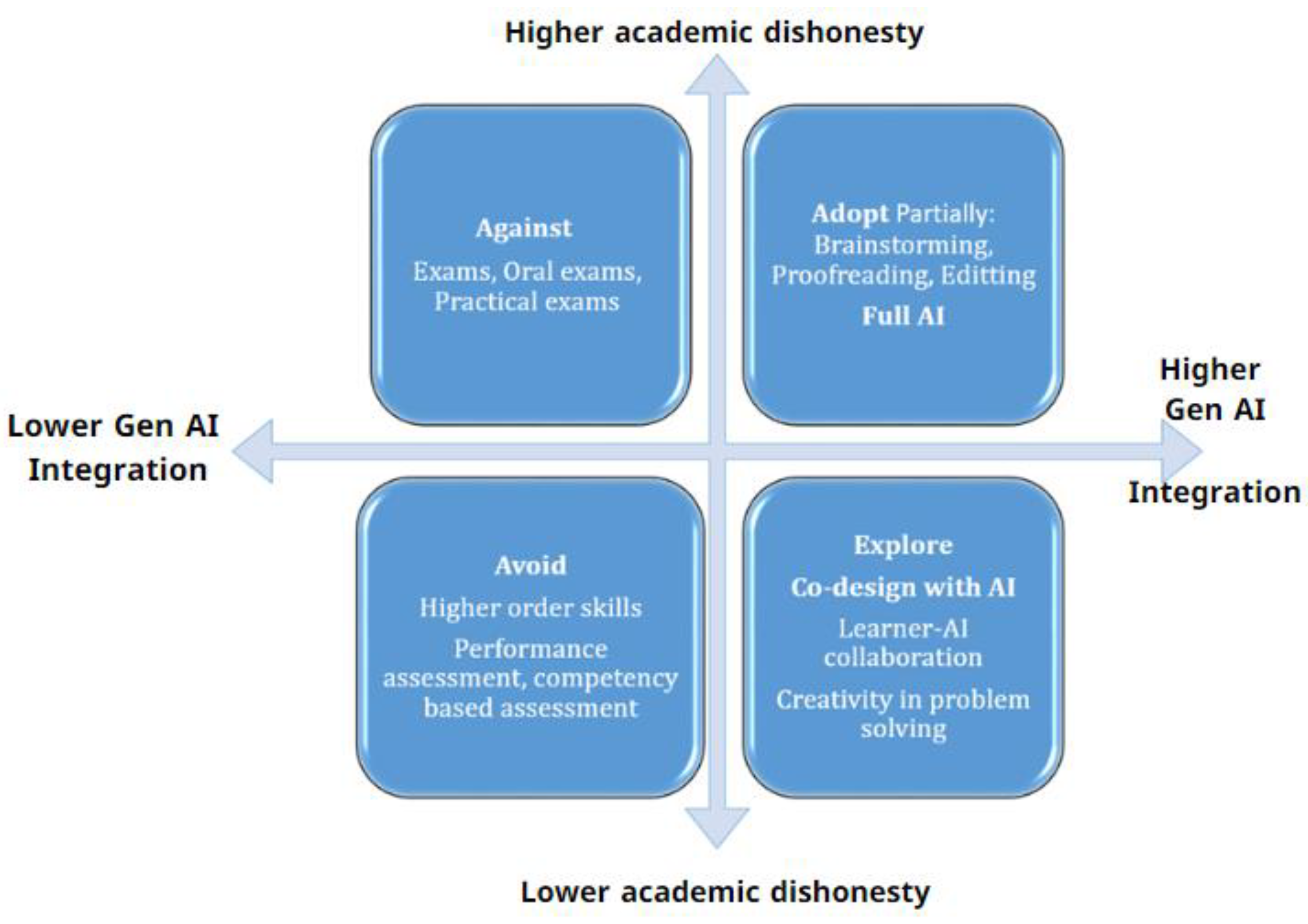
With detection demoted from judge to signal, universities have rewritten their integrity policies around transparency and responsible use. Rather than banning AI outright, many institutions now permit limited AI use for brainstorming, grammar assistance, and outlining--provided students disclose AI assistance in submissions, cite the tools used, and clarify the extent of AI involvement [3]. This tiered, disclosure-based approach treats students as emerging professionals learning to use powerful tools responsibly, rather than as suspects to be monitored.
Crucially, the new policies are paired with procedural fairness mechanisms designed to protect students from wrongful accusations. These include reviewing drafts and version history as evidence of process, and standardized procedures for contesting AI-related accusations [3]. The emphasis on education over punishment, combined with clearer rules around disclosure, represents an attempt to reframe integrity as a shared culture rather than an enforcement regime [4]. Notably, this reframing does not weaken standards--on the contrary, it demands that students engage genuinely with their work even when using new tools [4].
Whether these policy frameworks are actually working remains an open scholarly question. Recent academic research has explicitly asked whether universities' policies, procedures, and guidelines are effectively ensuring AI-related academic integrity in the generative AI era, signaling that the gap between policy documents and practice is itself now a subject of rigorous scrutiny [5][6].
Redesigning Assessment: The Structural Turn
The most substantive change is happening not in policy documents but in course design. A recent empirical study of lecturers' responses to generative AI distinguishes between two types of change: discursive changes--AI-use policies, declarations, and transparency requirements--and structural changes--increased task complexity, in-class and oral assessments, multimodal submissions, and critical evaluation of AI outputs [7]. The study's central finding is stark: lecturers viewed discursive measures as necessary but insufficient on their own, emphasizing that structural redesign is critical for sustaining authentic learning [7].
These structural shifts represent a move toward higher-order thinking and process-oriented evaluation, though at the cost of increased workload and emerging equity concerns [7]. The logic is straightforward: if an essay can be generated in seconds, assess what cannot be--oral defense, in-class reasoning, the documented evolution of a draft, or the quality of a student's critique of an AI output.
Innovative frameworks are emerging to guide this work. Education researchers argue that the "catch and punish" strategy is ineffective precisely because AI detection tools are unreliable, and instead propose prioritizing an "AI Collaboration Zone"--an assessment framework in which generative AI augments, but does not replace, students' creative and cognitive efforts [8]. Concrete applications include case-based projects where students integrate concepts through AI-supported research and analysis, and AI-assisted dialogues that position AI as a collaborative coauthor or feedback tool surpassing traditional essay formats [8].
International evidence reinforces the value of balance. Research from Zambia, Rwanda, and Kenya demonstrates that approaches combining AI efficiency with human judgment yield optimal results in contexts like dissertation examination, ensuring fairness while leveraging technological advantages [9]. The consistent theme across geographies and disciplines: human oversight remains crucial even as AI transforms workflow [9].
 AI and Academic Integrity: Universities Transform Assessment Methods in 2025 - Lumina Literati Publishing®
Restoring Trust: From Policing to Partnership
Underlying all these changes is a deliberate effort to repair the student-faculty relationship that detection-centric approaches strained. Proponents of the shift beyond detection argue for moving from policing to transparency as a way of improving student-faculty trust and refocusing on actual learning outcomes [2][1]. When disclosure replaces surveillance, conversations about AI use become pedagogical rather than adversarial.
There is also a learning-science dimension to this reorientation. Recent research indicates that frequent reliance on generative AI may diminish the brain's cognitive engagement in learning--a phenomenon echoed in education literature as "cognitive offloading," which can weaken critical thinking and deep learning [1][8]. Assessment redesign is thus not merely an integrity strategy but a cognitive one: well-designed tasks keep students doing the intellectual heavy lifting while AI plays a supporting role. Industry proposals have emerged alongside institutional efforts, including transparency tools designed to document how students work, promote responsible AI use, and encourage constructive student dialogue--though institutions must weigh such solutions carefully against privacy and equity considerations [2].
Supporting the Redesigners: Faculty Development and Institutional Infrastructure
None of this transformation happens without educators, and institutions are beginning to invest accordingly. Universities are making substantial investments in comprehensive faculty training programs, including cross-institutional continuing professional development (CPD) initiatives that equip educators with generative AI literacy, critical inquiry skills, and authentic assessment design capabilities [9]. Practical frameworks for educators--such as those offering strategies for redesigning assessments in the GenAI era with an emphasis on collaborative learning and authentic evaluation--are providing concrete scaffolding for this work [9]. At the institutional level, scholars emphasize that leading the AI response requires comprehensive strategic planning rather than ad hoc adjustments [9].
Yet the empirical evidence also reveals significant friction. The NTU study of lecturers found that while redesign motivations were driven primarily by maintaining academic standards and encouraging responsible AI use--supported by institutional guidance and lecturer autonomy--significant inhibitors remained, particularly time constraints [7]. Most tellingly, while assessment tasks and teaching activities were widely revised, most lecturers reported that formal Intended Learning Outcomes remained unchanged due to administrative constraints, creating potential misalignments between stated curricula and enacted pedagogy [7].
The study's conclusion doubles as a warning for the sector: universities must move beyond policy statements and provide targeted training, time, and structural support to sustain meaningful assessment redesign in the generative AI era [7]. Faculty training on AI capabilities and limitations, and clear communication with students about acceptable use, are now recognized as essential components of any integrity framework [3].
Academic Integrity Framework in the GenAI era. | Download Scientific Diagram
The Road Ahead: Challenges and Open Questions
Significant challenges remain. The rapid advancement of generative AI models continually outpaces policy cycles; the difficulty of distinguishing hybrid AI-human writing complicates both detection and adjudication; and institutions must constantly balance innovation with academic integrity [3]. The empirical literature adds further concerns: increased faculty workload, emerging equity issues as some students gain better access to premium AI tools than others, and the risk that redesigned assessments--however authentic--may demand resources that not all institutions can provide [7].
These tensions suggest the current moment is less a destination than a waystation. Universities continue to refine their frameworks as AI technology evolves, with the conversation having matured from fear-driven bans to structured governance, procedural safeguards, and responsible AI integration [3].
Conclusion
The story of generative AI in higher education has shifted from confrontation to adaptation. Detection tools remain part of the ecosystem, but they are no longer treated as final authorities; instead, universities are emphasizing fairness, transparency, and human oversight as the foundation of academic integrity in the AI era [3]. Policies now demand disclosure rather than abstinence, procedures demand corroborating evidence rather than algorithmic verdicts, and assessments increasingly demand what machines cannot fake: in-person reasoning, documented process, critical judgment, and authentic creation.
The deeper insight of this transition is that academic integrity was never really about catching cheats--it is about protecting the conditions under which genuine learning occurs. By redesigning assessment around higher-order thinking and reorienting integrity policies around trust and transparency, universities are not lowering standards in the face of technological disruption. They are reasserting them, demanding that students engage genuinely with their work even when powerful new tools are within reach [4]. Beyond detection lies something more ambitious: an education worth being honest about.
References
- 1.
- 2.
- 3.
- 4.
- 5.
- 6.
- 7.
- 8.
- 9.