Introduction
The modern physician's most constant companion is not the stethoscope but the keyboard. Physicians now spend more than half of their workdays documenting appointments in electronic health records (EHRs)--recording what patients reported, what was recommended, and what comes next--and increasing amounts of that documentation spill into evenings and weekends, a phenomenon clinicians grimly call "pajama time" [1]. The arithmetic is stark: for every hour spent with patients, physicians spend roughly two hours on administrative documentation, and recent workforce surveys suggest 62% of physicians report burnout symptoms [2]. In primary care, where the burden hits hardest, this toll is pushing doctors out of practice entirely [1].
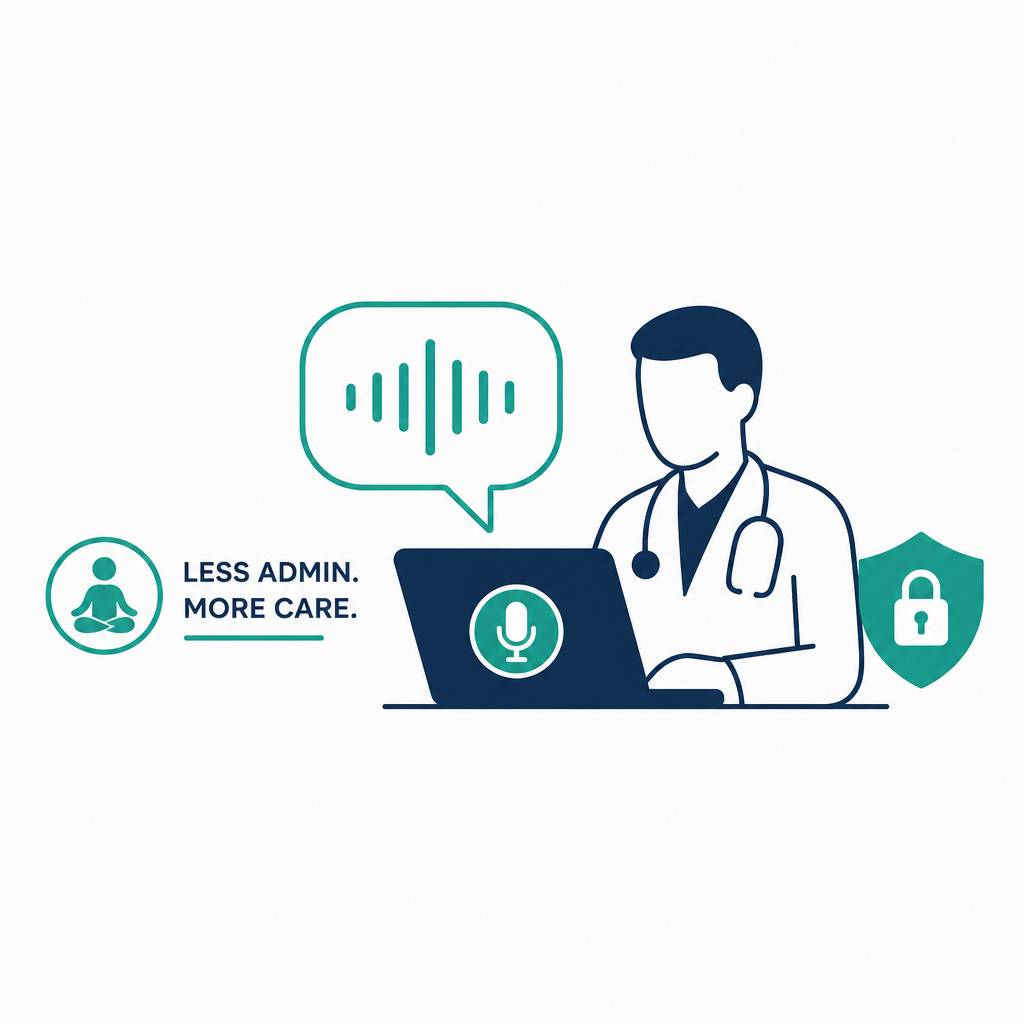
Into this crisis has stepped a new class of technology: ambient AI scribes. These tools work in the background during patient visits, recording the clinical conversation and using natural language processing to transform it into structured medical note drafts that clinicians review and approve before anything enters the record [3]. Commercial platforms such as Nuance's ambient clinical intelligence offering, Ambience Healthcare, and Freed AI promise to cut documentation time by 40 to 60 percent [2], and adoption by hospitals and provider groups is on track to be one of the fastest in recent healthcare history [4]. At Yale New Haven Health alone, more than 1,000 physicians now regularly use ambient AI in clinical practice [1].
But rapid adoption does not guarantee a cure. The evidence base has matured significantly between 2022 and 2025, moving from anecdote to large-scale, multicenter studies with encouraging results [5]. At the same time, researchers and governance experts caution that time savings do not automatically translate into lasting burnout relief, and that recording patients raises unresolved questions around accuracy, consent, data privacy, and regulatory compliance [6]. Can voice-driven documentation truly reduce physician burnout--and can it do so without compromising patient privacy?
The Scope of the Burnout Problem
Physician burnout--characterized by emotional exhaustion and professional inefficacy--is not merely a workforce inconvenience; the authors of a recent JAMA Network Open invited commentary describe it as "a public health crisis" [7]. The EHR is a central culprit, and part of the problem lies in the system's design itself: EHRs were built primarily to support billing and compliance rather than clinical care [6]. The result is a documentation apparatus that competes directly with the fundamentally cognitive, relational work of ambulatory medicine, which requires focused attention on patients to support complex decision-making, patient education, and the trusting therapeutic relationships that drive adherence [8].
The downstream effects are measurable. Documentation burden consumes hours that could go to additional patient visits, personal recovery, or leaving the clinic on time--all factors inversely correlated with burnout severity [5]. It is against this backdrop that ambient AI scribes have been framed not as a convenience but as a potential corrective to a crisis "created by older technology," one that, as the AMA-summary commentary notes, "will require a concerted effort, including partnerships between health systems and industry" [7].
The Evidence: What the Studies Actually Show
The Multicenter Breakthrough
The most consequential evidence to date comes from a multicenter quality improvement study published in JAMA Network Open in October 2025, led by researchers including Kristine Olson and Lee Schwamm and involving the University of Chicago Medicine among contributing institutions [3][8]. The study followed 263 physicians and nonphysician providers across six health care systems and found that after just 30 days with an ambient AI scribe, burnout among clinicians working in ambulatory clinics decreased significantly from 51.9% to 38.8%--representing 74% lower odds of experiencing burnout [1][7]. The accompanying commentary highlighted a net reduction of 13.9 percentage points in burnout and 6.2 percentage points in severe burnout across 186 clinicians, results that remained robust when controlling for demographic and site characteristics [7].
Notably, this was the first large, multicenter evaluation of ambient AI scribes' effect on clinician experience; previous studies had been limited to small, single-center efforts [1]. The benefits extended beyond burnout scores to significant improvements in cognitive task load, time spent documenting after hours, focused attention on patients, and perceived urgent access to care [7].
Time Savings: Modest but Meaningful
The time-savings data are more nuanced than marketing claims might suggest. In EHR usage analyses conducted alongside the multicenter study, clinicians using the ambient documentation tool spent 8.5% less total time in the EHR than matched controls, with a more than 15% drop in time spent composing notes specifically [3]. "At first glance, an 8.5% reduction in documentation time might seem small," said Kevin Pearlman, MD, a clinical informatics fellow at UChicago Medicine who helped lead the study, "but when you do the math, a clinician who sees 20 patients per day and saves two or three minutes per patient by using an ambient AI scribe could recoup multiple hours per week" [3].
Other studies report larger effects. Industry reporting describes a Stanford Medicine randomized controlled trial of 97 primary care physicians over six months, in which the AI scribe group reduced after-hours documentation by 68%, cut EHR time per visit from 14.2 minutes to 3.8 minutes, and showed a 23-point reduction on the Maslach Burnout Inventory emotional exhaustion subscale--with note quality rated equivalent by blinded reviewers and patient satisfaction scores improving 12 points [5]. Earlier pilot work at Stanford Health Care using DAX Copilot with 48 physicians over three months found statistically significant reductions in task load (-24.42) and burnout (-1.94), along with moderate improvements in usability scores [9].
The Mechanism: Why Small Time Savings May Yield Big Well-Being Gains
One of the study's most interesting findings is that modest documentation improvements coincided with outsized changes in burnout, suggesting "these small improvements may have an outsized influence or that other aspects of the intervention may improve overall clinician experience" [8]. That "other aspect" may be the restoration of presence. "Ambient AI is so exciting to me because it allows technology to fade into the background and allows care to come to the foreground," says Allen Hsiao, MD, professor of pediatrics and chief health information officer at Yale New Haven Health. "It takes a huge cognitive burden off of physicians so they no longer need to concentrate on computer screens and typing but instead can fully focus on the patient" [1].
Industry-reported longitudinal data point in the same direction: physicians using ambient scribes gained an average of 2.1 additional hours per day in schedule flexibility and reported a 31% increase in their sense of meaning from clinical work [5]. For physicians who entered medicine to care for people--not to document--restored patient interaction may be the most effective burnout buffer of all [5].
The Skeptic's View: Efficiency Is Not Well-Being
Despite the encouraging headline numbers, experienced observers urge restraint. The Patient-Driven Health Technology Investment (PHTI) organization's assessment concludes that ambient scribes are "potentially effective" at reducing documentation time and cognitive load, but health system leaders identify real gaps in evidence regarding impact on productivity and financial performance, with savings possibly materializing only as technology and implementation mature [4].
A more fundamental critique comes from governance analysts who argue that AI scribes are "best understood as a productivity tool rather than a comprehensive burnout solution" [6]. Early studies show documentation reductions in the range of 20% to 30%--meaningful, but not transformative--and time savings alone do not guarantee burnout reduction. Reclaimed time may simply be absorbed by additional clinical or administrative demands rather than translated into genuine cognitive relief [6]. The long-term value of AI scribes, this argument holds, will depend less on efficiency gains than on whether implementation is paired with deliberate changes in workflow, governance, and organizational policy: "Without deliberate organizational safeguards and regulatory compliance, efficiency gains risk being offset by workload expansion rather than producing lasting relief" [6].
Even the multicenter study's own data hint at this tension--the 8.5% EHR time reduction is far smaller than the 40-60% reductions claimed in market analyses [3][2]--and the durability of benefits beyond the initial months of enthusiasm remains an open question. Longer-term outcomes research, such as an 18-month Mayo Clinic study of ambient scribe use, will be critical to determining whether early gains persist [5].
The Privacy Equation: Recording Patients to Save Doctors
How the Technology Handles Sensitive Conversations
Herein lies the tension at the heart of the technology. Ambient scribes work by recording healthcare conversations--among the most intimate disclosures a person ever makes--and transmitting them for AI processing before a draft note is produced and reviewed [3][2]. Every safeguard, therefore, matters. Under HIPAA, vendors operating in this space function as business associates, requiring formal agreements, encryption of protected health information in transit and at rest, strict access controls, and audit trails [5]. Leading platforms emphasize these compliance frameworks, and the reviewed-and-approved workflow before chart entry provides an additional human checkpoint against error [5][3].
Consent and Governance Gaps
Yet compliance on paper is not the same as settled practice. Analysts flag accuracy, patient consent, data privacy, and regulatory compliance as unresolved issues accompanying AI scribe adoption [6]. Key open questions include how patients are notified that a visit is being recorded, whether they can meaningfully opt out, how long audio is retained after note generation, and whether encounter audio could ever be used to train commercial models. Because these tools are deployed under intense adoption pressure--potentially the fastest uptake of any recent healthcare technology [4]--there is a real risk that privacy governance lags behind deployment.
Health system leaders appear aware of the stakes. "Ambient documentation has proven to be one of the most effective and impactful methods for enhancing the provider experience," says Adam Landman, MD, chief information officer at Mass General Brigham, while stressing a commitment "to rigorously evaluating their safety and effectiveness" as the technologies evolve [4]. The emerging consensus among governance experts is that privacy protection cannot be delegated entirely to vendors: health systems must implement deliberate organizational safeguards--clear consent protocols, defined data-retention limits, note-verification requirements, and oversight of vendor data practices--if the technology is to earn durable trust from both clinicians and patients [6].
Implementation: Lessons from Early Adopters
The experience of large systems offers a preview of what responsible deployment looks like. At Yale New Haven Health, adoption by more than 1,000 physicians has been framed around a simple philosophy: technology should recede so care can come forward [1]. At UChicago Medicine, leaders emphasize that the goal is "to make us more humanistic clinicians" by offloading "clerical and administrative grunt work" [3]. And at Mass General Brigham, the emphasis falls on continuous, rigorous evaluation of safety and effectiveness [4].
The common thread is that successful programs treat the scribe as one component of a broader workflow redesign--not a plug-and-play fix. That includes protecting reclaimed time from reassignment to additional productivity quotas, training clinicians to review AI-generated notes critically, and establishing clear patient-facing policies about recording [6]. Where these pieces are in place, the early evidence suggests genuine improvements in clinician experience; where they are absent, the efficiency dividend risks being quietly consumed by the same system that produced the burnout in the first place [6].
Conclusion
The verdict on ambient AI scribes is more encouraging than skeptics expected and more complicated than vendors suggest. On the central question of burnout, the evidence has crossed an important threshold: a rigorous, six-system study documenting a drop in burnout from 51.9% to 38.8% within a single month of use, alongside consistent findings of reduced cognitive load, less after-hours documentation, and improved sense of meaning in clinical work [1][3][7]. Early pilots and randomized data reinforce the signal [5][9]. For a profession in crisis, these are not trivial results.
But two caveats deserve equal weight. First, modest EHR time savings and the risk that reclaimed hours are absorbed by new demands mean ambient scribes are best understood as a powerful productivity tool--one input into physician well-being--rather than a comprehensive burnout solution [6]. Durability beyond the first months, and impact on finances and productivity, remain open questions [4]. Second, the technology's foundation--recording patient conversations--places privacy, consent, and governance at the center of the enterprise, not at its periphery [6]. HIPAA compliance and human review of every note are necessary but not sufficient; sustainable trust will require transparent consent practices, strict data-retention policies, and health systems willing to evaluate these tools as rigorously as they would any new therapy [5][4][6].
Ambient AI scribes appear capable of giving physicians back their evenings and their attention--and with them, a measure of the meaning that drew them to medicine. Whether that gift endures, and whether patients pay for it with their privacy, will be decided not by the algorithms but by the governance built around them.
References
- 1.
- 2.
- 3.
- 4.
- 5.
- 6.
- 7.
- 8.
- 9.