Introduction
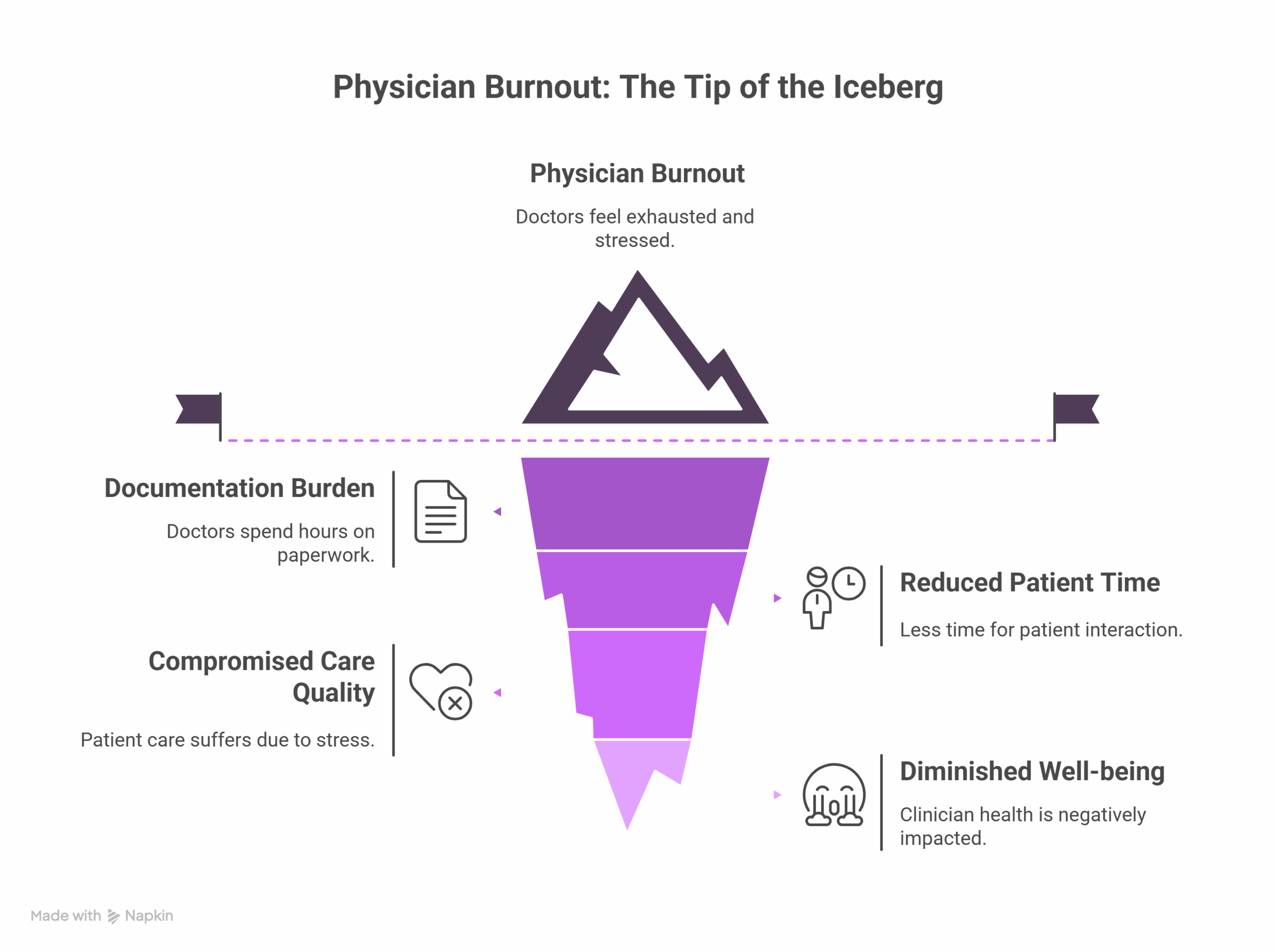
Physician burnout has reached crisis levels in modern healthcare, and the primary driver is not clinical complexity or patient volume--it is paperwork. Physicians now spend more than half of their workdays at computers, documenting appointments, entering orders, and completing electronic health record (EHR) tasks, a burden that is pushing doctors--particularly in primary care--out of practice [1]. Administrative tasks in the EHR now consume the majority of professionals' time, with documentation of the clinical encounter itself representing only a fraction of that total [2].
Into this environment has come a rapidly maturing technology: the ambient AI scribe. These tools work in the background during patient visits, capturing the natural conversation between clinician and patient and converting it into structured medical notes--without interrupting the flow of the visit or requiring follow-up documentation time from the physician [3][1]. Adoption by hospitals and provider groups is on track to be one of the fastest in recent healthcare history [3].
But speed of adoption does not guarantee safety or value. As health systems race to deploy these tools, critical questions remain about whether they truly deliver on their promise: Can autonomous documentation meaningfully reduce burnout at scale? What happens to patient privacy when conversations in exam rooms are recorded and processed by AI? And could reliance on automated notes compromise diagnostic accuracy or erode clinical skills? The emerging evidence offers grounds for both optimism and caution.
The Documentation Burden Behind the Burnout Crisis
Understanding why ambient AI scribes have generated such enthusiasm requires understanding the scale of the problem they address. The escalation of professional time spent on EHR administrative tasks has been driven by a confluence of factors: healthcare reform requirements, pandemic-era telehealth and patient portal adoption, open access to clinical notes, and policies mandating computerized physician order entry [2]. The result is a workforce in which clinicians have the lowest proportion of their workday available for patient-scheduled hours in modern memory.
The consequences extend beyond physician dissatisfaction. Documentation burden is associated with clinicians leaving practice entirely, with primary care bearing the heaviest load [1]. Earlier solutions--such as human scribes and virtual scribe services--offered some relief but were expensive, difficult to scale, and associated with only modest time savings, highlighting that documentation of the encounter is only one component of the broader EHR workload [2].
Early physician response to ambient AI scribes has been notably favorable. A 2024 analysis published in NEJM Catalyst, now cited hundreds of times in the literature, reported that physicians who used an ambient AI scribe service responded positively, citing the technology's capability to facilitate more natural patient interactions [4]. This enthusiasm set the stage for more rigorous evaluation.
The Evidence: Do Ambient Scribes Actually Reduce Burnout?
What the Studies Show
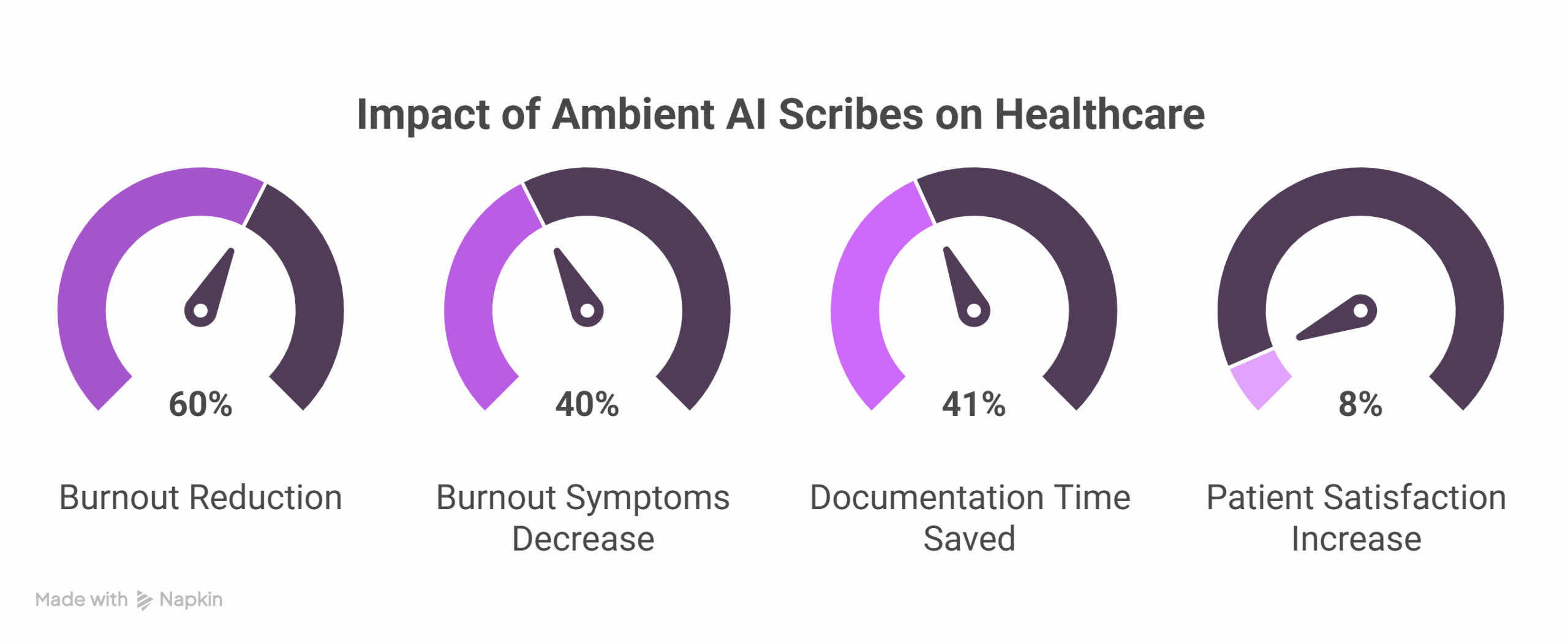
The most prominent evidence comes from a study led by Kristine D. Olson of Yale School of Medicine, published in JAMA Network Open in October 2025. The findings were striking: AI scribes were associated with reduced burnout among ambulatory care physicians and advanced practice practitioners after just 30 days of use, alongside improvements in cognitive task load, attention to patients, and reduced time spent on documentation [1][5].
The study population was substantial and diverse: 263 clinicians with a mean of 15.1 years in practice, including 131 primary care professionals (49.7%), 72 surgical specialists (27.4%), 46 adult specialists (17.5%), and 14 clinicians in neurology and psychiatry (5.3%). The sample was predominantly attending physicians (88.2%) and academic faculty (63.9%) [2][6].
Quantitative time savings, while modest on a per-encounter basis, compound meaningfully. Researchers at UChicago Medicine found that clinicians using an ambient clinical documentation tool spent 8.5% less total time in the EHR than matched controls, with more than a 15% drop in time spent composing notes specifically. As clinical informatics fellow Kevin Pearlman, MD, explained: "a clinician who sees 20 patients per day and saves two or three minutes per patient by using an ambient AI scribe could recoup multiple hours per week"--time that could be redirected toward deeper history-taking, clinical decision support, or other patient care tasks [7].
At Yale New Haven Health, more than 1,000 physicians now regularly use ambient AI in clinical practice. Allen Hsiao, MD, chief health information officer at the system, captures the technology's core appeal: "It takes a huge cognitive burden off of physicians so they no longer need to concentrate on computer screens and typing but instead can fully focus on the patient" [1].
 Ambient AI Scribes: Redefining Clinical Documentation & Burnout - John Snow Labs
The Caveats Behind the Headlines
Despite promising results, the evidence base has important limitations that health system leaders and researchers themselves acknowledge. The Yale study was structured as a quality improvement initiative rather than controlled research: it lacked a control group, could not adjust for temporal trends, relied only on complete survey responses, and was based on subjective reports without quantitative EHR data [5]. The authors concluded that ambient AI scribes "may represent a scalable solution to reduce administrative burdens for clinicians" at lower cost than human scribes--but the conditional language is notable [5].
The Peterson Health Technology Institute (PHTI), after extensive interviews with health system leaders and AI companies, reached a similarly nuanced verdict: ambient scribes are "potentially effective" at reducing documentation time and cognitive load, and early adopters report likely improvements in burnout--but the financial impact remains unclear, with gaps in evidence regarding productivity and financial performance. PHTI's AI Taskforce suggests savings may only materialize over time as the technology and implementation processes mature [3].
UChicago Medicine researchers emphasize that rigorous validation was essential precisely because the benefits are not self-evident. Well-designed studies are needed to separate the tool's impact from other simultaneous changes in a health system, identify which specialties benefit most, and confirm that efficiency gains actually translate into better care and clinician well-being [7]. This due diligence matters: adding technological innovation to a health system costs money, and investments must demonstrably add value.
There is also a ceiling effect to consider. Because much of the EHR burden stems from tasks beyond encounter documentation--order entry, inbox management, prior authorizations--scribe-assisted documentation is associated with only modest total time savings, underscoring the need for future tools that address the full range of administrative work [2].
Patient Privacy and Governance: The Non-Negotiables
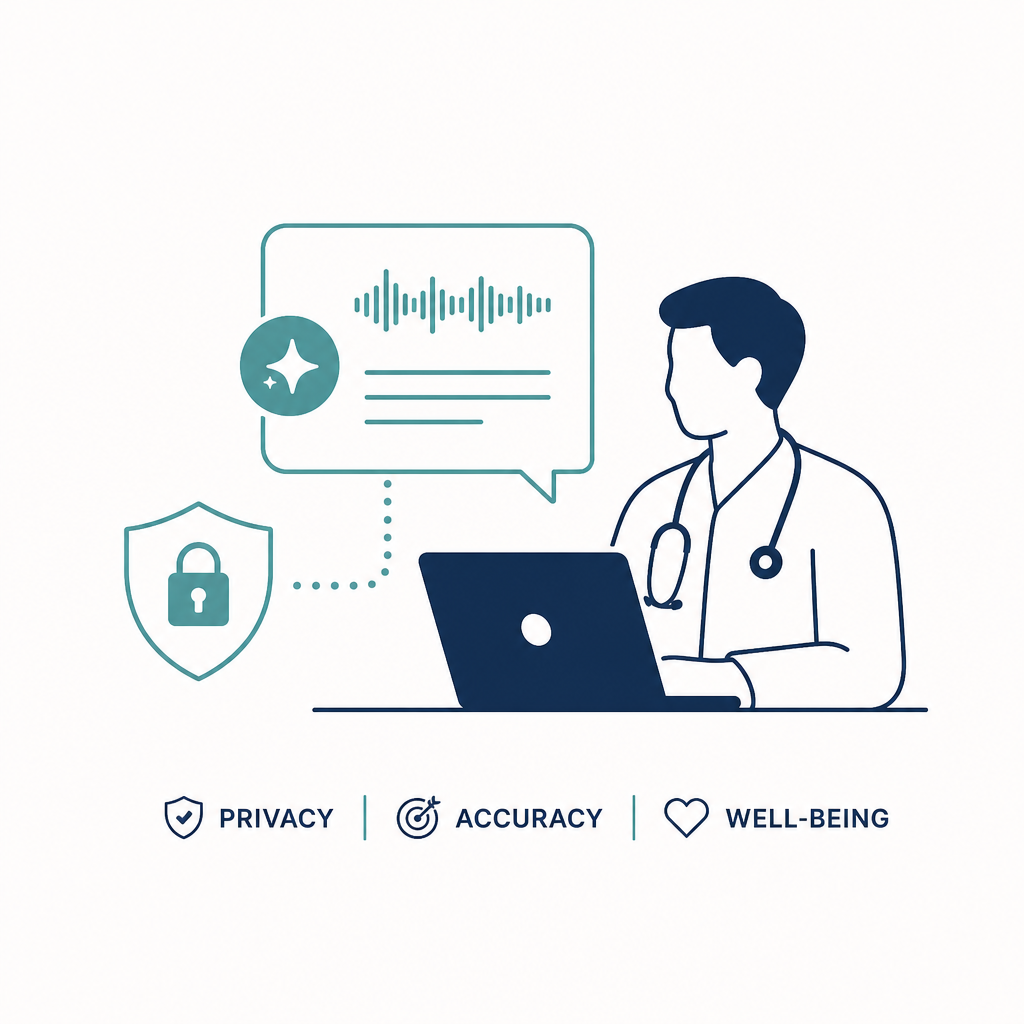
When a tool records conversations in exam rooms, patient privacy is not a secondary consideration--it is foundational to trust and regulatory compliance. Comprehensive reviews of ambient AI implementation consistently identify regulatory compliance and patient privacy among the most consequential challenges health systems must manage, alongside workflow optimization and organizational change management [8].
The consensus emerging from the literature is that ambient AI scribes deliver their benefits--reduced documentation burden, improved operational efficiency, clinician retention, and stronger patient-provider interactions--only "when implemented within appropriate governance and oversight frameworks" [8]. Thoughtful integration, not unchecked deployment, is the operative principle.
For health systems, this means several practical safeguards. Patients should be informed when ambient recording is occurring and consent obtained, consistent with applicable privacy regulations. Recorded conversations and AI-generated drafts must be handled within HIPAA-compliant infrastructure, with clear policies on data retention, vendor data usage, and model training practices. Governance structures should include clinician oversight of final note content, ensuring the AI output is reviewed and attested by the responsible provider rather than signed off reflexively. Organizations that treat these frameworks as afterthoughts risk both regulatory exposure and erosion of the patient trust on which the entire therapeutic encounter depends [8][3].
Diagnostic Accuracy and the Risk of Deskilling
Accuracy of AI-Generated Notes
A second critical concern is whether AI-generated documentation preserves--or degrades--clinical accuracy. Ambient scribes do not merely transcribe; they interpret, summarize, and structure conversation into medical notes, introducing the possibility of errors, omissions, or hallucinated content. Studies evaluating ambient AI tools for documentation quality are beginning to emerge in the literature, but the field is young, and the burden of proof rests on demonstrating that automated notes match or exceed the quality of physician-authored ones [6].
The UChicago Medicine team's emphasis on validation reflects this concern: efficiency gains must be shown to "support better care," not just faster note closure [7]. Documentation is not administrative overhead in a narrow sense--it is the clinical record on which subsequent care decisions, care coordination, legal protection, and quality measurement all depend. An inaccurate note is worse than a slow one.
The deskilling question also extends to the next generation of physicians. Yale researchers are now studying how to integrate AI scribes into medical training without causing what Steven Schwamm and colleagues call "cognitive atrophy or de-skilling," where learners stop knowing how to perform the task the AI has automated. Their approach is instructive: students interact with simulated patients while AI listens in the background, then compare their own handwritten notes to the AI version, blending both to produce better documentation while still learning the fundamentals [1]. This model--AI as a foil and editor rather than a replacement--may offer a template for preserving clinical reasoning skills in an ambient-AI era.
The Human-in-the-Loop Imperative
Taken together, the accuracy and deskilling concerns point to a clear implementation principle: ambient AI should function as a draft generator under clinician control, not an autonomous recorder of record. The physician remains responsible for the note's content, and meaningful review--not rubber-stamping--must remain standard practice. Health systems should monitor documentation quality metrics as part of their ambient AI programs, just as they would any other clinical quality initiative [8][7][6].
Implementation Realities and the Road Ahead
Beyond the clinical evidence, health systems face substantial operational and financial questions. PHTI's findings make clear that while burnout relief appears real, the business case remains unproven: health system leaders report gaps in evidence on productivity and financial performance, with savings potentially emerging only as technology and implementation processes improve [3]. The tools may also improve patient experience--clinicians freed from screens can attend more fully to patients--but this outcome has yet to be rigorously quantified [3][7]. Indeed, studying the patient's perspective is the explicit next step for UChicago Medicine's research program [7].
Organizational change management is equally critical. Successful implementation requires attention to workflow redesign, clinician training, specialty-specific customization, and long-term strategic planning [8]. A technology that reduces cognitive burden in theory can add friction in practice if it is poorly integrated into existing clinical workflows, or if clinicians distrust the output it produces.
There are also disclosure considerations on the industry side. In the Yale-led research, multiple authors disclosed financial relationships with Abridge AI, the vendor whose ambient AI intervention was funded by the participating institutions--a reminder that as the ambient AI market consolidates, transparency about industry ties will matter for interpreting the evidence [5].
 Ambient AI Scribes: Redefining Clinical Documentation & Burnout - John Snow Labs
Conclusion
The evidence to date suggests a genuine, if qualified, success story. Ambient AI scribes have demonstrated meaningful reductions in documentation time, cognitive load, and self-reported burnout within weeks of adoption, and their uptake is proceeding at a pace rarely seen in healthcare technology [3][1][5]. For a workforce losing clinicians to administrative exhaustion, tools that let "technology fade into the background and allow care to come to the foreground" address a real and urgent need [1].
But the qualifiers matter. The financial return remains uncertain, the strongest studies lack controls and rely on subjective measures, and time savings are modest when viewed against the full scope of EHR burden [3][2][5]. Patient privacy demands robust governance frameworks with informed consent, secure data handling, and clear vendor accountability [8]. Diagnostic accuracy and clinical skill preservation require human review of every AI-generated note and deliberate strategies--particularly in medical education--to prevent deskilling [1][6].
The balanced conclusion emerging from the literature is that ambient AI scribes are neither a panacea nor a gimmick. They are a promising, rapidly maturing intervention whose benefits are real but conditional: conditional on appropriate oversight, rigorous ongoing evaluation, transparent vendor relationships, and a commitment to keeping the clinician--not the algorithm--accountable for the clinical record. Health systems that implement these tools thoughtfully, within strong governance structures and with honest measurement of outcomes, are best positioned to capture the burnout relief on offer without compromising the privacy, accuracy, and trust on which medicine depends.
References
- 1.
- 2.
- 3.
- 4.
- 5.
- 6.
- 7.
- 8.