Introduction
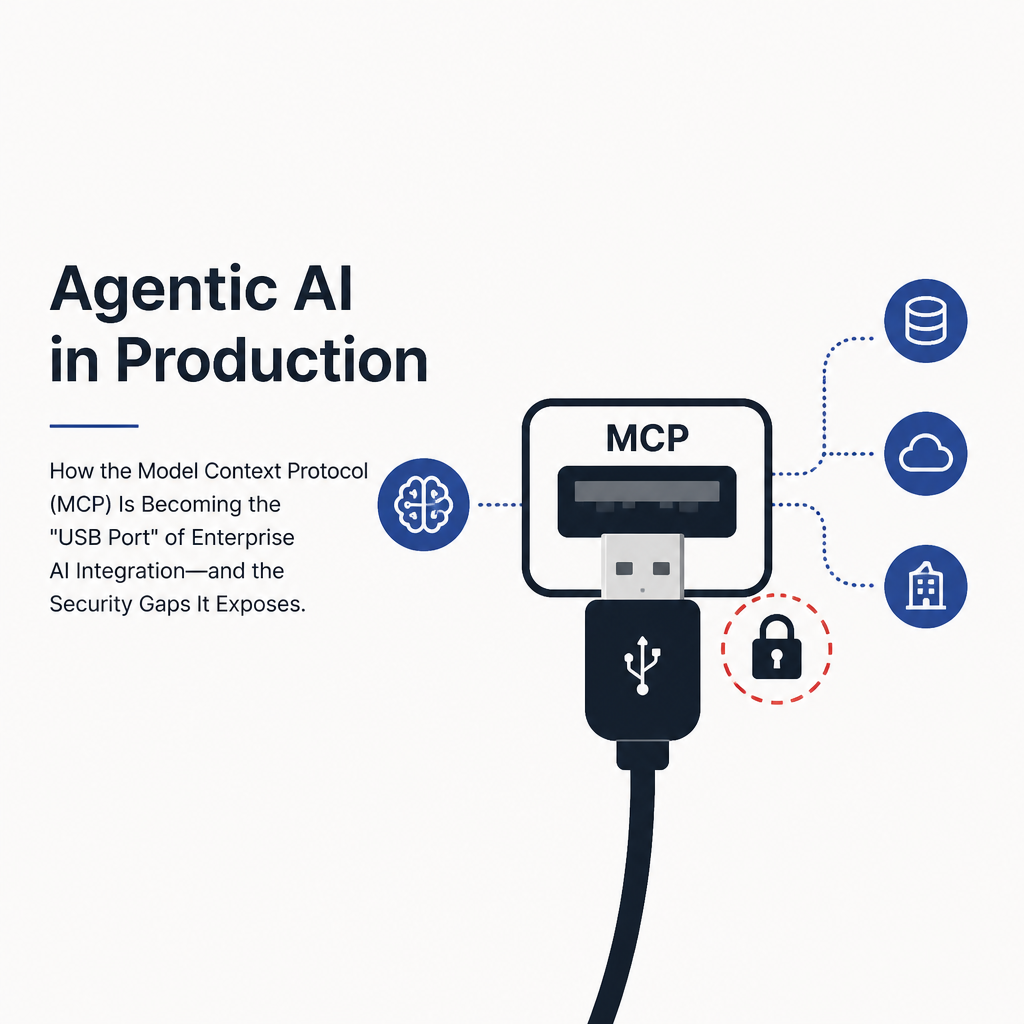
Over the past eighteen months, enterprise AI has shifted from chatbots that answer questions to agents that take action--querying databases, updating CRMs, opening tickets, and deploying code. The connective tissue enabling this shift is the Model Context Protocol (MCP), an open standard introduced by Anthropic in November 2024 that standardizes how large language models connect to external tools, data sources, and services [1]. Often described as the "USB-C for AI applications," MCP lets developers plug any compliant AI application into any compliant tool without bespoke integration code [2][3].
The protocol's momentum is hard to overstate. MCP now sees more than 97 million monthly SDK downloads across Python and TypeScript, over 10,000 published MCP servers spanning everything from developer utilities to Fortune 500 deployments, and backing from an industry coalition--including OpenAI, Google, Microsoft, AWS, and Cloudflare--that coalesced when Anthropic donated the protocol to the Linux Foundation's newly formed Agentic AI Foundation in December 2025 [4][1]. Analysts project the MCP server market alone will reach $10.4 billion by 2026, while Gartner estimates that 40% of enterprise applications will embed AI agents by the end of that year, up from just 5% [4].
But the same pluggability that makes MCP transformative also makes it dangerous. Security researchers describe a protocol "designed for convenience, not security," where credential hygiene is poor, authentication is frequently optional, and the attack surface grows with every new server an enterprise connects [5][6]. The question facing CISOs is no longer whether to adopt MCP--it is whether identity, access, and audit controls can govern autonomous systems that choose their own tools at runtime [7].
From the M×N Problem to a Universal Standard
To understand why MCP won, consider what came before it. For every AI model (M) an enterprise wanted to use and every tool or data source (N) it wanted to connect, developers had to write custom integration code--a classic M×N scaling trap that imposed a steep "integration tax" in cost, security risk, and slowed innovation [8]. Scientific laboratories faced the same wall: bespoke connectors broke whenever a system's schema changed, and every new compliance rule meant security had to be re-engineered from scratch [9]. Some firms experimented with "screen control," letting AI click through interfaces like a human--but the approach was fragile, insecure, and impossible to audit [9].
MCP flattens M×N into M+N: models and tools each implement the protocol once and instantly become interoperable [8]. Instead of one-off connectors, the protocol standardizes access to two primitives--resources (retrievable data) and tools (actions an agent can execute)--giving agents a consistent, governable way to interact with real systems [3].
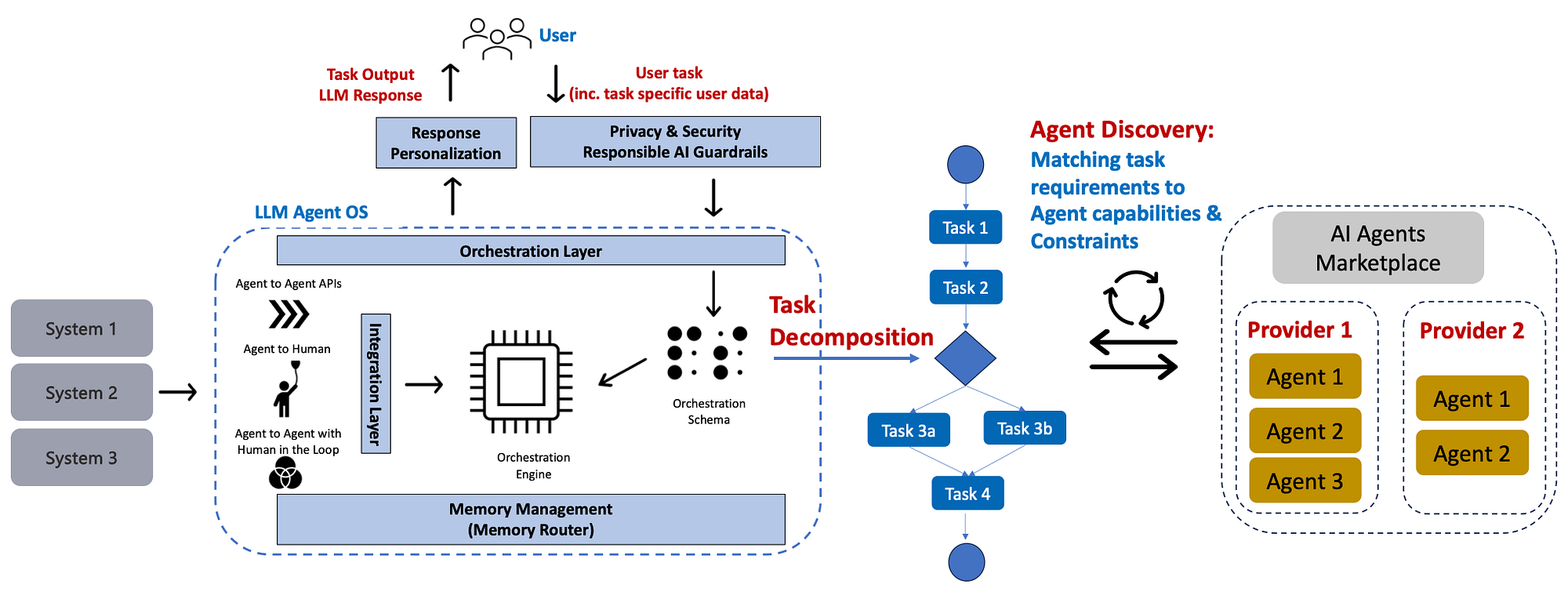 Agentic AI MCP Tools Governance. Discovery and governance guidelines for... | by Debmalya Biswas | Data Science Collective | Medium
The industry's embrace has been swift and unusually collective. OpenAI, Google, and Microsoft have all adopted support for the protocol [1], and the December 2025 transfer to the Linux Foundation's Agentic AI Foundation--with Anthropic, OpenAI, Block, Google, Microsoft, AWS, Cloudflare, and Bloomberg as founding stakeholders--ensures the standard remains open, vendor-neutral, and community-governed as it becomes critical enterprise infrastructure [4]. Open governance also delivers a practical benefit for enterprises: it guards against the vendor lock-in that has historically plagued integration standards [2].
How MCP Works--and Why It Fits Agentic Workloads
MCP's architecture has three core components. The MCP host is the AI application the user interacts with; the MCP client bridges the host to external systems; and the MCP server wraps individual tools--GitHub, Slack, a Postgres database, a CRM--and exposes their capabilities to the AI in a standardized format [8][5]. This architecture enables genuinely agentic workflows: a single conversation could analyze data from a database, create a GitHub repository with the results, send a Slack notification to the team, and deploy the solution to Kubernetes, all through standardized MCP interactions [5].
Compared to adjacent approaches, MCP's differentiation is structural. Retrieval-augmented generation (RAG) is a passive technique for pulling documents into context; function calling is a vendor-specific, one-off invocation pattern; traditional APIs are hard-coded, one-way endpoints. MCP, by contrast, provides standardized, bidirectional, real-time access designed explicitly for multi-step agentic automation [2]. The practical payoff shows up in three places: reduced hallucination, since models pull fresh, authoritative data rather than guessing; true agentic capability, chaining actions like "analyze Q1 sales, update the CRM, and email the team"; and developer productivity, since one MCP server works with every compatible client [2].
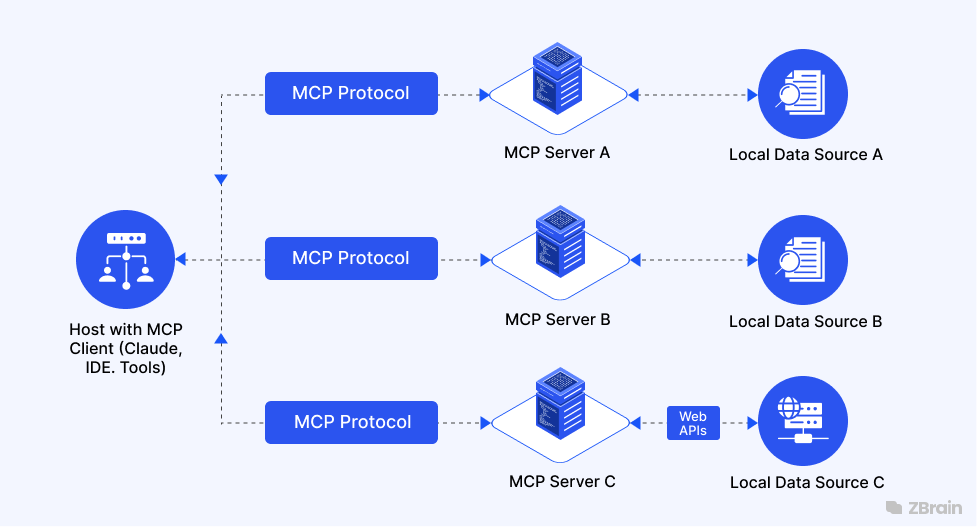 A Deep Dive into the Model Context Protocol (MCP)
Yet this architecture introduces a fundamentally different interaction model than traditional API integrations. As analysts at NHI Mgmt Group, drawing on research from Aembit, observe: MCP introduces stateful, bidirectional agent interactions, meaning an agent can discover tools, chain actions, and maintain context across multiple exchanges. The identity boundary shifts from a single authenticated request to a runtime relationship that can expand during the session [7]. That shift is precisely where the security model begins to strain.
The Security Ledger: What the Protocol Doesn't Do
The most important thing to understand about MCP is what it was never designed to be. It is a protocol, not a control plane. It standardizes how agents talk to tools--but it does not secure them [10]. The gaps are well-documented:
- No built-in authentication. There is no default mechanism enforcing identity between agents and tools; implementing and managing that layer is entirely the deployer's responsibility [10].
- No access control model. By default, any agent can discover and call any registered tool. Scoped visibility must be built separately [10].
- No observability. Direct MCP connections provide little insight into what is actually happening--no clear trace of agent behavior across tools [10].
- No guardrails. Tools execute with whatever permissions they have; the protocol does not inspect inputs or outputs for risky behavior [10].
The ecosystem data confirms these gaps are not theoretical. Astrix Security's State of MCP Server Security 2025 report found that while 88% of MCP servers require credentials, more than half (53%) rely on static API keys or personal access tokens, and modern OAuth authentication has been adopted by just 8.5% of deployments [1]. The broader context is equally sobering: IBM's 2025 Cost of a Data Breach Report found that 13% of organizations experienced breaches of AI models or applications, and of those compromised, 97% lacked proper AI access controls [1].
Perhaps most troubling is a systemic architectural flaw disclosed in April 2026 by OX Security: an estimated 200,000 vulnerable instances across a supply chain encompassing more than 150 million package downloads. Critically, this was not a coding error in any single product but a design default embedded in every official MCP SDK and propagated into downstream projects that trusted the reference implementation. Anthropic has confirmed the behavior is intentional and declined to modify the protocol architecture--leaving remediation responsibility with deployers [6]. The specification did add OAuth 2.1 support for HTTP-based transports in June 2025, but implementation varies widely across the ecosystem [4].
The Attack Surface: How MCP Deployments Get Compromised
The specific attack patterns targeting MCP deployments fall into several categories:
- Tool poisoning and rug pulls. Malicious tool descriptions can manipulate agent behavior; "rug pull" attacks alter a trusted tool's description after initial approval. Cross-origin escalation is another documented risk--security teams are advised to run scanning tools like Invariant Labs' mcp-scan across all installed servers [4].
- Context injection and privilege escalation. Because agents maintain context across exchanges and can chain actions, attackers can inject instructions into the context that escalate privileges or redirect agent behavior--failure modes that turn integration convenience into an identity problem [7].
- Supply chain compromise. New MCP servers are currently published without any mandatory security review process, authentication requirement, or coordinated disclosure mechanism--meaning the attack surface grows as MCP integration deepens into financial systems, regulated data environments, and privileged infrastructure [6].
- Credential theft. Malicious MCP servers can potentially compromise AI clients, steal credentials, or manipulate agents into performing unauthorized actions [5].
 MCP: What It Is and Why It Matters - by Addy Osmani
The Cloud Security Alliance frames the core failure through a zero-trust lens: "never trust, always verify" applies equally to AI tool integrations, and unauthenticated MCP deployments represent one of the clearest violations of that principle in the agentic AI stack [6].
Governing the Agent Workforce: A Practical Control Stack
If MCP standardizes communication but not control, the burden of governance shifts to the surrounding architecture--and to teams that have historically lived outside the AI organization. The emerging consensus is that MCP must be treated first and foremost as an identity and access problem. Security teams should govern the model-to-agent boundary as an authorization point, not just an integration point, asking whether the agent's identity, the tool's identity, and the data path are all separately governed. IAM, IGA, PAM, and non-human identity (NHI) programs need to treat agent-to-tool communication as governed workload identity, because autonomous tool use fundamentally changes how trust, authorization, and traceability must work [7].
In practice, a mature enterprise MCP deployment assembles controls from several sources into a coherent stack:
Discovery and vetting. Run tool-poisoning scans on all installed MCP servers, use only signed and trusted servers, and verify server code signatures to mitigate supply-chain risk [4][2].
Authentication and least privilege. Enforce OAuth 2.1 for all HTTP-based transports; default to read-only access--database servers should use read-only connection strings and file servers should be scoped to specific directories--with regular permission reviews [4][2]. High-security environments should prefer local stdio transports, reserving remote connections for strongly authenticated contexts [2].
Human oversight for consequential actions. Implement per-tool approval workflows for write, delete, and send operations--a capability supported by Claude Desktop, Cursor, and the OpenAI Agents SDK--and enable human-in-the-loop approval for sensitive actions [4][2].
Integrity monitoring. Enable tool pinning--hashing tool descriptions on first scan and alerting when they change--to catch rug pull attacks, alongside comprehensive logging and auditing [4][2]. Uniform audit trails, where every call is logged and permission-checked, are one of MCP's genuine governance advantages over screen-scraping and bespoke connectors [9].
Organizational governance. Establish an MCP governance council including security, legal, and business stakeholders to approve every new server deployment; CISOs should treat MCP governance as an ongoing program requirement with defined policies for which categories of tools are permitted and under what authentication and sandboxing requirements [4][6].
The rollout pattern matters as much as the tooling. Enterprises report the best outcomes when they start with resources and safe read-only tools, then progressively unlock write tools behind approval gates and tighter identity controls [3]. And critically, teams must recognize that MCP alone does not close the loop: the gateway layer sitting around MCP is what actually enforces governance and security. Teams that adopt MCP, see it working, and assume they are done have solved the communication problem--not the control problem [10].
The Road Ahead
The trajectory points toward MCP becoming foundational infrastructure. The Agentic AI Foundation's coalition signals that the industry has converged on a shared vision: AI agents will become the primary interface between employees and enterprise systems, and MCP is the protocol that makes it possible [4]. As one analysis puts it, in the age of AI agents the question won't be "Do you support MCP?" but rather "Which tools have you exposed to your agent workforce?" [8].
But maturity will be measured in governance, not adoption. The MCP ecosystem's security posture continues to lag its adoption curve, and enterprises should not treat current vulnerabilities as a bounded CVE remediation exercise--as integration deepens into production financial systems, regulated data environments, and privileged infrastructure, the attack surface will grow with it [6]. The protocol's move to open foundation governance provides the vehicle for hardening the specification over time, but deployers cannot wait for the spec to save them.
Conclusion
The Model Context Protocol has earned its place as the "USB port" of enterprise AI: it dissolves the M×N integration problem, enables genuinely agentic multi-step workflows across real business systems, and now rests on open, industry-wide governance. That achievement is real, and it is why MCP adoption is accelerating across every sector.
But a universal plug is not a security boundary. MCP standardizes communication; it does not standardize control. The identity gaps, credential sprawl, tool poisoning, and supply-chain risks now documented across the ecosystem make clear that the protocol's convenience model must be wrapped in zero-trust architecture, governed workload identity, human approval gates, and continuous auditability [7][10][6]. The enterprises that succeed with agentic AI in production will be those that internalize the distinction early: adopting MCP solves the integration problem--securing it is a discipline the organization itself must build.
---CONTENT-END---
References
- 1.
- 2.
- 3.
- 4.
- 5.
- 6.
- 7.
- 8.
- 9.
- 10.