Introduction
For most of the history of computational science, artificial intelligence has played a supporting role: aligning sequences, classifying images, and flagging candidates for human reviewers to pursue. That division of labor is now being upended. In 2026, AI has moved beyond analysis to become an active participant in the scientific method itself, with systems that independently generate hypotheses, design experiments, and draft research papers--compressing workflows that once took human teams months into days [1]. The most advanced of these systems, often called AI co-scientists, orchestrate entire research campaigns: searching literature, reasoning over evidence, proposing novel research directions, and even specifying the wet-lab protocols needed to test them [2].
The first wave of these platforms has arrived with remarkable speed. Google's AI co-scientist, a multi-agent system built on Gemini and published in Nature, uses a "generate, debate, and evolve" approach inspired by the scientific method itself [2][3]. AI-Researcher orchestrates the complete pipeline from literature review to publication-ready manuscript with minimal human intervention, while introducing Scientist-Bench to evaluate such systems [4]. OpenScientist takes a different tack, offering an open-source alternative designed to democratize access and make the hypothesis-generation process fully transparent [5]. Around them, a broader ecosystem has emerged--Robin, PharmaSwarm, cmbagent, AutoDS, and the Virtual Lab--each carving out a niche in the autonomous discovery landscape [6][7].
But capability claims demand scrutiny. How good are these machine-generated hypotheses, really? And how do we even measure quality when the systems being evaluated produce novel ideas rather than answers with ground truths? This article examines the architecture, early validation results, and evaluation frameworks of the first generation of LLM-driven autonomous research systems--and finds a field that is simultaneously more impressive and more fragile than its headlines suggest.
From Tools to Teammates: The Emergence of the AI Co-Scientist
Researchers in this space draw a crucial three-level distinction: automation, where the LLM acts as a tool executing predefined steps; multi-step analytical pipelines, where it acts as an analyst; and fully autonomous agentic operation, where it acts as a scientist--orchestrating observation, hypothesis, experiment, analysis, conclusion, and iterative refinement [6]. The systems now making headlines sit firmly at the third level, and their defining trait is that human researchers supply a research goal rather than a research question.
Google's AI co-scientist illustrates the paradigm. Given a research objective stated in natural language, the system searches and reasons over relevant literature, synthesizes prior work, and proposes original hypotheses with experimental protocols--grounding its recommendations in citations and verifying conclusions through external tools where possible [2]. Its architecture is "compound": a multi-agent system with asynchronous task execution in which agents generate candidate hypotheses, debate them against one another, and iteratively refine the strongest proposals, with performance that improves as test-time compute scales [2][3][8].
Other systems extend the frontier in different directions. AI-Researcher follows Google's framework lineage--The AI Scientist pioneered the comprehensive model of idea generation, experimentation, and paper writing, while CycleResearcher demonstrated that open-source LLMs could sustain a full cycle from literature review through refinement [4]. OpenScientist was built explicitly as a counterweight to proprietary platforms, providing complete transparency into its reasoning and accepting remarkably diverse inputs: electronic health records, genomics, transcriptomics, proteomics, metabolomics, structural biology, histopathology, imaging, and biomarker data, across text, tabular, binary omics, and image formats [5].
Meanwhile, a more algorithmically ambitious branch has appeared. AutoDS deploys Monte-Carlo Tree Search with progressive widening, treating each hypothesis as a node in a search tree and using "Bayesian surprise"--the KL divergence between the LLM's prior and posterior beliefs--to steer exploration toward genuinely novel findings [6]. Frameworks such as AI-Researcher, cmbagent, PharmaSwarm, and Robin decompose research into hierarchical modules spanning literature mining, hypothesis generation, code execution, analysis, and manuscript drafting [6].
 The AI co-scientist is here | Nature Medicine
Under the Hood: How Hypothesis Engines Work
What separates a hypothesis engine from a chatbot with a literature database? The answer lies in structured search over possibility space. Rather than asking one model for one answer, these systems spend additional inference-time computation generating many alternatives, comparing them, and refining the strongest candidates [8]. The AI co-scientist's "generate, debate, and evolve" mechanic is essentially an evolutionary algorithm over ideas: hypotheses compete, are critiqued by other agents, and are recombined, with tournament-style pairwise preferences and Elo ratings used to rank the survivors [3][8].
This design reflects a hard truth about hypothesis formation: a useful proposal must fit existing evidence, differ from what has already been tried, and lead to an experiment that could disconfirm it. A fluent model response can fail all three tests while still sounding plausible--which is exactly why architecture, not raw model capability, has become the field's key differentiator [8].
The biomedical focus of this first wave is no accident. The accelerating pace of biomedical data generation has created urgent demand for computational tools that can autonomously extract mechanistic insights from complex datasets, and agentic LLM methods are well suited to the field's mix of structured data, rich literature, and experimentally testable propositions [5]. Landmark efforts cataloged in recent surveys include Coscientist for autonomous chemistry, the Virtual Lab's AI-designed SARS-CoV-2 nanobodies from Stanford and CZ Biohub, TxAgent for therapeutic reasoning, and Biomni as a general-purpose biomedical agent [7].
The Verdict from the Lab Bench: Early Validation Results
The most consequential question is whether machine-proposed hypotheses survive contact with reality. Here, Google's AI co-scientist has produced the most striking evidence to date. In end-to-end laboratory experiments conducted with expert-in-the-loop guidance, the team validated hypotheses across three biomedical applications: drug repurposing for acute myeloid leukaemia, novel treatment target discovery for liver fibrosis, and elucidating mechanisms underlying antimicrobial resistance [9][2].
The liver fibrosis results are particularly noteworthy. The system proposed epigenetic targets grounded in preclinical evidence, and collaborator experiments demonstrated significant anti-fibrotic activity in human hepatic organoids--three-dimensional, multicellular tissue cultures derived from human cells--with detailed findings forthcoming from Stanford University collaborators [9]. Across its case studies, the system demonstrated the capacity for recursive self-improvement as compute scales, suggesting a ceiling not yet reached [2].
Yet benchmark results tell a more sobering story about the field as a whole. Scientist-Bench, developed alongside AI-Researcher, assesses autonomous research systems on both implementation Completeness and Correctness across guided and open-ended research tasks. The numbers are striking: Claude achieved 93.8% completeness on sub-tasks versus 50% for GPT-4o, but mean correctness across systems was just 2.65 out of 5 [4][6]. Systems can execute the research workflow far more reliably than they can execute it well.
 Will AI become our Co-PI? | npj Digital Medicine
The Evaluation Bottleneck: Grading a Machine's Imagination
Evaluating AI-generated science poses a genuinely novel methodological problem. As the AI-Researcher team notes, end-to-end automation presents unique evaluation challenges spanning literature review, hypothesis generation, experimental design, experimentation, and result reporting--each stage requiring distinct quality criteria [4]. Current approaches rely heavily on LLM-based pairwise comparisons, but as critics point out, pairwise preference and Elo scores rank outputs relative to one another; neither establishes that a winning hypothesis is actually true or genuinely novel [8].
The verification gap may be the field's most dangerous blind spot. SPOT, a new benchmark of 83 published papers paired with 91 errors significant enough to prompt errata or retraction, tested whether state-of-the-art LLMs could catch serious scientific mistakes. None surpassed 21.1% recall or 6.1% precision--o3 performed best, and still missed the overwhelming majority of errors [3]. A scientific ecosystem that produces hypotheses faster than it can verify them risks accumulating undetected errors at unprecedented scale.
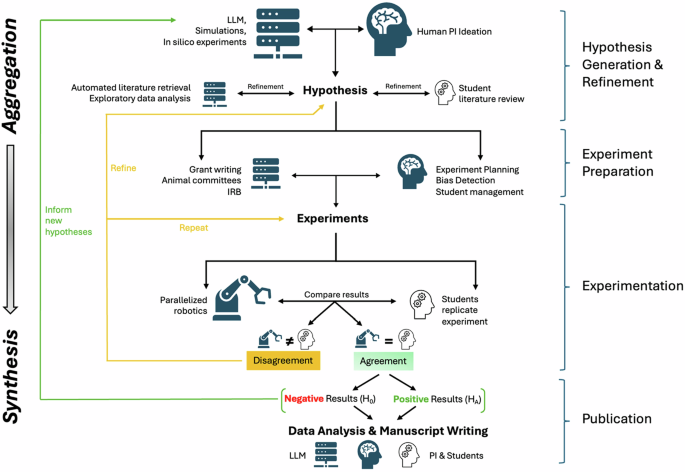
This is why researchers increasingly argue that the future lies in closed-loop discovery: AI scientists that generate hypotheses, select experiments to test them, interpret the resulting evidence, and update their beliefs accordingly, cycling until verification can keep pace with generation [10]. As one recent analysis puts it, autonomous biomedical discovery will advance only when verification matches the rate at which AI scientists generate hypotheses, so that each hypothesis is carried to the experiment that tests it and back to a revised version [10].
 Google's AI Co-Scientist Racks Up Two Wins - IEEE Spectrum
Open Questions: Risks, Limitations, and Guardrails
The limitations documented by the systems' own developers deserve equal attention to their successes. The AI co-scientist inherits factual errors and citation problems from its base model and search tools, and--more insidiously--multiple agents can repeat the same mistaken premise rather than correcting it, creating an illusion of consensus around a falsehood [8]. Its evaluation was small and concentrated in biomedicine, and several authors and collaborators participated in both system development and validation, meaning independent replication across other fields is needed before results can be generalized [8]. The team itself acknowledges the need for enhanced literature review, factuality checking, cross-checks with external tools, and larger-scale expert evaluations [9].
Open platforms face their own risk profile. OpenScientist's authors note that while on-premises deployment can keep sensitive clinical data within institutional governance, full data containment requires both the runtime and the underlying LLM in the same secure environment--and because agentic systems can execute arbitrary code, there remains a genuine risk of code that could destroy or exfiltrate sensitive data [5].
Broader surveys converge on a common list of unsolved problems: long-term coherence across extended research campaigns, domain adaptation beyond biomedicine, scalable verification, and epistemic guardrails [6]. A vibrant benchmarking ecosystem is emerging in response--PaperBench for replication ability, ScienceAgentBench for data-driven discovery tasks, GenoTEX for gene expression analysis, and DeepReview for AI-assisted peer review--each carving out measurable slices of the scientific method [7].
The Road Ahead: Closed Loops and Open Science
Two trajectories seem likely to define the field's next phase. The first is closing the loop: integrating hypothesis generation with automated experimentation so that the AI scientist, not just the human, learns from experimental outcomes [10]. The second is opening the stack: OpenScientist's transparency-first philosophy--letting researchers understand, validate, and modify the AI's reasoning--directly addresses the reproducibility and trust deficits of proprietary systems [5]. The rapid proliferation of open resources, from comprehensive research surveys to curated repositories of discovery systems, suggests a community actively building the scaffolding for scrutiny [7].
What seems clear is that the "co-" in co-scientist is doing real work. The most successful validations to date all involved expert-in-the-loop guidance [9], and Google's team explicitly frames the system as a collaborator that augments rather than replaces human scientists [2]. The near-term future is less autonomous science replacing researchers than human-AI teams where machines search hypothesis space at superhuman breadth while humans supply judgment, taste, and accountability.
Conclusion
The first wave of LLM-driven autonomous research systems has crossed a genuine threshold: AI systems can now propose novel, testable, and in several documented cases experimentally validated biomedical hypotheses--work once considered the exclusive province of trained scientists. Google's AI co-scientist has produced anti-fibrotic drug targets confirmed in human organoids; open platforms have made the machinery of hypothesis generation inspectable; and structured search methods like Bayesian surprise-driven MCTS are turning idea generation into an engineering discipline [9][5][6].
But the same evaluation literature that documents these wins also tempers them. Correctness scores lag far behind completion rates [4][6], even the best models detect only a fraction of serious scientific errors [3], and current ranking metrics measure persuasiveness more than truth [8]. The field's central challenge is no longer generating hypotheses but verifying them--closing the loop between what AI proposes and what evidence confirms [10]. If the next wave of systems rises to that challenge, the co-scientist of 2026 may be remembered not as a curiosity, but as the moment biomedical discovery changed gears.
References
- 1.
- 2.
- 3.
- 4.
- 5.
- 6.
- 7.
- 8.
- 9.
- 10.