
Introduction
For most of the past half-century, the geography of technological power was defined by oil fields, shipping lanes, and nuclear arsenals. Today, a new axis of geopolitical influence is being drawn around something seemingly more mundane: data centers, GPU clusters, and the semiconductor supply chains that feed them. As artificial intelligence becomes the central engine of economic productivity, the global distribution of AI infrastructure is emerging as a decisive measure of national power, reshaping sovereignty, alliances, and strategic competition in the process [1].
This shift has been accelerated -- and in many ways manufactured -- by policy. Since 2022, the United States has escalated a sweeping export control regime aimed at denying China access to frontier AI chips, a framework that has progressively expanded from targeted restrictions into a global system for managing where and how advanced compute can exist [2]. The unintended consequence has been profound: nations that view AI capability as a sovereign interest can no longer accept dependence on Washington's export policy as a constraint on their development. The response has been a worldwide rush of government-funded infrastructure programs, from the Gulf states' $100 billion compute commitments to India's national AI mission and France's €109 billion industrial plan [3][4].
This article examines the rise of what analysts now call "compute nationalism" -- the treatment of AI computing infrastructure as a strategic national asset subject to sovereign control, export restrictions, and industrial policy [5]. It traces the export control regime's escalation, maps the sovereign AI programs now proliferating across the globe, and asks a critical question: can any nation outside the United States and China actually achieve AI sovereignty, or does the very structure of the technology guarantee new forms of dependence?
Compute as the New Oil: Defining the Era of Compute Nationalism
The analogy circulating in boardrooms and ministries alike is straightforward: just as oil reserves once determined economic and strategic standing, chips, GPUs, and cloud infrastructure may now be the assets that decide whether a country is economically dominant and secure [6]. AI is not merely a software or algorithmic technology; it is a computational system dependent on semiconductors, data centers, cloud infrastructure, and energy systems -- and the concentration and geopolitical control of these resources increasingly determine which states, organizations, and research communities can build and deploy advanced AI [5].
Yet compute differs from earlier strategic resources in three structurally important ways. First, AI chips are physically bounded and trackable: they move through documented trade channels, making them uniquely amenable to export controls and verification. Second, the supply chain passes through a handful of firms -- ASML, TSMC, and NVIDIA chief among them -- each of which constitutes a single point of failure for the entire global system. Third, compute is the fastest strategic input to amass: a data center begins generating value the moment it comes online, whereas talent pipelines and data advantages take years to cultivate [5].
Proponents of sovereign AI describe capability as resting on three distinct fronts: compute (the ability to possess and control infrastructure rather than rent it overseas), model access, and data/deployment residency [6]. The stakes are tangible -- dependence on foreign infrastructure creates exposure to a remote "kill switch," the possibility that a foreign government could cut off access, data flows, or chip supply in a moment of geopolitical crisis [6][7]. It is precisely this vulnerability that has turned compute into an instrument of statecraft.
The Export Control Regime: From Targeted Sanctions to Global Compute Management
What began as a targeted effort to slow China's AI ambitions has evolved into the most ambitious technology control regime in modern history. Over successive rounds of escalation, U.S. export controls have expanded to manage global compute diffusion, with each iteration reflecting shifting Washington assessments of AGI timelines and China's push for semiconductor self-sufficiency [3][2].
The inflection point came in January 2025, when the outgoing Biden administration introduced the AI Diffusion Rule, which globalized the control regime in three sweeping ways. It imposed license requirements on state-of-the-art AI chips, high-bandwidth memory, and semiconductor manufacturing equipment destined for more than 100 countries. It extended controls to cloud computing services that could remotely provide access to restricted hardware. And it stratified the world into tiers -- eighteen close allies, including the United Kingdom, were effectively exempt, while every other country faced caps on chip volumes and performance thresholds [2].
The policy logic is explicitly competitive. As reasoning-intensive models become the industry standard, the gap between nations with compute and those without widens -- and exacerbating that imbalance is precisely what the controls are designed to achieve. By restricting China's access to cutting-edge compute, the United States seeks to prevent Chinese labs from training frontier models and to cripple their ability to deploy AI at scale [2].
The regime has also proven politically volatile. In late October 2025, the Trump and Xi administrations agreed to a one-year truce on tariffs and rare earths -- but left export controls on AI chips entirely untouched. Within days, Trump signaled he would permit limited NVIDIA sales to China before reversing course, an episode that revealed the deeper tension in American strategy: how to balance short-term technological leverage against long-term industrial strength in the race for compute dominance [2].
 The Sovereign AI Revolution 2026 Why Your Data is the New Border
Perhaps the regime's most consequential effect is structural rather than restrictive. The export control system has accelerated national AI infrastructure programs in every Tier 1 and Tier 2 country that can afford to build them. The strategic calculation is simple: nations convinced that AI is a sovereign interest cannot allow U.S. chip export policy to constrain their development [3].
The Sovereign AI Gold Rush: Government Infrastructure Programs Around the World
By 2026, global spending on sovereign AI systems is projected to surpass $100 billion -- and the programs behind that figure span every continent [4].
The Gulf: Buying Compute Sovereignty at Hyperscale
The most aggressive entrants are the Gulf states. The UAE's G42 and Saudi Arabia's HUMAIN are building hyperscale data centers with direct NVIDIA partnerships, backed by combined AI infrastructure investments exceeding $100 billion [3]. Both countries sit in Tier 2 under U.S. export controls, requiring licenses for the highest-performance chips -- a complication that has pushed both toward government-to-government arrangements in which U.S. oversight provisions are accepted in exchange for access [3]. The arrangement encapsulates the middle-power dilemma: compute sovereignty purchased at the price of American supervision.
India: Building the Full Stack
India has embarked on perhaps the most comprehensive approach, pairing the IndiaAI Mission's national compute buildout with the India Semiconductor Mission's attempt to domesticate chip fabrication itself [3][5]. The logic is systems-level: compute sovereignty without semiconductor capacity merely relocates the chokepoint. India's strategy also reflects a distinctive concern that compute inequality produces epistemic inequality -- concentrating in a few hands the ability to determine which data, languages, priorities, and forms of knowledge are embedded in the world's AI systems [5].
Japan and East Asia: Industrial Champions as Policy
Japan's approach channels sovereignty through its industrial champions. Fujitsu's MONAKA processor program, developed in partnership with NVIDIA, represents an attempt to build domestic silicon capability while remaining embedded in the American compute ecosystem [3]. It is a strategy of layered autonomy -- partial self-sufficiency as insurance rather than full independence.
Europe: Macron's "Third Way"
France offers the most explicit ideological framing. Under the France 2030 plan, Paris has committed €109 billion to AI infrastructure, with targets including 1.2 million deployed GPUs and 100,000 AI professionals trained annually by 2030 [4]. President Macron's "Third Way" positions France as a strategic alternative to both U.S. commercial dominance and Chinese state control. The regulatory architecture reinforces the investment: France's stringent SecNumCloud 3.2 security certification remains out of reach for U.S. hyperscalers unless they collaborate with local firms, and the impact is visible -- French managed services grew 142% year-on-year in the second quarter of 2025 as regulated industries pivoted toward sovereign solutions [4]. Energy strategy is part of the calculus too: low-carbon nuclear and hydroelectric power are increasingly leveraged as competitive advantages for AI infrastructure [4].
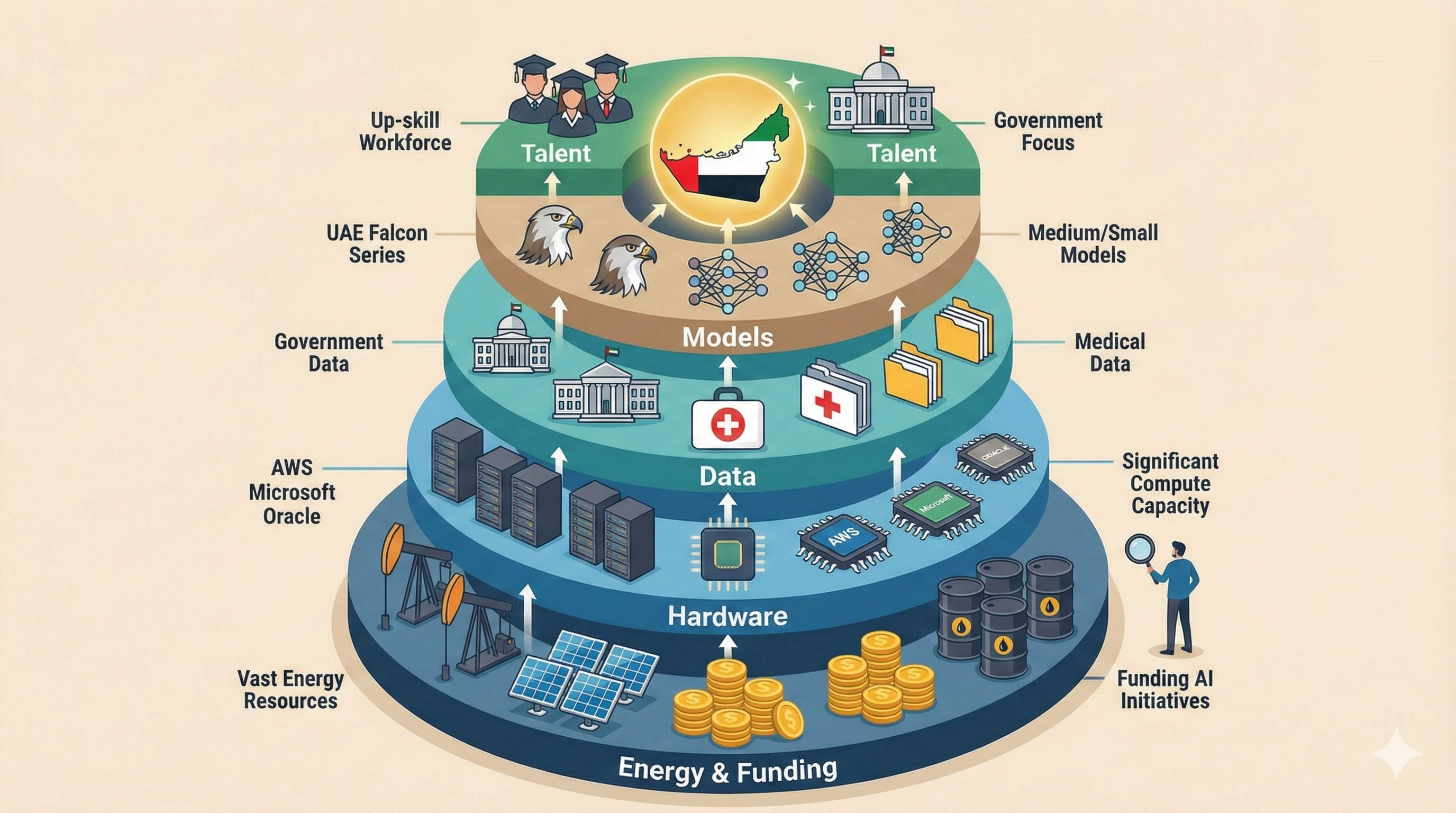 The New Front Line: Sovereign AI in the AI Cold War
The Chokepoint Economy: Concentration and Single Points of Failure
The sovereign AI gold rush collides with a stark physical reality: compute is extraordinarily concentrated. According to Carnegie Endowment analysis, nearly three-quarters of all advanced AI compute clusters as of mid-2025 sat within U.S. borders, with China accounting for roughly 14 percent. Ninety percent of the computing power needed to develop and deploy frontier AI resides in the United States and China, whose companies have produced virtually all of the world's top-ranked foundation models [8][9].
The downstream picture is even more lopsided. Only 32 countries worldwide host AI-specific data centers, leaving roughly 160 nations entirely dependent on foreign infrastructure [8]. This concentration is itself a driver of sovereign AI initiatives -- governments wary of dependence on foreign models and cloud platforms are pouring resources into compute under their own control [9].
The chokepoints that make American leverage possible are structural and difficult to dislodge. NVIDIA dominates AI accelerators; Taiwan holds a near-monopoly on advanced chip fabrication; and ASML enjoys exclusive control over the extreme ultraviolet lithography machines required to manufacture leading-edge semiconductors [5][8]. Because nearly every nation outside the U.S. and China must access frontier AI through infrastructure Washington can, in principle, switch off, export controls aimed at China inevitably reach the entire world [8].
 Sovereign AI and the Geopolitics of Compute: Export Controls, National Chip Programs, and the Fracturing Global AI Stack - Vamsi Talks Tech
Middle Powers and the Global South: Navigating a Fractured Stack
For middle powers -- the Gulf states, Europe, Japan, Singapore -- the strategic question has become one of calibration: how much "sovereign AI on American terms" is acceptable, weighed against the risks of deepened dependence and the alternative of Chinese technology ecosystems [8]. That alternative is no longer hypothetical. China's Zhipu AI has begun offering governments private hardware and sovereign large-language-model infrastructure in partnership with Huawei, while OpenAI has countered with an "OpenAI for Countries" program promoted in coordination with the U.S. government [7]. Sovereign-AI services have become, in effect, a marketplace of geopolitical alignment, in which nations purchase compute and models bundled with strategic orientations [7].
Russia's Sberbank has similarly marketed locally adapted models to Global South governments -- even as its own executives candidly acknowledge dependence on foreign chips and NVIDIA's CUDA software ecosystem, a reminder of how thin sovereign claims can run beneath the surface [7].
For the majority of the world's nations, the stakes extend beyond economics. Unequal access to computational infrastructure generates epistemic inequality: it concentrates the ability to determine the data, languages, priorities, and knowledge systems embedded in AI models [5]. Nations excluded from the compute map risk consuming AI systems whose values and assumptions were shaped entirely elsewhere -- a subtler form of dependency than chip controls, but no less consequential.
The Limits of Sovereignty: Costs, Contradictions, and Criticisms
For all its momentum, the sovereign AI movement faces a structural contradiction that its champions rarely confront in full. As the Center for a New American Security's Sovereign AI Index observes, building national data centers to escape reliance on U.S. cloud platforms does not eliminate dependence on American technology -- it merely shifts exposure from one layer of the U.S. tech stack to another. In the near term, it is difficult to envision any sovereign compute project outside China that is wholly independent of the American technology stack [9].
The term "sovereign AI" itself is contested. It remains loosely defined, with no agreed scope: some initiatives rely on imported processors and foreign cloud technology while retaining only local control over data or deployment [7]. Critics point to the enormous cost and questionable performance of national programs, the environmental burden of large data centers, and -- most pointedly -- the role of technology vendors in defining and supplying "sovereignty" projects, a dynamic in which NVIDIA benefits handsomely from every nation's pursuit of independence from NVIDIA [7]. Analysts have likewise warned of a "sovereignty trap," in which compute nationalism fragments the global AI supply chain and complicates the strategies of multinational enterprises that must now architect AI deployments around jurisdictional boundaries rather than technical logic [10].
There are domestic trade-offs as well. Sovereign AI demands enormous public expenditure, a specialized workforce, and sustained energy commitments -- resources that might otherwise fund healthcare, education, or conventional infrastructure [6][4]. And the approach to sovereignty varies in depth: a nation may achieve control over one layer of the stack while remaining exposed on the others [6]. Sovereignty, in short, is not binary but a spectrum -- and most national programs purchase a marginal reduction in dependency at extraordinary cost.
 Sovereign AI and the Geopolitics of Compute: Export Controls, National Chip Programs, and the Fracturing Global AI Stack - Vamsi Talks Tech
Conclusion
Compute nationalism is no longer a fringe preoccupation but the organizing logic of global AI competition. The United States has converted its chokepoint position into an instrument of statecraft; China has responded with self-sufficiency drives and its own sovereign-AI export offers; and everyone in between -- from Abu Dhabi to Paris to New Delhi -- is scrambling to build national compute capacity before the frontier closes [3][8][7][2]. The numbers tell the story: three-quarters of advanced AI clusters within American borders, ninety percent of frontier compute in just two countries, and 160 nations with no AI-specific infrastructure of their own [8][9].
Yet the sovereign AI era carries an inherent irony. Nations building data centers to escape foreign dependence are, in most cases, purchasing American chips, American software ecosystems, or -- at best -- a carefully negotiated share of American-supervised compute [3][9]. The global AI stack is fracturing along national lines, but the fracture lines run through supply chains that remain profoundly interdependent. Whether sovereign AI matures into genuine technological independence, calcifies into a tiered system of American-licensed compute, or gives way to a contested bipolar ecosystem will define not only the AI industry but the distribution of economic and epistemic power for decades to come. The new great game is underway -- and its strategic reserve is measured not in barrels, but in gigawatts and FLOPS.
References
- 1.
- 2.
-
3.
Sovereign AI and the Geopolitics of Compute: Export Controls, National Chip Programs, and the Fracturing Global AI Stack - Vamsi Talks Tech. (n.d.). Retrieved https://www.vamsitalkstech.com/ai-infrastructure/sovereign-ai-and-the-geopolitics-of-compute-export-controls-national-chip-programs-and-the-fracturing-global-ai-stack
- 4.
- 5.
- 6.
- 7.
- 8.
- 9.
- 10.