Introduction
For decades, software engineering followed a simple formula: developers wrote explicit instructions for computers, line by line. That formula is now being rewritten. A new generation of AI systems -- autonomous coding agents -- no longer merely suggest the next line of code or answer questions in a chat window. Instead, they operate at the repository level, generating entire pull requests, implementing features, and even deploying changes with minimal human intervention [1][2].
The adoption curve has been striking. Roughly 80% of developers now report using AI coding agents in their workflows, yet trust in AI accuracy has paradoxically fallen from 40% to 29% year-over-year [2]. This tension -- mass adoption colliding with growing skepticism -- defines the current moment in agentic development. Engineering organizations are racing to integrate these tools while researchers are only beginning to produce rigorous evidence about their effects on velocity, quality, and technical debt [3].
This article examines how agentic AI is reshaping software engineering across three dimensions: the day-to-day workflows of individual developers, the quality and maintainability of the code they produce, and the structure and composition of engineering teams themselves. It also explores the governance challenges that emerge when software stops being something engineers write and becomes something they supervise.
From Assistant to Agent: Understanding the Technology
Two Paradigms of AI-Assisted Development
AI-powered coding tools have evolved along two distinct paths. The first is the pre-agentic coding assistant: tools that integrate into developer environments like Visual Studio Code to provide real-time code suggestions, inline autocompletion, and on-demand chat assistance. The second -- and far more transformative -- paradigm is the IDE- and web-based coding agent: autonomous AI systems that operate at the repository level to generate entire pull requests and implement features with minimal human intervention [1].
This distinction matters because the two paradigms carry fundamentally different risk profiles. Assistants augment a human who remains in full control of every change; agents make larger-scale contributions with greater autonomy, introducing challenges that earlier AI tools never posed [3].
The Anatomy of an Autonomous Coding Agent
Recent advances in LLM reasoning and code synthesis have given rise to generalist coding agents capable of tackling sophisticated development tasks when equipped with basic toolkits such as code-execution sandboxes, web search, and environment-management utilities. An autonomous coding agent (ACA) typically consists of three core components [4]:
- The LLM, which drives reasoning and code generation
- The coding agent, which structures task execution, manages state, and applies reasoning loops
- The sandbox infrastructure, which provides a controlled environment for safe, reproducible code execution and iteration
Together, these components enable something qualitatively new: enterprise software conceived not as static code, but as an adaptive network of intelligent components capable of evolving with the business it serves [4].
 AI Agents and Agentic Workflow for DevOps and Progressive Delivery
Reshaping Developer Workflows
AI as a First-Pass Executor Across the SDLC
The most immediate and tangible impact of agentic AI is on development velocity. The industry is moving beyond AI as a sophisticated coding assistant toward AI as an autonomous, multi-skilled team member. Agentic AI increasingly acts as a first-pass executor across the entire software development lifecycle: analyzing feasibility during planning, implementing features during build, expanding test coverage during validation, and surfacing risks during review -- compressing weeks of coordination into continuous workflows [5].
In practice, this means agents participate in activities that once required human scheduling and handoffs. They write code, execute tests, debug failures, create pull requests, and deploy changes [2]. They integrate directly with Git repositories, CI/CD pipelines, issue trackers, and project management platforms, turning fragmented manual processes into automated, end-to-end flows [6]. The result is faster iteration cycles, reduced manual overhead, and better alignment between planning and execution [6].
From Coding to Supervising
The developer's lived experience is changing accordingly. As one practitioner put it: "You are not coding anymore, you are supervising" [2]. Rather than typing out implementations, engineers increasingly define goals, review agent-generated pull requests, and validate outputs while the agent iterates through subtasks with a human kept in the loop [7].
This shift is best understood as a maturity curve with three phases. It begins with assistance, where AI supports discrete, atomic tasks -- largely the stage most organizations occupy today. It progresses to augmentation, where AI manages multi-step processes within defined domains, such as autonomously overseeing a CI/CD pipeline. Ultimately, the trajectory leads to autonomy, in which AI operates across domains and makes smarter decisions guided by high-level business objectives. Each phase demands different engineering structures, skills, and governance models -- and companies must be intentional in their progression, avoiding the temptation to run before they can walk [5].
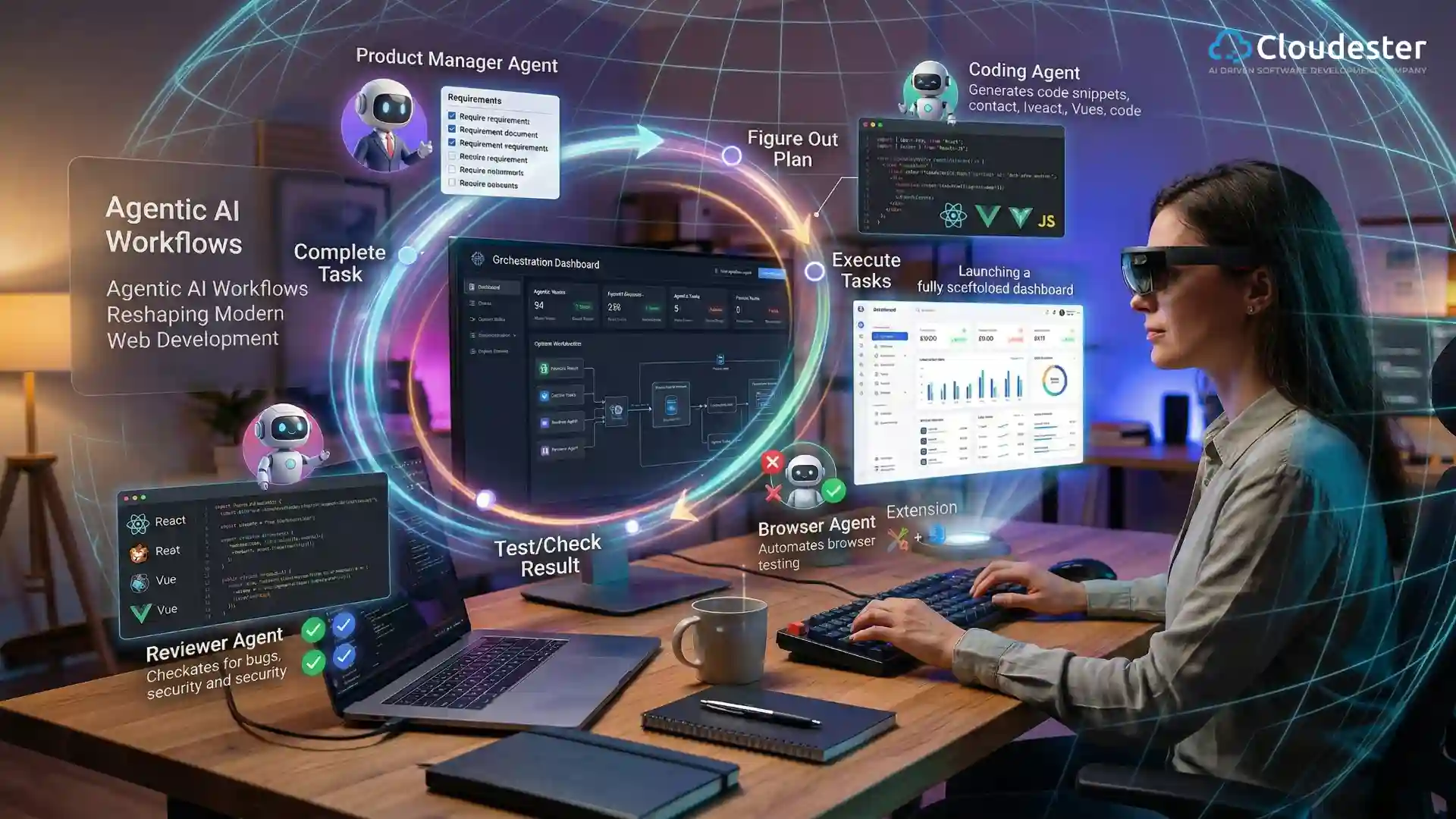 How Are Agentic AI Workflows Reshaping Web Development
The Code Quality Question
Automated Quality Gains
Proponents point to genuine quality improvements. Autonomous agents can run static analysis, identify potential vulnerabilities, and ensure coding standards compliance continuously -- transforming quality assurance from a gated, manual review step into an ongoing, automated process [6].
Documentation, one of the most neglected parts of software development, may benefit most. AI agents can generate API documentation, summarize pull requests, create onboarding guides, and update README files automatically -- improving knowledge sharing and reducing onboarding time for new team members [6]. In the agentic model, testing shifts from an afterthought to a core deliverable: agents write and execute tests as a routine part of their workflow rather than as a phase squeezed under deadline pressure [8].
Velocity Versus Maintainability
Yet speed cuts both ways. Coding agents can contribute changes at tremendous pace, which naturally raises questions about code quality, maintainability, and technical debt [1]. An agent generating dozens of pull requests a day can accumulate subtle architectural drift far faster than a human team ever could, and probabilistic code generation introduces failure modes that deterministic logic never had [7].
The research community is racing to catch up. While the effects of IDE-based assistants on productivity and quality have been studied, the impacts of autonomous, repository-level agents remained largely unexplored -- a concerning gap given that agentic tools operate with greater autonomy and make larger-scale contributions. Recent work has begun to close it, providing the first large-scale longitudinal evidence on agentic contributions at the repository level, along with the first causal evidence on the differential effects of transitioning from IDE-based AI assistants to autonomous coding agents [3]. Early findings suggest that a repository's prior AI exposure shapes how agent adoption affects both velocity and quality -- a nuance that complicates one-size-fits-all adoption strategies [3].
The Trust Gap
Perhaps the most telling data point comes from developers themselves. With 80% adoption but trust in AI accuracy falling from 40% to 29% in a single year, the industry's relationship with agentic tools is defined by enthusiastic use and reserving judgment [2]. Developers will delegate to agents; they are far less willing to trust them blindly. Human oversight -- reviewing, validating, and correcting agent output -- remains the load-bearing wall of the entire paradigm [7].
 Agentic Engineering: How Swarms of AI Agents Are Redefining Software Engineering
New Roles, Hybrid Teams, and Organizational Change
The Emergence of Agent-Native Roles
As agents become coworkers rather than tools, entirely new engineering roles are materializing [9]:
- Agent Orchestration Engineer: coordinates multi-agent workflows, much like managing a team of specialized digital coworkers
- Prompt Architect: crafts structured reasoning patterns that guide AI thinking step by step
- LLMOps Specialist: ensures reliability, safety, and performance in agentic pipelines
Notably, the fundamental unit of delivery is changing. It is no longer just code -- it is capability: a system that can repeatedly achieve a goal with predictable results [9].
The Hybrid Human-Agent Team
Analysts describe these changes in terms of ordered impacts. First-order impacts are the direct changes to an engineer's daily tasks -- using an agent to generate code, automate testing, or retrieve information. Second-order impacts are systemic: new engineering roles, the evolution of Agile and DevOps practices to accommodate AI teammates, and the design of agent-native system architectures. Third-order impacts extend to the economics, business models, and philosophical underpinnings of the software industry itself, including labor market transformation [8].
In the long-term vision, a software development team becomes a true hybrid entity. AI agents handle the bulk of the automatable work -- generating code, writing and executing tests, managing CI/CD pipelines, and updating documentation -- freeing human engineers to focus on tasks that remain uniquely human: complex system architecture, creative problem-solving, understanding stakeholder needs, and setting the strategic and ethical direction for the products they build [8].
Writing Behavior Versus Shaping Behavior
This realignment is prompting some to rethink the discipline's very name. In traditional software engineering, developers write behavior; in agentic engineering, developers shape behavior -- shifting away from deterministic logic toward the nuanced territory of probabilistic judgment. The "agentic" half refers to an organization of agents that write the code, while a human developer oversees and validates output as the agent or multi-agent system iterates through subtasks. The "engineering" half describes the expertise required to use these workflows for meaningful code production without jeopardizing quality [7]. This has profound implications for the talent pipeline, as computer science programs built around conventional software engineering careers confront a far less conventional professional reality [7].
The Management Challenge
The organizational questions are as hard as the technical ones. How do we evaluate the performance of an AI agent? How do we foster team cohesion between humans and digital workers? How do we retrain and upskill existing talent? These are the profound management and cultural challenges of the near future, and they require as much attention as the technology itself [5]. Notably, emerging evidence suggests AI agents enable developers to move toward higher-order work rather than simply doing more of the same work faster [10].
 Agent Engineering: How Agentic AI Is Redefining Software Development | by Sai Kumar Yava | Towards AI
Governance and the Human Element
Agents Can Act, but Humans Must Decide
Autonomy is useful, but it is not the same as responsibility. AI agents can move fast -- generating patches, updating configurations, triggering pipelines, creating specifications. But humans still decide: what gets built, what risks are acceptable, and what ethical boundaries apply [9]. As agentic systems take on more consequential actions, ethical and governance challenges move from theoretical to operational, demanding clear accountability structures for machine-generated changes [9].
Workflow Redesign as the Real Key
Perhaps the most important insight from early adopters is that tooling alone delivers little. Workflow redesign -- rethinking how work flows through a team when some of the workers are software -- is the real key to AI-driven success [9]. Organizations that simply bolt agents onto unchanged processes tend to amplify existing dysfunctions; those that redesign their development pipelines around delegation, validation, and continuous oversight capture the genuine step-function improvements in productivity, quality, and innovation that agentic AI promises [5].
Conclusion
Agentic AI is not merely accelerating software engineering -- it is redefining it. Autonomous coding agents have moved from novelty to near-ubiquity in a remarkably short time, taking over code generation, testing, documentation, and pipeline management while compressing development cycles that once took weeks [6][2][5]. Yet the data tells a story of negotiated trust rather than wholesale replacement: adoption is nearly universal, but confidence in AI output is falling, keeping human judgment firmly at the center of the process [2][3].
The emerging equilibrium looks less like "AI replacing developers" and more like a fundamental redivision of labor. Agents execute; humans supervise, architect, and decide [8][9]. New roles -- orchestrators, prompt architects, LLMOps specialists -- are forming around the management of intelligent systems, while the discipline itself shifts from writing deterministic behavior to shaping probabilistic outcomes [7][9]. The organizations that thrive will be those that treat agentic transformation as what it truly is: not a tooling upgrade, but a redesign of workflows, team structures, and governance from the ground up [5][9]. The code, increasingly, will write itself. The engineering -- in every sense of the word -- remains human.
References
- 1.
- 2.
- 3.
- 4.
- 5.
- 6.
- 7.
- 8.
- 9.
- 10.