Introduction
Generative artificial intelligence has arrived at a paradoxical moment. Over one billion people now use generative AI tools daily, each interaction drawing on vast, invisible infrastructure that consumes electricity, water, and raw materials at staggering scale [1]. A single prompt to a modern large language model may seem weightless--a fraction of a watt-hour, a few milliliters of water--but multiplied across billions of daily queries, the aggregate environmental footprint of generative AI is already comparable to the annual electricity consumption of a low-income country [1]. This is not a distant theoretical concern; it is a present-day ecological ledger that is growing exponentially.
What makes this challenge particularly complex is that the environmental costs of AI cannot be reduced to a single metric. Carbon emissions, water consumption, embodied energy in hardware manufacturing, e-waste generation, and the geographic distribution of these burdens form a tightly coupled system--a water-energy nexus--in which optimizing for one variable can inadvertently worsen another [2][3]. Researchers have demonstrated, for instance, that strategies designed solely to reduce the carbon footprint of model training may actually exacerbate water consumption, underscoring the need for holistic, multi-dimensional assessment [2].
This article examines the full spectrum of generative AI's environmental impact, from the training floor to the inference server, explores the paradoxes that make efficiency gains elusive, and surveys the emerging standards, regulatory frameworks, and technical innovations that aim to put AI on a sustainable trajectory.
The Anatomy of AI's Environmental Footprint
Training Emissions: The Upfront Carbon Debt
Training a state-of-the-art large language model is among the most computationally intensive tasks ever undertaken in the history of information technology. OpenAI's GPT-3 consumed an estimated 1,287 MWh of electricity during training, producing approximately 552 metric tons of CO₂ equivalent [4]. Projections for GPT-4 suggest emissions as high as 21,660 tCO₂e--comparable to the lifetime emissions of several passenger vehicles [5][4]. These figures represent a one-time but enormous carbon debt that must be amortized over the model's useful life.
Yet training emissions tell only part of the story. The manufacturing of AI-specific hardware--particularly high-performance GPUs--entails the extraction of rare earth metals, intensive water use, and complex global supply chains that generate substantial embodied emissions [4]. These upstream impacts are frequently omitted from standard CO₂ assessments but contribute meaningfully to the overall ecological footprint [3][4]. The European Union's policy discourse has explicitly linked these impacts to tensions with Sustainable Development Goal 13 (Climate Action), SDG 7 (Affordable and Clean Energy), and SDG 15 (Life on Land) [5].
Inference Emissions: The Long Tail of Deployment
Once deployed, LLMs enter a phase of continuous energy consumption that, while lower per interaction, accumulates relentlessly. Measured production-scale data from 2025 reveal that a typical Gemini-class service consumes approximately 0.24 watt-hours and 0.26 mL of water per prompt [6]. For context, charging a phone requires roughly the same energy as 50 to 70 prompts; one hour of laptop use corresponds to 125 to 300 prompts [6]. These per-interaction figures are modest, but the scale of deployment transforms them into a significant and growing burden.
Not all models are equal in their inference costs. Research benchmarking LLM inference across architectures has found that models such as DeepSeek-R1 consistently emit over 14 grams of CO₂ and consume more than 150 milliliters of water per query--equivalent to driving 50 meters in a gasoline-powered car and using two-thirds of a standard cup of water [7]. These elevated figures likely reflect inefficiencies in data center infrastructure, including higher Power Usage Effectiveness (PUE) ratios and suboptimal cooling technologies, demonstrating that environmental impact is shaped as much by deployment strategy and regional infrastructure as by model architecture itself [7].
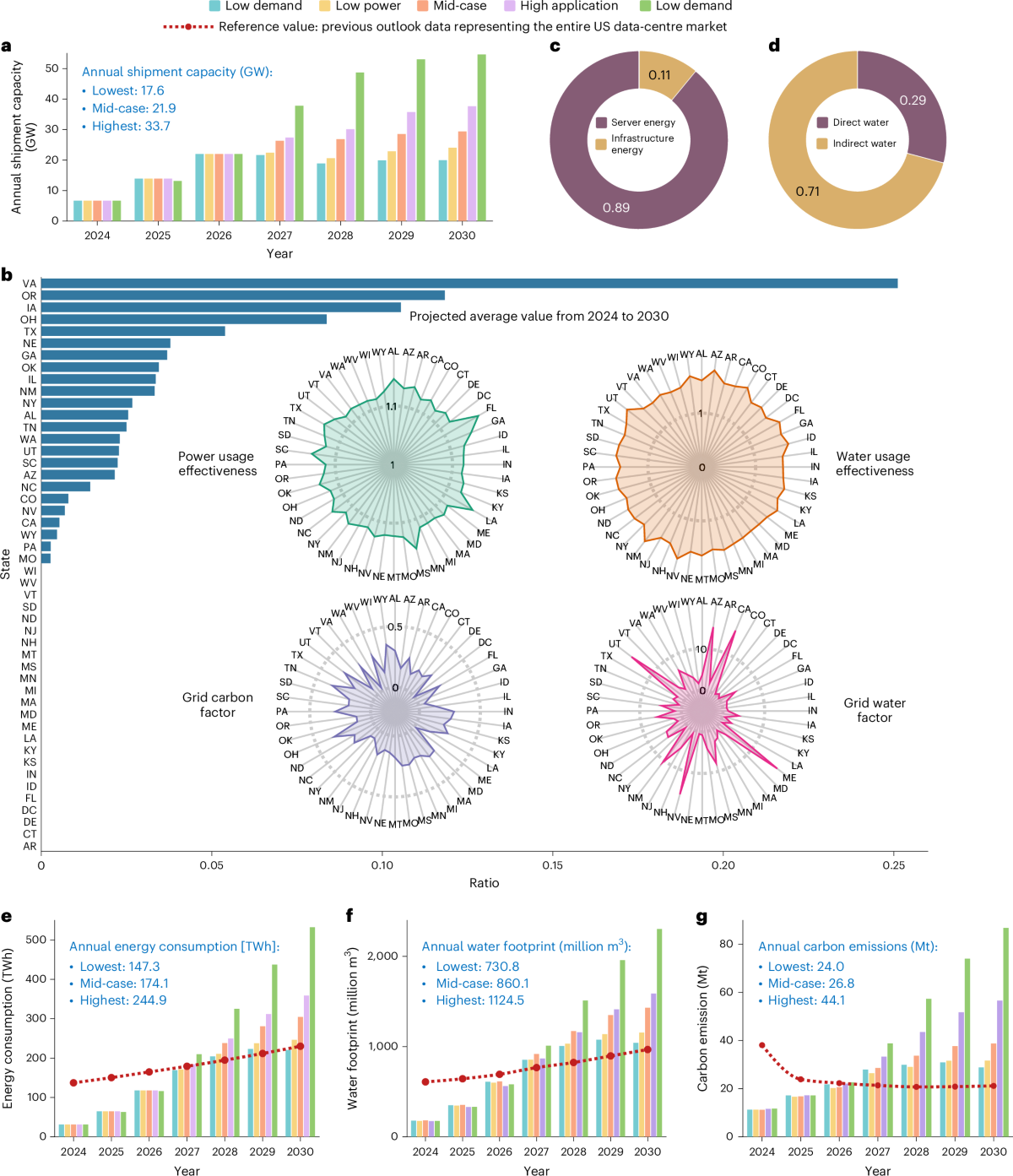 Environmental impact and net-zero pathways for sustainable artificial intelligence servers in the USA | Nature Sustainability
The Water-Energy Nexus: Why Carbon Alone Is Insufficient
The Hidden Water Cost of AI
Data centers require enormous volumes of water for cooling, a fact that has received far less public attention than carbon emissions but is no less consequential. The industry standard metric--Water Usage Effectiveness (WUE)--measures liters of water consumed per kilowatt-hour of computing energy, with a typical average around 1.9 L/kWh [6]. Applying this benchmark, even a modest 0.24 Wh prompt translates to roughly 0.24 mL of water, a figure that closely matches Google's own measured 0.26 mL per prompt [6].
At scale, the numbers become alarming. Researchers project that global AI water withdrawals could reach 4.2 to 6.6 billion cubic meters by 2027 absent efficiency gains and strategic siting decisions [6]. To ground this figure: a single almond requires 12 to 14 liters of water to grow; one avocado demands around 60 liters [6]. AI's water footprint does not exist in isolation--it competes directly with agricultural, municipal, and ecological water needs in regions that are often already water-stressed.
The Carbon-Water Tradeoff
A critical insight from recent research is that carbon and water optimization are not always aligned. Optimizing a model's training process to reduce carbon emissions--for example, by shifting computation to regions with cleaner energy grids--may increase water consumption if those regions rely more heavily on water-intensive evaporative cooling [2]. Conversely, data centers in water-scarce regions that use less water for cooling may depend on energy-intensive alternatives like mechanical refrigeration, driving up carbon emissions [2][3].
This tension demands that technologists and policymakers move beyond single-metric optimization. As researchers have argued, the field must "consider a range of factors and analyze the tradeoffs" rather than allowing environmental considerations to remain on the margins of machine learning research and development [2]. The water-energy nexus is not a problem that can be solved by focusing on carbon alone.

The Jevons Paradox: When Efficiency Breeds Consumption
One of the most counterintuitive dynamics in AI's environmental story is the Jevons Paradox--the economic principle that increased efficiency in resource use can drive increased total consumption rather than reducing it [7]. Although large language models consume significantly less energy, water, and carbon per task than equivalent human labor, these per-task efficiency gains do not inherently reduce overall environmental impact [7]. Instead, as per-task costs fall, usage expands far more rapidly, amplifying net resource consumption.
The mechanics are straightforward: the acceleration and affordability of AI remove traditional human and resource constraints, enabling unprecedented levels of usage across industries, applications, and user populations [7]. A model that costs a fraction of a cent per query will be deployed in contexts where a more expensive model never would--embedded in search engines, customer service platforms, coding assistants, educational tools, and countless other applications. The cumulative environmental burden of this ubiquitous deployment "threatens to overwhelm the sustainability baselines that AI efficiency improvements initially sought to mitigate" [7].
This paradox has profound implications for sustainable AI strategy. It means that technical efficiency improvements--while necessary--are insufficient on their own. Sustainable AI deployment must focus on "systemic frameworks that assess how well models balance" performance against environmental cost, rather than celebrating per-task efficiency gains in isolation [7].
Geographic Disparities and Environmental Justice
The environmental burden of AI is not distributed evenly across the globe. AI's impact "is greater in particular geographic regions, and tends to be especially problematic in the Global South and in drought-stricken areas" [2]. Data centers sited in water-stressed regions place disproportionate strain on local water supplies, while the benefits of AI--economic value, technological capability, and data sovereignty--accrue disproportionately to the high-income countries and corporations that control the infrastructure [1].
This geographic imbalance extends to access itself. According to the International Telecommunication Union, only 5% of Africa's AI talent has access to the computing power needed to build or use generative AI [1]. The concentration of AI infrastructure in high-income countries deepens global inequalities while exporting some of the environmental costs--particularly water depletion and e-waste--to regions with fewer resources and less regulatory capacity to manage them [5][1].
Some researchers have proposed environmentally equitable AI through geographical load balancing--dynamically routing computation to regions where the combined carbon and water footprints are lowest at any given time [2]. While technically promising, this approach raises its own equity questions: if computation is always routed away from water-stressed regions, those regions may lose the economic benefits of hosting data center infrastructure, creating a new form of environmental colonialism. Navigating these tradeoffs requires frameworks that integrate environmental justice principles into AI infrastructure planning from the outset.
Emerging Standards for Sustainable Compute
From Voluntary Disclosure to Regulatory Frameworks
The landscape of AI sustainability standards is evolving rapidly. In July 2025, Mistral AI published a first-of-its-kind comprehensive study quantifying the environmental impacts of its LLMs, explicitly aiming "to provide a clear analysis of the environmental footprint of AI, contributing to set a new standard for our industry" [8]. The Brandtech Group similarly released a Generative AI Environmental Impact Study in May 2025, uncovering AI's carbon impact and strategies for sustainable innovation while calculating the environmental footprint of specific AI marketing use cases [8].
These voluntary efforts are increasingly complemented by regulatory and standards-based approaches. The UNESCO report on generative AI advocates for "clean by design" systems and the use of smaller, specialized models, calling for collective action toward sustainable and inclusive digital transformation [8]. At the supply chain level, researchers recommend standardized reporting on key indicators such as energy usage, carbon emissions, and water consumption, aligned with international frameworks including the Green Software Foundation and ISO 14001 [9]. The EU AI Act, meanwhile, has elevated environmental sustainability as a priority in the governance of large language models, linking sustainable AI practices to the bloc's broader climate commitments [5].
Toward Per-Inference Environmental Thresholds
Perhaps the most consequential emerging proposal is the establishment of government-mandated thresholds on the permissible environmental footprint per inference. Researchers argue that agencies should set limits on the energy, water, and carbon emissions that AI models must not exceed per query [7]. These thresholds could be met through a combination of architectural innovations--such as sparsity and quantization--and infrastructure-level optimizations, including more efficient hardware, cleaner energy sourcing, and improved cooling systems [7][9].
A standardized, scalable methodology for quantifying these impacts is essential for such thresholds to be enforceable. Recent benchmarking work offers a promising template, providing a framework that measures energy, water, and carbon footprint across different model architectures, input sizes, and deployment conditions [7]. Incorporating technologies like dielectric liquid cooling--which can drastically reduce or eliminate water use in data centers--offers a complementary path toward meeting stricter environmental standards [7].
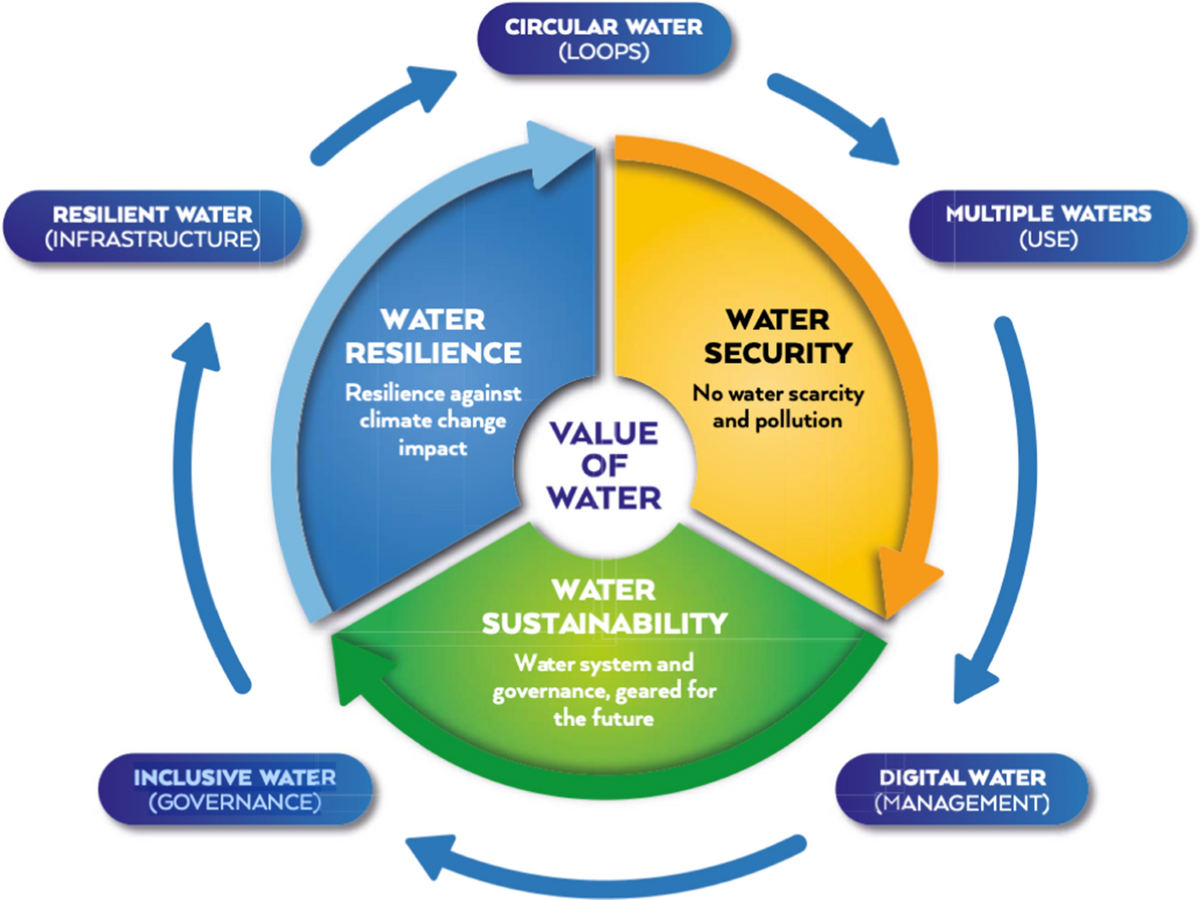 Exploring nexus policy insights for water-energy-food resilient communities | Sustainability Nexus Forum | Springer Nature Link
Solutions and Pathways Forward
Technical Innovations That Work
A series of original experiments conducted by computer scientists at University College London, published in conjunction with UNESCO, identified three technical innovations that enable substantial energy savings without compromising model accuracy [1]. While the full specifications of these techniques vary, the broader category includes well-established methods such as model compression, query optimization, sparse training, model pruning, quantization, and knowledge distillation [8][9][1]. These approaches lower computational overhead by reducing the number of parameters a model must process, decreasing the precision of calculations where full precision is unnecessary, or training smaller "student" models to mimic the behavior of larger "teacher" models.
Critically, these efficiency techniques are "particularly useful in low-resource settings, where energy and water are scarce" [1]. Smaller, specialized models are not only more environmentally sustainable--they are also more accessible, offering a pathway to democratize AI capabilities in regions that lack the computing power to run frontier-scale models [1]. This alignment between environmental sustainability and global equity is one of the most promising developments in the field.
Systemic and Behavioral Interventions
Technical innovation must be accompanied by systemic change. Researchers call for optimizing the geographic placement of servers, incorporating environmental performance criteria into the evaluation of upstream suppliers, and implementing geographical load balancing that accounts for both carbon and water footprints simultaneously [2][9]. On the demand side, educating consumers about the environmental impact of their AI usage--"what they can do to reduce their environmental impact"--is identified as a necessary component of any sustainable AI strategy [1].
Institutions deploying AI can take immediate practical steps: using measured rather than estimated environmental data, requesting Water Usage Effectiveness (WUE) metrics from vendors, favoring low-water cooling in low-stress regions, and avoiding misleading comparisons between on-premises and hyperscale cloud deployments [6]. On-premises AI systems, which run on locally owned and maintained servers, can be 10 to 100 times less energy- and water-efficient than hyperscale cloud datacenters, making infrastructure choice a significant lever for environmental impact [6].
Conclusion
The environmental footprint of generative AI is real, measurable, and growing--but it is not destiny. The latest 2025 research has finally provided the production-scale data needed to move beyond speculation and into evidence-based decision-making, allowing us to compare a prompt's footprint to the familiar metrics of daily life [6]. What the data reveal is a complex landscape in which model architecture, deployment infrastructure, geographic siting, and usage patterns all interact to determine the ultimate environmental cost.
The water-energy nexus demands that we abandon the simplification of treating carbon emissions as the sole proxy for environmental harm. The Jevons Paradox warns us that efficiency gains, without systemic constraints, may perversely accelerate resource depletion. Geographic disparities remind us that environmental costs are also questions of justice. And the emerging ecosystem of standards, benchmarks, and regulatory frameworks offers--perhaps for the first time--a coherent architecture for holding the AI industry to account.
The path forward requires all three pillars: technical innovation in model and infrastructure efficiency, systemic regulation that sets and enforces environmental thresholds, and a cultural shift that treats environmental stewardship as a core design constraint rather than an afterthought. As UNESCO's Tawfik Jelassi has articulated, "To make AI more sustainable, we need a paradigm shift in how we use it" [1]. The data are now available. The standards are taking shape. What remains is the collective will to act on what the numbers tell us.
References
- 1.
- 2.
- 3.
- 4.
- 5.
- 6.
- 7.
- 8.
- 9.