Introduction
The rapid proliferation of generative artificial intelligence has ushered in a transformative era for global industries, reshaping everything from creative arts to software engineering. Yet, beneath the surface of these remarkable technological leaps lies a growing, uncomfortable tension: the very tools poised to help humanity combat climate change are themselves significant contributors to global carbon emissions. As tech giants race to deploy ever-larger large language models (LLMs) and image generators, the massive data centers required to train and serve these systems are drawing unprecedented amounts of power and water, creating a glaring environmental paradox [1].
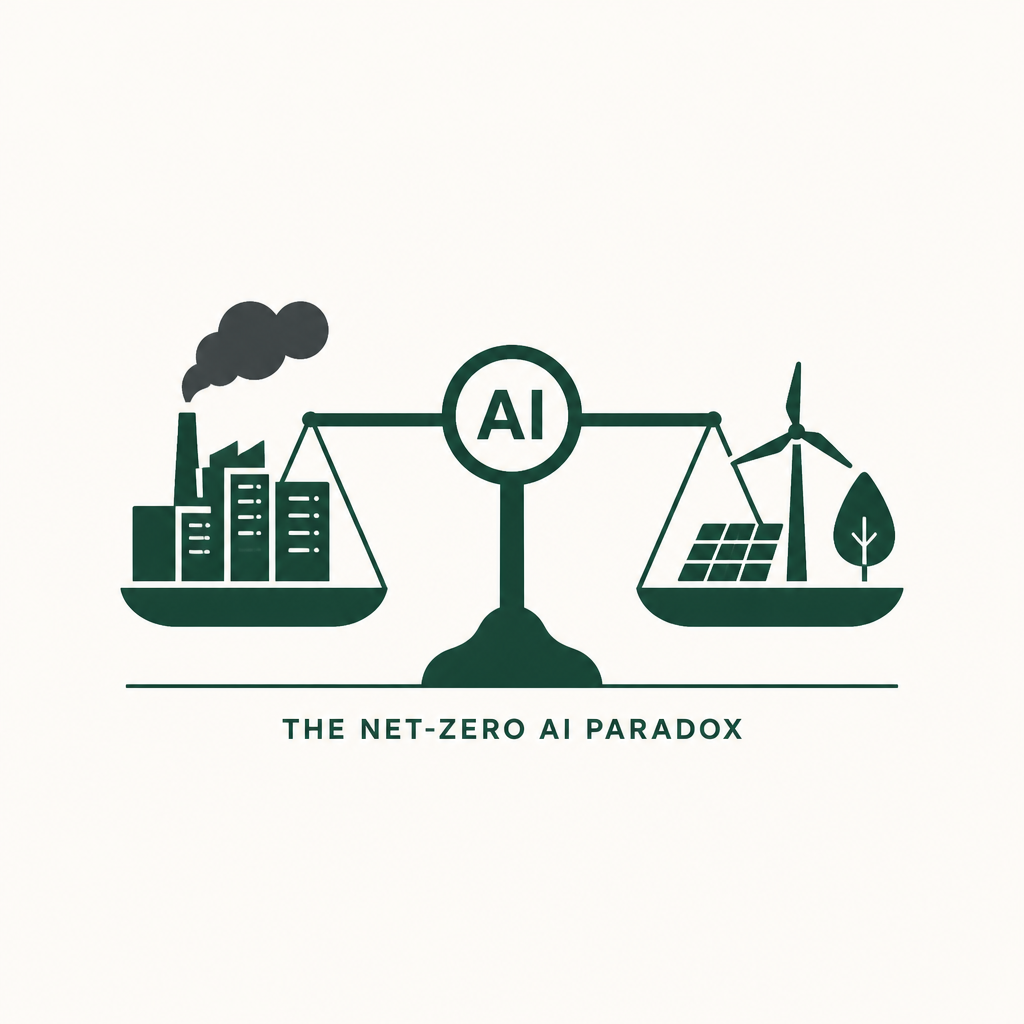
This dynamic--the Net-Zero AI Paradox--forces a critical reckoning. Can we truly achieve global climate goals by relying on technologies that inherently accelerate energy demand? Resolving this paradox requires a nuanced examination of both sides of the ledger. We must meticulously quantify the ecological toll of generative AI, from the extraction of rare earth metals to the operational emissions of hyper-scale compute clusters, and weigh it against the technology's capacity to unlock breakthroughs in renewable energy, sustainable agriculture, and climate modeling.
Ultimately, the generative AI revolution will not be judged solely by its ability to generate human-like text or photorealistic images, but by its net impact on the Earth's systems. Evaluating this balance is no longer an academic exercise; it is an urgent imperative for policymakers, technologists, and environmentalists striving for a sustainable future.
The Hidden Environmental Toll of Generative AI
The physical infrastructure required to sustain the generative AI boom is staggering. Unlike traditional software, which scales efficiently, deep learning models scale inversely, requiring exponentially more compute power to achieve incremental improvements in accuracy. This insatiable demand for compute translates directly into a massive ecological footprint that begins long before a model is ever deployed.
Energy Intensity of Training and Inference
The lifecycle emissions of a generative model are dominated by two phases: training and inference. Training a state-of-the-art LLM can require thousands of specialized GPUs running continuously for months. Studies have estimated that training a single frontier model can emit over 300 tons of carbon dioxide, equivalent to the lifetime emissions of five average American cars [2]. However, as these models are democratized and integrated into daily consumer products, inference--the process of generating responses to user prompts--has become the primary driver of energy consumption. A single query to an LLM can consume nearly ten times the electricity of a traditional web search, a multiplier that becomes catastrophic when scaled to billions of daily users [3].
The Water Footprint
Often overlooked in carbon-centric discussions is the immense water footprint of generative AI. Data centers generate vast amounts of heat and rely heavily on evaporative cooling towers to maintain safe operating temperatures for delicate silicon. Furthermore, water is consumed indirectly through the generation of the electricity that powers these facilities. Research indicates that training GPT-3 alone consumed roughly 700,000 liters of clean freshwater, and standard LLM inference requires a bottle of water for every handful of user prompts [4]. In regions already facing severe water scarcity, this demand poses a direct threat to local ecosystems and municipal water supplies.
Hardware Lifecycle and E-waste
The generative AI arms race has triggered a surge in demand for highly specialized hardware, such as Graphics Processing Units (GPUs) and Tensor Processing Units (TPUs). The manufacturing of these chips is incredibly resource-intensive, involving toxic chemicals, rare earth metals, and massive amounts of energy. Furthermore, the rapid pace of hardware obsolescence in the AI industry means that millions of servers are decommissioned long before their functional lifespan ends, contributing to the growing global crisis of electronic waste.
Generative AI as a Climate Mitigation Engine
While the environmental costs of generative AI are undeniable, its potential as a catalyst for climate mitigation is equally profound. If harnessed correctly, AI could serve as a force multiplier for climate scientists, engineers, and policymakers, offering solutions that were previously computationally impossible.
Accelerating Materials Science and Green Tech
One of the most promising applications of generative AI lies in the discovery of new materials necessary for the green energy transition. Historically, discovering a novel battery chemistry or a highly efficient solar cell material took decades of trial and error in the lab. Generative models can rapidly simulate molecular structures and predict their properties, drastically shrinking this timeline. For instance, AI models have recently been used to identify hundreds of thousands of new battery materials and solid-state electrolytes, potentially unlocking energy storage systems that are cheaper, safer, and more resource-abundant than current lithium-ion technologies [5]. Similarly, AI is being deployed to discover new catalysts for carbon capture and storage, a critical technology for achieving net-zero emissions.
Optimizing Energy Grids and Urban Efficiency
As the global energy grid transitions from fossil fuels to intermittent renewable sources like wind and solar, managing the delicate balance of supply and demand has become incredibly complex. Generative AI and deep learning models excel at pattern recognition and predictive forecasting. They can analyze weather patterns, historical consumption data, and real-time sensor feeds to optimize grid distribution, reducing reliance on carbon-heavy peaker plants. Furthermore, these models are being integrated into smart city infrastructure to optimize traffic flows, reducing vehicular idling and emissions, and to maximize the energy efficiency of commercial HVAC systems, which account for a significant portion of global electricity use [6].
Enhancing Climate Modeling and Forecasting
Traditional climate models are computationally heavy and often struggle to achieve high spatial and temporal resolutions. Generative AI approaches, particularly physics-informed neural networks, are now being used to downscale global climate projections to local levels. This allows policymakers to predict localized impacts of climate change--such as increased flood risk or agricultural drought--with unprecedented accuracy. Better data leads to better adaptation strategies, ultimately saving lives and reducing the economic devastation wrought by extreme weather events [7].
Quantifying the Paradox: Do the Scales Balance?
The central challenge of the Net-Zero AI Paradox is that the costs and benefits operate on entirely different temporal and spatial scales. Determining whether generative AI is a net positive for the climate requires navigating significant analytical hurdles.
The Time-to-Value Problem
The environmental cost of training and deploying a generative model is immediate and highly concentrated in specific geographic locations--usually areas where cheap electricity and water are available. Conversely, the climate benefits, such as a new material discovered by AI making its way into commercial solar panels, can take a decade or more to materialize. In the short term, the carbon ledger for generative AI is overwhelmingly negative. If we are to avoid catastrophic climate tipping points in the next decade, the immediate emissions of AI deployment cannot simply be written off against speculative future gains [8].
The Jevons Paradox in AI
There is also a structural risk that generative AI will fall victim to the Jevons Paradox, where increases in technological efficiency lead to an overall increase in resource consumption. As AI makes grid management more efficient, it may inadvertently drive down the cost of energy consumption, encouraging overall usage that outpaces the efficiency gains. Furthermore, as generative AI becomes cheaper and more integrated into consumer software, the sheer volume of inference requests could trigger an exponential increase in energy demand that outstrips any green optimizations made to the underlying hardware [9].
Aligning AI Development with Net-Zero Goals
Resolving the Net-Zero AI Paradox requires a fundamental shift in how the technology is developed, deployed, and regulated. The industry must move away from the "bigger is always better" paradigm and adopt a ethos of sustainable computing.
Algorithmic Efficiency and Smaller Models
Not every AI application requires a frontier-level model with hundreds of billions of parameters. The industry is increasingly recognizing the value of smaller, highly specialized models that are fine-tuned for specific tasks. Techniques like model distillation, quantization, and mixture-of-experts architectures can drastically reduce the computational cost of inference without sacrificing task-specific performance. Shifting the focus from parameter count to practical utility is a necessary step toward reducing AI's baseline energy footprint [10].
Mandating Renewable Energy and Transparency
Tech companies must be held accountable for the energy sources powering their data centers. This requires aggressive procurement of renewable energy--going beyond simple carbon credit offsetting to ensure that AI compute is directly matched with clean power generation on the same grid. Furthermore, there is a pressing need for standardized transparency. AI developers should be required to publish "Model Cards" that detail the total energy consumed, carbon emitted, and water used during both training and inference, allowing consumers and enterprises to make environmentally informed choices [11].
Conclusion
The Net-Zero AI Paradox is not a mere philosophical quandary; it is a defining challenge of the 21st century. Generative AI possesses the extraordinary potential to decrypt the complexities of climate change, discover life-saving green technologies, and orchestrate a sustainable global economy. However, realizing this potential is entirely contingent upon the industry's willingness to confront and curtail its own voracious appetite for power and resources.
If left unchecked, the unchecked proliferation of generative AI could easily become a net accelerant of climate change. But if guided by stringent environmental standards, algorithmic efficiency, and an unwavering commitment to clean energy, AI could tip the scales in humanity's favor. The ultimate measure of artificial intelligence will not be its ability to mimic human thought, but its capacity to ensure that the planet remains habitable for the humans it seeks to serve.