
Introduction
For decades, the cybersecurity industry has operated on a fundamental assumption: the asymmetry of effort favors the defender. Discovering a zero-day vulnerability required hundreds of hours of manual code review, reverse engineering, and fuzzing. Weaponizing that vulnerability demanded elite, highly specialized skills. Today, that paradigm is shattering. The advent of Large Language Models (LLMs) has ignited a full-spectrum arms race, fundamentally altering the economics, speed, and accessibility of both vulnerability discovery and advanced exploitation techniques [1].
Generative AI is acting as a force multiplier for both sides of the cyber battlefield. Defenders are leveraging these models to rapidly triage vulnerabilities, predict attacker movements, and automate secure coding practices. Conversely, threat actors are weaponizing the exact same technologies to automate reconnaissance, generate polymorphic malware, and exploit known vulnerabilities at unprecedented scales [2]. According to recent industry surveys, a majority of cybersecurity professionals note that criminals are already leveraging generative AI to facilitate sophisticated phishing and social engineering campaigns [3].
This article delves into the mechanics of the LLM arms race, analyzing how generative AI is transforming automated vulnerability discovery, collapsing the economics of exploit generation, enabling advanced evasion techniques, and scaling offensive operations. As the line between human-authored and machine-generated threats blurs, understanding this dynamic is no longer theoretical--it is an operational necessity.
Automated Vulnerability Discovery: From Months to Minutes
Traditional vulnerability discovery has long been a resource-intensive endeavor, relying heavily on manual code review, fuzzing, and reverse engineering. Security researchers spend countless hours analyzing millions of lines of code to identify potential weaknesses. While thorough, this process struggles to keep pace with the explosive growth of modern software supply chains and complex codebases [1]. LLMs are revolutionizing this phase by introducing pattern recognition at scale, capable of simultaneously analyzing vast repositories of code to identify subtle weaknesses and variations that human analysts might overlook [1].
The true power of LLMs in vulnerability discovery lies in their ability to generalize patterns from massive pre-training datasets. Because new vulnerabilities are frequently variations of older, well-documented flaws, LLMs are exceptionally well-suited for identifying these novel iterations of known issues [4]. Rather than casting a wide, computationally expensive net across an entire codebase, state-of-the-art models can narrow the search to specific components, functions, or libraries that are statistically more likely to yield exploitable results [4].
However, advanced pattern matching alone is not a silver bullet. Automating vulnerability discovery requires orchestrating numerous complex processes. Current AI models are increasingly capable of acting as orchestrators--automating software builds, executing traditional fuzzing tools, and analyzing the subsequent crash reports to separate false positives from genuine security flaws [4]. On the defensive side, organizations are adopting AI-driven blueprints, such as NVIDIA's Vulnerability Analysis Roadmap, which employs LLM agents to continuously scan for vulnerabilities and assess their exploitability, streamlining tedious security processes while retaining human analysts for critical decision-making [5].
 Generative AI in cybersecurity: A comprehensive review of LLM applications and vulnerabilities - ScienceDirect
The Economics of Exploitation: Weaponizing One-Days
Perhaps the most alarming shift in the threat landscape is the dramatic collapse of the time window between vulnerability disclosure and weaponization. Historically, defenders had a brief grace period--sometimes days, occasionally weeks--to patch a system before a working exploit appeared in the wild. LLMs have effectively eliminated this window. Recent research demonstrates that AI systems can now generate working exploits for Common Vulnerabilities and Exposures (CVEs) in just 10 to 15 minutes, at an average cost of approximately $1.00 per exploit [6].
While zero-day vulnerabilities garner the most media attention, threat actors are achieving devastating efficiency by targeting "one-day" vulnerabilities--issues that have recently been disclosed and patched, but remain unpatched in target environments. A landmark study found that LLM agents, particularly GPT-4, could autonomously exploit 87% of one-day vulnerabilities using nothing more than publicly available CVE descriptions [7]. This capability allows attackers to reliably compromise environments that lag behind in patch management, without needing to invest in discovering entirely new zero-days.
The accessibility of these capabilities fundamentally alters the threat actor landscape. Because exploitation strategies for common vulnerability classes are widely available online--and are inevitably included in the pre-training data of LLMs--state-of-the-art models can generate functional exploits that require only minor human modification to run properly and fit into a larger attack toolkit [4]. This not only speeds up the attack process but drastically lowers the barrier to entry, enabling lower-skilled threat actors to execute attacks that previously required veteran exploit developers [7].
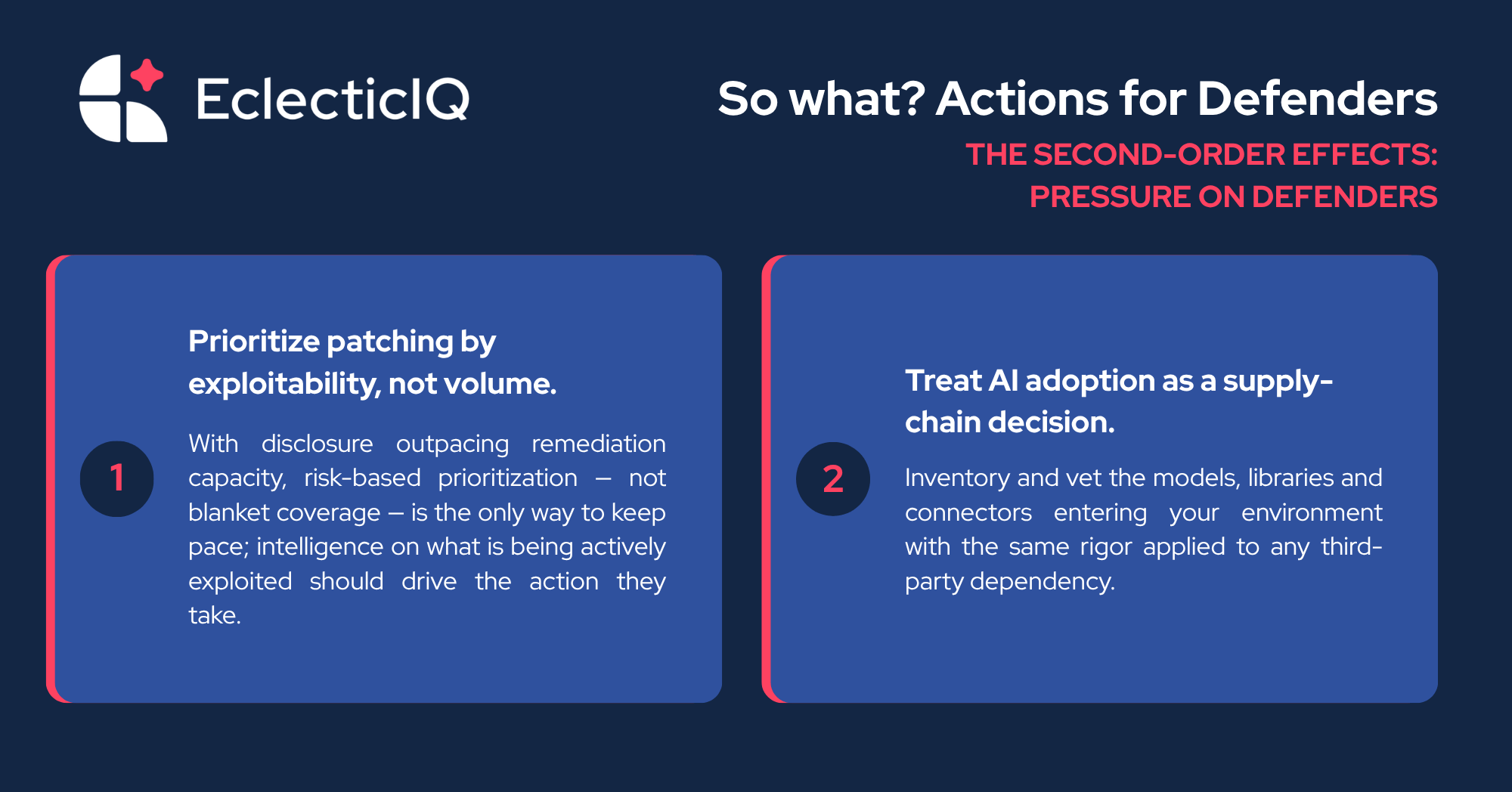 The AI Arms Race: How Adversaries are Weaponizing AI for Speed and Scale
Advanced Evasion Techniques and Malware Mutation
Generating an exploit is only half the battle; delivering it without triggering security controls is equally critical. Here, too, LLMs are tipping the scales in favor of the attacker. Traditional security infrastructure relies heavily on signature matching and hash-based detection. However, AI-driven malware can dynamically analyze the security products installed on a target system and specifically craft evasion techniques, even timing its execution to blend seamlessly with legitimate traffic patterns [6].
To defeat hash-based detection, threat actors are using LLMs to generate polymorphic malware. By automating variable renaming, code reordering, dead code insertion, and encoding changes, an LLM can produce functionally identical malware with a completely unique hash every single time it is compiled or executed [6]. The implications of this were starkly demonstrated in a study by Unit 42 (Palo Alto Networks). Researchers used an LLM to rewrite 10,000 unique samples based on real-world, phishing-related JavaScript malware. When analyzed by a deep learning-based detection model, the verdict flipped from malicious to benign in 88% of the cases. Furthermore, when uploaded to VirusTotal, these mutated samples went entirely undetected by conventional security tools [7].
Interestingly, this AI-generated malware is not entirely invisible to human forensic analysts. While LLMs can bypass automated scanners, they often leave distinct fingerprints. Security researchers have noted that the structure of the scripts, the presence of comments after each line of code, and the highly generic choice of function names and variables can be strong clues that a threat actor used generative AI to create the malware [8]. As AI models evolve, removing these stylistic fingerprints will likely become the next frontier in the evasion arms race.
Scaling Operations: Reconnaissance and Phishing-as-a-Service
Beyond the technical exploitation of software flaws, LLMs are dramatically scaling the initial phases of the cyber kill chain. AI tools can extract massive volumes of public and breached data to build detailed victim profiles in seconds. They can simulate legitimate user behavior, craft pretexts for social engineering, and identify potential points of entry based on a target's digital footprint, enabling stealthy and scalable network mapping [7].
Nowhere is this scaling more evident than in the realm of social engineering. Generative AI has further lowered the barrier to entry for phishing attacks, making Phishing-as-a-Service (PaaS) platforms even more straightforward to use and tailor to specific targets [8]. While LLM developers implement safety guardrails to prevent the generation of malicious content, threat actors routinely bypass these restrictions through carefully crafted prompts that yield highly effective phishing emails [9].
These AI-generated campaigns are not theoretical. Symantec researchers have observed a marked increase in attacks leveraging LLMs to generate malicious code for payload delivery. In these campaigns, phishing emails executed HTML files with embedded JavaScript exhibiting the characteristic hallmarks of LLM generation. These scripts were designed to download a smorgasbord of malicious payloads, including Rhadamanthys, NetSupport, LokiBot, and ModiLoader [8]. To combat this, defenders are attempting to fight fire with fire; for instance, Symantec's Incident Prediction system leverages generative AI to predict the next four or five moves an attacker will take within a customer's environment with high confidence, attempting to disrupt the attack chain before it reaches its payload delivery stage [9].
Conclusion
The integration of Large Language Models into the cybersecurity domain has triggered an unprecedented arms race, eroding the traditional asymmetries that favored defenders. By automating vulnerability discovery, collapsing the economics of exploit generation to mere dollars and minutes, and enabling hyper-realistic evasion and phishing techniques, generative AI has fundamentally weaponized the software vulnerability lifecycle.
However, the same technologies powering these threats are also the foundation of next-generation defense. AI-driven triage systems, predictive analytics, and automated remediation workflows are essential for matching the speed and scale of AI-assisted threat actors. Yet, as industry leaders from NVIDIA to Amazon emphasize, the human element remains indispensable [5]. AI excels at processing data and generating code, but it lacks the strategic context, ethical grounding, and nuanced decision-making required to navigate the complexities of modern cyber defense.
Ultimately, surviving the LLM arms race will not be achieved by relying solely on algorithms. It requires striking a delicate balance between automation and human expertise, establishing robust regulatory and ethical frameworks, and fostering collaboration across the security community [1]. As both attackers and defenders wield the same powerful weapons, the decisive factor will not be who has the best AI, but who best integrates that AI with human intelligence.
References
- 1.
- 2.
- 3.
- 4.
- 5.
- 6.
- 7.
- 8.
- 9.