Introduction
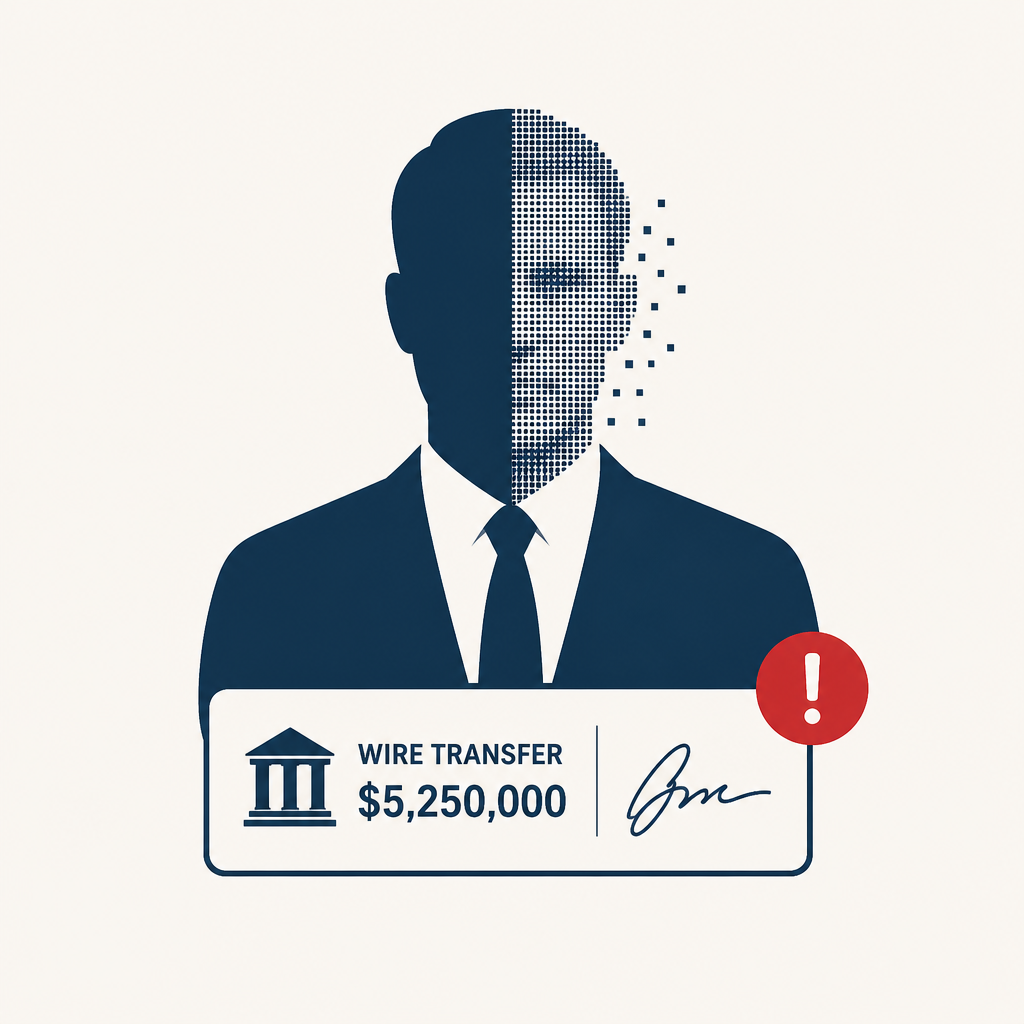
In early 2024, a finance employee at a multinational firm in Hong Kong joined a video conference with several familiar colleagues, including the company's CFO. Every participant on the call discussed an urgent, confidential transaction with convincing authority. By the time the meeting ended, the employee had wired approximately $25 million to fraudsters. Every person on that call--except the victim--was an AI-generated deepfake [1][2][3].
The incident was not an anomaly but a preview. Voice cloning attacks have since become routine in CEO fraud schemes, synthetic media is being used to bypass Know Your Customer (KYC) checks at financial institutions, and regulators--including the SEC--have flagged AI-generated disinformation targeting publicly listed companies as an active concern [1]. According to a September 2025 Gartner survey, 62% of organizations experienced a deepfake attack involving social engineering or exploitation of automated processes, making synthetic media one of the fastest-growing enterprise threat vectors [3].
What makes this threat uniquely dangerous is that it weaponizes the highest-trust, lowest-verification workflows that most organizations have never hardened: an urgent wire request from "the CEO," a vendor banking change approved after a phone call, a video interview with a promising remote candidate. For enterprise security teams, deepfakes are no longer a media literacy curiosity--they are a direct assault on financial controls, identity systems, and internal communications [3]. This article dissects the anatomy of AI-generated executive impersonation fraud, examines the escalating arms race between attackers and detection tools, and explains why the strongest defenses may not be technical at all.
 Detect Deepfake AI Videos: Your Practical Detection Guide | Adaptive Security
Anatomy of a Landmark Attack: The $25 Million Video Call
The Hong Kong case deserves close examination because it established the template that subsequent attacks have followed. The fraud unfolded as a multi-participant video conference in which only the targeted employee was real; the attacker's camera feed--and those of every other "attendee"--was synthetic [1][2]. The deepfake participants behaved naturally, maintained eye contact, and spoke with the cadence and phrasing the victim expected from actual colleagues, creating an overwhelming illusion of legitimacy.
The scheme demonstrated a chilling evolution in social engineering: the fraud succeeded despite the existence of internal verification policies, because the authentication signals themselves--the faces and voices of senior leadership--had been manipulated. The eventual detection of an earlier attempt in the same campaign came down not to technology but to private, shared organizational knowledge that the deepfake could not replicate, a detail that proved prophetic for how enterprises should think about defense [2].
The playbook has already been reused. In March 2025, a finance director in Singapore received contact from someone posing as her company's CFO, then joined a video call with what appeared to be multiple senior executives. Under their instruction, she authorized a wire transfer of US$499,000 to a corporate bank account. Again, the deepfake participants behaved naturally and convincingly [4]. These incidents illustrate how AI impersonation has moved from experimental novelty to operational threat, with single-event losses regularly reaching into the millions of dollars [5][6].
The Attack Playbook: From Three Seconds of Audio to a Signed Wire Transfer
Building the Synthetic Executive
The raw material for these frauds is abundant and free. A voice can be cloned from as little as three seconds of clean audio, and every public recording a leadership team has ever made--earnings calls, conference keynotes, podcast interviews, webinars--sits on the open internet, indexed and downloadable [7]. Attackers use this material to build voice models of executives, then call finance teams impersonating them with urgent wire transfer requests [1]. The cloned voices preserve prosody, accent, cadence, and emotional tone; when combined with caller-ID spoofing, the result is a phone call that sounds indistinguishable from the real executive demanding an urgent transfer [7].
Video synthesis follows a similar trajectory. What required a production studio in 2020 now requires a laptop and a free tool [3]. Face-swap technology and full avatar generation from reference video enable not just one-way fake messages but interactive, real-time deception during live calls [3][4].
Multi-Channel Convergence
The most effective attacks no longer rely on a single deepfake. A single fraud operation can deploy a synthetic voice over a phone call, a synthetic face on a Teams or Zoom video, and an AI-generated follow-up email--each channel reinforcing the others until the target's skepticism collapses [7]. Typically, the sequence begins with an email from a spoofed executive domain establishing the financial request and creating an administratively legitimate paper trail, then escalates to voice and video contact to override residual doubt [7]. This deepfake-enhanced business email compromise (BEC) represents a qualitative leap over the spoofed-email scams of the past decade [2][7].
The Manufactured Urgency
What these attacks exploit is not technical vulnerability but organizational psychology. Attackers combine authority--impersonating the very people whose instructions employees are conditioned to obey--with urgency, manufacturing time pressure that suppresses verification behavior [8]. The decisive weakness is trust in identity signals that were never designed for generative AI manipulation [5]. Deepfake vectors rank at the top of enterprise threat registers not because they are the most technically sophisticated attacks, but because they exploit the highest-trust, lowest-verification workflows most organizations have never hardened [3].
 AI Deepfake Business Impact: $450K in Average Losses | Adaptive Security
Beyond the CFO Call: The Expanding Threat Surface
Executive impersonation is the headline act, but it is only one of several deepfake vectors now operating against enterprises. Security analysts identify four distinct enterprise threat categories: executive impersonation fraud, KYC bypass, disinformation, and synthetic identity attacks [1]. By 2026, the highest-risk vectors include CEO impersonation for financial fraud, identity verification bypass, synthetic employee creation, fabricated legal evidence, and manipulation of internal communications [3].
Two of these deserve particular attention. First, KYC bypass and synthetic identity fraud: AI-generated identity documents, combined with voice and video synthesis, create complete synthetic identities capable of passing automated identity verification systems [1]. Unlike impersonation, which mimics real people, synthetic identity fraud fuses fabricated information with real identifiers to manufacture entirely new personas that sail through onboarding checks [5]. Second, AI hiring fraud: deepfake video interviews and cloned voices are being used to win remote IT, engineering, and finance roles--moves that transform social engineering into persistent internal access, granting attackers the ability to exfiltrate data or redirect payments from inside the network [5][4].
Financial institutions face an additional frontier: contact center attacks, in which deepfake voices call into banks and pass knowledge-based authentication to attempt account takeovers, fund transfers, and credential resets [4]. One voice-cloning operation against a bank reportedly resulted in $35 million in losses [5]. Meanwhile, deepfake videos falsely depicting executives in compromising situations pose reputational risks that damage brand credibility before the content can even be debunked [2]. AI impersonation, in short, is not isolated fraud but a structural enterprise risk category rather than a temporary trend [5].
The Detection Arms Race: Why Technology Alone Is Losing
The Capabilities Gap
The defensive technology race is real, but attackers currently hold structural advantages. Today's deepfake cyberattacks rely largely on pre-recorded cloned voices and synthetic videos--but that limitation is dissolving as real-time interactive agents emerge, capable of responding naturally in live conversations [4]. Experts caution that what cyberattackers build today will look primitive against what arrives within the next 24 months [4]. Meanwhile, Gartner predicts that by 2026, 30% of enterprises will no longer consider identity verification trustworthy in isolation--a formal acknowledgment that the authentication signals enterprises rely on (face, voice, documents) can no longer be taken at face value [3].
The Detection Toolbox
That said, detection tooling is advancing meaningfully. Platforms such as Sensity AI offer forensic-grade detection across video, audio, and images, with native Microsoft Teams integration and the ability to analyze voice patterns in real time during phone calls to flag synthetic audio--a capability particularly valuable for finance teams and call centers where voice-based fraud risk is highest [2]. In the financial sector, recommended implementations include deepfake detection integrated into customer interaction channels, analyzing real-time voice cadence, lip-sync mismatches, and digital manipulation artifacts--for example, intercepting a fraudulent call to a fraud hotline where a cloned CEO voice attempts to approve an unauthorized transaction [6].
The Fundamental Limitation
Yet even the best detection tools face an uncomfortable truth: detection is probabilistic, while fraud is binary. A detection system that is 95% accurate still admits one in twenty attacks, and the adversarial nature of generative AI means every detector improvement is matched by generator improvements trained to evade it. The deeper problem is architectural: when the signals being authenticated--voice, face, document--can be synthetically manufactured, any system that relies solely on recognizing those signals is verifying the wrong thing [5][8]. As security researchers have framed it, the decisive control shift must be from content scrutiny to transaction-level verification, because human judgment alone cannot reliably absorb synthetic authority at the point of approval [8].
 AI-Powered CEO Impersonation & Deepfake Fraud: The $200 Million Crisis of 2025 | Capture The Bug
Building Defenses That Don't Depend on Spotting the Fake
Out-of-Band Verification: The Core Control
The strongest deepfake defenses are process controls that make the underlying fraud difficult regardless of how convincing the synthetic media is [1]. The cornerstone is out-of-band verification: making wire transfers, vendor banking changes, and access alterations dependent on a callback or signed approval through a pre-registered channel that cannot be substituted during the same interaction [8]. The logic is simple and devastating to attackers--a deepfake that does not know the code word cannot complete the fraud, regardless of how convincing the voice or video is [1]. The Hong Kong case itself was ultimately foiled in its earlier stages because the targeted employee relied on private, shared knowledge the deepfake could not replicate, demonstrating that procedural verification often outperforms technical detection alone [2].
Redesigning Executive Approval Workflows
Enterprises should map the exact steps where leadership instructions can trigger action and insert a second control that verifies the request through an identity-bound process--not a call, text, or video alone [8]. Financial institutions add complementary layers such as dynamic, context-aware warnings on digital banking interfaces and "intelligent friction" that appears when risky behaviors are detected--for instance, a transfer labeled as a bail payment initiated late at night to a newly added overseas recipient [6].
Reducing the Attack Surface and Training Leadership
Two supporting controls round out the defense. First, organizations should reduce the publicly available audio and video of executives that can be used to train voice and video synthesis models--scrutinizing which earnings calls, podcasts, and event recordings are posted publicly [1]. Second, and perhaps counterintuitively, executives themselves must be trained to support verification rather than bypass it: organizations should set a standing expectation that sensitive actions are not delayed by verification, even when the request appears to come from the very top, and rehearse that expectation in tabletop exercises [8]. Trained skepticism at the employee level matters, but the decisive cultural shift is ensuring that no one--least of all senior leadership--treats verification requests as an insult to their authority.
 Deepfake Statistics [2026]: Growth, Fraud & Detection Data
Conclusion
The $25 million video call in Hong Kong marked the moment deepfake fraud graduated from a technical curiosity to a boardroom risk. In the two years since, the attack playbook has been refined and industrialized: voices cloned from seconds of public audio, faces swapped into live video calls, multi-channel campaigns that layer synthetic email, voice, and video until an employee's doubt collapses [3][7]. Detection technology--real-time voice analysis, forensic media inspection, lip-sync detection--is improving and deserves a place in the stack [2][6]. But the arms race favors attackers in the near term, and Gartner's prediction that identity verification will become unreliable in isolation is less a forecast than a deadline [3].
The lesson of the landmark attacks is paradoxically encouraging: the frauds that failed were stopped not by better algorithms but by better questions. Out-of-band callbacks, pre-registered code words, identity-bound approval workflows, and leadership that models verification rather than resenting it constitute a defense that remains effective no matter how photorealistic the fake [1][2][8]. In an era when the CEO's face and voice can be counterfeited on demand, enterprises must stop asking "does this look and sound real?" and start asking "does this request verify through a channel the attacker cannot touch?" The organizations that make that shift will find that even a flawless deepfake cannot sign the wire transfer.
References
- 1.
- 2.
- 3.
- 4.
- 5.
- 6.
- 7.
- 8.