Introduction
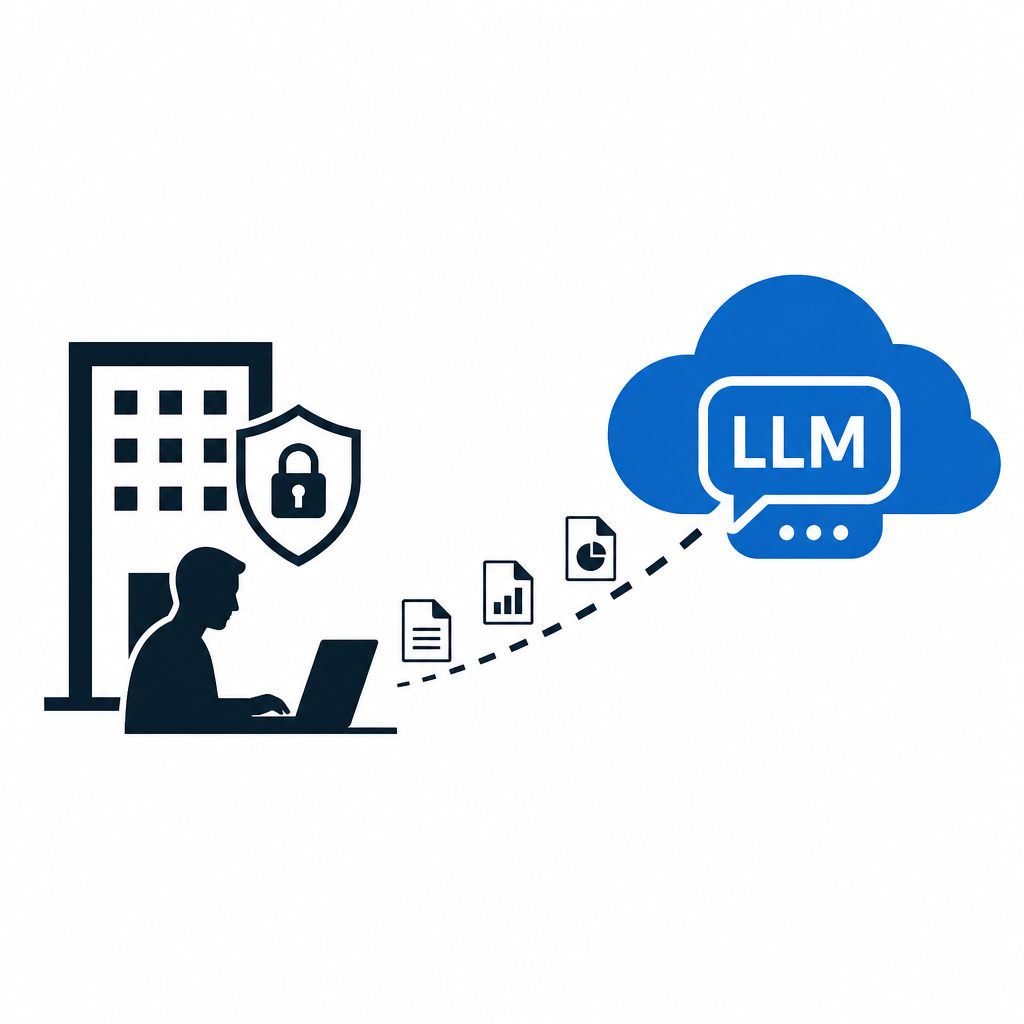
Somewhere in your organization right now, an engineer is pasting proprietary source code and a live database connection string into a public chatbot. An HR manager is uploading performance reviews containing health information into an unsanctioned AI summarizer. A finance analyst is feeding an internal revenue forecast into a consumer LLM to "clean up the formatting." None of these employees thinks of themselves as committing a security violation--they are simply doing their jobs faster with the most powerful tools available to them. Yet each action constitutes a data exfiltration event that most security teams have no mechanism to detect [1][2].
This is shadow AI: the use of AI tools, models, or embedded AI features without IT approval, security oversight, or governance. Unlike traditional shadow IT, where a file sits passively in unapproved cloud storage, shadow AI actively processes, retains, and can reproduce sensitive data--often with outputs that persist well beyond the original session [3]. The scale is staggering. According to Netskope's Cloud and Threat Report 2025, the average organization uploads 8.2 GB of data per month to AI applications, including customer records, financial projections, source code, M&A documents, and regulated personal information [2]. IBM's 2026 Cost of a Data Breach Report found shadow AI was a factor in 43% of breaches studied--up from 20% the prior year--with those incidents averaging $5.39 million [3].
The uncomfortable truth is that banning these tools makes the problem worse, pushing usage onto personal devices and erasing what little visibility remains [3]. This article examines the mechanics of shadow AI exfiltration, the statistics that quantify the risk, the reasons conventional controls fail, and--most importantly--the detection architectures and governance frameworks that security teams can deploy to reclaim control without stalling the productivity gains their employees are chasing.
What Makes Shadow AI Different from Shadow IT
From Data at Rest to Data in Motion
Traditional data loss prevention (DLP) and governance frameworks were built around a simple assumption: sensitive data mostly sits somewhere, and if you know where it lives, you can protect it. Shadow AI breaks that assumption entirely. As Adaptive Security notes, shadow AI "transforms every employee prompt into a potential data exfiltration event... Every paste, every prompt, every document upload creates a data transfer that most security teams have no mechanism to detect. That structural invisibility is precisely where shadow AI thrives" [2].
Forcepoint draws the distinction even more sharply: shadow AI doesn't just store data outside your control--it actively processes it, often producing outputs that reflect sensitive patterns and can persist long after the session ends. Standard governance frameworks designed for shadow IT were never built for this exposure profile, which is why shadow AI demands its own dedicated controls [3]. Cyberhaven adds a related blind spot: data security posture management (DSPM) tools can tell a security team where sensitive data lives, but not where it went after an employee fed it into an AI tool. Discovery and classification without movement visibility leaves the most consequential part of the risk unaddressed [4].
The Embedded-AI Blind Spot
The most insidious vector isn't the obvious one. Employees increasingly encounter AI as a button inside tools they already trust--Copilot summarizing a confidential strategy document, Gemini analyzing sensitive financial spreadsheets [5]. As Adaptive Security observes, "The platform passed review. The AI feature never did. This distinction rarely occurs to the employee, who sees only a new button inside a familiar tool" [5]. The most dangerous blind spot is often not the unsanctioned chatbot at all--it is the sanctioned tool silently routing proprietary information through models that were never evaluated under the organization's data governance framework [5][2].
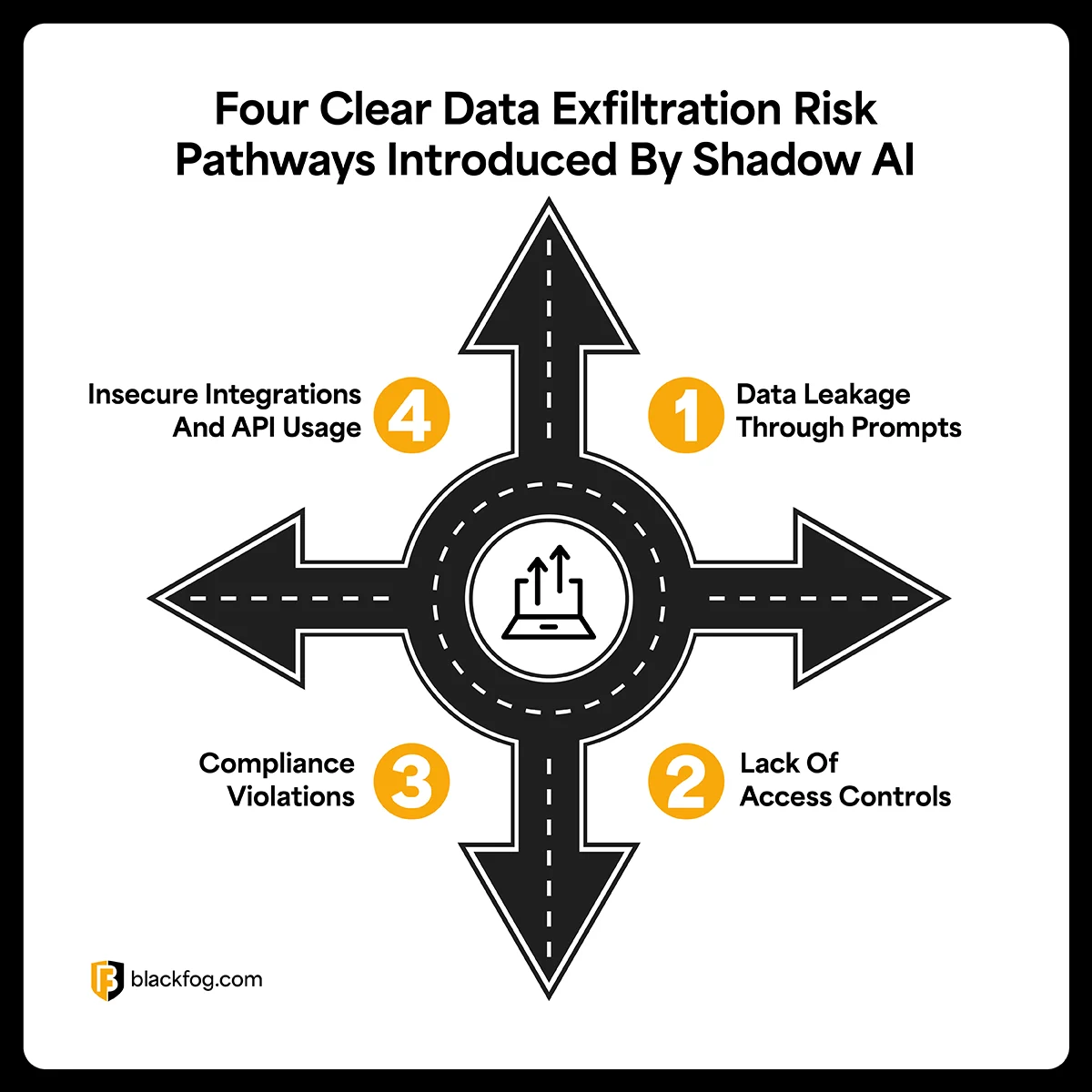 Shadow AI And The Expanding Enterprise Attack Surface - BlackFog
Anatomy of an Exfiltration: Real-World Scenarios
Shadow AI examples are not edge cases--they are the everyday workflow of every department in every modern organization [1]. Examining concrete scenarios reveals both what leaves and why governance responses must be tailored.
Engineering: Code and Credentials
When a developer asks a public chatbot to debug a service, the data that leaves can include proprietary source code, an active database connection string, and internal architecture details. The AI's response may be correct and helpful--the exposure is the problem. ShadowLock's recommended response is instructive: blocking engineering teams from AI assistance is counterproductive, so the right path is an enterprise-licensed code assistant (GitHub Copilot Business, Cursor Business, Anthropic Business) with a data processing agreement, paired with a credential classifier that fires whenever a connection string or API key is pasted--regardless of destination. That last detail matters: it catches the worst-case mistake, pasted credentials, even on approved tools [1].
Human Resources: Regulated Personal Data
An HR manager summarizing employee feedback can exfiltrate full names, performance ratings, manager comments, and health or personal-circumstance information--data regulated under GDPR special-category provisions, employment law, and internal HR policies [1]. The governance response: classify HR data under sensitive-content rules, block it from consumer AI tools, and steer users toward enterprise AI bundled with the HRIS (Workday, BambooHR) or a corporate Microsoft Copilot deployment scoped to the HR dataset [1].
Finance and Customer Support
Finance teams paste internal financial summaries into tools like Claude; support agents draft customer responses in Gemini, moving customer PII through ungoverned channels [1]. In each case, the pattern is identical: the shadow path wins when the sanctioned path is slower. Building effective governance is as much about reducing friction on the sanctioned path as it is about adding controls on the shadow one [1].
The Scale of the Problem: By the Numbers
The volume of shadow AI exfiltration is not theoretical. A convergence of statistics paints a picture of an enterprise risk surface expanding faster than most security programs can respond:
- 8.2 GB per month of data uploaded to AI applications by the average organization (Netskope, 2025) [2]
- 43% of breaches involved shadow AI, up from 20% the prior year, averaging $5.39 million per incident (IBM, 2026) [3]
- Shadow AI adds roughly $670,000 to average breach costs [6]
- 80% of employees use unapproved AI tools, yet only 37% of organizations have governance policies in place [6]
- The average enterprise experiences 223 data policy violations per month related to AI usage (Netskope) [6]
- The average organization utilizes 54 GenAI applications--and employees adopt new tools faster than security teams can assess them [4]
- 72% of employees sign into GenAI tools on work devices using personal email accounts (Teramind) [7]
- Roughly 76% of unsanctioned AI tools fail SOC 2 compliance [7]
- 67% of uploads and pastes to GenAI tools occur via personal, non-corporate accounts (Akamai) [8]
Two structural forces compound these figures. First, the rate of change: by the time a security team has assessed a new AI tool, categorized its risk, and written a policy for it, employees have typically been using it for weeks [4]. Second, the visibility gap: shadow AI creates blind spots that compound over time, because organizations cannot govern what they cannot see [9].
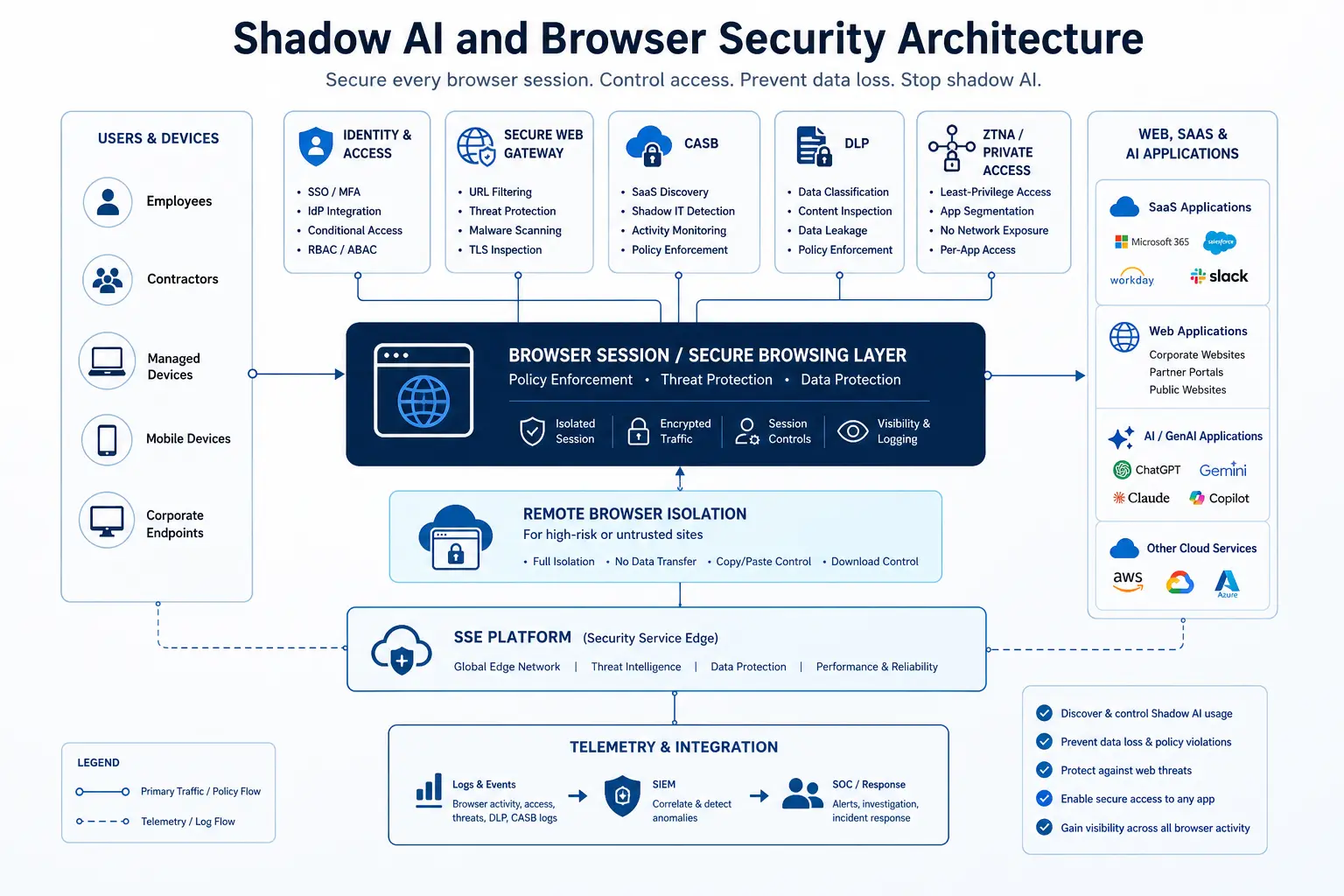 Shadow AI and Browser Security: Protecting Data
Why Traditional Security Controls Fail
The Block-Only Trap
The instinctive response--firewall rules, domain blacklists, acceptable use policies with punitive enforcement--consistently fails, and often backfires. These controls "do not change behavior. They drive usage underground, where the organization loses the visibility it needs to govern" [5]. Forcepoint is blunt about the consequence: banning AI tools outright pushes usage onto personal devices, which erases visibility instead of reducing risk [3].
The arithmetic of modern work makes blocking impractical anyway. With 67% of GenAI uploads flowing through personal accounts--and 87% for instant messaging tools--simply blocking access to these services leads straight back to shadow IT [8]. Organizations that treat shadow AI purely as a blocking problem fail because they ignore the behavioral engine driving adoption: employees adopting tools that make their work faster [5][9].
Gaps in Legacy Tooling
Even well-funded security stacks have structural holes here. Traditional network monitors and DLP tools are blind to the fragmented ways data moves into generative AI platforms--manual copy-and-paste actions, direct file uploads, and AI-generated output inserted back into core business systems [7]. Static controls written in advance cannot account for tools that did not exist when the rules were written [4]. And when an agentic AI system combines access to private data, exposure to untrusted content, and the ability to make external requests, security researchers call it the "lethal trifecta"--a combination shadow AI deployments almost never have the controls to mitigate [9].
Detection: Building a Multi-Layer Visibility Architecture
Detecting shadow AI requires a multi-layer architecture spanning network, endpoint, SaaS, and browser telemetry--no single control point catches everything [2]. Practitioners have converged on a repeatable playbook:
- Inventory all known AI tools via CASB and SaaS management platforms
- Monitor network traffic for connections to generative AI API endpoints
- Audit OAuth tokens and API keys for unauthorized AI integrations--third-party AI tools connected to corporate SaaS environments are a frequently missed vector [5][6]
- Deploy endpoint DLP tuned for AI exfiltration patterns, including source code, credentials, and protected health information [6]
- Scan for local AI model installations on corporate endpoints [6]
- Review browser extensions and personal account usage patterns [6]
ISACA's audit methodology recommends integrating these steps into existing IT audit cycles, though continuous monitoring--not quarterly surveys, which miss tools employees forget to mention or deliberately withhold--is what actually catches usage in real time [2][6].
The Browser Is the New Perimeter
Detection at the browser layer is essential, because that is where employees paste proprietary code, customer PII, and financial data into public AI chatbots. Browser extensions that scan text before it reaches an AI tool can block or warn on sensitive data patterns in real time, and just-in-time coaching can explain why a specific paste action is risky--turning a blocked action into a learning moment rather than an antagonizing one [5].
Hunting Local LLMs
A growing blind spot lives entirely inside the endpoint. Local LLM frameworks such as Ollama, LM Studio, GPT4All, Jan, llama.cpp, and KoboldCPP let users download and run powerful language models entirely on their own machines, processing sensitive corporate data with no cloud-based safeguards and no enterprise visibility [10]. Splunk's security research team has published detection analytics that monitor process execution patterns, creation of model files with .gguf, .ggml, and safetensors extensions, DNS queries to model repositories, and network connections--correlating Windows Security Event Logs (Event ID 4688), Sysmon telemetry (Events 1, 11, 22), and behavioral indicators to surface unauthorized local AI infrastructure early [10].
Tracking Data in Motion
Discovery alone is insufficient. Closing the gap requires tracking data in motion across AI interactions, not just data at rest in known repositories. Cyberhaven's approach illustrates the emerging model: shadow AI discovery surfaces unsanctioned tools before they become ungoverned egress channels; data lineage tracks how sensitive information moves from the originating file to the external system that received it; and risk-calibrated enforcement applies controls proportionate to each tool's actual risk profile [4]. Continuous visibility must also watch the sanctioned estate--including whether tools like Microsoft Copilot are surfacing data employees were never meant to see [2].
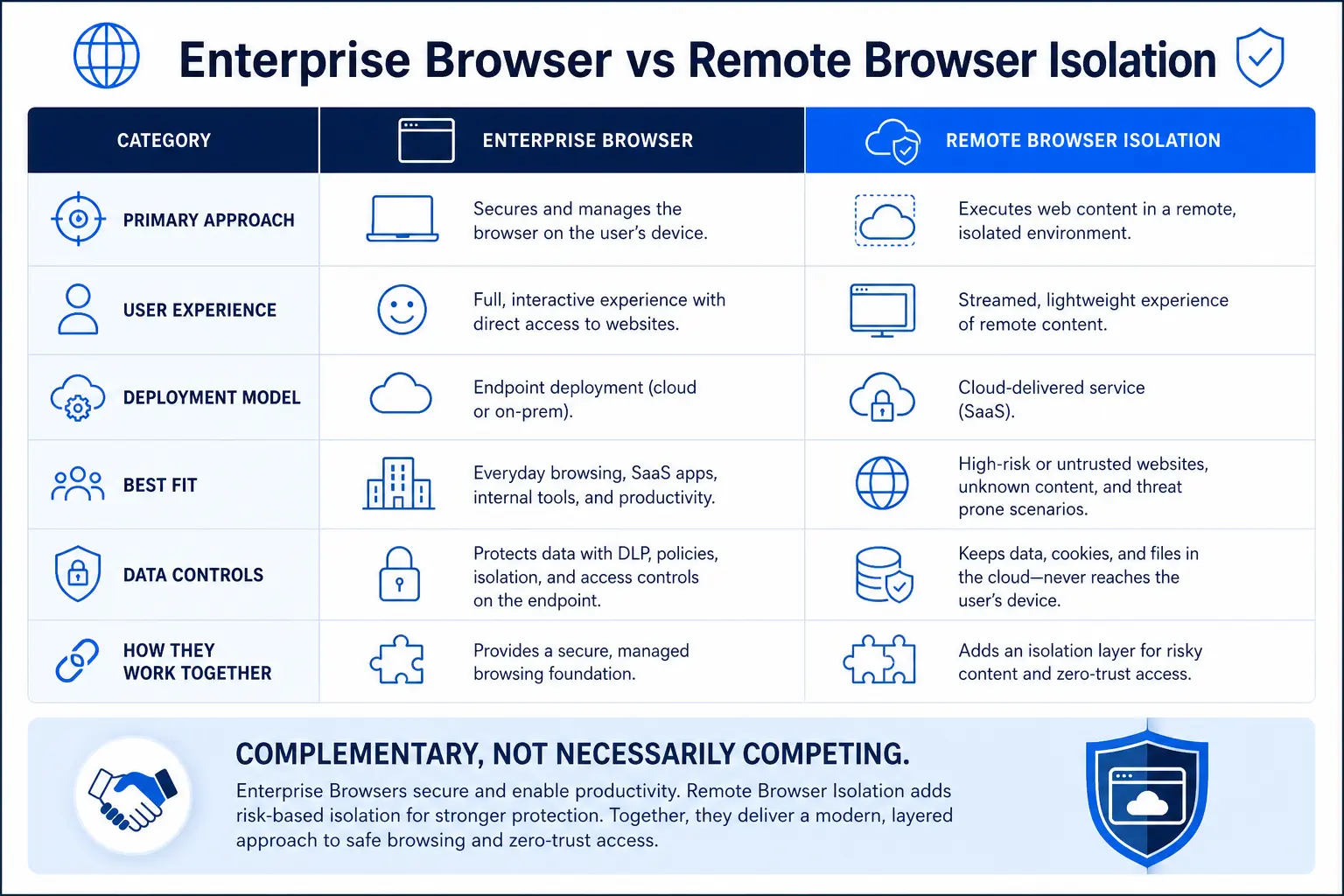 Shadow AI and Browser Security: Protecting Data
Governance Frameworks That Actually Change Behavior
Detection is half the equation. The other half is making governance work for people rather than against them [6]. The frameworks gaining traction share a common philosophy: data boundaries instead of blanket bans, and enablement instead of prohibition.
Classify Tools, Bound Data--Don't Ban
Forcepoint advocates three-tier tool classification combined with role-based access and DLP enforcement that extends into AI prompt windows, ensuring all AI usage--sanctioned or not--operates within defined data security boundaries [3]. Akamai pushes the same logic further: rather than a binary block/allow posture, deploy data-centric policies that allow employees to access personal instances of ChatGPT or Google Drive while browser-level controls specifically prevent sensitive corporate data, identified by classifiers, from being pasted or uploaded into them. "This approach acknowledges the reality of modern workflows while creating a crucial security boundary around the data itself, not the application" [8].
Effective AI acceptable use policies should be lightweight and specific, outlining the tools that are approved, the data types prohibited from public models, and what an employee should do when a use case isn't covered [5][7]. Vague or overly restrictive policies simply produce communication failures and non-compliance [7].
Make Compliance the Path of Least Resistance
The strongest predictor of governance success is whether sanctioned alternatives actually match what employees are trying to do. When approved tools are provided, unauthorized use drops by 89% [6]. One CIO reduced unauthorized AI tool usage by 65% simply by publishing a one-page "AI Quick Reference Guide" employees could bookmark and offering approved tools matching consumer capabilities [9]. For engineering, that means enterprise-licensed code assistants with proper data processing agreements [1]; for HR, AI bundled with the HRIS; for general productivity, a corporate Copilot or equivalent deployment scoped correctly [1].
Reduce Friction, Then Mobilize Champions
Speed of approval is itself a security control. If employees need permission for new AI use cases, the process should take days, not months--via a lightweight intake form and a cross-functional review team that meets weekly [9]. Momentum matters more than perfection: iterative governance that improves monthly beats a comprehensive framework that takes a year to build [9]. Human infrastructure helps too--identifying enthusiastic early adopters in each department, training them on governance, and letting them guide their teams, because peer influence outperforms top-down mandates [9].
Account Governance and Behavioral Guardrails
Because 72% of employees sign into GenAI tools with personal email accounts, security leaders must detect and block personal AI account usage on work devices and direct staff toward business channels such as single sign-on [7]. Pair these technical controls with reinforcement: real-time coaching and warnings rather than hard blocks, conducted alongside regular AI audits and a living AI system inventory [6]. Crucially, programs that pair detection with education preserve visibility while changing behavior--they recognize that "the employee who pasted sensitive data into ChatGPT last quarter is no liability to be punished. That employee is a person whose workflow needs a better-supported path" [5].
The Next Frontier: Agentic AI and the Expanding Attack Surface
Just as security teams are catching up to chatbots, the risk surface is shifting again. Agentic AI systems and ungoverned MCP (Model Context Protocol) servers extend the same exposure to autonomous systems that act without a human prompt [3]--and Splunk's detection research now covers suspicious MCP activities alongside local LLM frameworks [10]. An agent with access to private data, exposure to untrusted content, and the ability to make external requests embodies the lethal trifecta, and it can exfiltrate data without anyone pasting anything [9].
This reframes the fundamental governance question. As Airia puts it, the issue is no longer just "Can someone break into our AI systems?"--that's security. It is "Can we stand behind what this AI does--today and six months from now?"--that's governance [9]. Vectra AI's guidance is a fitting watchword for the agentic era: monitor not just what employees do with AI, but what AI does on its own [6].
Conclusion
Shadow AI is not a problem organizations can ignore, ban, or solve with a single tool. The data is unambiguous: four in five employees use unapproved AI, shadow AI features in a rapidly growing share of costly breaches, and only a minority of organizations have governance policies in place [3][6]. Every unmonitored prompt is a potential exfiltration event moving source code, customer records, regulated personal data, and M&A secrets into models that process, retain, and can reproduce them--largely invisible to the security stack [2][3].
The path forward combines three pillars. Visibility first: continuous, multi-layer detection across network, endpoint, SaaS, and browser telemetry, including local models and OAuth grants [2][6][10]. Boundaries, not bans: data-centric policies, three-tier tool classification, and credential classifiers that fire regardless of destination [1][3][8]. Enablement always: enterprise-grade alternatives, lightweight approvals, AI champions, and just-in-time coaching that make the sanctioned path faster than the shadow one [5][9][1][6].
The organizations that succeed will be those that treat shadow AI as a structural and behavioral challenge rather than a policy violation--one governed workflow at a time, iterated monthly rather than perfected annually [9]. The exfiltration is already underway; the question is whether governance arrives before the next breach does.
References
- 1.
- 2.
- 3.
- 4.
- 5.
- 6.
- 7.
- 8.
- 9.
- 10.