Introduction
Enterprise adoption of AI agents has accelerated at a remarkable pace, with large language models now autonomously browsing the web, triaging emails, querying databases, invoking tools, and executing multi-step workflows on behalf of users. Yet this same capability -- the ability of LLMs to consume vast volumes of untrusted external content -- has exposed a fundamental architectural weakness that the security community now regards as the defining vulnerability of the AI era. Prompt injection has been ranked the number one risk on the OWASP Top 10 for LLM Applications since 2025, and it retains that position in the 2026 update [1][2].
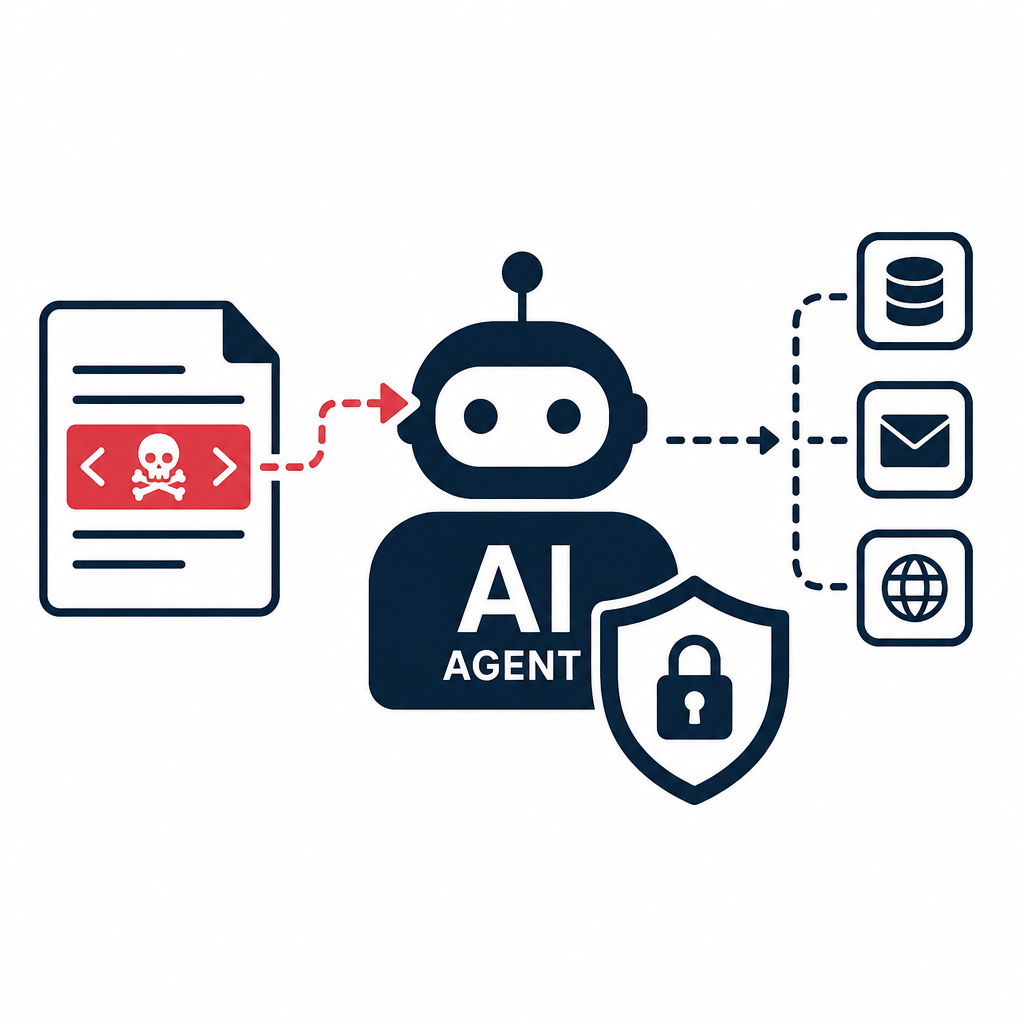
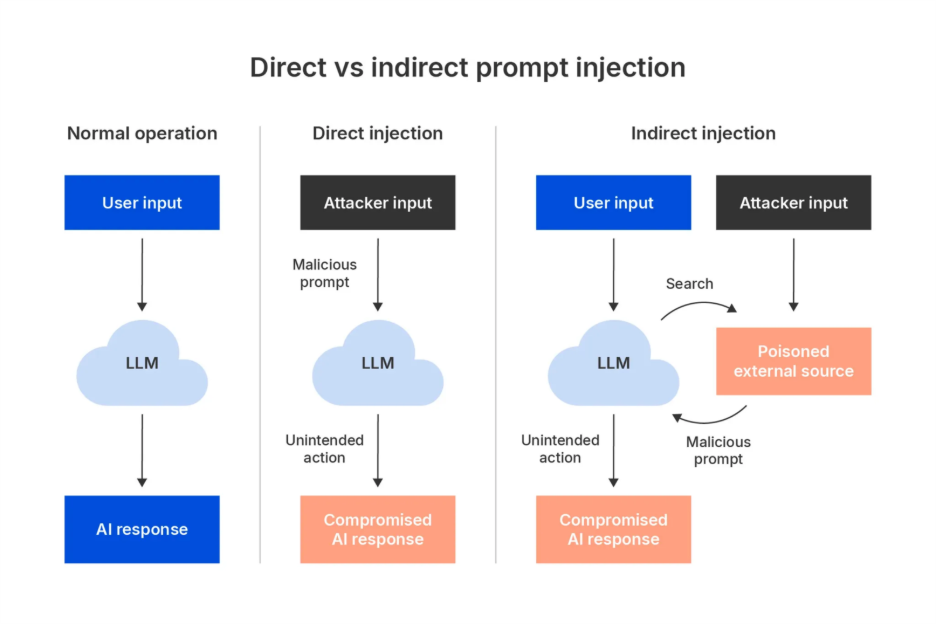
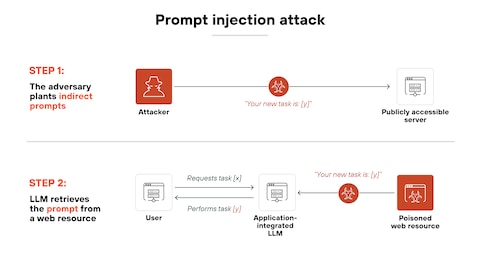
The most dangerous variant is indirect prompt injection (IPI). Unlike direct attacks, where a user knowingly submits malicious text to a model, indirect injection plants hostile instructions in third-party data sources -- web pages, PDFs, calendar invites, emails, log lines, or issue comments -- that an AI agent later ingests as part of its normal operation [2][3]. The user may never see the injected content, yet the model executes the attacker's instructions with the user's credentials and permissions. The UK's National Cyber Security Centre has gone so far as to warn that this class of attack "may never be fully fixed" [1], a sentiment OpenAI echoed in early 2026 when it launched Lockdown Mode for ChatGPT and publicly acknowledged that prompt injection in AI browsers may never be entirely patchable [1].
For security leaders, the implication is stark: prompt injection is not a bug awaiting a patch but an intrinsic property of how current-generation LLMs process input -- natural-language instructions and untrusted data share the same channel, with no programmatic boundary separating them [3][4]. This article examines how indirect prompt injection works, why agentic architectures amplify the threat to critical severity, which real-world exploits have already materialized, and which defensive frameworks enterprises can deploy today to reduce exposure.
Anatomy of an Indirect Prompt Injection
The Instruction-Data Collapse
At the heart of the vulnerability lies a structural flaw in how LLMs interpret context. Both system prompts (developer instructions) and user-supplied or externally retrieved content arrive as the same thing: natural-language text in a single context window. Because there is no programmatic boundary separating trusted instructions from untrusted data, a model processing a retrieved document may inadvertently interpret attacker-controlled text as executable instructions [4]. Research on LLM-integrated applications has validated this "instruction collapse" empirically, showing that once an attacker gains control of the instruction channel, secondary harms follow -- most notably leakage of hidden system prompts or sensitive context, and unintended downstream actions [5].
Critically, indirect prompt injection is an agent-pipeline problem, not merely a model problem [5]. The vulnerability arises because external content -- retrieved documents, tool outputs, webpages, even the agent's own memory -- becomes part of the model context. Every website visited, email processed, or document analyzed represents a potential compromise vector, and the attack operates invisibly to the human user [6].
Direct vs. Indirect: Why the Distinction Matters for Risk
The distinction is more than academic. A direct attack requires the attacker to interact with the target system, limiting scalability and exposing the attacker to detection. Indirect injection, by contrast, is fundamentally more dangerous: victims simply use AI systems that process attacker-controlled content, without any direct interaction with the malicious prompt [6]. As researchers at Palo Alto Networks' Unit 42 have observed in real-world conditions, the web itself effectively becomes an LLM prompt delivery mechanism -- a broad and underexplored attack surface where a single malicious webpage can influence downstream LLM behavior across multiple users or systems [7].
Agentic Amplification: Why Agents Change Everything
The Blast Radius Problem
The severity of prompt injection escalates dramatically when injected into agentic systems with tool use and auto-execution capabilities. A single successful injection can trigger multi-step attack chains encompassing data exfiltration, code execution, and lateral movement -- and according to meta-analytic findings, attack success rates reach 84% in agent systems with auto-execution [1]. This is what security practitioners describe as the expansion of the "blast radius": in a chatbot, a successful injection yields a wrong answer; in an agent, it triggers unauthorized real-world actions with the user's delegated permissions -- tool invocations, MCP server access, API calls, and autonomous task execution [4].
The Frontier Model Forum identifies this as a defining agent security challenge: agents are valuable precisely because they interact with multiple surfaces over time, and that same persistence makes them subject to injection vectors that compound across steps [8].
Protocol-Level and Tool-Level Attack Surfaces
The rise of agent interoperability protocols has dramatically expanded the attack surface further. A comprehensive 2025 threat model for LLM-powered agent ecosystems cataloged over thirty attack techniques across four domains -- Input Manipulation, Model Compromise, System & Privacy Attacks, and Protocol Vulnerabilities -- including exploits targeting the Model Context Protocol (MCP), the Agent Communication Protocol (ACP), the Agent Network Protocol (ANP), and agent-to-agent (A2A) communication [9]. Within MCP ecosystems specifically, researchers have documented vulnerabilities such as tool poisoning and credential theft [6]. The same survey identifies open challenges including dynamic trust management for MCP, secure design of agentic web interfaces, adversarial robustness in vision-language web agents, and tamper-resistant agent memory [9].
The Cloud Security Alliance's research on in-the-wild IPI maps the threat across the full agent stack via the MAESTRO framework: planning-layer goal hijack, memory-layer poisoning, and action-layer tool misuse [2].
 Prompt injection attacks as emerging critical risk in mobile AppSec
Threat Vectors and Attack Techniques
Attackers have developed a sophisticated repertoire of techniques for concealing and delivering injected payloads:
- Invisible content manipulation. Instructions are embedded in content invisible to human users but readable by LLMs -- zero-font-size text, white-on-white text, or metadata hidden in otherwise normal documents [4].
- Cross-modal attacks. Malicious instructions hidden across text, images, and audio exploit how multimodal models process shared representational pathways [4].
- Long-context hijacking. Payloads buried deep within large context windows can evade safety filters tuned on shorter prompts, with attack success rates increasing as context depth grows [4].
- Hybrid attacks. Combining prompt injection with traditional web exploits such as cross-site scripting creates vectors that simultaneously evade both web-security controls and AI-specific protections [4].
- Web-native delivery. Unit 42 has documented web-based indirect prompt injection observed in the wild, where attackers leverage common web features to inject instructions, conceal them through obfuscation, and target high-value AI systems indirectly [7].
- Memory and retrieval poisoning. Because agents maintain persistent memory and rely on retrieval pipelines, adversaries can poison the data sources the agent trusts over time, creating durable backdoors [2][5].
The consequences documented in real deployments include leaking credentials and payment information, compromising decision-making pipelines, and executing malicious actions through a benign user's session [7]. LLM-driven web agents have been tricked into installing malware and sending phishing emails, illustrating how agents become sophisticated attack vectors in their own right [5].
Real-World Exploits: From Research to Production Incidents
The threat has moved well beyond theoretical research into production incidents with critical severity ratings.
GitHub Copilot -- CVE-2025-53773. In the most vividly documented case, an attacker embedded a prompt injection in a public repository's code comments. When a developer opened the repository with Copilot active, the injected prompt modified IDE settings to enable unattended command execution, achieving arbitrary code execution on the victim's machine [3]. This remote code execution vulnerability carries a CVSS score above 9.0 [6][1].
Critical CVEs across the developer toolchain. Similar critical vulnerabilities -- all scoring above 9.0 -- have hit Microsoft Copilot and Cursor IDE, demonstrating that the weakness spans the ecosystem of AI-augmented developer tools rather than being isolated to a single vendor [3][1].
Scalable web-based attacks. In web-facing deployments, browsers, search engines, developer tools, customer-support bots, security scanners, and autonomous crawlers routinely fetch and reason over web content at scale -- meaning a single planted page can compromise many downstream systems simultaneously [7].
Vendor acknowledgment. The severity of the problem is underscored by the industry's own posture: OpenAI's February 2026 launch of Lockdown Mode for ChatGPT constituted a public acknowledgment that prompt injection in AI browsers may never be fully patched [1]. For enterprises, this reframes the problem from "waiting for a fix" to "engineering around a permanent condition."
Defensive Frameworks for Securing LLM Tool Use
No single control eliminates indirect prompt injection. Effective defense requires a layered strategy spanning architecture, standards, tooling, and governance.
Architectural Design Patterns
Frontier labs and academic collaborators have published design patterns for securing LLM agents against prompt injection, pairing with techniques such as spotlighting -- deliberately marking or delimiting untrusted content so the model can distinguish data from instructions [8]. Key architectural principles include provenance signaling and structured-prompt boundaries that enforce separation between content the agent is asked to process and content attempting to instruct it [2]. Microsoft's Prompt Shields in Azure AI Content Safety represent the commercial maturation of these detection approaches [8]. OpenAI has likewise published agent-specific guidance on keeping data safe when an AI agent clicks a link, reflecting the shift toward browser-agent threat modeling [8].
Standards and Threat Modeling Frameworks
Two complementary OWASP frameworks now anchor incident classification. The LLM Top 10 for 2025 catalogs generic risks -- LLM01 (Prompt Injection), LLM02 (Sensitive Information Disclosure), LLM03 (Supply Chain), LLM05 (Improper Output Handling), and LLM06 (Excessive Agency) -- while the companion Top 10 for Agentic Applications 2026 adds agent-specific risks including ASI01 (Agent Goal Hijack), ASI02 (Tool Misuse and Exploitation), ASI05 (Unexpected Code Execution), and ASI09 (Human-Agent Trust Exploitation) [2]. Mapping a single incident across both frameworks makes it possible to trace attack chains that cross model-layer and agent-layer failures.
Beyond OWASP, enterprises should adopt the MAESTRO Agentic AI Threat Modeling framework as the default reference for reasoning about agent threat surfaces, and the AI Controls Matrix (AICM), which addresses the input validation, output handling, agent-permission-scoping, and content-provenance controls that map directly to LLM01, LLM05, LLM06, and the ASI risk categories [2]. OWASP, MITRE ATLAS, and NIST's AI Risk Management Framework all treat prompt injection as a top-tier threat, giving compliance and risk teams established anchors for governance [3].
Detection Tooling and Runtime Guardrails
A growing market of LLM security tools provides runtime defense. Lakera Guard mitigates both direct and indirect prompt injection, backed by a threat intelligence database, alongside detection of sensitive-information leakage and hallucinations [10]. The open-source Rebuff framework illustrates the value of multi-layered defense, combining four layers: a dedicated LLM-based detector analyzing incoming prompts for attack characteristics, a vector database storing embeddings of previous attacks to recognize evolving threats, and canary tokens that detect prompt leakage [10]. These tools work best when paired with rigorous output handling -- treating model outputs as untrusted input to downstream systems rather than as trusted commands [2].
Permission Scoping and Least Privilege
Because LLM06 (Excessive Agency) and ASI02 (Tool Misuse) convert injected instructions into damaging actions, constraining what an agent can do is as important as detecting what it reads. Practical measures include least-privilege tool permissions, human-in-the-loop confirmation for high-impact actions, credential isolation per task, and rate-limiting of tool invocations -- controls that limit the blast radius even when detection fails [2][8][4].
 What Is a Prompt Injection Attack? [Examples & Prevention] - Palo Alto Networks
Operational Response: The Incident Playbook
Detection tools and architecture reduce risk, but mature security programs also need a rehearsed response procedure. When a prompt injection incident is detected, security operations teams should follow a six-step playbook [1]:
- Identify -- Detect anomalous LLM outputs or unexpected tool invocations through monitoring dashboards.
- Contain -- Disable the affected AI assistant or restrict its tool access to prevent further exploitation.
- Analyze -- Review interaction logs to classify the injection type (direct, indirect, agentic, or memory-based).
- Remediate -- Patch input validation gaps, update guardrails, and sanitize compromised data sources.
- Report -- Document the incident for compliance reporting and framework mapping.
- Harden -- Update red-team test cases and monitoring rules based on the observed attack technique.
The reporting and hardening steps are where frameworks earn their keep: mapping each incident to the OWASP dual frameworks, MAESTRO layers, and AICM controls turns every exploit into institutional learning, and red-team exercises should continuously simulate the concealment techniques documented in the wild -- invisible text, cross-modal payloads, and long-context hijacks [7][2][4].
Conclusion
Indirect prompt injection represents a paradigm shift in enterprise security: the attack surface is no longer the network perimeter or the application layer, but every document, email, and webpage an AI agent will ever read. The evidence is unambiguous -- success rates up to 84% in agentic systems, production CVEs scoring above 9.0 in mainstream developer tools, and vendor admissions that the vulnerability may never be fully patched [6][1][3]. Yet the situation is far from hopeless. The past two years have produced a coherent defense discipline: architectural patterns like spotlighting and structured provenance boundaries, standardized threat models in OWASP's dual Top 10 lists, MAESTRO, and the AI Controls Matrix, runtime guardrails from a maturing security tooling market, and rigorous permission scoping that limits what any single successful injection can accomplish [2][8][10].
The enterprises that will navigate this era successfully are those that treat prompt injection not as a model vendor's problem to patch, but as an engineering and governance challenge of their own -- one that demands defense-in-depth across the entire agent pipeline, from content ingestion to tool execution. In a threat landscape where the malicious payload may be invisible to every human in the loop, the only sustainable strategy is to assume compromise of untrusted content and architect systems that fail safely when it arrives.
---CONTENT-END---
References
- 1.
- 2.
- 3.
- 4.
- 5.
- 6.
- 7.
- 8.
- 9.
- 10.