Introduction
Retrieval-Augmented Generation (RAG) has rapidly become the enterprise standard for deploying large language models (LLMs). By tethering generative AI to proprietary knowledge bases, RAG promises context-aware, accurate responses without the need for continuous model retraining. However, this architectural bridge between static data stores and dynamic LLMs has created a全新 class of security vulnerabilities. Securing RAG systems requires a fundamentally different approach than traditional application security, demanding that organizations address unique challenges across an increasingly complex pipeline [1].
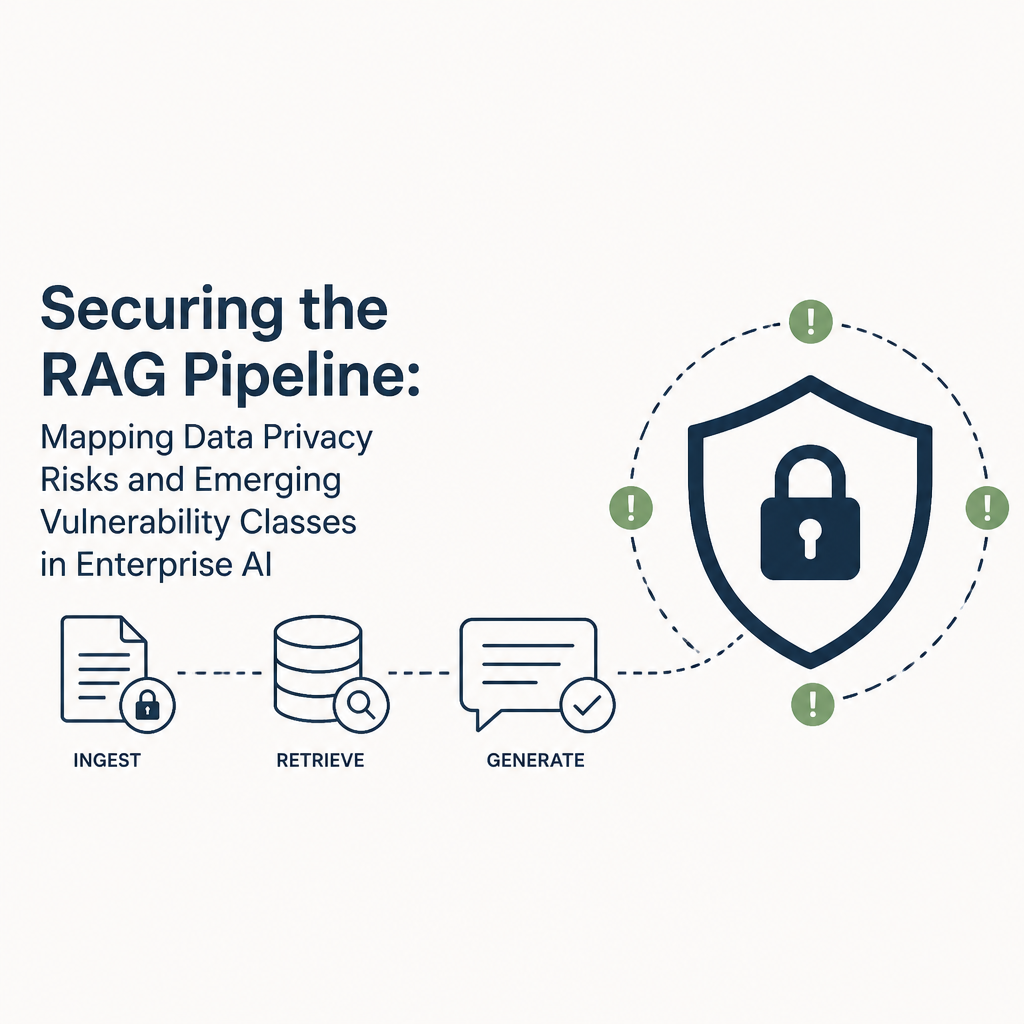
The core dilemma lies in the nature of the data flow. In a RAG environment, sensitive information continuously moves through ingestion, chunking, embedding, vector storage, retrieval, and generation [2]. Every single step represents a potential exposure point. Furthermore, the threat landscape is shifting beneath our feet. Researchers have identified dozens of distinct classes of AI vulnerabilities that differ fundamentally from traditional software flaws, emerging from probabilistic learning dynamics, data composition, and optimization trade-offs rather than deterministic code errors [3].
As enterprises rush to integrate AI into critical workflows, understanding and mitigating these risks is no longer optional. It requires a granular understanding of the RAG pipeline, an acknowledgment of emerging attack vectors like zero-click exfiltration, and the implementation of rigorous, AI-specific defense-in-depth strategies.
The Anatomy of a RAG Breach: Threat Vectors Across the Pipeline
To secure a RAG system, security teams must first deconstruct how data flows through its three distinct phases: ingestion, retrieval, and generation [4]. Attackers are increasingly targeting the seams between these phases, exploiting the data transformations that occur along the way.
During the ingestion and embedding phase, raw enterprise data is parsed, chunked, and converted into vector representations. If organizations use naive chunking strategies--such as splitting text without regard for logical boundaries like section headers--they risk creating vector embeddings that capture entire documents containing a single secret [5]. Furthermore, the embedding process itself can be a point of leakage. Security best practices dictate stripping or hashing identifiers not strictly necessary for retrieval relevance. If referencing sensitive IDs is required, organizations must use format-preserving tokenization or keyed hashing so the token is meaningful only within their secure environment [5].
The storage and retrieval phase introduces the vector database, a relatively new technology that has already proven to be a soft target. Recent real-world incidents have demonstrated the severity of this exposure: in one notable fintech breach, attackers exploited exposed API keys to use "reconstruction attacks," successfully reverse-engineering embeddings back into millions of original client investment portfolios. A similar access-control bypass in a major vector database provider exposed over 200,000 healthcare records [4].
Finally, the generation phase presents a massive privacy risk, particularly when relying on third-party LLM APIs. Any data included in the prompt context is shared with external providers. Without strict prompt-level privacy protection, such as masking out personally identifiable information (PII) before transmission, enterprises risk leaking proprietary data to external AI vendors [1].
Emerging Vulnerability Classes: Beyond Traditional CVEs
The integration of LLMs into enterprise data architectures has birthed vulnerability classes that traditional security scanners are ill-equipped to handle. These are not buffer overflows or SQL injection flaws; they are manipulations of logic, context, and probability [6].
One of the most alarming emerging threats is Zero-Click Data Exfiltration. The "EchoLeak" vulnerability (CVE-2025-32711) demonstrated how attackers could use a specially crafted, unclicked email to manipulate an enterprise RAG pipeline. By burying hidden instructions within a routine message, attackers tricked the AI into retrieving and exfiltrating sensitive corporate data without any employee interaction whatsoever [4][7]. This proves that an attacker no longer needs to breach the network perimeter; they just need to send an email to an employee whose mailbox is indexed by the enterprise copilot.
Perhaps even more consequential is the rise of Agentic RAG. The traditional threat model assumes RAG operates as a question-and-answer pipeline where a bad response is the worst-case scenario. That assumption is rapidly becoming obsolete [7]. When RAG feeds an autonomous agent, every retrieval-layer vulnerability becomes a potential real-world action. If a poisoned document is retrieved by an agentic pipeline, it doesn't just produce a bad chat response--it may execute a tool call, write to a database, trigger a downstream workflow, or send an API request to an external service [7]. The blast radius of upstream vulnerabilities is multiplied when the retrieval pipeline feeds an agent with real-world capabilities.
Additionally, researchers must contend with blind spots and zero-day vulnerabilities specific to RAG. Because not all risks can be identified during development, and because patches may not fix problems rooted in probabilistic model behaviors, organizations face a persistent challenge requiring proactive risk management and continuous monitoring [8].
Architectural Defenses and Mitigation Frameworks
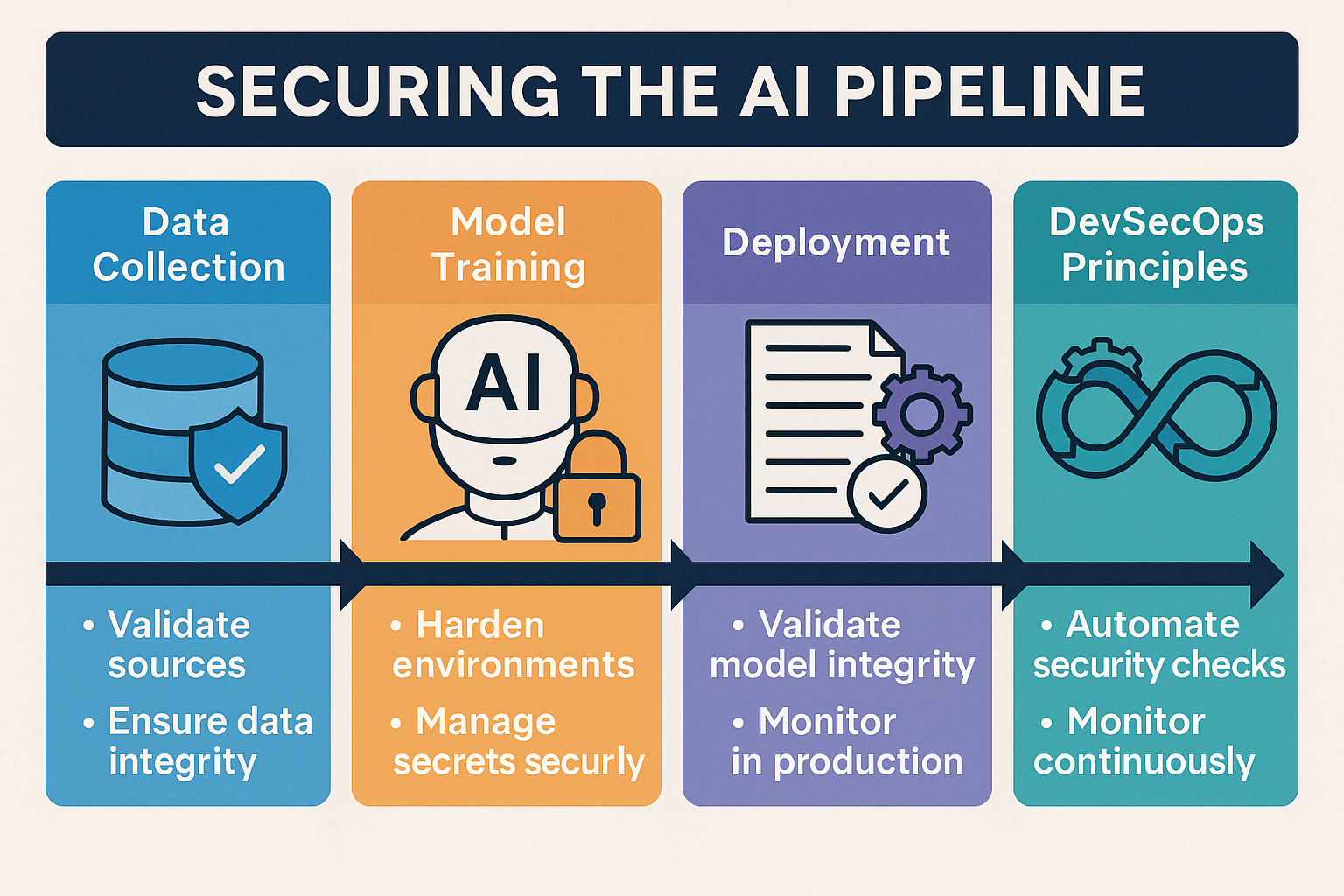
Securing a RAG pipeline requires a zero-trust posture across the entire data lifecycle. Organizations cannot rely solely on the LLM to behave safely; security must be layered across ingestion, retrieval, and generation [4]. Effective solutions typically combine AI-based vulnerability management scanning with rule-based or heuristic approaches, forming a layered strategy [6].
At the ingestion level, organizations must implement privacy-aware chunking and strict provenance tracking. Security teams should track embedding model versions, preprocessing steps, and chunk-to-source mappings. This provenance enables reproducible investigations and supports secure re-embedding when models are rotated [5]. If aggressive compression techniques are used, their effect on recall must be evaluated to ensure important but rare facts remain retrievable [5].
During retrieval, technical controls like re-ranking and noise injection serve as critical mitigations. Re-ranking uses a secondary model to identify and filter the most relevant documents, preventing irrelevant or potentially sensitive data from advancing in the pipeline, thereby reducing the data volume exposed to potential misuse [8]. Similarly, carefully applied noise--such as adjusting embeddings or inserting random characters--can mitigate privacy risks while, paradoxically, sometimes improving response accuracy [8].
To protect the generation phase, prompt redaction is non-negotiable when using third-party LLMs. Privacy-enhancing technologies must be used to pseudonymize retrieved context before sending prompts to LLMs, ensuring sensitive information doesn't leave the secure enterprise environment [1]. Furthermore, organizations must maintain independent ownership of their encryption keys and enforce consistent security controls like tokenization and masking across hybrid cloud environments [2].
 Securing the RAG ingestion pipeline: Filtering mechanisms | AWS Security Blog
Future-Proofing RAG: Privacy-Enhancing Technologies and Governance
As threat actors evolve their tactics, the next generation of AI vulnerability management solutions will require advanced detection capabilities to counter attackers focusing specifically on AI systems [6]. This necessitates looking beyond current architectures toward Privacy-Enhancing Technologies (PETs) that fundamentally alter how data is processed.
Emerging technologies such as Homomorphic Encryption--which enables computations on encrypted data without decryption--and Federated Learning--which allows models to train without centralizing sensitive data--represent the frontier of RAG security [1]. Coupled with Differential Privacy, which adds mathematical guarantees of privacy protection, these technologies could eventually allow enterprises to reap the benefits of RAG without exposing raw data at rest or in transit [1].
However, technology alone is insufficient. The regulatory landscape is rapidly catching up to enterprise AI. As data privacy regulations like GDPR and CCPA are more rigorously implemented, organizations must ensure their RAG systems comply with evolving legal requirements [1]. This highlights a core tension in AI privacy: the principle of data minimization. AI systems inherently require vast amounts of data to improve their learning, but collecting this data without proper governance poses severe privacy risks [9]. Enterprises must build comprehensive data inventories, mapping and records of processing activities (ROPA) specifically tailored to their AI pipelines [9].
Furthermore, transparency and explainability remain key privacy challenges. Organizations must implement continuous cycles of scanning, patching, retraining, and verification to ensure their AI models and the tools derived from them remain immune to emerging threats [6][9].
Conclusion
Securing the RAG pipeline is not a one-time configuration but a continuous, lifecycle-based discipline. The emergence of zero-click exfiltration, embedding reconstruction attacks, and agentic workflow manipulation signals a permanent shift in the enterprise threat landscape. Organizations can no longer afford to view AI security as a subset of traditional application security; it is a distinct domain requiring specialized expertise, granular data controls, and architectural zero-trust.
Enterprises that rush to deploy AI without securing the RAG pipeline risk becoming tomorrow's breach headlines [2]. Success lies in implementing defense-in-depth strategies that protect data throughout the entire pipeline--from initial ingestion through final response generation. This includes technical controls like encryption and access management, operational procedures like real-time monitoring and incident response, and robust governance frameworks that ensure compliance with an increasingly strict regulatory environment [1]. By integrating security into the architecture from day one, organizations can build trust into every AI interaction, ensuring that their knowledge bases empower their workforce without exposing their deepest secrets.
References
- 1.
- 2.
- 3.
- 4.
- 5.
- 6.
- 7.
- 8.
- 9.