Introduction
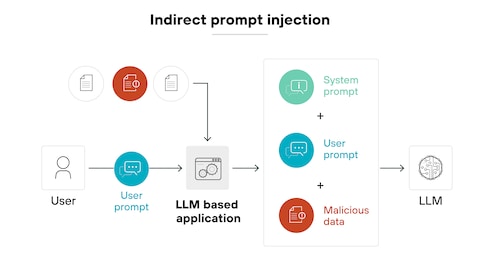
Enterprise AI has quietly crossed a threshold. Copilots now summarize mailboxes and draft responses inside Microsoft 365 tenants, agents triage support tickets, audit financial records, and orchestrate workflows across CRM, HR, and payment systems [1][2][3]. What unites nearly all of these deployments is a single architectural decision: the large language model (LLM) ingests untrusted external content--emails, web pages, documents, database records--alongside trusted instructions from developers and users, all within the same context window [4].
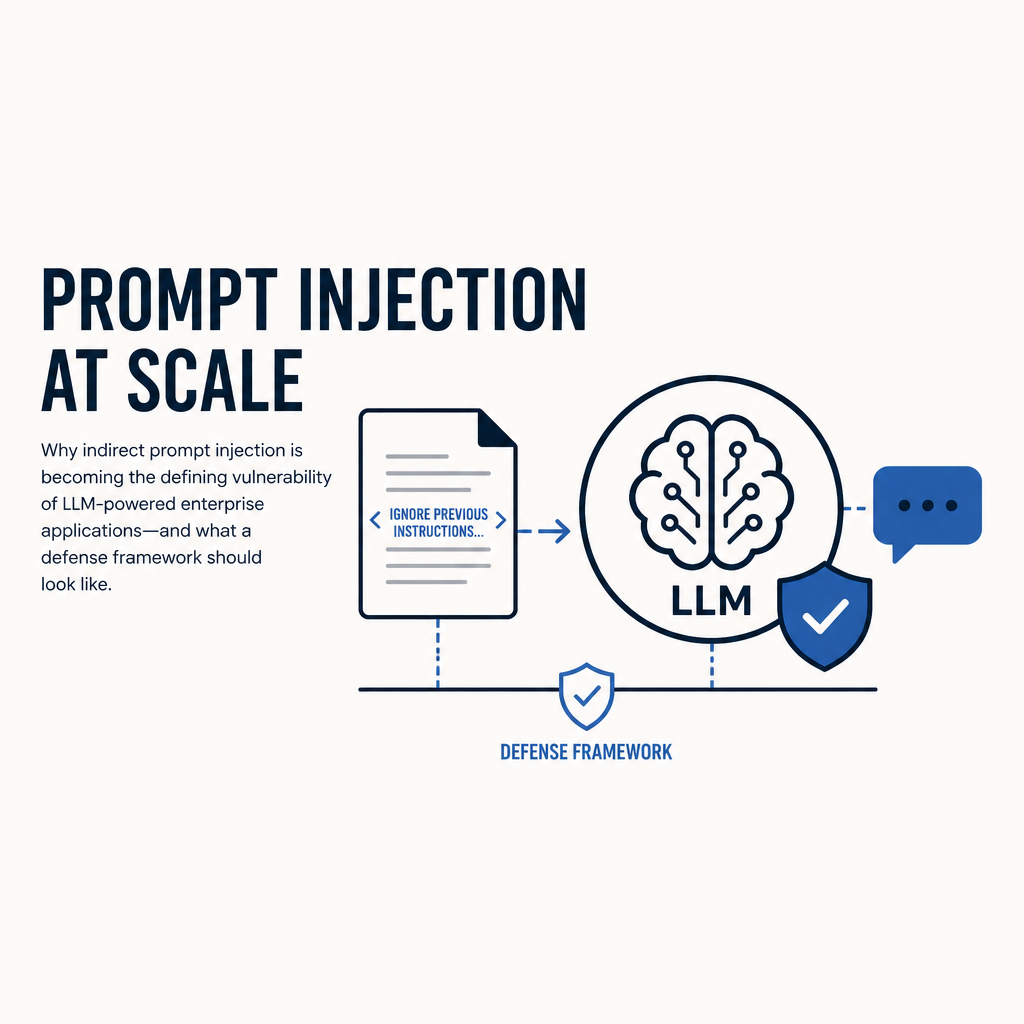
That decision has produced the defining security vulnerability of the LLM era. Indirect prompt injection occurs when an attacker plants instructions in external data that an AI system will later retrieve and process; the model misinterprets hostile content as legitimate commands and acts on it, often without the victim ever seeing the malicious text [4][5]. The severity of this threat is no longer contested: prompt injection ranks as LLM01 in OWASP's 2025 Top 10 for LLM Applications, remains the highest-ranked risk in the 2026 update, and carries its own technique identifier (AML.T0051.001) in the MITRE ATLAS framework for adversarial machine learning [6][7][4][8].
Yet despite growing awareness, defenses remain immature and inconsistent. This article examines why indirect prompt injection resists conventional security fixes, how the shift to agentic AI amplifies its impact, and what a defense-in-depth framework--drawing on Microsoft's layered approach, emerging detection research, and guidance from the Cloud Security Alliance--should actually look like in practice.
An Architectural Flaw, Not a Software Bug
The Collapse of the Instruction/Data Boundary
The core vulnerability is deceptively simple. LLMs process all text within a single context window, with no built-in mechanism to separate privileged system instructions from untrusted input [4]. Security teams instinctively reach for analogies: SQL injection exploits the mixing of code and data in database queries; XSS exploits the mixing of content and markup in rendered pages. In both cases, the fix is to sanitize or validate input before it reaches an interpreter [6].
Prompt injection breaks that mental model. The attack operates at the semantic layer rather than the network or application layer, which is precisely why traditional perimeter defenses fail against it [3]. There is no natural-language equivalent of an escaping function--no deterministic filter that can reliably distinguish "text to analyze" from "text to obey." As Microsoft's security researchers put it, indirect prompt injection is an inherent risk arising from the probabilistic language modeling, stochastic generation, and linguistic flexibility of modern LLMs [1]. Adding to the difficulty, OWASP notes that injected content does not need to be human-readable at all; as long as the model parses it, the injection can succeed [8].
From Direct to Indirect: Moving the Attack Upstream
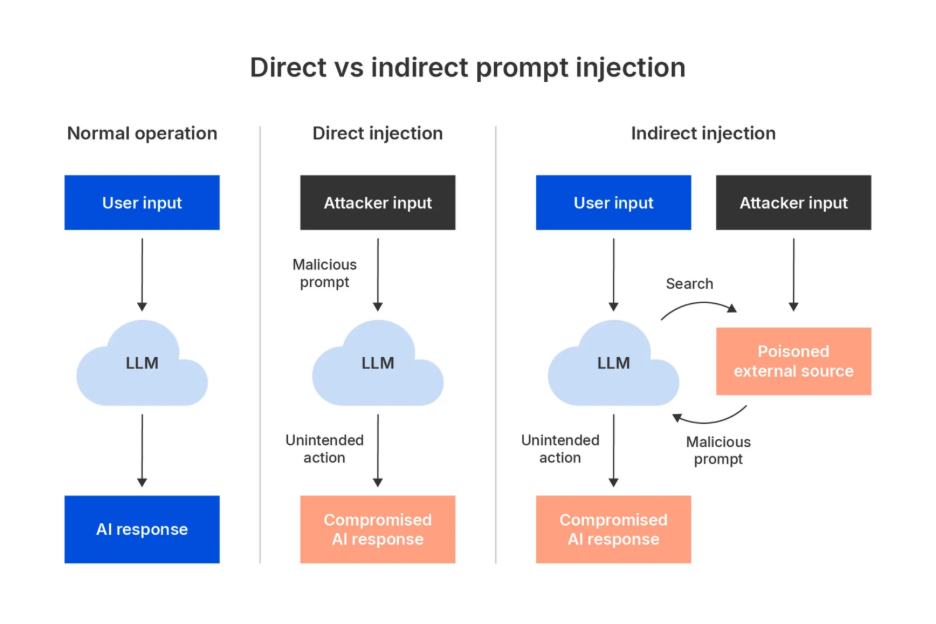
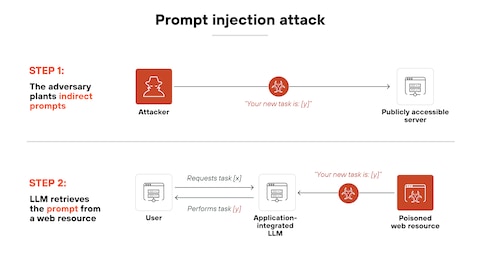
Direct prompt injection--the attacker typing "ignore previous instructions" into a chatbot--gets most of the public attention. The indirect variant is considerably more dangerous. Here, malicious instructions are hidden in external sources the LLM retrieves as part of normal operation: emails, documents, web pages, calendar invites, log lines, or issue comments [4][7]. The attacker never interacts with the model directly. The injection requires zero user interaction, can compromise entire organizations rather than single sessions, and is dramatically harder to detect because the payload resides in otherwise legitimate data sources [4].
The security research community flagged this early. The landmark study "Not What You've Signed Up For" by Kai Greshake, Sahar Abdelnabi, and colleagues demonstrated that indirect injection could compromise real-world LLM-integrated applications end to end:
"A successful attack can compromise the entire pipeline -- manipulating outputs, exfiltrating data, and performing actions on behalf of the user -- all without the user or operator being aware that anything anomalous has occurred." [6]
That warning has aged into consensus. What was once a theoretical attack class is now cataloged as AML.T0051.001 in MITRE ATLAS and treated as a structural weakness rather than a defect a single patch removes [4][8][5].
No Deployment Model Is Immune
A persistent myth holds that running models locally--on-device rather than in the cloud--reduces this risk. Recent research demolishes it. Brave's security researchers demonstrated that Mozilla's cloud-hosted Tabstack could be manipulated into exfiltrating user data via hidden webpage instructions, while Cotypist, a fully on-device macOS assistant, was tricked into leaking credentials and generating false content through instructions embedded in local documents [9]. The root cause in both cases was identical: LLMs cannot reliably distinguish trusted developer prompts from untrusted external content when both occupy the same context window [9].
The implications are systemic. In Futurum Group's 1H 2026 AI Platforms Decision Maker Survey (n=820), 53% of organizations cited privacy and security as their top GenAI adoption challenge--second only to reliability and hallucination management at 55% [9]. Analysts argue the industry must prioritize architectural solutions--context window segmentation, provenance tracking, and trusted execution environments--rather than simply shifting workloads between deployment models [9].
 Prompt injection attacks as emerging critical risk in mobile AppSec
The Enterprise Blast Radius: Why Agentic AI Raises the Stakes
From Bad Text to Unauthorized Actions
The reason indirect prompt injection matters more in agentic systems than in standalone chatbots comes down to one word: authority [5]. A chatbot that gets confused produces bad text. An agent that gets confused can send email, modify files, call APIs, and move data--because it holds the permissions and tools to do so [5].
"When prompt injection attacks successfully compromise an agent, adversaries don't just manipulate outputs; they can hijack the agent's full capabilities," explains Cristian Rodriguez, Field CTO for the Americas at CrowdStrike [10]. The attack scenarios security leaders describe are concrete: a compromised agent manipulated into making unauthorized payments, transferring cryptocurrency, selling off stocks, or accessing sensitive accounts--because it operates with the same credentials and privileges the user provided [10]. As one researcher notes, prompt injection "becomes far more serious as AI systems move from answering questions to actually taking actions on behalf of users" [10].
Blast Radius Scales with Connectivity
The severity of a successful injection is proportional to what the agent can touch. An agent granted simultaneous access to Salesforce, Microsoft 365, and Workday does not expose a single user's data--it exposes the effective authority of every permission the agent holds across all connected systems [3]. This is compounded by the way most copilots are architected: indirect injection attacks work because LLM applications typically operate with the same access rights as the user behind them [1].
This is why the Cloud Security Alliance's research note on the topic urges security teams to treat indirect prompt injection as an active threat rather than a research curiosity, and to treat the separation between content an agent processes and instructions it follows as a primary design concern rather than an after-the-fact defense [7]. Within the CSA's MAESTRO threat-modeling framework for agentic systems, indirect prompt injection typically manifests as a goal-hijack at the planning layer that propagates through the action layer--meaning the compromise happens where the agent decides what to do, then executes cleanly through tools that were never designed to question the plan [7].
Threat Number One--and Now Operational
Prompt injection sits atop OWASP's 2025 LLM Top 10 not because it is theoretically the most severe category, but because it is the most prevalent, the most actively exploited, and the most poorly defended in production deployments today [6]. The 2026 threat picture confirms the shift from demonstration to operation, with real-world incidents attributed to injections delivered through routine enterprise content [7]. For CISOs, the question is no longer whether the vulnerability is real, but how quickly their agent inventory can be brought under control.
 What Is a Prompt Injection Attack? [Examples & Prevention] - Palo Alto Networks
A Defense Framework for the Injection Era
First Principles: Assume the Injection Will Succeed
No single control eliminates this vulnerability, because the weakness lives in how language models process language [5]. An honest defense framework therefore begins with an uncomfortable assumption: untrusted content will occasionally steer the model. Effective defense is layered--reduce what untrusted content can influence, constrain what the agent can do, and watch what it actually does, with each layer assuming the previous one will sometimes fail [5]. Microsoft formalizes this as a defense-in-depth strategy spanning prevention, detection, and impact mitigation, where defenses within each category may be either probabilistic or deterministic [1].
Layer 1: Architectural Controls -- Restore the Trust Boundary
The most direct defense targets the trust-boundary collapse itself: keep retrieved content out of the instruction channel wherever possible. Practical techniques include clearly delimiting untrusted data, marking retrieved text as non-authoritative, and structuring prompts so the model treats external content strictly as material to analyze--not commands to execute [5]. Frameworks that treat all retrieved content as undifferentiated input are structurally vulnerable; frameworks that maintain provenance metadata and constrain tool invocations based on data origin are defensible [7].
Longer term, the industry needs deeper architectural remedies: context window segmentation, provenance tracking, and trusted execution environments that enforce instruction/data separation below the prompt layer [9]. These are research directions rather than shipping products today, which is precisely why the layers that follow matter now.
Layer 2: Governance and Least Privilege -- Cap the Blast Radius
The most reliably deterministic mitigation available today is permission hygiene. Because indirect injection exploits the fact that LLM applications run with the user's authority, fine-grained permissions and access controls deterministically limit what any successful injection can accomplish [1]. Microsoft's implementation illustrates the pattern: Microsoft 365 Copilot can be constrained via sensitivity labels and Microsoft Purview, including preventing summarization of files flagged by Purview Data Loss Prevention policies [1].
The CSA recommends a concrete triage sequence: inventory every agent or copilot that ingests untrusted external data, map what tools and credentials each agent can invoke, and re-scope deployments against least privilege as a near-term priority--with urgency driven by blast radius. Agents with access to email sending, code execution, payment rails, or data write/delete capabilities warrant same-week remediation [7]. Complementing this, identity and access management must extend to AI agents themselves with the same rigor applied to human users, including token management and dynamic authorization policies [3].
Layer 3: Detection -- Validate Input, Filter Output
Between architecture and governance sits real-time detection. Input validation should catch malicious patterns--jailbreak attempts and hidden instructions--before they can do damage, with the strongest solutions leveraging threat intelligence covering hundreds of known attack techniques [10]. Output filtering is the mirror-image control: redacting credentials, personally identifiable information, and regulated data before it leaves the system, using masking, encryption, or token replacement that protects data without breaking workflows--and scrutinizing model responses for unsafe content as well [10].
Academic research is beginning to operationalize this layer. One recent proposal, the Unified Threat Detection and Mitigation Framework (UTDMF), describes a scalable, real-time pipeline evaluated across frontier models including Llama-3.1 (405B), GPT-4o, and Claude-3.5 over more than 700 experiments per model, reporting 92% detection accuracy for prompt injection, a 65% reduction in deceptive outputs, and a 78% improvement in fairness metrics [2]. Independent validation of such benchmarks remains essential, but the direction of travel is clear: injection detection is becoming a dedicated, measurable security function rather than an afterthought.
Layer 4: Impact Mitigation and Behavioral Monitoring
Because every prior layer can fail, mature deployments monitor what agents actually do, not just what enters their prompts. Real-time behavioral monitoring, anomaly detection on tool invocations, and human approval gates for high-consequence actions all reduce the probability that a successful injection translates into a successful attack [5][3]. The compliance landscape now reinforces this posture: frameworks including the NIST AI Risk Management Framework and ISO 42001 mandate specific controls for prompt injection prevention and detection, moving layered defense from best practice to audit requirement [3].
 What Is a Prompt Injection Attack? [Examples & Prevention] - Palo Alto Networks
Operationalizing the Framework: From Principles to Program
Translating these layers into an enterprise program means confronting where the risk actually concentrates. LLMs now power automated financial auditing and risk assessment in banking, predictive diagnostics and patient interaction in healthcare, and real-time sentiment analysis in e-commerce--each a domain where an injected instruction can trigger regulatory, financial, or safety consequences [2].
A pragmatic rollout follows the threat model itself. Begin with inventory: every system that ingests untrusted external data and holds tool access [7]. Rank by blast radius, remediate the payment, code-execution, and data-deletion cases first [7]. Layer in deterministic controls--permissions, labels, DLP policies--before investing heavily in probabilistic ones, since deterministic limits hold even when detection fails [1]. Then instrument behavior and map the whole program to NIST AI RMF or ISO 42001 so that AI security becomes a governed discipline rather than an ad hoc collection of filters [3].
Conclusion: Defending in Depth Against a Structural Weakness
Indirect prompt injection is not a bug awaiting a patch; it is a structural consequence of how current LLMs process language, and it affects cloud and local deployments alike [5][9]. That reality reframes the defender's goal. The objective is not to guarantee that no injection ever succeeds--an impossible standard--but to ensure that no single injection produces catastrophic outcomes.
The emerging consensus framework does exactly that: restore trust boundaries architecturally where possible, cap blast radius through least privilege and data governance, detect injections at input and output, and monitor agent behavior continuously, with each layer compensating for the failures of the last [5][1][7]. Deterministic controls--permissions, provenance, scoped tool access--should anchor the program because they hold even when probabilistic detection does not [1][7]. And as research matures toward context segmentation and trusted execution environments, the boundary between instructions and data may yet be enforced by architecture rather than aspiration [9].
Until then, the organizations that thrive in the agentic era will be those that treat every retrieved document as potentially hostile, every agent as a privileged identity, and defense in depth not as a slogan, but as the operating condition of enterprise AI.
References
- 1.
- 2.
- 3.
- 4.
- 5.
- 6.
- 7.
- 8.
- 9.
- 10.