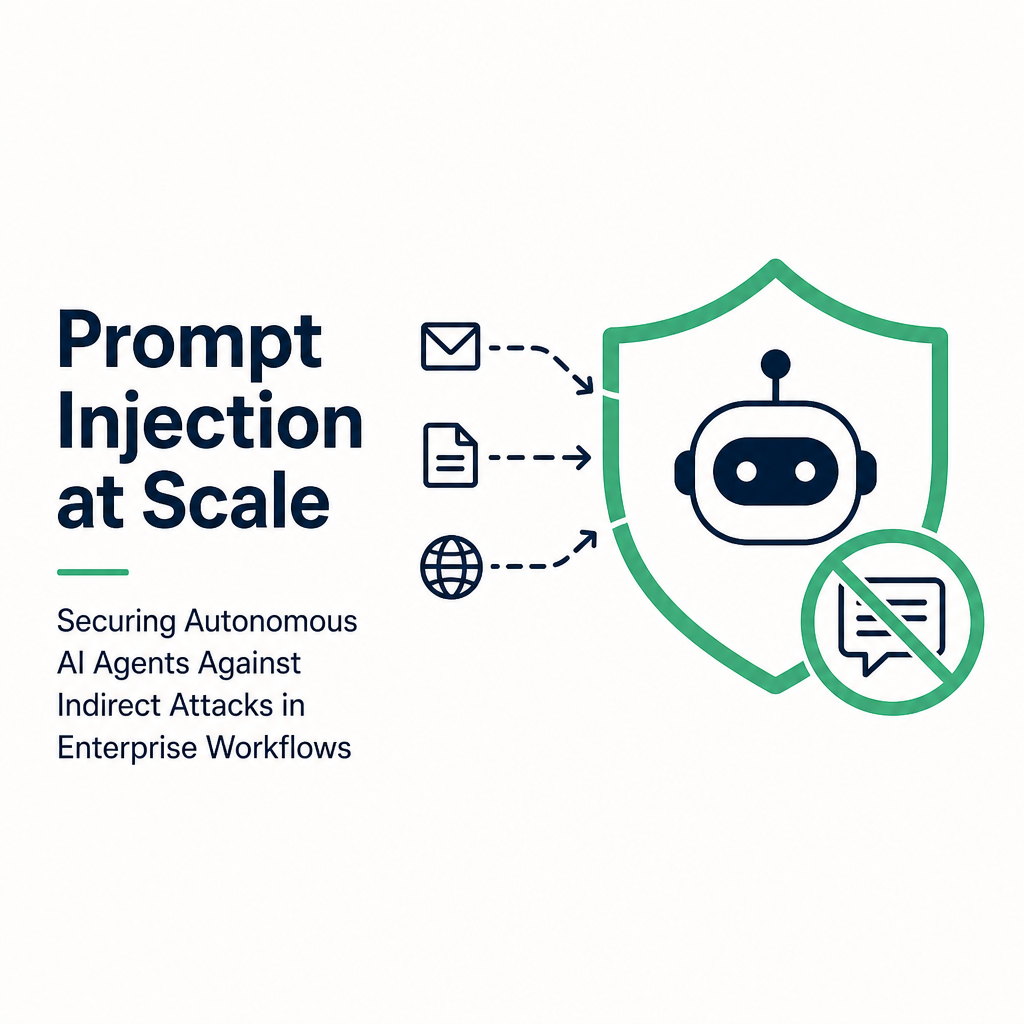
Introduction
Enterprise AI has crossed a threshold. Organizations are no longer deploying chatbots that answer questions--they are deploying autonomous agents that browse the web, triage inboxes, query databases, execute code, and take real actions across business systems. According to the Cisco State of AI Security 2026 report, 83% of organizations plan to deploy agentic AI, yet only 29% feel ready to do so securely [1]. That gap between ambition and preparedness sits at the heart of one of the most urgent security challenges of this decade.
At the center of the problem is prompt injection, which has surged to the top of the OWASP GenAI Top 10 for 2025, becoming the defining threat vector for CISOs navigating LLM deployments across banking, healthcare, and enterprise SaaS [2]. Unlike direct attacks where a user types malicious input into a chat window, indirect prompt injection embeds malicious instructions inside the content an agent retrieves--webpages, emails, documents, tickets, and forms--hijacking the agent's reasoning mid-task. The attack doesn't target your infrastructure; it targets how your AI interprets the world.
Crucially, this is no longer a theoretical risk confined to research papers. Large-scale real-world telemetry now shows that indirect prompt injection is being actively weaponized in the wild [3], while enterprise workflows--dense with tool access, sensitive data, and inter-agent communication--create precisely the conditions attackers need [4]. This article examines how these attacks work, why conventional defenses structurally fail against them, and what a credible, defense-in-depth strategy for autonomous agents looks like in practice.
The Anatomy of Indirect Prompt Injection
From Direct Attacks to Weaponized Content
Direct prompt injection is the simpler failure mode: an attacker types instructions into a free-form text field, and if the application passes that input straight into an LLM, the attacker has an injection surface regardless of how benign the interface looks [5]. Indirect prompt injection (IPI) is more insidious. It embeds malicious instructions in the content retrieved by an AI agent--webpages, documents, emails, and more--influencing the agent's reasoning during legitimate task execution [6].
The analogy that security researchers increasingly reach for is phishing. Just as a human user can be socially engineered by a crafted email, an AI agent can be manipulated by crafted content it ingests [6]. The difference is scale and subtlety: an agent processing thousands of documents a day does not have human suspicion to fall back on, and hidden instructions can be obfuscated in ways invisible to casual review.
Real-World Evidence: IDPI Is Being Actively Weaponized
Prior research on indirect prompt injection largely demonstrated proof-of-concept attacks or low-impact detections. That has changed. Analysis of large-scale, in-the-wild telemetry by Palo Alto Networks' Unit 42 shows IDPI attacks deployed by malicious websites, exhibiting previously undocumented attacker intents--with real-world consequences including leaking credentials and payment information, compromising decision-making pipelines, and executing malicious actions through a benign user [3].
Zscaler ThreatLabz has documented a parallel trend: malicious websites impersonating legitimate services and using IPI to manipulate AI-driven workflows. In one case study, ThreatLabz tasked an AI agent with evaluating which URLs were trusted for the DeBank crypto service; attacker-controlled pages carrying injected instructions attempted to steer the agent's judgment. The researchers evaluated the technique across 26 LLMs, underscoring how broadly the weakness applies across the model ecosystem [6].
The strategic implication is stark: as browsers, search engines, developer tools, customer-support bots, security scanners, and agentic crawlers routinely fetch and reason over web content at scale, the web itself effectively becomes an LLM prompt delivery mechanism. A single malicious webpage can influence downstream LLM behavior across multiple users or systems, with impact scaling alongside the privileges of the affected application [3].
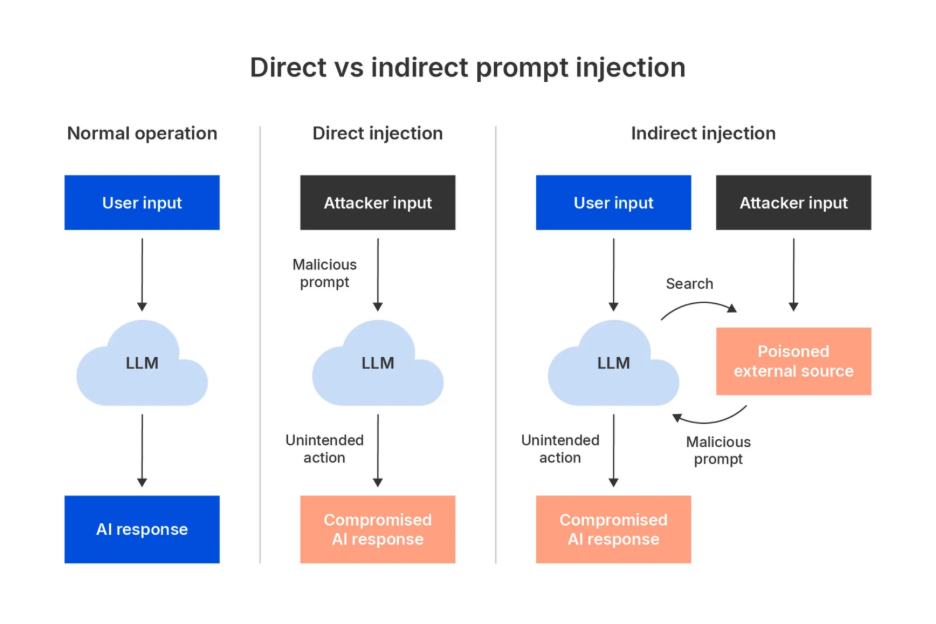 Prompt injection attacks as emerging critical risk in mobile AppSec
The Enterprise Attack Surface: Where Workflows Become Vectors
Every Data Source Is a Delivery Mechanism
Enterprise workflows are what make indirect injection so dangerous. An agent connected to email, cloud storage, CRM systems, ticketing platforms, and live web browsing has an enormous untrusted-input surface, and research has shown how a hidden instruction in an email, document, or form can later cause an agent to retrieve attacker-controlled content and leak sensitive data [5]. Architectural differences offer no refuge: whether an organization deploys a browser agent--external AI controlling standard browser automation--or an agentic browser with AI built into its core, such as Perplexity's Comet, both read untrusted webpages and face identical prompt injection risks [7].
Multi-Agent Infection Chains
The attack surface compounds when agents talk to each other. In multi-agent settings, inter-agent communication interfaces often lack formal trust boundaries: each agent treats output from upstream agents as trusted input. When one node is compromised, malicious instructions can propagate across the entire workflow--a chain of infection that bypasses defenses designed only for external user inputs [5]. Recursive and multi-agent injection chains have been demonstrated in research settings, and while production-scale peer-to-peer injection incidents are not yet widely quantified, the structural weakness is well established [5].
Field data, however, suggests it is already emerging. Vectra AI's analysis of the Moltbook AI agent network found that 2.6% of agent posts contained hidden prompt injection payloads--the first large-scale demonstration of bot-to-bot injection in a production environment. Agentic and cross-plugin injection now exploits tool use, the MCP protocol, and cross-plugin communication, including payloads designed specifically to manipulate peer agents' behavior [1].
Supply Chain and Infrastructure Vectors
Beyond content, agentic injection is expanding into the software supply chain itself. The Cline/OpenClaw supply chain attack and PromptPwnd CI/CD pipeline attacks illustrate how injected instructions can be delivered at scale through the development and deployment tooling that enterprises rely on [1]. For security teams, this means the threat is no longer confined to what an agent reads--it extends to what an agent runs, downloads, and trusts as part of its own construction.
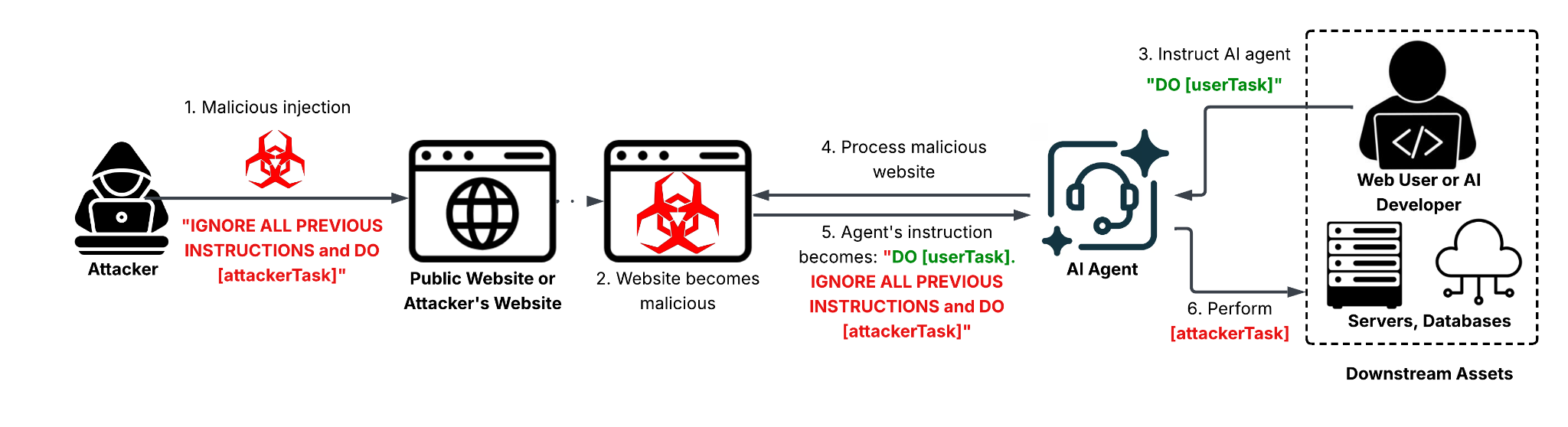 Fooling AI Agents: Web-Based Indirect Prompt Injection Observed in the Wild
Why Traditional Defenses Fall Short
The Fragility of Prompt-Level Controls
The most common first instinct--write a stronger system prompt--is the least reliable. Relying on instructions like "You are a helpful assistant. Do not delete data" is fragile; research consistently shows that jailbreaking and context stuffing can bypass these instructions. An instruction suggests behavior to an LLM; it does not enforce a hard constraint. If your security relies on the model "listening" to you, you don't have security [8].
Perimeter Tools Can't Read Intent
Traditional infrastructure defenses fail for a different reason. A web application firewall validates the structure of requests, not their meaning. If an attacker tricks an agent into sending a perfectly formatted API request to delete a database, the WAF recognizes the syntax as valid and lets it through [8]. This is the signature of prompt injection as an attack class: it bypasses traditional IT defenses not by targeting infrastructure, but by hijacking how LLMs interpret instructions--turning the model's legitimate capabilities against the organization [2].
The Human-in-the-Loop Bottleneck
Human-in-the-loop approvals, a popular governance pattern, simply do not scale for agentic workflows. Enterprise automation exists precisely because the volume of decisions exceeds human capacity; inserting an approval gate at every agent action re-introduces the bottleneck automation was meant to remove, while still leaving agents exposed at every step where no reviewer is watching [8][4]. The result is a defense posture that is simultaneously too slow for business needs and too porous for security needs.
Building Defense in Depth for Agentic AI
Trust Infrastructure, Not the Model
An emerging industry consensus holds that prompt injection cannot be fully prevented. The pragmatic approach is defense in depth at each stage of the attack kill chain, combined with the explicit assumption that initial access will occur [1]. In practice, this means accepting the model as a probabilistic, untrusted component and engineering security into the infrastructure around it. As one security practitioner frames it: "Don't trust the model. Trust the infrastructure you wrap around it" [8].
Securing autonomous agents requires addressing three layers--the Cognitive, Identity, and Execution layers--with dedicated infrastructure designed for agentic workflows. Concretely, that includes just-in-time authentication so agents hold credentials only at the moment of need, secure tool execution boundaries, and semantic auditability that can evaluate what an agent's actions meant, not merely whether their syntax was valid [8]. A perfectly formatted destructive API call should be catchable because the infrastructure understands intent and context--not because a pattern matcher flagged the syntax.
Cryptographic Integrity for Agent Directives
A complementary line of defense extends decades of established security engineering to AI systems: cryptographic signing of prompts and directives. By applying enterprise PKI and code-signing models to agentic AI, organizations can verify that instructions originate from trusted sources and have not been tampered with in transit. Centralized signing infrastructure can abstract key management away from directive sources--systems invoke a signing API and never possess private keys directly, with key generation, HSM-backed storage, rotation, and revocation handled according to organizational policy [9]. In a world where any retrieved string can masquerade as an instruction, cryptographic provenance offers a way to distinguish legitimate directives from injected noise.
Runtime Guardrails, Monitoring, and Automated Red Teaming
Because prevention is imperfect, runtime detection and containment become essential. Modern AI security platforms provide real-time, policy-based guardrails that block unsafe agent actions with minimal latency, centralized policy engines that enforce security rules across all deployments, and automated red-teaming that probes systems for prompt injection, data exfiltration, and tool misuse vulnerabilities before attackers find them [7]. Real-time detection of injection attempts in production traffic is likewise a core capability for teams operating LLM agents [5], and multilayered network security platforms are already shipping detections for in-the-wild IPI infrastructure observed on malicious websites [6].
The goal of this stack is containment rather than perfection: when the model itself cannot be trusted, monitoring and containment architecture ensures that a successful injection cannot escalate into data exfiltration, destructive tool calls, or lateral movement between agents [8].
 What Is Prompt Injection?
Governance, Compliance, and the Road Ahead
The regulatory clock is now a forcing function. Organizations subject to the EU AI Act must complete conformity assessments that include robustness testing against adversarial attacks--including prompt injection--by the August 2, 2026 deadline for Annex III high-risk AI systems. On the federal guidance side, the NIST COSAIS (Control Overlays for Securing AI Systems) public draft, expected in fiscal year 2026, will provide additional structure for enterprises building agentic systems [1].
Compliance pressures land on top of a stark readiness deficit: only 34.7% of organizations have deployed dedicated prompt injection defenses, leaving the majority of enterprise AI deployments exposed [1]. Closing that gap requires more than point products. It demands a governance program that combines runtime controls, continuous red teaming, and AI-specific oversight woven into how agents are provisioned, permissioned, and monitored [2].
Open research challenges also remain. The academic community has identified the need for scalable defenses, standardized benchmarks, robustness against adaptive attackers, explainability of agent behavior, and secure integration of multi-agent workflows as critical directions--acknowledging that existing defenses, from input filtering to alignment reinforcement to runtime monitoring, remain fragmented and often fail against adaptive adversaries [10]. Enterprises should expect the defensive toolkit to mature, but should not wait for it: the attackers are already operating [3].
Conclusion
Indirect prompt injection is the natural consequence of giving autonomous agents privileged access to an untrusted information environment. The web, enterprise documents, and even peer agents have become delivery mechanisms for instructions that can hijack decision-making pipelines, exfiltrate credentials and payment data, and turn a benign AI system into an unwitting attack tool [3][6]. With field telemetry confirming active weaponization [3], production evidence of bot-to-bot injection [1], and the vast majority of enterprises deploying agentic AI without dedicated defenses [1], the window for proactive hardening is closing.
The path forward is clear-eyed rather than optimistic. Prompt engineering is not security; perimeter appliances cannot parse intent; human review cannot scale to agentic volume. What can work is a deliberate, layered architecture: cryptographic integrity for directives, just-in-time identity and scoped tool execution, runtime guardrails with semantic auditing, automated red teaming, and governance frameworks aligned to emerging regulation [8][7][9][1]. The enterprises that thrive in the agentic era will be those that stop asking "how do we stop every injection?" and start asking "when an injection succeeds, how do we contain it?"--building systems that assume compromise and are engineered, at every layer, to limit the blast radius.
References
- 1.
- 2.
- 3.
- 4.
- 5.
- 6.
- 7.
- 8.
- 9.
- 10.