Introduction
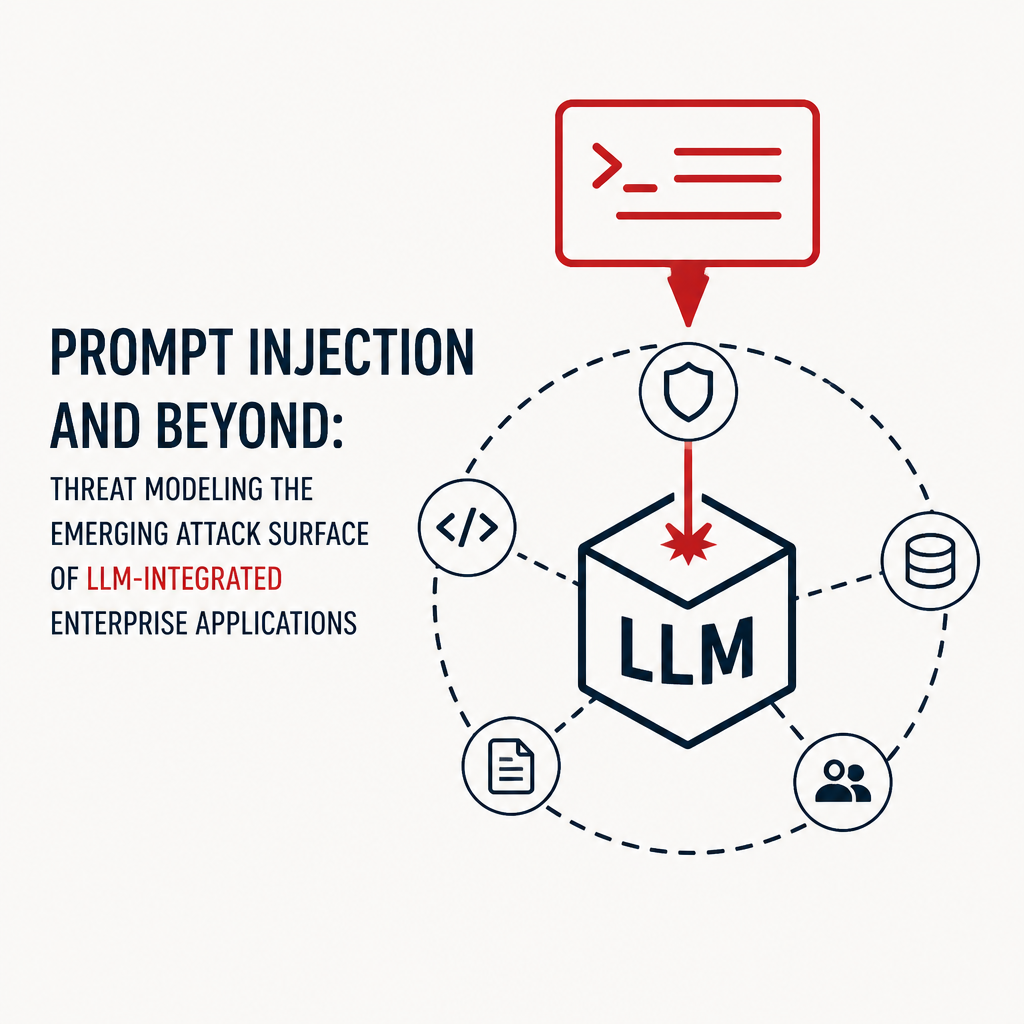
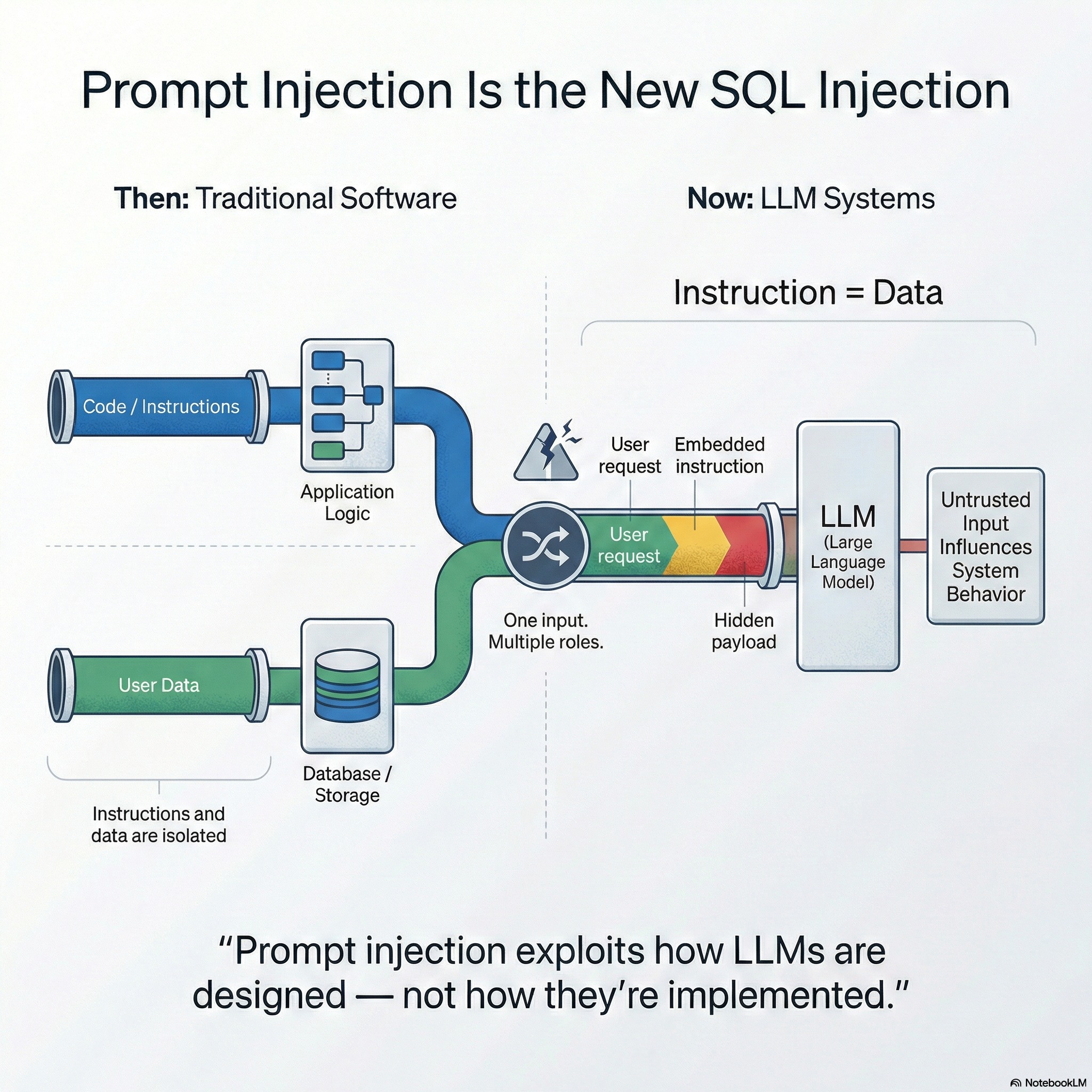
The rapid enterprise adoption of Large Language Models (LLMs) has ushered in a paradigm shift in software architecture, but it has also introduced a fundamentally new class of cybersecurity vulnerabilities. LLM-Integrated Applications (LIAs) seamlessly blend natural language processing with traditional business logic, creating a unique threat surface where adversaries can exploit systems without ever touching a line of source code [1]. At the center of this evolving landscape is prompt injection, an attack technique that exploits the model's inherent inability to distinguish between trusted system instructions and untrusted user input [2].
Unlike traditional application security--which relies on clear boundaries between server-side code and user input--LLM systems process both trusted and untrusted data through the exact same semantic mechanism [3]. This collapse of the trust boundary has rendered many legacy security controls obsolete. The threat has become so severe that prompt injection has been ranked as the number-one risk (LLM01) on the OWASP Top 10 for LLM Applications 2025 [2][4]. Even frontier model developers have conceded the gravity of the issue; notably, OpenAI's launch of Lockdown Mode for ChatGPT came with a public acknowledgment that prompt injection in AI browsers "may never be fully patched" [2].
For enterprise security leaders, the era of treating AI integrations as mere experimental features is over. As attack success rates reach up to 84% in agentic systems and production exploits begin carrying CVSS scores upwards of 9.0, understanding the mechanics of these attacks and implementing robust threat modeling is no longer optional [2]. This article explores the expanding attack surface of LIAs, the escalating impact of agentic AI compromises, and the architectural defenses required to secure the next generation of enterprise software.
The Anatomy of the LLM Attack Surface
To effectively threat-model LLM-integrated applications, security teams must first map a drastically altered attack surface. In traditional web applications, the attack surface is largely defined by server endpoints, APIs, and source code. In contrast, LLM attack vectors encompass prompts, embeddings, training data, output handling, and plugin integrations [1]. This expanded perimeter requires a complete re-education in how data flows through an enterprise.
Research into real-world LIA vulnerabilities reveals that attackers routinely exploit publicly accessible service endpoints, manipulating inputs with high degrees of freedom [5][6]. A critical mechanism in these attacks is the use of "Separator Components"--techniques such as syntax-based manipulation, language switching, and semantic-based filtering--to successfully bypass initial application defenses and inject malicious instructions into the LLM's context window [5][6]. These strategies represent only the tip of the iceberg, with researchers noting that future variations will likely become far more efficient and difficult to detect [6].
Furthermore, the concept of "excessive agency" has emerged as a primary vector for exploitation. Excessive agency occurs when an LLM is granted access to APIs that interact with sensitive information or systems, but lacks the guardrails to prevent unsafe usage [7]. Attackers can easily map this API attack surface, sometimes by simply asking the LLM to list its available tools or by using misleading context (such as claiming to be a developer with elevated privileges) to extract operational details [7]. Once the boundaries are understood, attackers can push the LLM far beyond its intended scope.
 Securing AI: Addressing the Emerging Threat of Prompt Injection - Gradient Flow
From Information Theft to Operational Destruction
The evolution from static chatbots to autonomous AI agents has fundamentally transformed the consequences of prompt injection. In simple conversational LLMs, a successful prompt injection might result in misinformation or the extraction of a system prompt--a concerning, but largely informational threat. However, when LLMs are granted tool-calling capabilities, prompt injection escalates from an information threat to an operational threat with potential physical consequences [3].
This escalation is vividly illustrated by recent demonstrations where hidden instructions embedded within a benign-looking PDF successfully manipulated an AI agent into interacting with industrial control systems (SCADA). By leveraging the agent's legitimate credentials and Model Context Protocol (MCP) integrations, the attack resulted in actual damage to industrial equipment [3]. This convergence of Information Technology (IT) and Operational Technology (OT) security through AI intermediation creates qualitatively new risks that traditional cybersecurity frameworks were never designed to address [3][8].
The real-world exploitation of these vectors is accelerating rapidly. Critical CVEs have been documented across major enterprise platforms, including Microsoft Copilot (CVSS 9.3), GitHub Copilot (CVSS 9.6), and Cursor IDE (CVSS 9.8) [2]. Attackers are also chaining vulnerabilities, using an LLM's excessive agency to execute classic web exploits--such as using an LLM API that accepts filenames to launch a path traversal attack on backend systems [7]. Additionally, "insecure output handling," where LLM responses are passed to downstream systems without validation, facilitates secondary attacks like Cross-Site Scripting (XSS) and Cross-Site Request Forgery (CSRF) [7]. Cross-plugin request forgery has also been demonstrated, where an attacker uses one compromised plugin to attack another within the same LLM ecosystem [4].
Prompt injection attack against an LLM-integrated application. | Download Scientific Diagram
Threat Modeling the LLM Ecosystem
Given the unpatchable nature of prompt injection, enterprises must shift from a mindset of vulnerability eradication to one of continuous threat modeling and impact reduction. Traditional threat modeling struggles to keep pace with the unique semantic vulnerabilities of LLMs, driving the development of automated, AI-assisted threat modeling frameworks. For example, the ThreatModeling-LLM framework demonstrates how combining prompt engineering with fine-tuning techniques can drastically improve an LLM's ability to identify threats and suggest mitigations--improving mitigation identification accuracy from 0.36 to 0.69 on base models like Llama-3.1-8B [9].
However, automated tools are only part of the solution. Effective AI governance requires continuous red teaming: actively simulating attacks against AI systems to uncover exploit chains before adversaries do [3]. This requires a specialized skill set that goes beyond traditional penetration testing. AI red teamers must possess deep knowledge of prompt engineering, jailbreaking techniques, and the ability to craft adversarial inputs that exploit semantic processing [3]. Because many organizations lack this internal expertise, there is a surging demand for specialized AI security consulting to map out complex LLM workflows [3].
A core tenet of modern LLM threat modeling is accepting that some attacks will bypass initial defenses. OWASP advocates for "reducing the impact of prompt injection attacks through design," a philosophy that assumes breach and architectures systems to contain the blast radius [4]. This involves strictly defining what an AI agent is allowed to do, limiting its access to only the specific tools and data required for its immediate task [8].
Defense in Depth: Mitigating the Unpatchable
Because no complete fix exists for prompt injection--even after applying the best defenses from OpenAI, Google, and Anthropic--defense in depth is the only viable strategy for enterprises [2]. This requires layering multiple security controls across the entire LLM lifecycle, from data ingestion to output delivery.
At the input layer, organizations are deploying next-generation prompt injection monitoring solutions. These tools apply semantic filtering, contextual validation, and real-time anomaly detection to intercept malicious instructions hidden in text, documents, or third-party content before they ever reach the model [1]. Simultaneously, data provenance and model lineage tools are becoming critical for providing transparency into where training and fine-tuning data originates, ensuring that supply chain vulnerabilities like poisoned training data or tampered vector databases are identified and mitigated [1].
Within the application architecture, restricting agent scope is paramount. Security teams must implement strict tool controls, routing third-party integrations through directories of vetted tools. Untrusted or custom tools should be rigorously tested in a sandbox environment before they are ever granted access to real enterprise data [8]. Finally, at the output layer, organizations must treat LLM outputs as untrusted data, applying strict validation and sanitization to prevent downstream vulnerabilities like XSS and SQL injection [7].
To tie these disparate controls together, enterprises are increasingly turning to Attack Signal Intelligence. By monitoring behaviors across the hybrid attack surface--including AI agent interactions--Security Operations Center (SOC) teams can identify and stop multi-stage attacks before they reach their objectives, effectively breaking the "promptware kill chain" at the stages where actual damage occurs [2].
Conclusion
The integration of large language models into enterprise applications represents a massive leap forward in capabilities, but it has fundamentally broken the traditional trust boundaries that cybersecurity has relied upon for decades. Prompt injection is not a temporary bug to be patched; it is an inherent architectural constraint of semantic processing. As AI agents become more autonomous and deeply integrated into critical business and operational technology systems, the stakes of these vulnerabilities will only rise.
Enterprise security teams must abandon the hope of a silver bullet and instead embrace comprehensive threat modeling, continuous AI-specific red teaming, and rigorous defense-in-depth architectures. By restricting agent scope, implementing robust input and output filtering, and leveraging advanced behavioral detection, organizations can safely harness the power of LLMs while keeping the emerging attack surface firmly under control.
References
- 1.
- 2.
- 3.
- 4.
- 5.
- 6.
- 7.
- 8.
- 9.