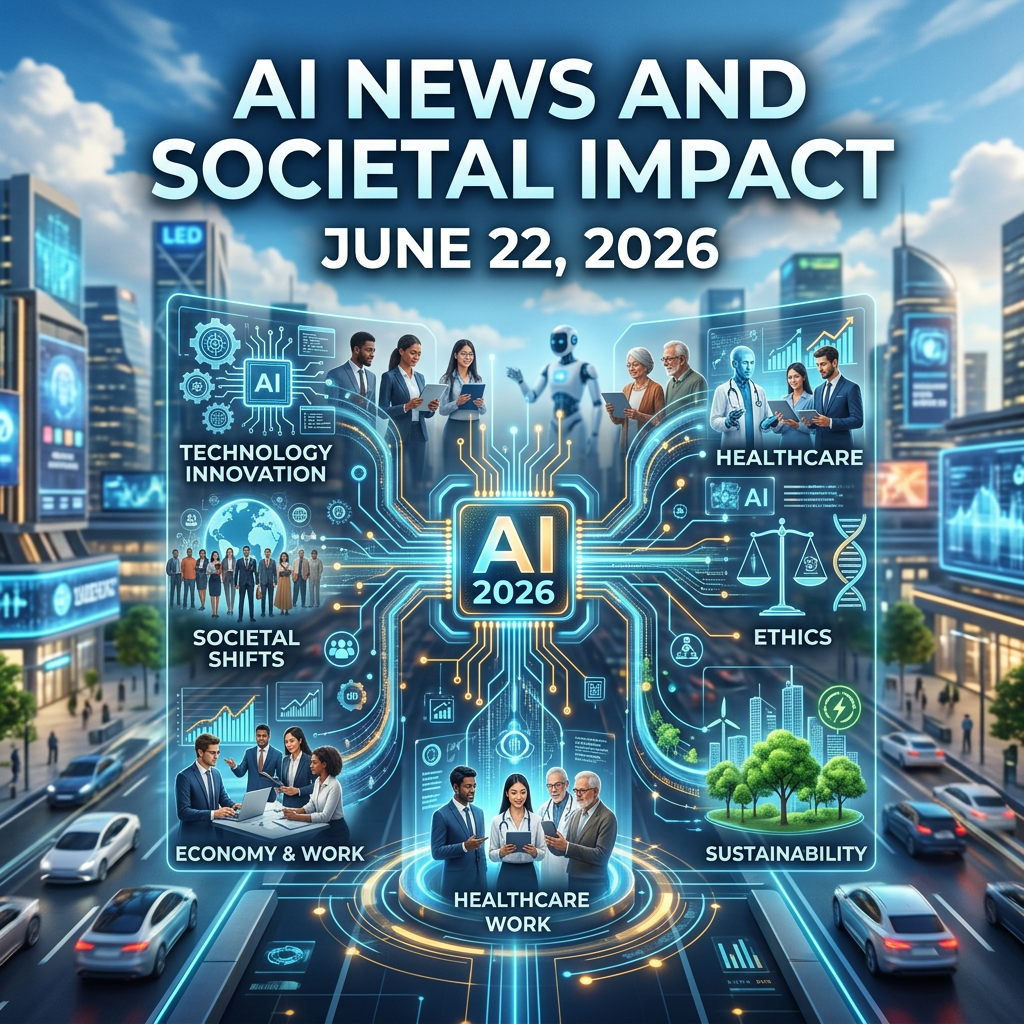
AI Frontier: Today's Most Impactful Developments in Science & Research
Published: June 22, 2026 | Source: Reducates AI Research
A comprehensive daily digest covering the latest developments in artificial intelligence and their real-world impact on science and research. This article examines 7 key topics drawn from today's most credible AI news sources, providing actionable insights for researchers, professionals, and anyone interested in how AI is transforming our world.
Table of Contents
- AI in Healthcare: From Diagnostics to Drug Discovery
- Generative AI in Enterprise: 2026's Operational Reality
- The Global AI Regulation Landscape: EU AI Act and Beyond
- AI Agents as Core Digital Workers
- AI's Energy Paradox: Powering the Future
- Education Transformed: LLM-Agnostic and Outcome-Centric
- The Workforce Revolution: Creation Amid Displacement
Introduction
Artificial intelligence continues to evolve at an unprecedented pace, affecting nearly every aspect of modern life. As of June 22, 2026, the AI landscape is marked by significant breakthroughs in research, new product launches, evolving regulatory frameworks, and growing public discourse about the societal implications of these technologies.
This daily digest brings together the most informative and impactful AI news, curated from trusted sources across the technology, science, business, and policy domains. Whether you're a researcher, a business leader, an educator, or simply an AI enthusiast, this article provides the insights you need to stay informed about the rapidly changing world of artificial intelligence.
1. AI in Healthcare: From Diagnostics to Drug Discovery
AI's transformation of healthcare has accelerated dramatically in 2026. According to Boston Consulting Group, the emergence of autonomous AI agents that can observe, plan, and act independently is revolutionizing patient care, health systems, and biomedical science Source.
Precision medicine is now a reality -- treatments are being tailored to individual genetic profiles, with AI-powered imaging improving cancer detection accuracy by nearly 40%. Drug discovery timelines have compressed from 15 years to just 5 years, and with agentic AI, some predict this could shrink even further to months.
AI co-pilots are reducing clinician documentation time dramatically. Ambient AI scribes record and summarize patient conversations, allowing doctors to spend more time on direct patient care. AI clinical assistants synthesize patient data, symptoms, and the latest research in real time, improving productivity and reducing diagnostic errors.
BCG's research highlights the 10-20-70 rule for AI success: organizations should dedicate 10% of effort to algorithms, 20% to technology and data, and a full 70% to people and processes. This human-centered approach is critical for realizing AI's potential in healthcare.
2. Generative AI in Enterprise: 2026's Operational Reality
Generative AI has moved decisively from experimental pilots to production-ready systems. According to Inceptive Technologies, in 2026 GenAI is "no longer a future investment -- it is a present-day necessity," embedded deeply in business operations across industries Source.
Key enterprise use cases include:
- Enterprise automation: Automatically generating operational reports, optimizing supply chains, and reducing manual compliance effort
- Customer experience: Virtual assistants with contextual memory, personalized recommendations, and dynamic content generation
- Software development: AI-assisted code generation, automated bug detection, and test case generation
- Data analysis: Predictive analytics, scenario modeling, and real-time business intelligence from raw data
Itransition reports that AI adoption across organizations has grown from 50% in 2022 to 88% in 2025, with GenAI deployment specifically rising from 20% to 36% in the same period Source. The share of companies still piloting initial GenAI use cases dropped from 39% to 13%, signaling maturation.
Generative AI is designed to augment human intelligence, not replace it -- and the most successful implementations combine AI capabilities with human oversight.
3. The Global AI Regulation Landscape: EU AI Act and Beyond
The regulatory environment for AI has matured significantly. Mind Foundry reports that at least 72 countries have proposed over 1,000 AI-related policy initiatives and legal frameworks Source.
European Union: The EU AI Act -- the world's first comprehensive AI law -- became effective on August 1, 2024. By August 2026, high-risk obligations will apply. The Act uses a risk-based framework categorizing AI systems as unacceptable (banned), high-risk, or limited-risk, with penalties up to €35 million or 7% of global turnover.
United States: The regulatory approach has shifted significantly. While the Biden administration's Executive Order 14110 required safety testing and reporting, the Trump administration revoked it in January 2025, replacing it with an order focused on "Removing Barriers to American Leadership in AI." At the state level, Colorado enacted the first comprehensive AI law, and over 25 states have passed deepfake-related legislation.
United Kingdom: The UK's approach is evolving from "pro-innovation" toward more structured regulation, with binding regulations for frontier AI being proposed and a Private Member's AI Bill progressing through the House of Lords.
4. AI Agents as Core Digital Workers
According to AI World Journal, 2025 was the year AI became "present-day infrastructure," and 2026 is the year of discipline Source.
AI agents -- software entities capable of planning, reasoning, executing tasks, and coordinating with other systems -- have evolved from experimental to persistent digital workers. They manage processes end-to-end, coordinate across tools and departments, and operate continuously rather than on demand.
This shift represents a fundamental change from "AI assisting humans" to human-AI teams operating side by side. Enterprises that delayed AI integration experienced competitive drag -- slower execution, higher costs, and weaker insight. Leading organizations moved beyond generic copilots to custom AI stacks aligned with their data, governance, and strategic goals.
Governance has moved into the C-suite, with Chief AI Officers, AI risk and compliance dashboards, and board-level AI accountability becoming standard. Trust has become a competitive advantage, and proprietary agent frameworks will differentiate platforms going forward.
5. AI's Energy Paradox: Powering the Future
The World Economic Forum highlights one of AI's most pressing challenges: while AI promises to revolutionize energy management, it also consumes enormous amounts of electricity Source.
By the numbers: US data centers could account for 8.6% of total electricity by 2035. Global data centers consumed approximately 415 TWh in 2024, a figure expected to more than double by 2030.
The paradox is that AI could help solve the very problem it creates. AI technologies can improve renewable energy forecasting, balance power grids, optimize building efficiency, and enable flexible demand management. The COP30 "twin transition" recognized that AI's growth must accelerate clean energy deployment, not just meet its own power needs.
Energy and compute define winners in 2026. The biggest constraint is no longer talent -- it's power. Energy availability, compute efficiency, and infrastructure access determine scalability. This is driving massive investment in green energy, specialized chips, and model efficiency breakthroughs.
6. Education Transformed: LLM-Agnostic and Outcome-Centric
Cengage Group's Chief Digital Officer Darren Person outlines six key impacts of AI in education for 2026, marking a shift from "promise to practice" Source.
The rise of LLM-agnostic AI in EdTech means that competitive advantage is shifting from model selection to architecture, orchestration, and educational alignment. Learning has moved from passive to interactive -- content now adapts to mastery levels in real time, search has become dialogue-like, and feedback is bespoke rather than generic.
AI amplifies educator impact rather than replacing teachers. AI assistants help design lesson plans, generate formative assessments, differentiate instruction, and surface student support insights. This frees educators for what matters most: relationship-building, coaching, and guiding deeper learning.
The biggest overlooked shift is the rise of vertically tuned small language models built on proprietary content and pedagogy. As Person notes, "Educational advantage will be defined less by access to models and more by ownership of domain-specific intelligence."
7. The Workforce Revolution: Creation Amid Displacement
The World Economic Forum's Future of Jobs Report presents a nuanced picture of AI's impact on employment Source.
The numbers: AI is expected to create 170 million new roles while displacing 92 million, yielding a net +78 million jobs between 2025 and 2030. However, 50% of employers plan to reorient their business in response to AI, 66% plan to hire talent with specific AI skills, and 40% anticipate reducing their workforce where AI can automate tasks.
Demand for human-centric skills is increasing as AI adoption grows. The most sought-after core skills are analytical thinking, resilience and flexibility, and leadership with social influence. This counterintuitive finding suggests that AI doesn't simply replace humans -- it shifts the value of uniquely human capabilities.
Generational impacts are also significant. While 47% of Gen Z use generative AI weekly, 41% feel anxious about the technology, and approximately 50% are concerned it will harm critical thinking. Entry-level roles are being reshaped or hollowed out by automation, creating pressure on young workers to be "AI-ready" with fewer opportunities to learn on the job.
Key Takeaways
Today's AI landscape, as examined on June 22, 2026, reveals several important trends:
- Accelerating Innovation -- AI research and development continues to accelerate, with new models, tools, and applications emerging regularly across every sector.
- Real-World Impact -- AI is increasingly moving from research labs into practical applications that affect healthcare, education, business, and daily life.
- Growing Regulatory Attention -- Governments and international bodies are increasingly focused on creating frameworks for responsible AI development, with the EU AI Act leading the way.
- The Energy Challenge -- AI's enormous energy consumption is driving innovation in green computing and specialized chips, creating both a challenge and an opportunity.
- Human-AI Collaboration -- The most successful implementations of AI are those that augment rather than replace human capabilities, emphasizing the importance of people and processes.
This article was researched and compiled by Reducates AI Research. Visit reducates.com for more AI insights and research tools.
Tags: AI, Artificial Intelligence, AI News, Technology, Research, June 22, 2026