Introduction
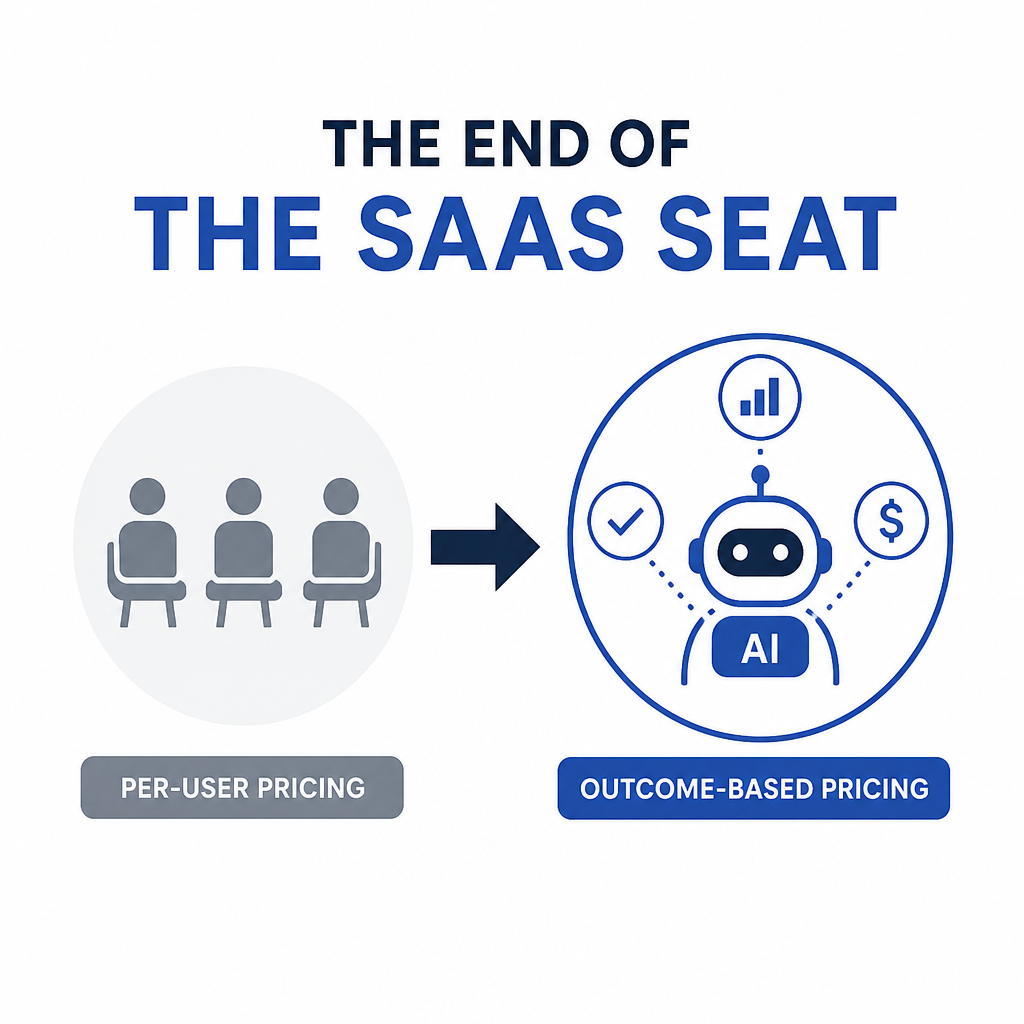
For more than two decades, the economics of enterprise software rested on a deceptively simple equation: software helps humans do their work, so software should be priced by the human. The seat--per user, per month--became the default unit of value for the entire SaaS industry, powering predictable recurring revenue, steady expansion through headcount growth, and the meteoric valuations of the cloud era. That equation is now coming apart.
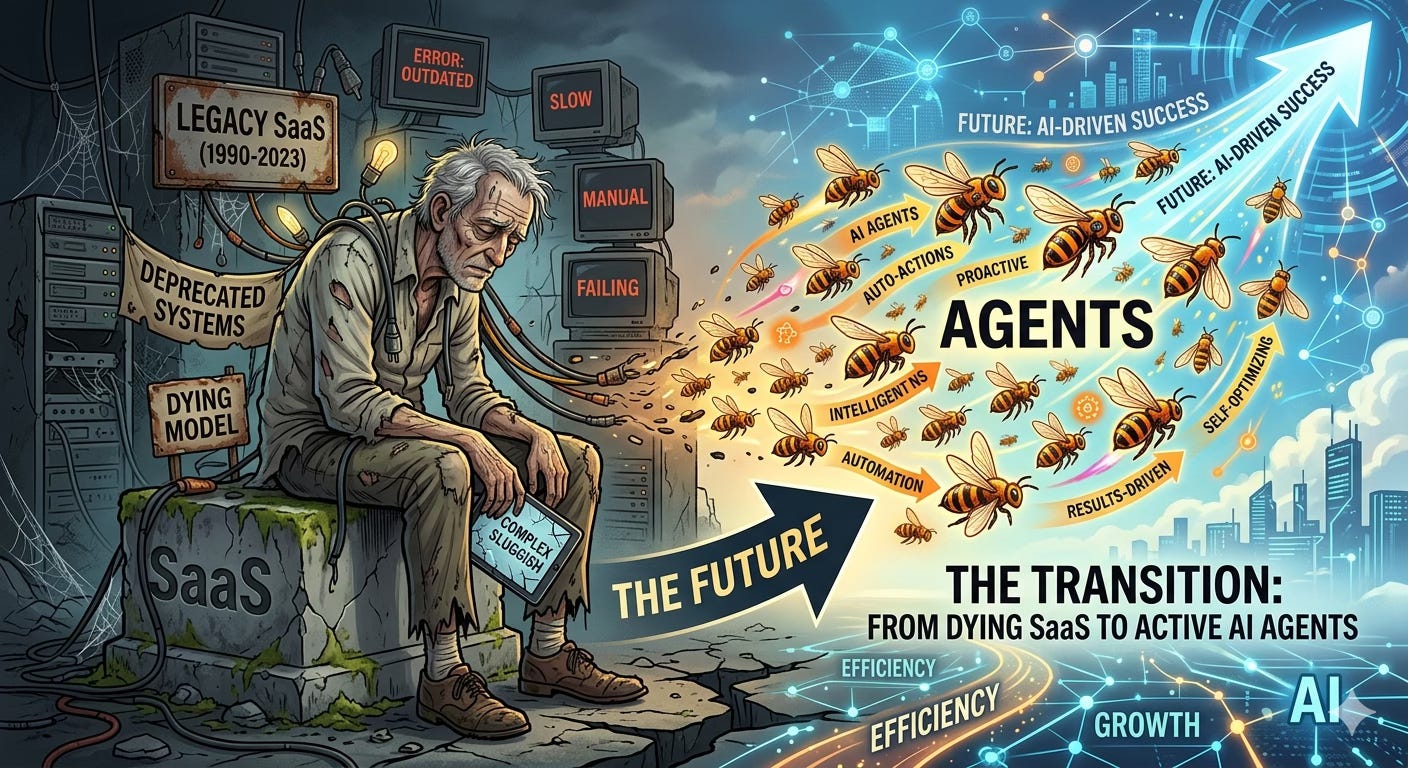
Artificial intelligence, and specifically autonomous AI agents, has severed the link between software value and human headcount. A support bot that resolves hundreds of tickets overnight, or a model that translates thousands of pages without a single click, simply does not fit into "per seat" logic--and this disconnect risks either overcharging customers for minimal usage or dramatically underpricing massive value creation [1]. As one analysis puts it, AI agents don't need seats; they need compute, tokens, and outcomes [1].
The consequences are no longer theoretical. Seat-based pricing has fallen from 21% to just 15% of SaaS companies in a single twelve-month period, while hybrid pricing models have surged from 27% to 41% [2]. McKinsey estimates AI could cut software seats by 70%, and Gartner projects that by 2030, at least 40% of enterprise SaaS spend will shift toward usage-, agent-, or outcome-based pricing [1][2]. This article examines why the seat is collapsing, what pricing models are replacing it, how incumbents and AI-native startups are responding, and what the transition means for the future economics of enterprise software.
Why the Per-Seat Model Is Breaking
The seat made sense in the era it was built for. In the 1980s and 1990s, software arrived in shrink-wrapped boxes, and you paid whether you used it or not. The internet enabled Salesforce to pioneer selling software as a service, letting companies add or remove seats as headcount changed [3]. But even SaaS carried a hidden inefficiency: once you bought a seat, you paid annually regardless of usage--hence the derisive industry moniker "shelfware" [3]. The waste is staggering: an estimated 66% of licenses sit unused, costing enterprises roughly $21 million per year [4].
AI agents attack the model at its foundation, along two dimensions: the value software delivers and the cost structure it imposes [5]. Generative AI tools that automate customer service interactions may replace entry-level support roles entirely, which means the traditional price-per-human meter loses relevance. If a business customer needs fewer humans to operate the software, the economics of pricing based on headcount disintegrate [5]. A company that once required 50 Salesforce logins might now need 15, with AI handling the rest [2].
The strategic implications run deeper than pricing mechanics. The classic SaaS growth model relied on expansion through user count, seat count, and cross-functional standardization--and agentic workflows weaken all three assumptions. Venture investors note that pressure is now falling directly on net revenue retention, long the central KPI of SaaS, because buyers no longer want five seats because they have five employees; they want the task completed [6]. The data reflects this unraveling: 63% of vendors expect AI to change their business models within five years, and 40% see AI driving revenue growth of 20% or more beyond original projections [1].
 AI Agents and the End of Seat-Based SaaS
The New Pricing Spectrum: From Access to Outcomes
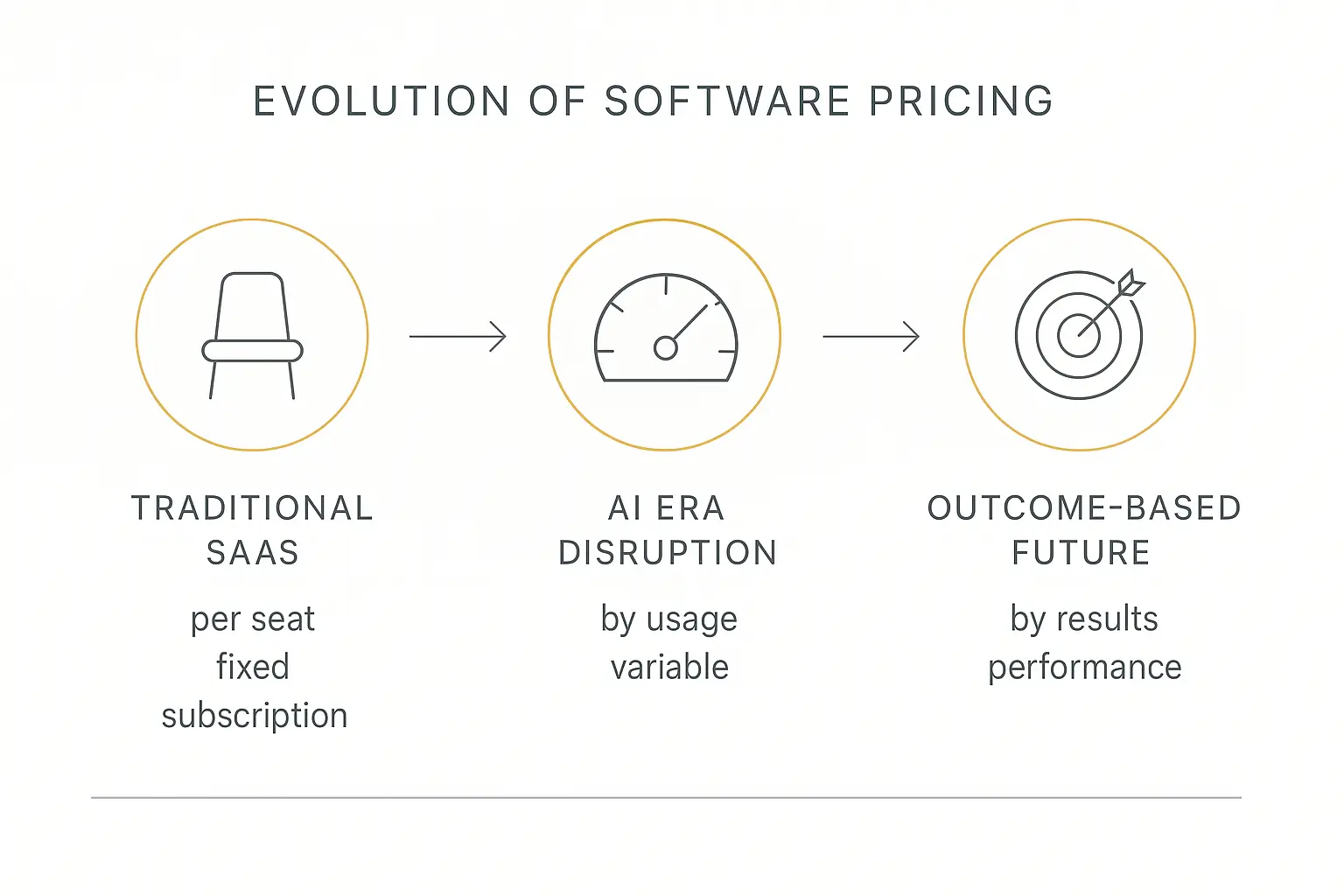
What replaces the seat is not a single model but a spectrum--a ladder of pricing structures, each rung shifting more risk from buyer to vendor and aligning price more closely with delivered value [2].
Rung one: traditional per-seat SaaS. You pay for access; the number of users determines the bill, whether users are productive or idle. It is simple and predictable--and declining [2].
Rung two: hybrid and premium AI tiers. Roughly 35% of incumbent vendors have simply raised per-seat prices and bundled AI features into existing tiers--Zoom has taken this path--while about 65% have layered an AI meter, charged by usage or feature access, on top of seat-based pricing, an approach adopted by Adobe and Salesforce [5]. Chargebee data suggests 43% of companies already use hybrid pricing, with adoption projected to reach 61% by the end of 2026 [2].
Rung three: credits and consumption. Credits have emerged as a middle ground between access and outcome pricing [2], echoing the consumption-based models that infrastructure players like AWS and Snowflake pioneered, where contract value ultimately depends on actual usage [3].
Rung four and five: actions and outcomes. At the top of the ladder sits true outcome-based pricing, where you pay only when the software achieves a specific, valuable result [3]. Sierra, for example, explicitly ties its pricing to resolved outcomes, while Salesforce's Agentforce experiments with an entire portfolio of economic units--users, conversations, actions, prompts, credits, and business outcomes--simultaneously [7].
Bessemer Venture Partners offers a useful taxonomy for understanding who lands where on this spectrum. Copilots--AI sidekicks that enhance human productivity without replacing the person, such as GitHub Copilot or Abridge--are typically priced per seat or by consumption. Agents--autonomous AI actors that execute entire workflows, decoupling output from human headcount--are increasingly priced against tangible ROI: per workflow, per outcome, per dollar of cost savings, or per human-equivalent unit of work. AI-enabled services companies blend automation with human oversight and pass the savings to customers [8].
The macro trajectory is unambiguous. Gartner predicts 40% of enterprise applications will feature task-specific AI agents by the end of 2026, up from less than 5% in 2025 [2], while Bloomberg analysis suggests outcome-based pricing could rise from 10% to 60% of the market within a decade [4].
 The End of SaaS as We Know It - by Douglas Levin
Case Studies: Incumbents Hedge, Natives Leap
Salesforce: the hybrid giant. Salesforce has become the most visible test case for incumbent transition. Its Einstein 1 platform blends subscriptions with consumption credits [1], and Agentforce pairs Flex Credits and conversation-based pricing with traditional per-user options [7]. The results are revealing: Agentforce and Data 360 products hit nearly $1.4 billion in combined ARR, growing 114% year-over-year--while simultaneously cannibalizing Salesforce's own seat-based revenue [2]. For enterprises seeking predictability, Salesforce now offers the Agentic Enterprise License Agreement (AELA): unlimited use of Agentforce, Data 360, and MuleSoft for a fixed fee on two-to-three-year terms, arguably the most visible large-incumbent template for pricing beyond per-seat metered billing [9].
Zendesk: the outcome pioneer. In August 2024, Zendesk became the first major incumbent SaaS vendor to launch outcome-based pricing for AI agents, billing per Automated Resolution--a support ticket resolved by AI without human intervention, confirmed after 72 hours of inactivity. The price: $1.50 per committed resolution, $2.00 pay-as-you-go [9]. The critical catch, often missed by buyers: you must agree contractually on what counts as "resolved" before signing. That Outcome Measurement Agreement is the prerequisite most procurement teams are not yet prepared for [9].
The AI natives. Sierra has built its entire commercial model around paying per outcome [7], while Intercom's Fin agent for customer service exemplifies the agentic pricing model--charging for automation that substitutes for incremental hires [8].
The reality check. Despite the headlines, a Bain analysis of more than 30 incumbent vendors found that roughly 35% have simply raised seat prices with bundled AI, 65% have adopted hybrid meters, and--crucially--none have fully shifted to AI usage- or outcome-based pricing, in contrast with many new AI companies [5]. Per-seat pricing isn't dead; it's being surrounded.
 From Seats to Outcomes: How Agentic AI Is Disrupting SaaS Pricing Models and Forcing a Reckoning in Software Unit Economics | Reducates
The Minefield: Why Outcome Pricing Is Harder Than It Looks
For all its elegance, outcome-based pricing shifts substantial risk from buyer to vendor--and carries practical limitations that have tripped up early adopters [2]. The practitioner community is blunt about the failure modes. Companies rushing into outcome pricing are frequently "failing to collect revenue": one founder who attempted to charge based on sales closed--a model that mirrors how salespeople are compensated--ended up with contracts where attribution could not be proven and invoices went unpaid, forcing a pivot back to conventional pricing [10].
The deeper problem is measurement. Most AI agents today are sophisticated automation rather than full human replacements, so charging as if replacing a $150,000 employee invites disputes over attribution and value capture [10]. Meanwhile, enterprises cannot operate on volatile "pay per resolved ticket" budgets when they need to forecast quarterly spend--consumption models, however well-intentioned, can create chaos in procurement [10].
Successful bridges tend to rely on stable proxy metrics that correlate with value without swinging wildly month to month. Klaviyo, for instance, has long charged per contact in the database rather than per user--a metric that scales with value while remaining predictable for budgeting [10]. This is precisely why most analysts see the future as hybrid and nuanced rather than a wholesale leap to outcomes: vendors will combine subscriptions, usage, actions, credits, and outcomes depending on how autonomous the AI is and how measurable its impact [7]. Even Bain, despite documenting the disruption, warns that transitioning away from per-seat pricing "will be complex and difficult to execute--a minefield for the unprepared" [5].
What It Means for Enterprise Buyers
For buyers, the shift transforms software from a fixed, predictable cost line into variable spend that scales with AI agent activity--demanding reserve buffers, real-time usage monitoring, and a fundamental budget reclassification argument: AI consumption spend replaces labor costs, not just software costs [9]. That reframing matters enormously in CFO conversations, because the comparison point is no longer last year's software invoice but the payroll line.
Timing confers leverage. The 2025-2026 window is a transition period in which vendors are building alternative pricing infrastructure while still defending legacy revenue--buyers who approach negotiations as preferred early adopters will have more power than they will once models standardize [9]. Practical guidance is emerging: scrutinize usage-based pricing models carefully, demand accurate measurement and reporting [1], and contractualize outcome definitions before signing anything--Zendesk's definition of "resolved" remains Zendesk's definition until the buyer writes their own into the contract [9]. For organizations that prize predictability over optionality, fixed-fee structures like Salesforce's AELA offer an alternative path through the volatility [9].
The New Software Economics: What Survives, What Wins
The end of the seat does not mean the end of enterprise software--or even of SaaS. Systems of record such as SAP may persist for years, even as the interfaces through which users interact with them are rewritten by agents [6]. What changes is where defensibility lives. When AI makes application-layer features cheaper and faster to replicate, value migrates toward infrastructure, proprietary data, and execution discipline [6].
Net revenue retention will not disappear as a metric, but its mechanics will invert: expansion will come from workflow volume and outcomes delivered rather than headcount growth, and the vendors who thrive will be those who match the economic unit of pricing to the unit of value--for some products that unit remains a user, for others a conversation, an action, a workflow, or a successful resolution [7]. The larger shift, ultimately, is from paying for access to software toward paying for the work that software performs and the value that work creates [7].
Conclusion
The per-seat license is not dying of obsolescence alone--it is being outcompeted by a fundamental change in what software is. When AI agents do the work once associated with human users, charging by the login becomes economically incoherent, and the market is responding with remarkable speed: seat-based models have already lost a third of their market share in a single year, and the majority of vendors now layer consumption meters atop traditional subscriptions [2][5]. Yet the transition is neither automatic nor safe. Outcome-based pricing transfers execution risk to vendors who often lack the measurement infrastructure to collect on it, and it transfers budget volatility to buyers whose procurement processes were built for predictability. The likely destination is not a pure outcome economy but a sophisticated hybrid landscape--credits, actions, workflows, and outcomes matched to context. In that landscape, the scarcest asset will not be a good product but a trustworthy meter: the ability to measure, verify, and bill for value delivered. The companies that build that capability first will define the post-seat era of enterprise software.
References
- 1.
- 2.
- 3.
- 4.
- 5.
- 6.
- 7.
- 8.
- 9.
- 10.