Introduction
Physician burnout has become one of medicine's most stubborn crises, and its roots run directly through the electronic health record. In the United States, clinicians now spend nearly half of their working hours on documentation and administrative tasks, and only about 27% of their time in face-to-face patient interaction [1]. For every hour spent with a patient, physicians may devote up to two hours to the EHR--much of it after clinic has closed, in the phenomenon now universally known as "pajama time" [2]. The consequences are measurable: high cognitive load is associated with emotional exhaustion and depersonalization, and burnout itself has been directly linked to higher rates of medical errors [1]. In primary care, where the documentation burden hits hardest, the toll is pushing physicians out of practice entirely [3].
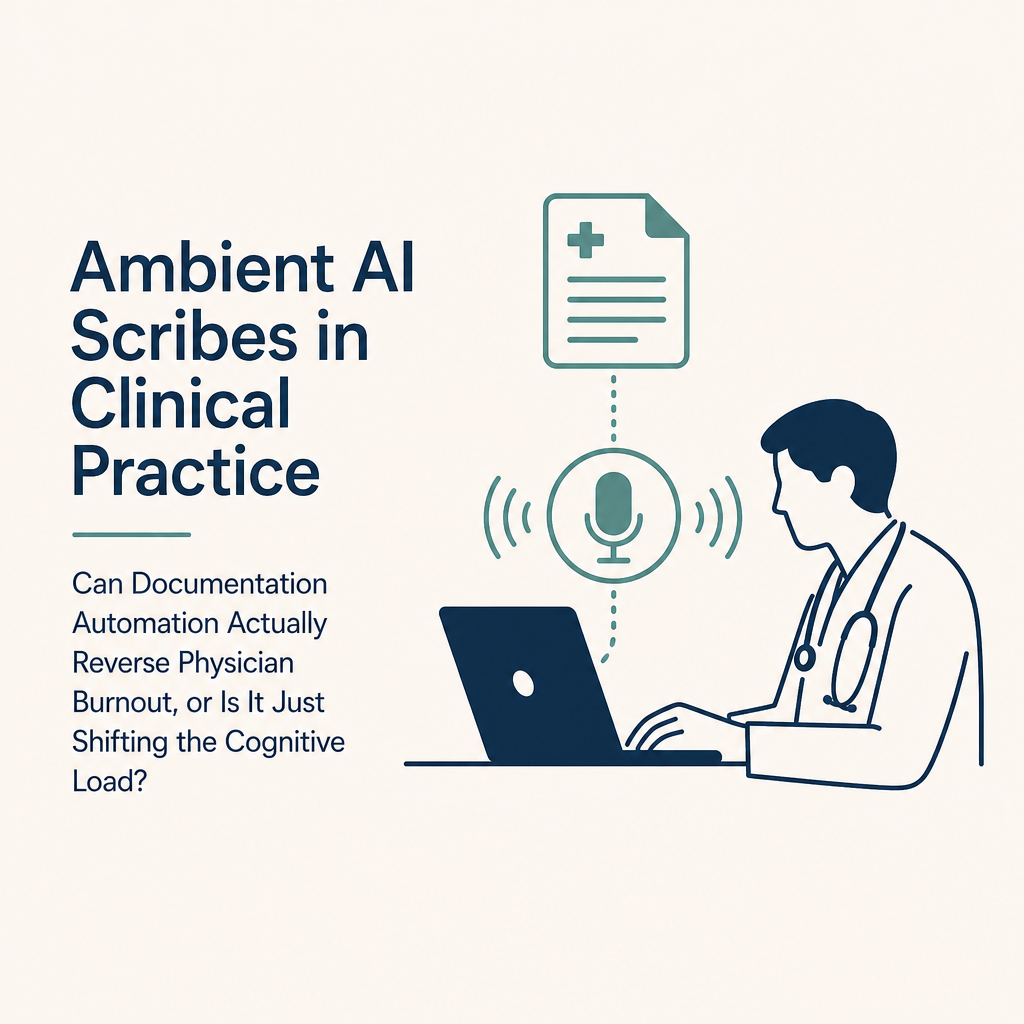
Into this crisis has stepped a new class of technology: ambient AI scribes. These generative AI tools work in the background of the exam room, recording the conversation between clinician and patient and drafting a structured clinical note for physician review and sign-off. After years of pilots, they have moved rapidly into real clinical deployment at health systems including Yale New Haven, Mass General Brigham, and Emory Healthcare [3][2].
The early results have been genuinely striking. Multiple large studies now report significant reductions in burnout after just weeks of use--a rarity among wellness interventions in medicine. But the evidence also contains a tension that demands scrutiny: the time savings these tools produce are surprisingly modest, while the burnout improvements are dramatic. That gap raises the central question of this article. Is ambient AI genuinely reversing burnout by relieving cognitive load--or is it quietly relocating that load into new tasks, new pressures, and new forms of oversight?
The Documentation Burden at the Heart of the Crisis
A Problem of Design, Not Just Volume
To understand why AI scribes have generated such excitement, it helps to understand why documentation became so punishing in the first place. The EHR was built primarily to support billing and compliance rather than clinical care, meaning much of the work clinicians do in it serves administrative rather than medical purposes [2]. Notes are long because reimbursement structures reward long notes. Templates multiply because auditors demand them. The result is a system that consumes clinician attention without returning much clinical value.
This burden is not merely a matter of inconvenience. High cognitive load--competing demands on attention, memory, and decision-making--is associated with increased risk of burnout, particularly its emotional exhaustion and depersonalization dimensions, which in turn degrade the quality of patient care [1]. Documentation also follows clinicians home: studies of ambient scribes consistently track "time spent documenting after hours" as a key outcome precisely because evening and weekend charting has become a defining feature of modern practice [4].
The Evidence Base: Encouraging, but With Important Nuances
The Multicenter Quality Improvement Study
The most frequently cited evidence comes from a quality improvement study spanning six health care systems, in which 263 ambulatory clinicians--roughly half of them in primary care, with a mean of 15 years in practice--completed surveys before and after 30 days of ambient AI scribe use [5]. The headline finding: the proportion of clinicians experiencing burnout fell from 51.9% to 38.8% (odds ratio, 0.26; 95% CI, 0.13-0.54)--which the Yale investigators characterize as 74% lower odds of burnout [3][5].
The secondary outcomes may be equally important. On 10-point scales, users reported significant improvements in note-related cognitive task load (a mean difference of 2.64 points), along with reductions in after-hours documentation and improvements in focused attention on patients and even urgent access to care [4][5]. Notably, a separate cognitive load study of an ambient AI platform found reductions across effort, mental demand, and temporal demand in a multispecialty provider population, suggesting that the tools conserve cognitive resources rather than merely saving minutes [1].
The Mass General Brigham-Emory Study
A larger follow-up published in JAMA Network Open surveyed more than 1,400 physicians and advanced practice providers across two academic medical centers [6]. At Mass General Brigham, burnout prevalence dropped by roughly 21 percentage points in absolute terms by 84 days; at Emory, the share of clinicians reporting that documentation positively affected their well-being rose from 1.6% to over 32% at around 60 days [7][6]. Clinicians described more eye contact, better focus during visits, and greater joy in practice [7]. These were, to the authors' knowledge, the first large multicenter evaluations of their kind--previous studies had been limited to small, single-center designs [3].
But the Time Savings Are Modest
Here is where the story complicates. A separate JAMA study, co-led by Mass General Brigham and UCSF investigators, tracked ambient documentation use across five U.S. hospitals for more than two years and found reductions of just 13 minutes of daily EHR usage and 16 minutes of documentation time--relative decreases of only 3% and 10% [8]. Other estimates put documentation time savings somewhere between 20% and 34%, depending on the tool and workflow [2][9]. As senior author Rebecca Mishuris, chief health information officer at Mass General Brigham, acknowledged: "The modest reductions in documentation time we observed are unlikely to fully account for changes in burnout, underscoring the need to understand how these tools change how clinicians approach care delivery while using them" [8].
The Paradox: Why Does Burnout Fall More Than Time Saved?
The gap between modest time savings and substantial burnout reduction is the most intellectually interesting finding in this literature, and several explanations are on the table.
The first is that burnout may be driven less by raw minutes than by the character of the work. Dictating a note in real time while maintaining a therapeutic conversation--splitting attention between patient and screen--may be more depleting than the clock time it consumes. If ambient AI removes the anticipatory dread of documentation and the cognitive juggling act of typing while listening, the relief clinicians feel could exceed what a stopwatch captures. The observed reductions in mental demand and temporal demand in cognitive load studies point in this direction [1].
The second explanation is relational. When technology "fades into the background and allows care to come to the foreground," as Yale's Allen Hsiao puts it, the restored human connection of medicine may itself be protective against burnout [3]. Many clinicians in the MGB-Emory study specifically cited more eye contact and greater joy in practice [7].
The third explanation, however, is less benign: reclaimed time may simply be absorbed. In the JAMA time study, ambient scribes were associated with a slight increase in productivity--about half an additional patient visit per week [8]. That figure can be framed as improved access, or as work intensification. As critics of the technology note, "time savings alone do not guarantee reductions in burnout. Reclaimed time may be absorbed by additional clinical or administrative demands, rather than be translated into cognitive relief" [2]. A scribe that helps a health system fill schedules more tightly has not given its clinicians a gift; it has given their administrators one.
The Skeptic's Case: Band-Aid or Solution?
Methodological Caution
Joshua Lang, a physician-commentator who describes himself as someone who "loves ambient scribes" but considers them "just a bandaid," has flagged several reasons for restraint [7]. The MGB-Emory study combined two health systems using different primary outcomes--MGB measured burnout while Emory measured documentation-related well-being--making the headline results difficult to compare directly. Survey response rates were also modest: 30% at MGB (falling to 22% at the second time point) and just 11% at Emory [7]. Self-selected respondents who love a new tool may not represent their colleagues. And because the studies are short-term quality improvement designs, no one yet knows whether the gains will persist, plateau, or reverse as novelty fades and productivity expectations adjust--a question investigators themselves say they intend to track [6].
Root Causes Remain Untouched
The deeper critique is conceptual. Burnout in medicine is driven by a web of systemic factors: EHRs designed around billing, prior authorization battles, staffing shortages, administrative overhead, and what some call moral injury--the conflict between what clinicians know patients need and what systems allow [7][2]. Ambient scribes address exactly one strand of this web. As one analysis concluded, "AI scribes are best understood as a productivity tool rather than a comprehensive burnout solution," and the long-term value of the technology "will depend less on efficiency gains than on whether their implementation is paired with deliberate changes in workflow, governance" and organizational practice [2].
The broader evidence on AI and clinician well-being supports this conditionality. Across the literature, AI improves well-being only when it genuinely removes work; implementations that introduce additional monitoring requirements, poorly integrated tools, or parallel workflows tend to shift administrative and cognitive burden rather than reduce it [9].
Unresolved Governance Risks
Deployment also raises questions that efficiency studies do not answer: the accuracy of AI-drafted notes, patient consent to being recorded, data privacy, and regulatory compliance all remain live issues [2]. Clinicians reviewing AI drafts take on a new verification task--an editing cognitive load of their own--and early adopters have flagged the need for specialty-specific workflow improvements, since a tool tuned to primary care may fit surgery or psychiatry poorly [7].

Implementation Is the Deciding Variable
If the technology's effect on burnout depends less on the algorithm than on the organization deploying it, then implementation becomes the critical frontier. The evidence suggests several principles are emerging.
First, reclaimed time must be protected. If health systems capture AI-driven efficiency as increased patient volume, clinicians will experience intensification rather than relief [2]. Second, AI should replace workflows, not run alongside them--a scribe layered on top of existing documentation habits creates parallel work, which the literature associates with worsened rather than improved well-being [9]. Third, governance cannot be an afterthought: accuracy monitoring, consent protocols, and regulatory alignment need to be built into deployment from the start [2].
There is also an economic argument in favor of getting this right. Ambient AI solutions may be scalable at substantially lower cost than the human scribes they resemble, meaning that if implementation is done well, relief could reach far more clinicians than previous interventions ever did [5]. The rapid real-world uptake--more than 1,000 physicians at Yale New Haven alone--are already using these tools routinely [3], and observational comparisons of more than 1,800 scribe users against 6,770 control clinicians are now generating the kind of scale that earlier wellness programs never approached [8].
The Road Ahead
The research agenda is coming into focus. Investigators at Mass General Brigham and Emory plan continued surveillance to determine whether burnout improvements endure, plateau, or erode as the technology matures and organizational expectations adapt [6]. Researchers also need to understand the mechanism--why burnout falls more than time savings would predict--because that answer determines whether the effect is durable or fragile [8]. Broader reviews of the field suggest cautious optimism, noting that ambient scribes are consistently associated with reduced burnout and lower cognitive task load, while emphasizing that evidence for long-term benefit remains incomplete [10].

Conclusion
The honest answer to the question in this article's title is: both, and neither, yet. The evidence that ambient AI scribes meaningfully reduce burnout is stronger than almost any clinician wellness intervention that has preceded them--large, multicenter, and directionally consistent, with burnout prevalence falling by double digits within weeks [4][6][5]. The evidence that this relief operates partly through reduced cognitive load rather than pure time savings is also credible, and it may explain why clinicians report feeling better even when their days have not actually gotten shorter [1][8].
But "reversing burnout" overstates the case. Ambient scribes address a single contributor to a systemic problem, and their benefits are conditional on implementation choices--whether reclaimed time is protected or recaptured, whether workflows are simplified or duplicated, and whether governance keeps pace with deployment [2][9]. The cognitive load of documentation is genuinely lightened; the risk is that the freed capacity gets reallocated upward into more visits, more review work, and more administrative expectation, leaving clinicians exactly where they started, just with a new listener in the room.
The most defensible conclusion is that ambient AI scribes are the most promising documentation intervention medicine has seen--provided that health systems treat them as an opportunity to give work back to clinicians rather than as a license to take more from them. The technology can fade into the background. Whether the burden fades with it is a decision institutions, not algorithms, will make.
References
- 1.
- 2.
- 3.
- 4.
- 5.
- 6.
- 7.
- 8.
- 9.
- 10.